Tiger’s Bay First Flute mural in Edlingham Street, Belfast, with UDA crest and scrolls to “M[ark?] Bacon” (UDA, a captain of the flute band, killed by IRA stabbing in July 1986 at age 26 – one | two | three) and “R Baird”.
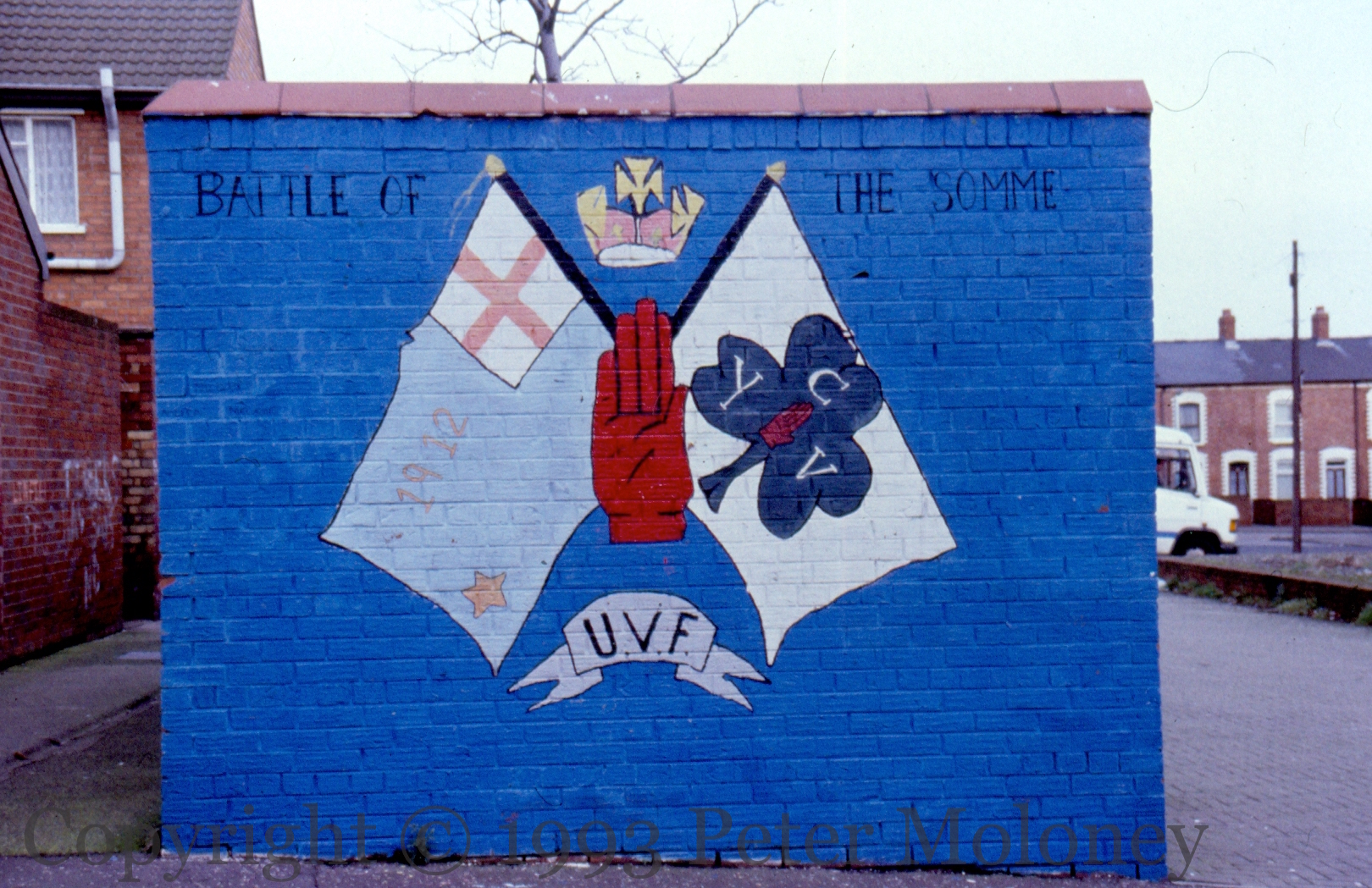
The YCV shamrock and a small board with the (unofficial) arms of the 36th (Ulster) Division, including a Union flag and harp above a red hand on a field of shamrocks. Crumlin Road, Belfast. Seen previously in 1988.
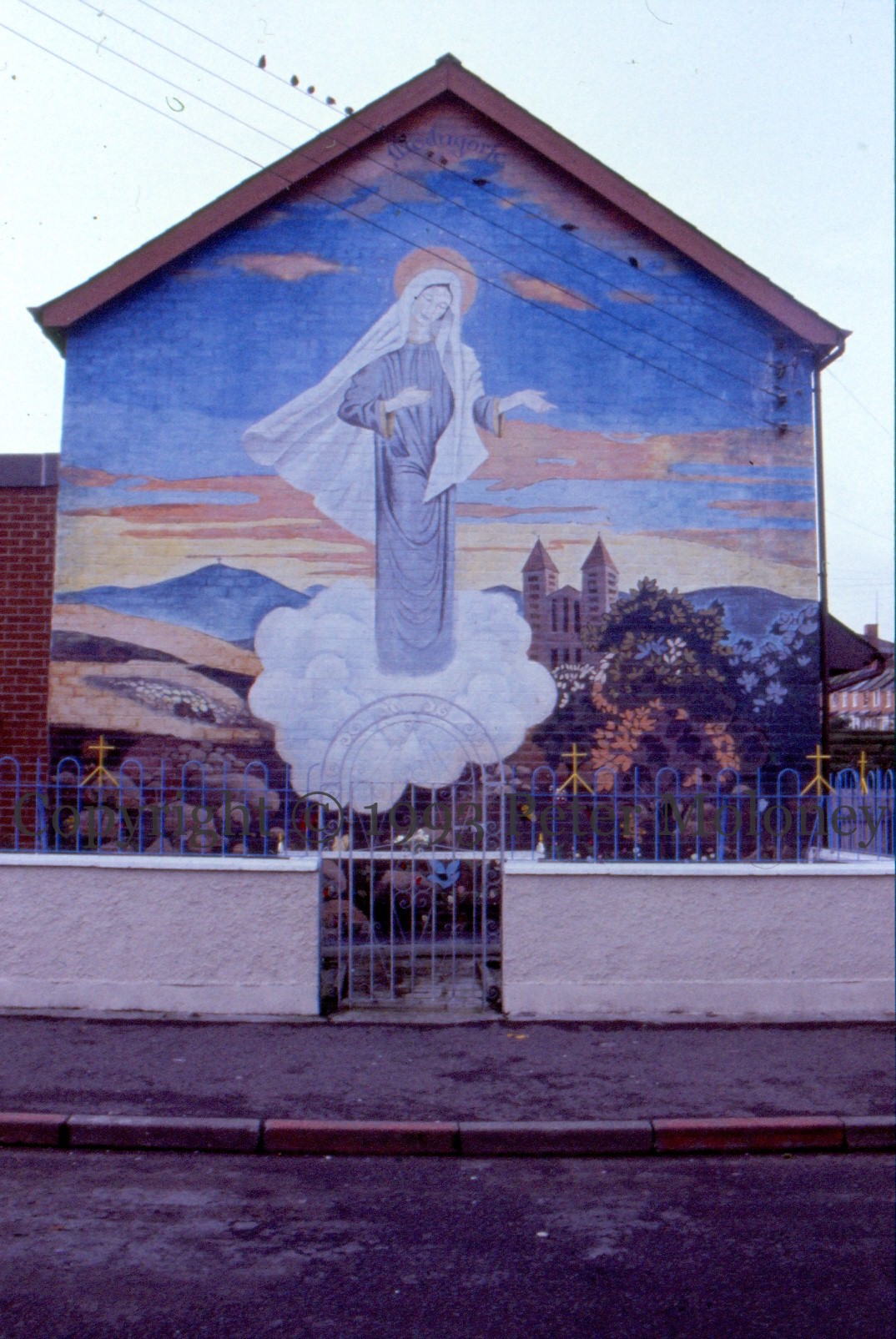
In 1981, six Med[j]ugorje children claimed to have seen visions of Mary. The statue is a now a major site of pilgrimage, though it is not officially approved by the Catholic church. The church of St James is in the background.
“The spirit (of outdoor music – fiddle, accordion, and flute – and Irish dancing) still lives”, “Maıreann ceoıl agus cultúır na ndaoıne [the music and culture of the people] go foıll”. Mural celebrating the Ard Eoın/Ardoyne Fleadh Cheoıl.
This “Fáılte go dtí Ard Eoın” (Welcome to Ardoyne) mural celebrates the local Cumann Luthcleas Gael (Gaelic Athletic Club) (Tw) “founded 1902”, with images of a footballer and a camogie player. At the bottom is a standing eagle in Celtic style.
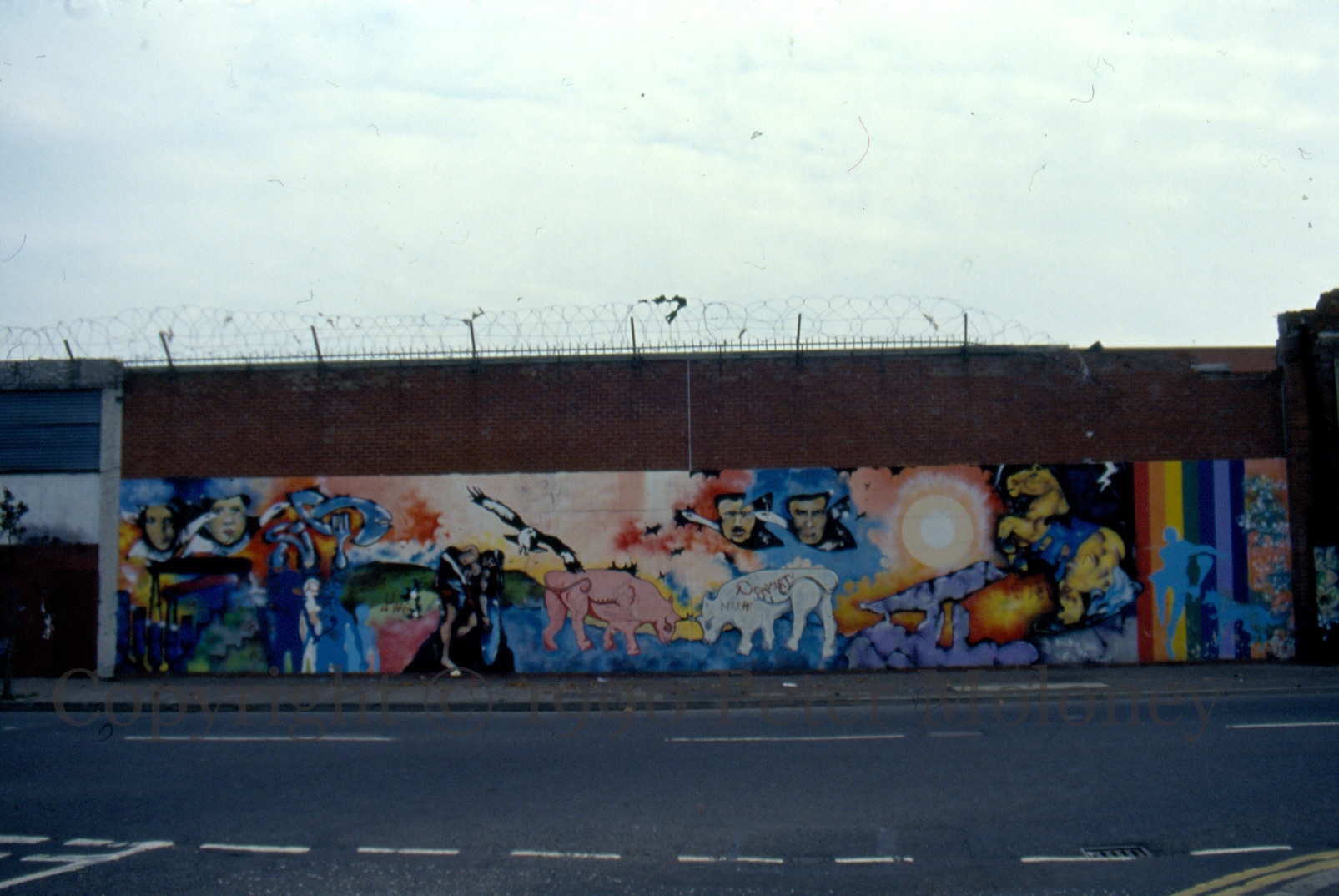
This is an interesting mural from North Queen Street, if only because of its psychedelic colour-scheme and composite style.
The two bulls (presumably from the Táın though they are not the classic brown and white bulls) provide a centre, on either side of which we find Cú Chulaınn dying (and Tuan the eagle) and a dolmen. The horse on the right is perhaps Galloper. There are four faces superimposed on flying geese. The cranes Samson and Goliath are on the left (which suggests a cross-community sponsorship) and a Pride rainbow is on the right.
The mural can also be seen in the Paddy Duffy Collection. If you have any information about the piece, please get in touch.
Núada of the Tuatha Dé Danann and Morrígan (from Jim Fitzpatrick’s Beneath The Sky Of Stars) embrace below a ram (from Fitzpatrick’s Senach The Spectre) and between Celtic creatures inspired by the Book Of Kells.
(This is probably not the “dragon mural” mentioned by Julian Watson in Circa #8.)





 Peter Moloney Collection