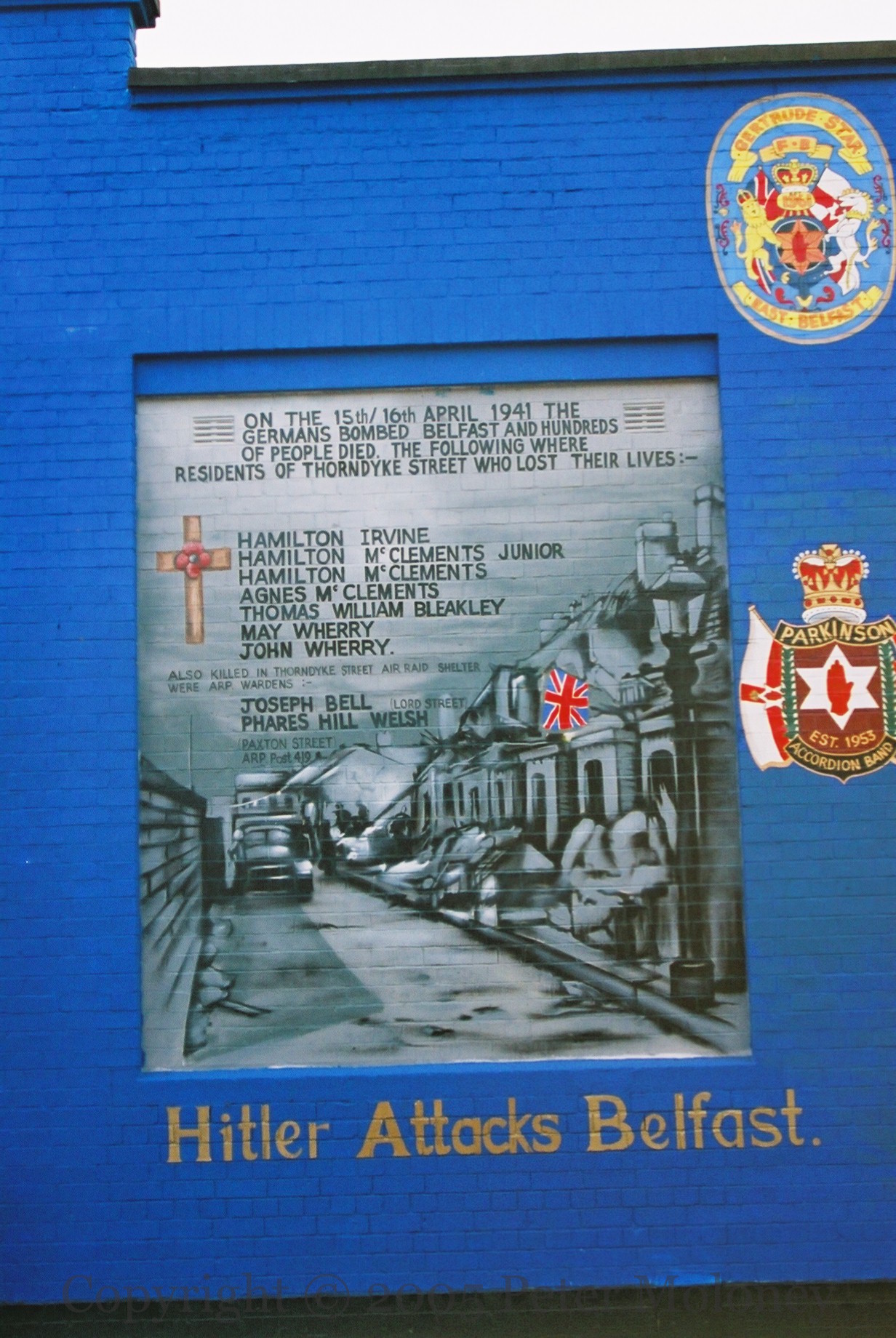
Hitler Attacks Belfast

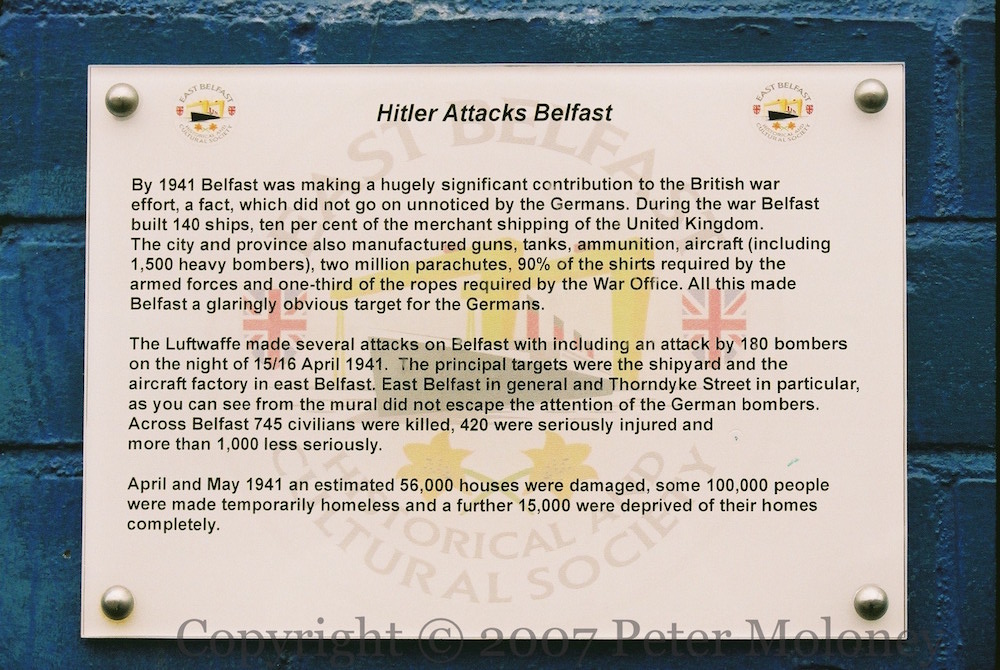
“By 1941 Belfast was making a hugely significant contribution to the British war effort, which did not go unnoticed by the Garmans. During the war Belfast built 140 ships, ten per cent of the merchant shipping of the United Kingdom. The city and province also manufactured guns, tanks, ammunition, aircraft (including 1,500 heavy bombers), two million parachutes, 90% of the shirts required by the armed forces and one-third of the ropes required by the War Office. All this made Belfast a glaringly obvious target for the Germans. The Luftwaffe made several attacks on Belfast with including an attack by 180 bombers on the night of 15/16 April 1941. The principal targets were the shipyard and the aircraft factory in east Belfast. East Belfast in general and Thorndyke Street in particular, as you can see from the mural did not not escape the attention of the German bombers. Across Belfast 745 civilians were killed, 420 were seriously injured and more than 1,000 less seriously. April and May 1941 an estimated 56,000 houses were damaged, some 100,000 people were made temporarily homeless and a further 15,000 were deprived of their homes completely.” The Thorndyke Street casualties listed are Hamilton Irvine, Hamilton McClements Junior, Hamilton McClements, Agnes McClements, Thomas William Bleakley, May Wherry, John Wherry. “Also killed in the Thorndyke Street air raid shelter were ARP wardens Joseph Bell (Lord St), Phares Hill Welsh (Paxton St Post 419).” With the emblems of Gertrude Star Flute Band and Parkinson Accordion Band.

One of fourteen panels in Thorndyke Street, east Belfast. For a list of entries for each panel, see East Belfast Historical And Cultural Society.

Click image to enlarge
Copyright © 2005, 2007 Peter Moloney
M02306 M03630 [M08003]

Civil And Religious Liberty For All

“Dan Winter’s cottage, Co Armagh. Dan Winter was one of the founders of the Orange Order.” “For many, perhaps even most, Orangemen the Order is primarily a religious organisation. As as organisation it is not anti-Roman Catholic; it is a Protestant organisation. The Orange Hall, the meeting place for Orangemen has long occupied a central place in the social life of the community. They serve as venues for a much wider range of gatherings than those, which are strictly Orange. The Orange Order is also a cultural organisation, transmitting a culture and heritage – whether it is banner painting, sustaining a great musical tradition or teachings its ritual – from one generation to the next. It also remains the most cohesive force in Ulster Protestant society and the essential expression of the culture and heritage of the Ulster Protestant people.” Fourth panel on Thorndyke Street, Belfast. With emblem of Pride of the Raven (flute band).

One of fourteen panels in Thorndyke Street, east Belfast. For a list of entries for each panel, see East Belfast Historical And Cultural Society.

Click image to enlarge
Copyright © 2005/2007 Peter Moloney
M02301 M03633 [M08004]

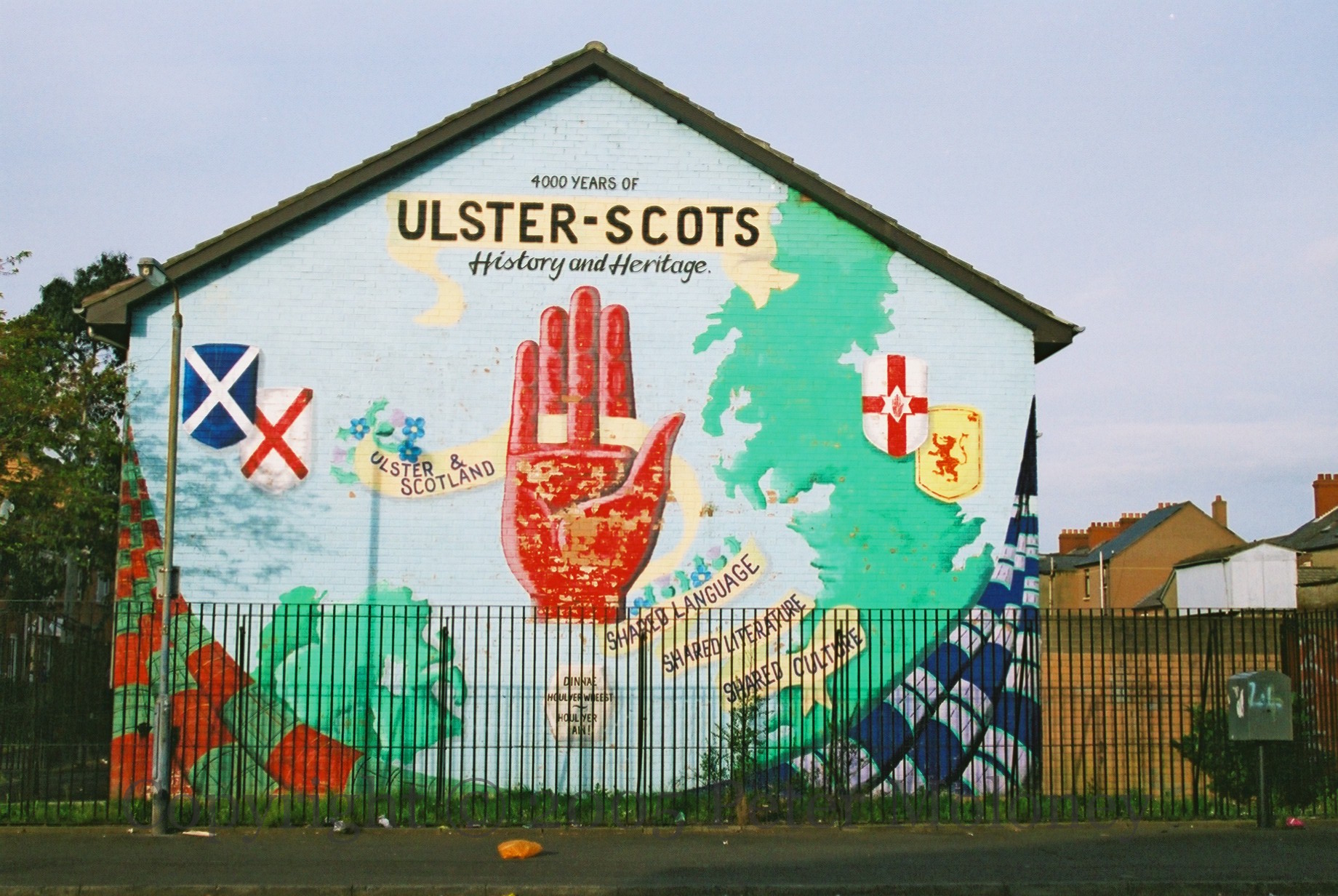
4000 Years Of Ulster Scots

“4000 years of Ulster-Scots history and heritage. Ulster & Scotland – shared language, shared literature, shared culture.” 400 years takes us back to the plantation; 4000 years suggests an even deeper connection.

Ulster-Scots was included in the 1998 Good Friday Agreement under the principle of support for “linguistic diversity”. This mural celebrating Ulster-Scots and ties between Northern Ireland and Scotland dates to 1999, with the crests of St Andrew and St Patrick on the left, and an Ulster Banner and Scottish lion rampant on the right.

“Dinnae houl yer wheest, houl yer ain!” [Don’t hold your tongue, hold your own!]

Templemore Street, east Belfast

Click image to enlarge
Copyright © 2005 Peter Moloney
M02321

Marching & Dancing

This cross-cultural mural from inside the Cathedral Youth Club, in the Fountain, Londonderry, celebrates both the music of flute-and-drum bands and Irish dancing. The tune illustrated ‘There Is A Green Hill Far Away’ by Cecil Alexander, wife of Church Of Ireland bishop William Alexander. They lived in Strabane and the eponymous hill is said to be one outside the old walls of Derry.

Click image to enlarge
Copyright © 2004 Peter Moloney
M02154

George Washington

“If defeated everywhere else I will make my final stand for liberty with the Scotch-Irish (Ulster-Scots) of my native Virginia.” George Washington commanded the Continental Army during the revolution and served as the first president of the United States beginning in 1789. His ancestry was English and the quote is undocumented, the closest being this statement from McKinley. The note in the corner reads “History records that almost half of Washington’s army were Ulster-Scots”; the basis for this claim might be General (Charles?) Lee’s report that “half the rebel Continental Army were from Ireland.” (See Chapter 2 of Bagenal, The American Irish and their Influence on Irish Politics.)

Previously: Theodore Roosevelt | James Buchanan.

Ebrington Street Lower, Londonderry

Click image to enlarge
Copyright © 2003 Peter Moloney
M02023

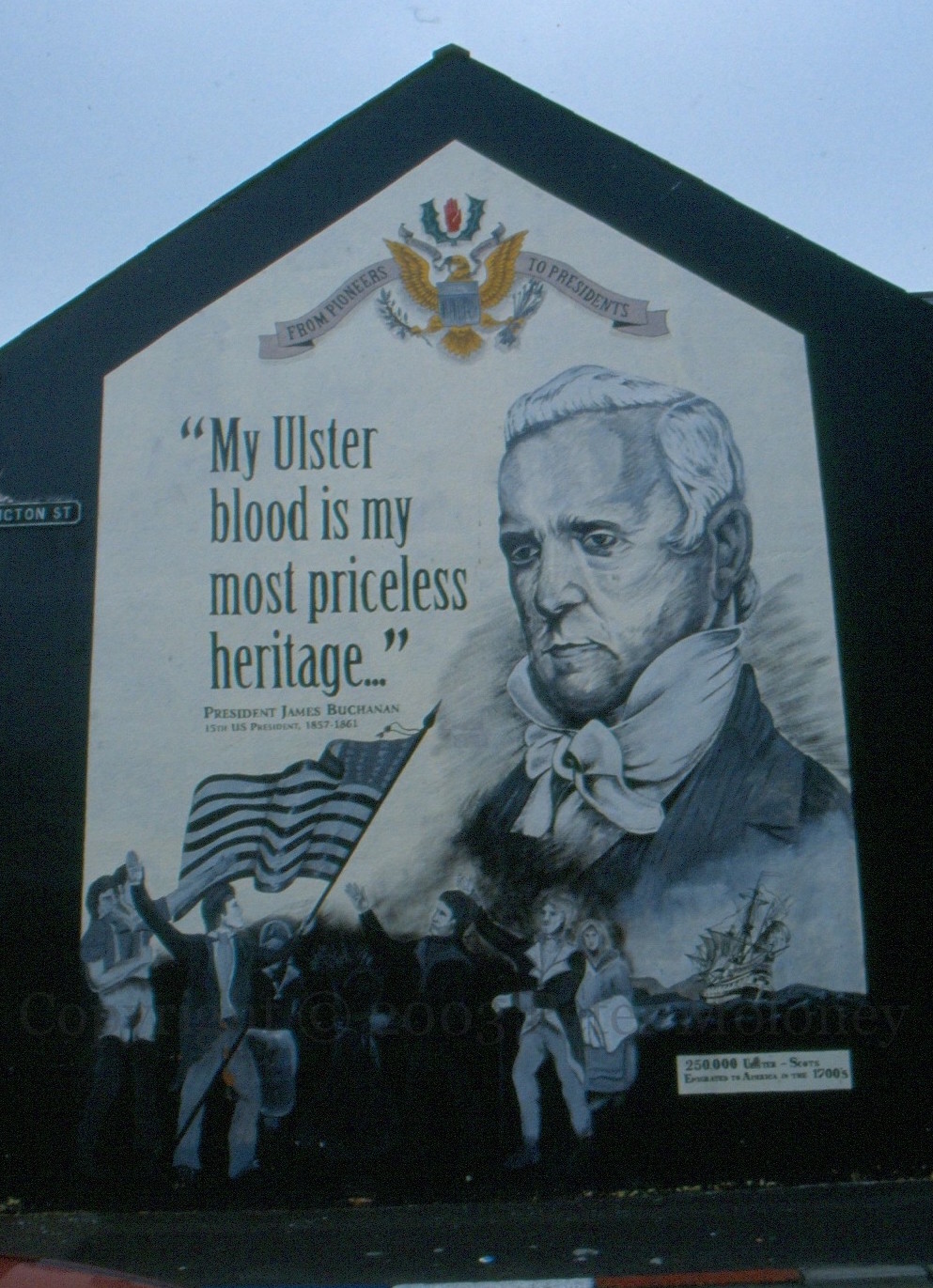
James Buchanan

James Buchanan was “15th US president 1857-1861.” Buchanan’s father, also called James, was born in Ramelton, Co Donegal, and was living in Co Tyrone when he emigrated to the United States from Derry in 1783, (one of the “250,000 Ulster-Scots [who] emigrated to America in the 1700s”). James junior was born in 1791, the second of eleven children.

The confusion over the wording of the quote – “My Ulster blood is my most priceless [or simply: a priceless] heritage … [and I can never be too grateful to my grandparents from whom I derived it.]” – is matched by confusion over who said it (Buchanan junior or senior?); the source of the quote is unknown. Likewise we do not know where in Scotland the grandparents might have come from and perhaps the move to Ireland happened much earlier.

There is a similar mural to Buchanan in west Belfast. See also the Visual History page on Ulster-Scots murals.

Ebrington Street, Londonderry

Click image to enlarge
Copyright © 2003 Peter Moloney
M02022