The Victoria Cross shows a lion on top of the crown of St Edward. The medal has been awarded since 1856 for combat valour by British Army soldiers. The four faces are perhaps those of Cather, McFadzean, Quigg, and Bell (see the mural in Cappagh Gardens). Painted by Dee Craig in Pitt Park, east Belfast, as part of the Re-Imaging Communities programme (Irish Times), perhaps replacing J2585.
“They said we’d never last.” The UVF Regimental (flute) Band (tw) celebrates 40 years in existence with a banner across the Newtownards Road at the Belvoir Bar (to the left of the bunting in the third image). (The final image is of the bunting in Lendrick street, across Newtownards Road). See also: 50th anniversary.
“This memorial was erected by the office bearers and members of the 1st Shankill Somme Association. It is dedicated in solemn, but glorious memory to those brave and gallant men from the greater Shankill who served with the 36th (Ulster) Division and were immortalised on the fields of France and Flanders during the Great War 1914-1918. It stands also as a tribute to the men and women of the greater Shankill, who in the many conflicts which followed the Great War, fought with courage and defiance for crown and country, and made the ultimate sacrifice. ‘At the going down of the sun/And in the morning/We will remember them.'” “The unveiling of this memorial was carried out by Col. D. Smyth 21-02-2009.” “This memorial was dedicated by Rev. Edith Quirey 21-02-2009.”
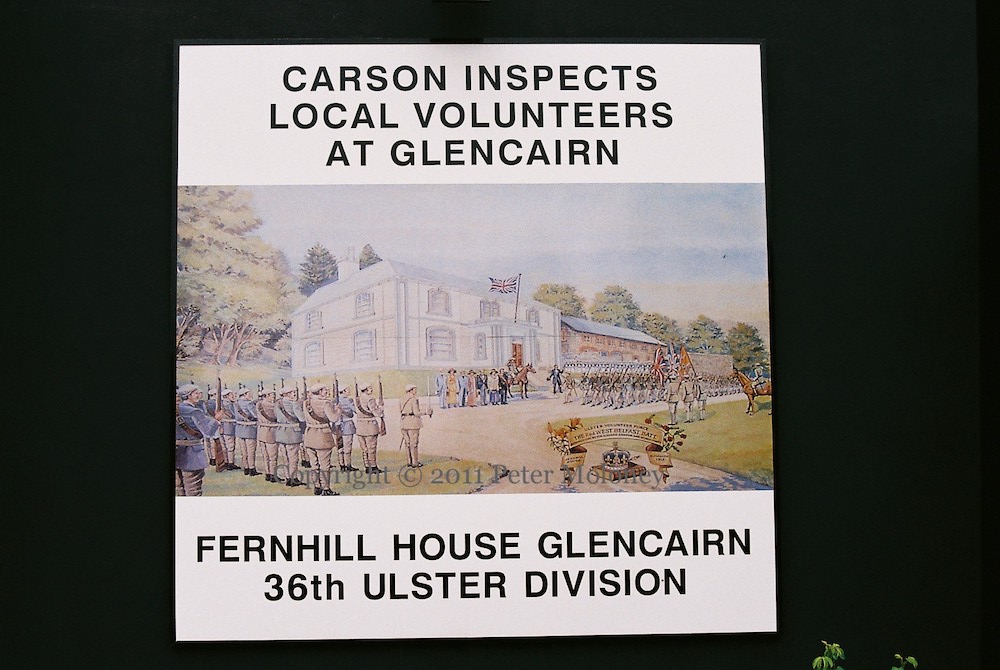
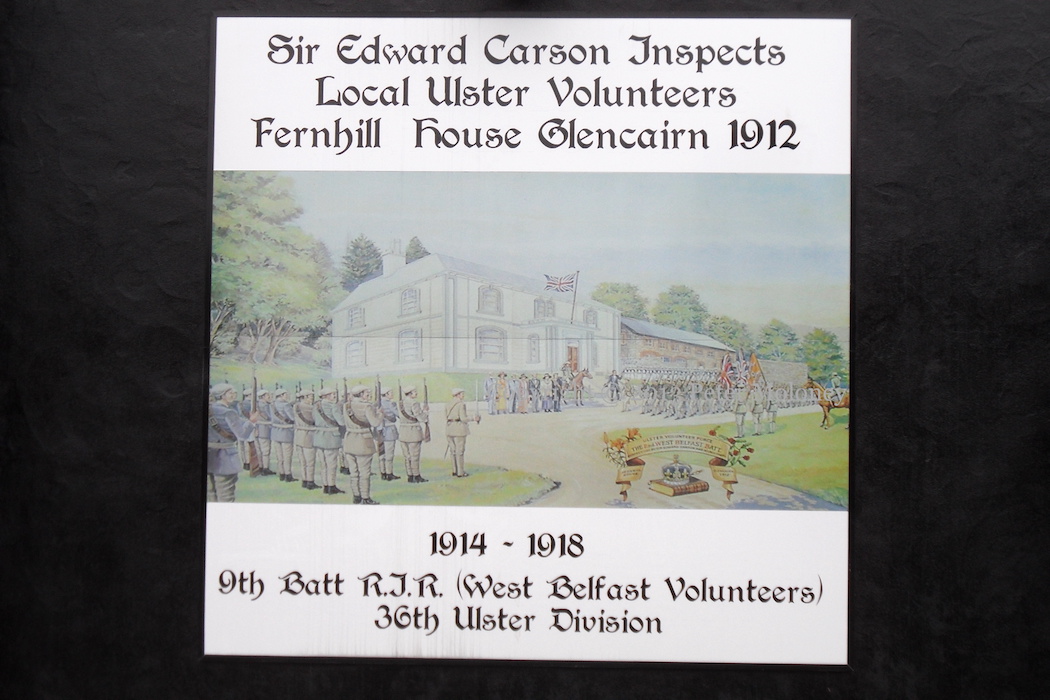
The board showing Carson inspecting the troops at Fernhill House was added to the right in 2011.
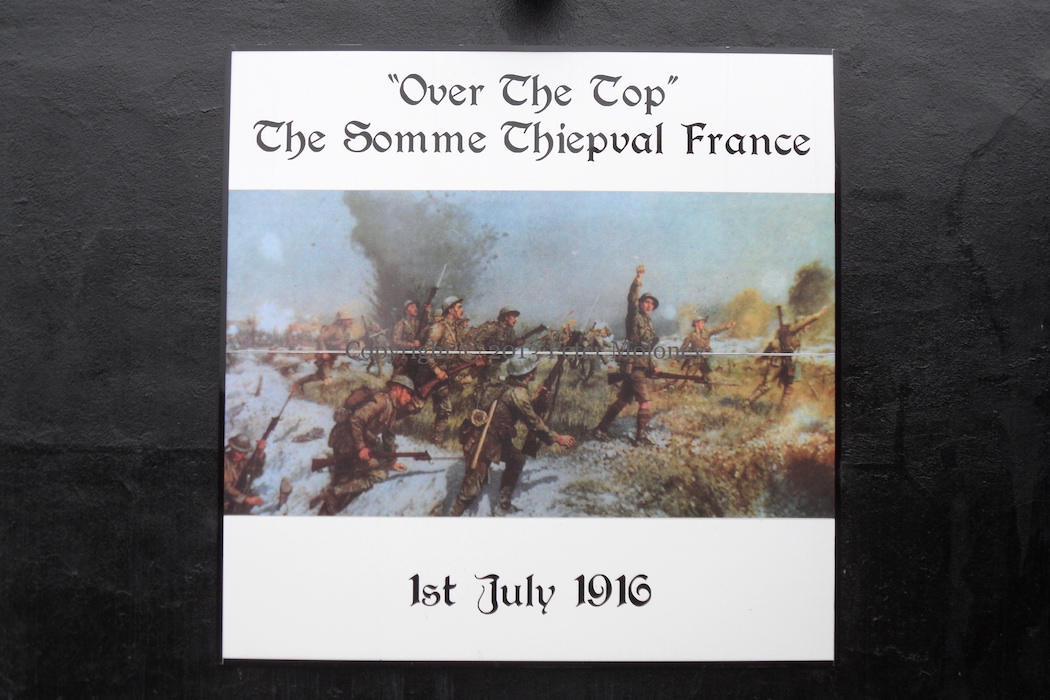
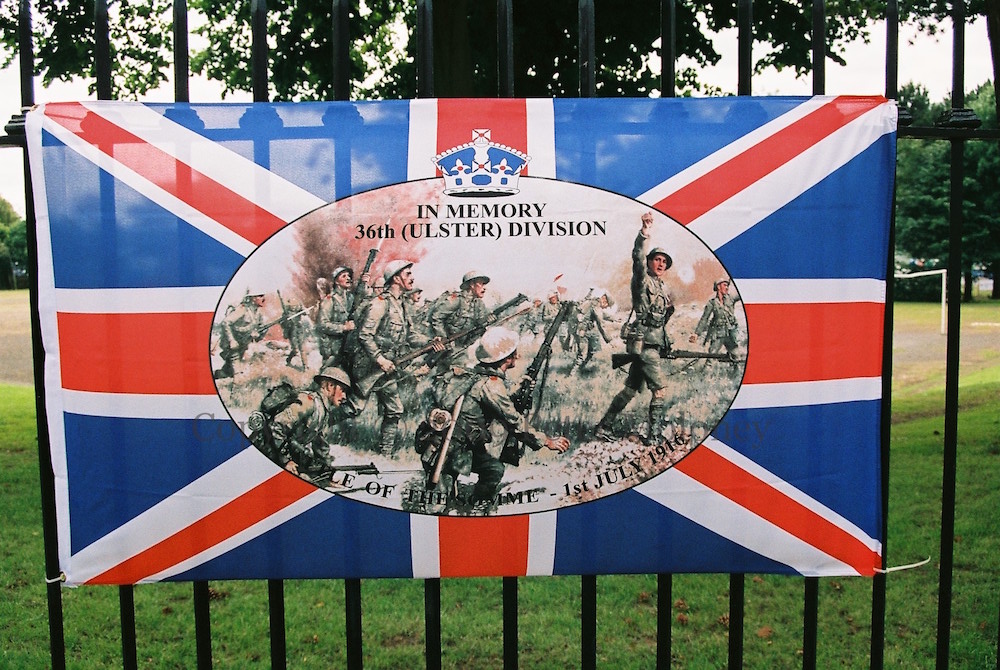
Flags on the railings of Woodvale Park for the Twelfth: soldiers going over the top, as depicted in JP Beadle’s Attack Of The Ulster Division, and the coat of arms of Northern Ireland.
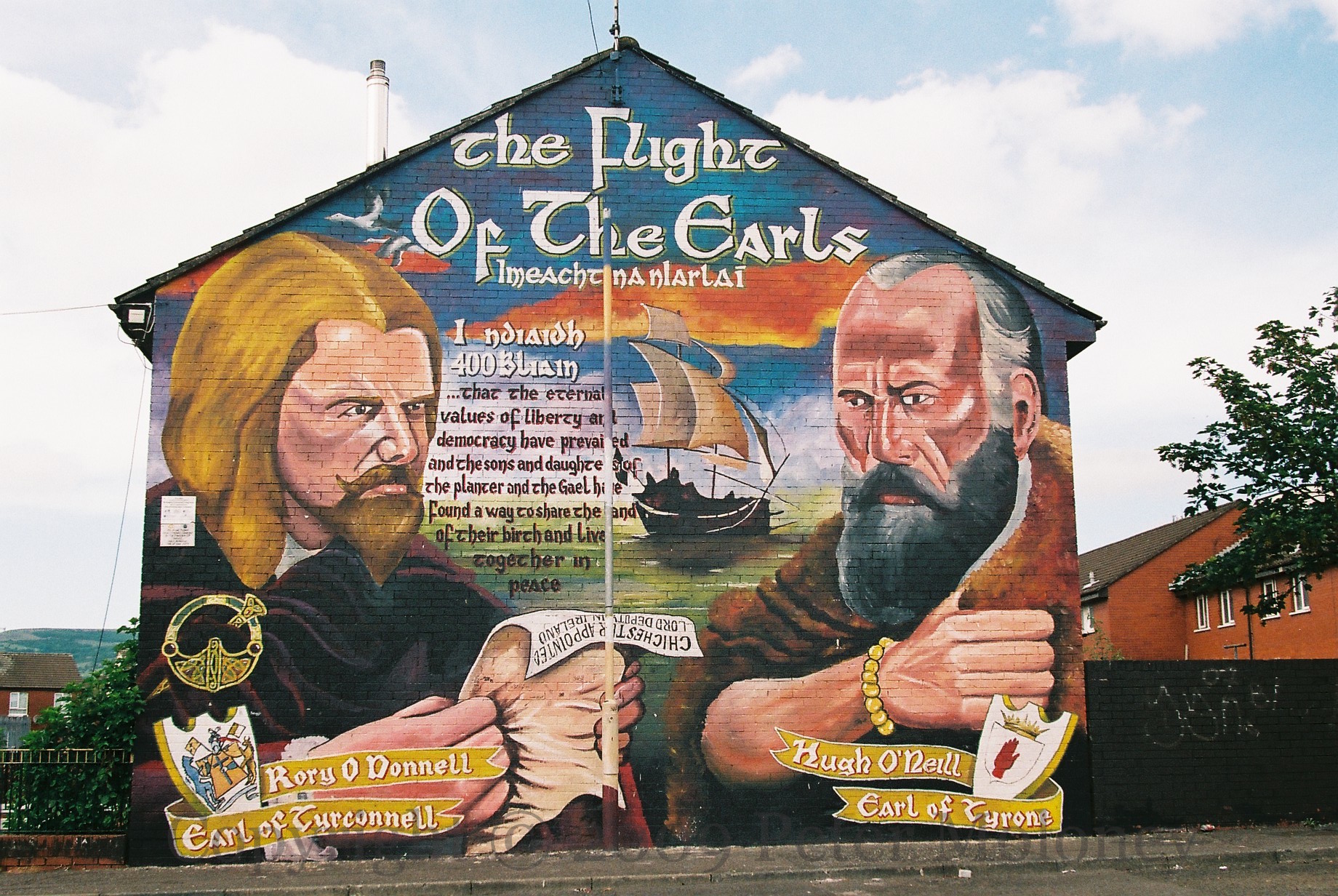
In 1607 – “400 blıaın” after the Anglo-Norman invasion of Ireland – 50 years of newly-asserted English control, most recently at the hands of Charles Blount – who defeated the pair in the Nine Years’ War – and Arthur Chichester – who, as O’Donnell is shown reading, was “appointed Lord Deputy in Ireland” in 1605 – compelled Earls Hugh O’Neill of Tyrone and Rory O’Donnell of Tyrconnell to depart Ireland on a ship bound for Spain in order to petition for Spanish support in reclaiming the lands and status they were losing under English rule. They ended up in Rome instead and never returned, ending the period of Gaelic chiefs rule in Ireland and making way for the plantation of Ulster.
The pair of plaques on the left indicate that the mural was painted as part of the Re-Imaging Communities Programme’ (top) and launched by President Mary McAleese on June 19th (bottom). Even though the subject was historical, the state funding for the project required the removal of a sword from O’Neill’s right hand; he is shown instead clutching the collar of his cloak. For more on the re-imaging programme, see Visual History 10.
“Imeacht na nIarlaí. I ndıadh 400 blıaın … that the eternal values of liberty and democracy have prevailed and the sons and daughters of the planter and the Gael have found a way to share the land of their birth and live together in peace.”
The 2009 Sandy Row bonfire in progress in Wellwood Street, with an Irish Tricolour on its side. The balconies at right are on the ‘Victoria Place’ apartment building. For the finished construction, see Sandy Row Bonfire.
Old photos and uniforms of the Queensway Flute Band in Seymour Hill are displayed on a living-room wall. “This mural is dedicated to all our members who have passed away since our formation [in 1977]. Lest we forget.”






 Peter Moloney Collection