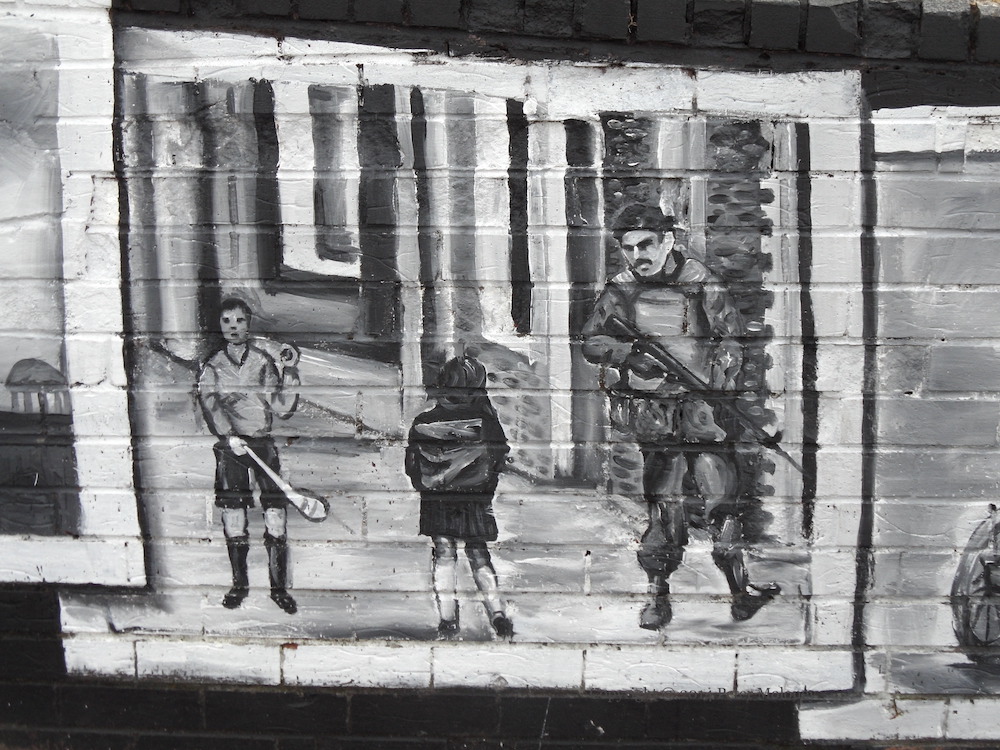
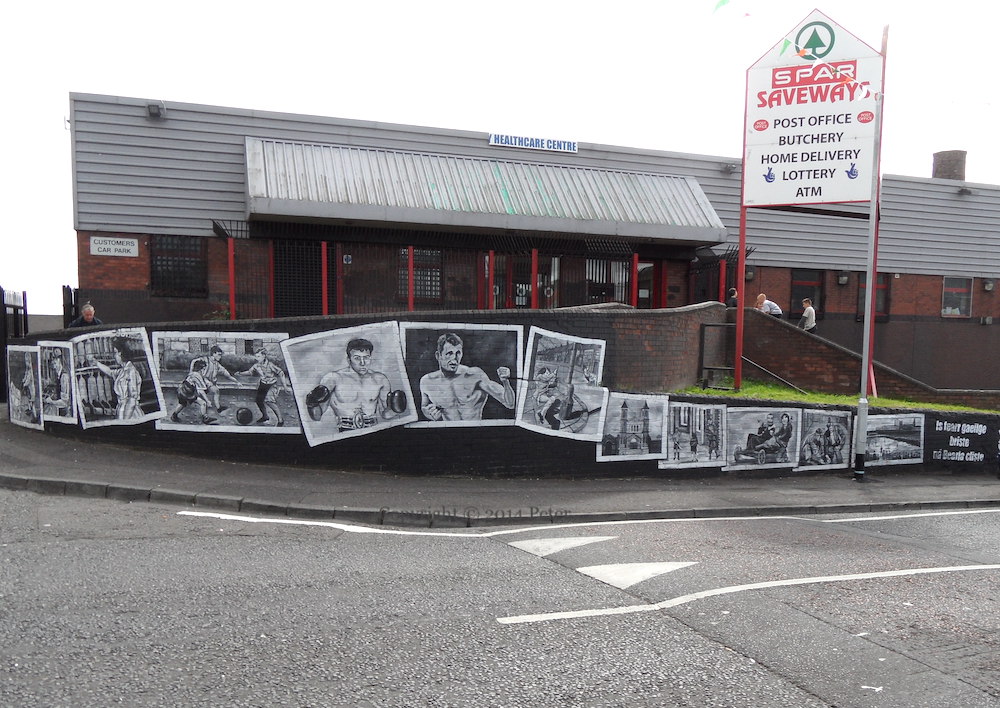
A British soldier patrols the streets while a girl walks home from school and a boy plays hurley. This is one of the panels in the long mural at the shops on Ardoyne Avenue.
The “Welcome” verbiage is just out of shot on the left-hand side; on the right is “Is fearr Gaeılge brıste ná Béarla clıste” [Broken Irish is better than clever English] and (out of shot) some Celtic knotwork. For close-ups of all of the panels, see Growing Up Too Fast.
The local New Lodge GAA club Cumman An Phıarsaıgh is named in honour of Patrick Pearse, executed after the 1916 rising. The club’s new mural features footballers contesting a ball and Pearse’s image appears at the centre of a Celtic cross along with part of his 1912 poem Mıse Éıre in the bottom corner (shown in the close-up).
Painted by Lucas Quigley and Michael Doherty. Replaces ‘New Lodge 2000‘.
Mıse Éıre: Sıne mé na an Chaılleach Bhéarra. Mór mo ghlóır: Mé a rug Cú Chulaınn croga. Mór mo náır: Mo chlann féın a dhíol a máthaır. [Mór mo phıan: Bıthnaımhde do mo shíorchıapadh. Mór mo bhrón: D’éag an dream ınar chuıreas dóchas.] Mıse Éıre: Uaıgní mé ná an Chaılleach Bhéarra.
I am Ireland: I am older than the old woman of Beare. Great my glory: I who bore Cuchulainn, the brave. Great my shame: My own children who sold their mother. [Great my pain: My irreconcilable enemy who harasses me continually. Great my sorrow: That crowd, in whom I placed my trust, died.] I am Ireland: I am lonelier than the old woman of Beare.
“Mol an óıge agus tıocfaıdh sí” – “youth responds to praise”, such as when playing in the annual Easter Gaelic games tournament, now in its eighth year. Joe Cahill (WP) holds the cup aloft.
The group in the bottom left corner are Pat O’Hare, Frank Cahill, Tom Cahill, (the three Cahills were featured in the previous mural) Ned Maguire, Jr., Ned Maguire, Sr., Alec Crowe, Paddy Meenan, Tommy Crowe, Dal Delaney, and Hugh Elliot.
In the crook of Cahill’s arm are Rita McParland, Sean Wallace, Paddy Corrigan, John Pettigrew, and John Stone. None of these adults is still alive; all were from the local area.
The chalet bungalows in the background on the left are gone, but you can see images of them on the Belfast Forum.
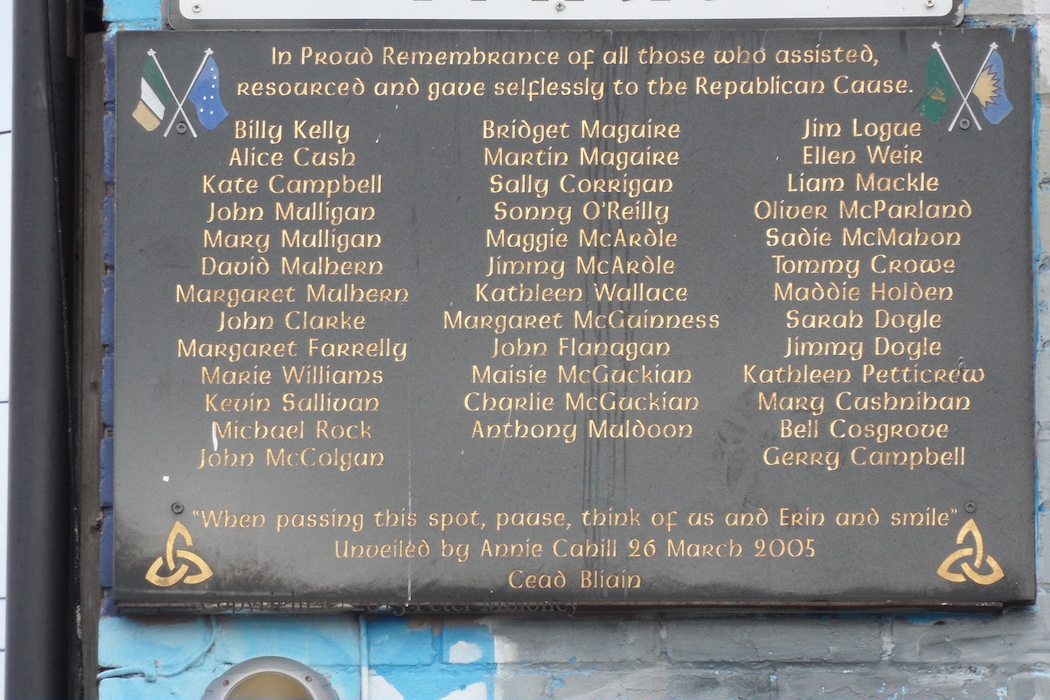
The plaque on the left names others in addition “who assisted, resourced and gave selflessly to the republican cause”: Billy Kelly, Alice Cush, Kate Campbell, John Mulligan, Mary Mulligan, David Mulhern, Margaret Mulhern, John Clarke, Margaret Farrelly, Marie Williams, Kevin Sullivan, Michael Rock, John McColgan, Bridget Maguire, Martin Maguire, Sally Corrigan, Sonny O’Reilly, Maggie McArdle, Jimmy McArdle, Kathleen Wallace, Maragret McGuinness, John Flanagan, Maisie McGuckian, Charlie McGuckian, Anthony Muldoon, Jim Logue, Ellen Weir, Liam Mackie, Oliver McParland, Sadie McMahon, Tommy Crowe, Maddie Holden, Sarah Doyle, Jimmy Doyle, Kathleen Pettigrew, Mary Cushnihan, Bell Cosgrove, Gerry Campbell.
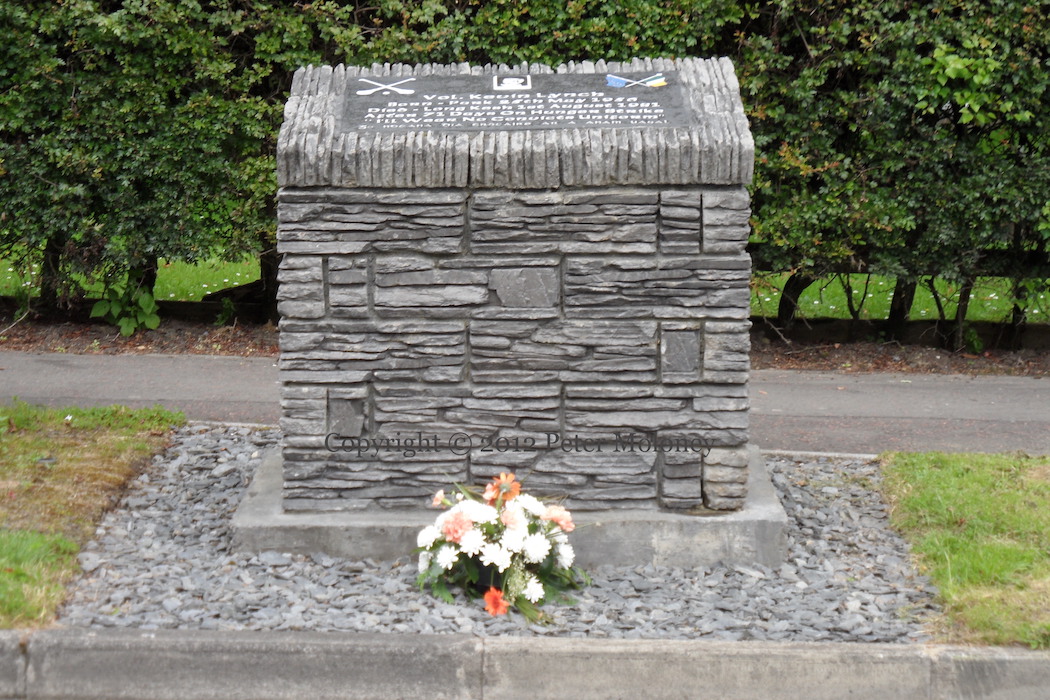
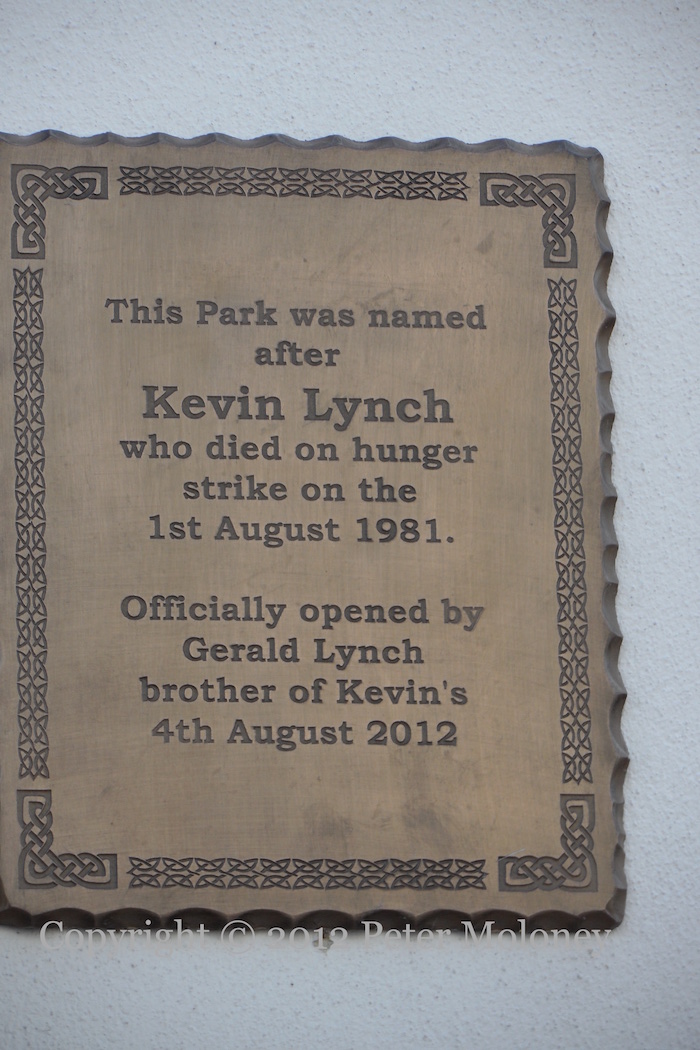
“Vol. Kevin Lynch, born Park 25rg May 1956, died – Long Kesh 1st August 1981 after 71 days on hunger strike “I’ll wear no convicts uniform” Go ndéana Dıa trócaıre ar a anam uasal.”
“Erected by Counties Derry & Antrim Commemorative Committee. Unveiled by Raymond McCartney MLA on 24th May 2009.”
Kevin Lynch is shown raising the Under-16 County Derry hurling trophy (photo below). He was arrested in December 1976 and went on the blanket and then the second hunger strike. Lynch died after 71 days on hunger strike – the longest-surviving striker – in Long Kesh/the Maze prison. The H-Block Song (with lyric “I’ll wear no convict’s uniform/nor meekly serve my time/that Britain might brand Ireland’s fight/800 years of crime” was played by a piper at his funeral. (An Phoblacht)
Along the bottom are the emblems of Kevin Lynch Memorial flute band (Fb), Kevin Lynch’s hurling club (“mısneach ‘s dílseacht”), and St Dympna’s football club, Luton (Fb).
The mural is shown on the day of its launch, August 4th, 2012 – the plaque on the left is covered by a small curtain in the first image above but shown in the second.
The street was also named in Lynch’s honor, with a plaque at the other end.
The placard is in Chapel Road – it seems to be the same one as in 2011, but with a frame added.
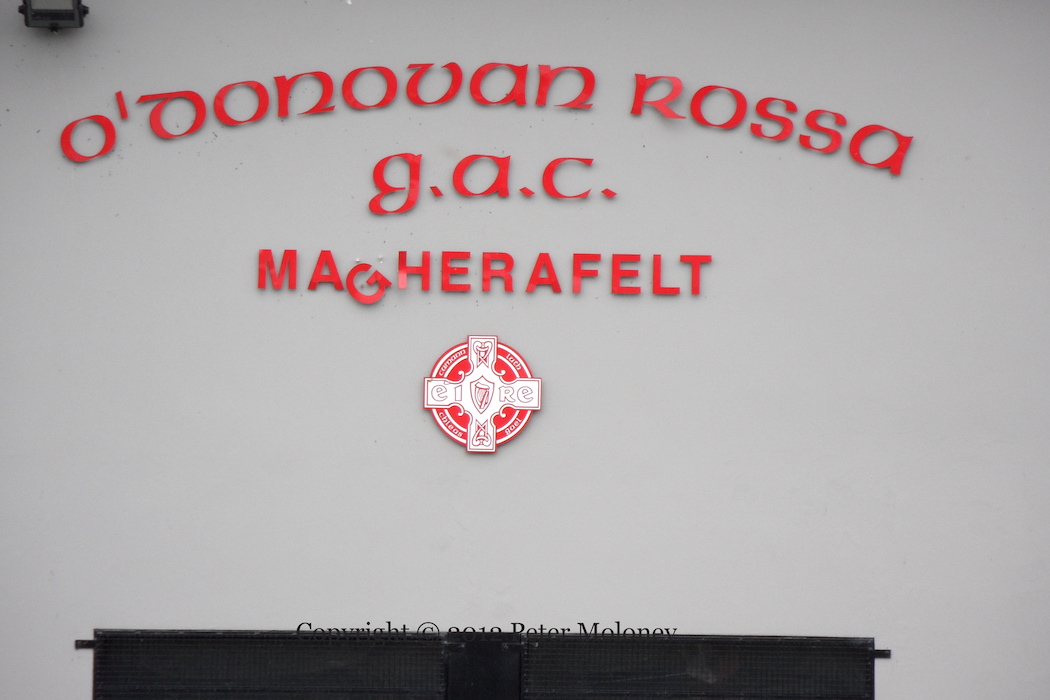
St Malachy’s (tw | Fb) is a junior (i.e. 2nd division/B-tier) GAA club established 1936 in the Markets area of south Belfast and also drawing from Ormeau and Short Strand.
It is not known who the four portraits are of (perhaps Sean Flynn bottom left) or who the four players are. Get in touch if you have any information.
With support from Lorag (the Shaftesbury recreational and leisure centre) and sponsorship (along the bottom) from Pulse, Belfast City Council, New Belfast Community Arts Initiative, the Housing Executive, and Brighter Belfast.
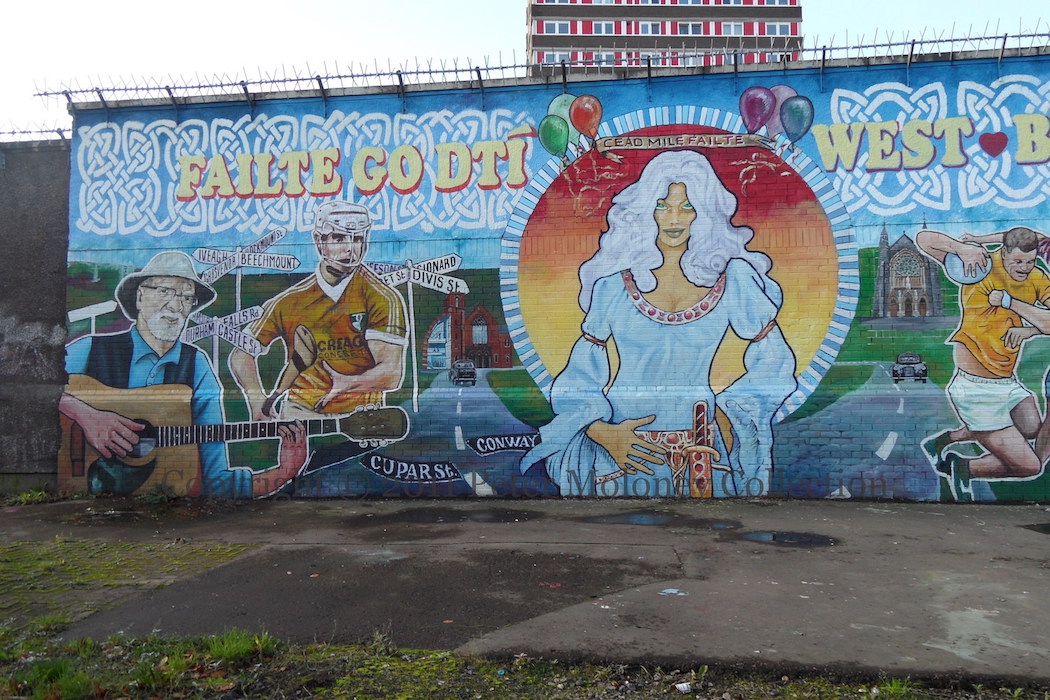
“Welcome to west Belfast”. West Belfast is portrayed as a place of music, sport, and dancing, whose landmark buildings and streets are under the watchful eye (and sword) of the goddess Érıu.
The image of the little boy with the “I [heart] Belfast” stickers and a bag of sweets, standing in the waste ground of Divis flats, is a photograph from the early days of Féıle An Phobaıl/West Belfast Festival.
On the Divis Street side, characters in the style of cartoonist Cormac (see e.g. Notes) are “Promoting west Belfast tourism” for “Fáılte Feırste Thıar”, “www.visitwestbelfast.com“. The attractions touted are: “Bop at the August “fleadh”. “Craıc agus ceol” (for Robert Ballagh’s dove coming out of the concrete block, see Féile An Phobail 2008), “The only thing you have here is “choice”. Tar ısteach agus (lıg do scíth)”. “Baın sult as. Tá mé ag éısteacht le Raıdıó Fáilte 107.1 FM”, “For more ideas on things to do, visit Oıfıg Fáılte at An Chultúrlann. There’s really nice food there too! at Caıfe Feırste”, “If it’s history you want go on a cemetery tour “City or Milltown””, “Enjoy a walk on ‘Slıabh Dubh’ (The black … … mountain)”, “Make sure you visit the “Irish republican history museum” at Conway Mill” (with ‘Long Kesh University Of Freedom’ sweater; “Sinn Féin touts” is not a sweater but graffiti.)
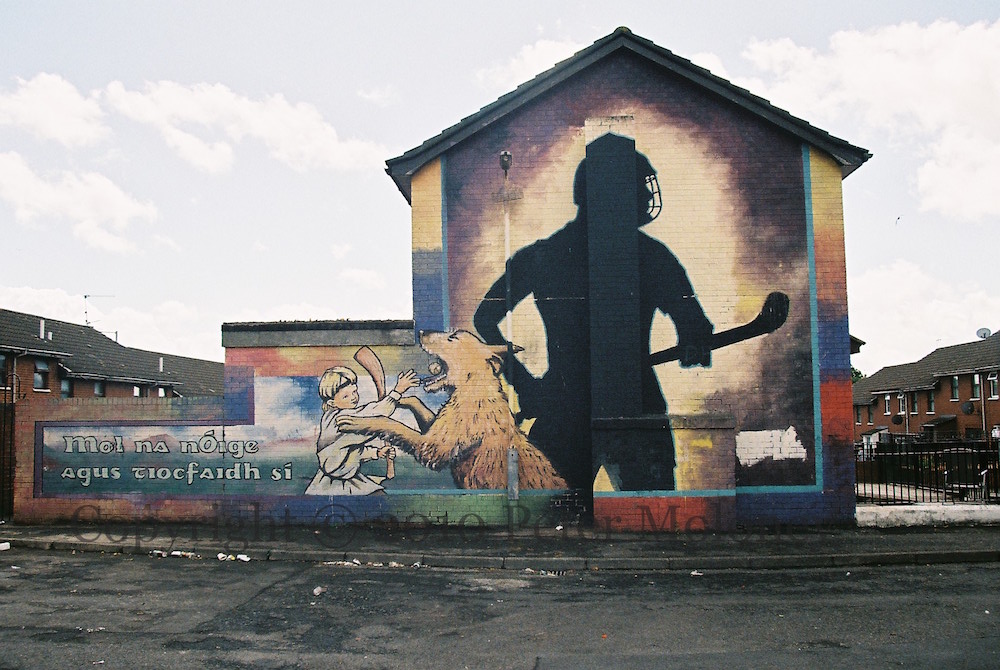
A seven-year old Setanta become Cú Chulaınn (Culann’s Hound) after killing the beast by driving a slıotar (the ball used in hurling) down its throat. “Mol na nóıge agus tıocfaıdh sí” [as written: praise the young [people] and it [sic] will flourish; usually the phrase is “Mol an óıge …” “praise youth …”]










 Peter Moloney Collection