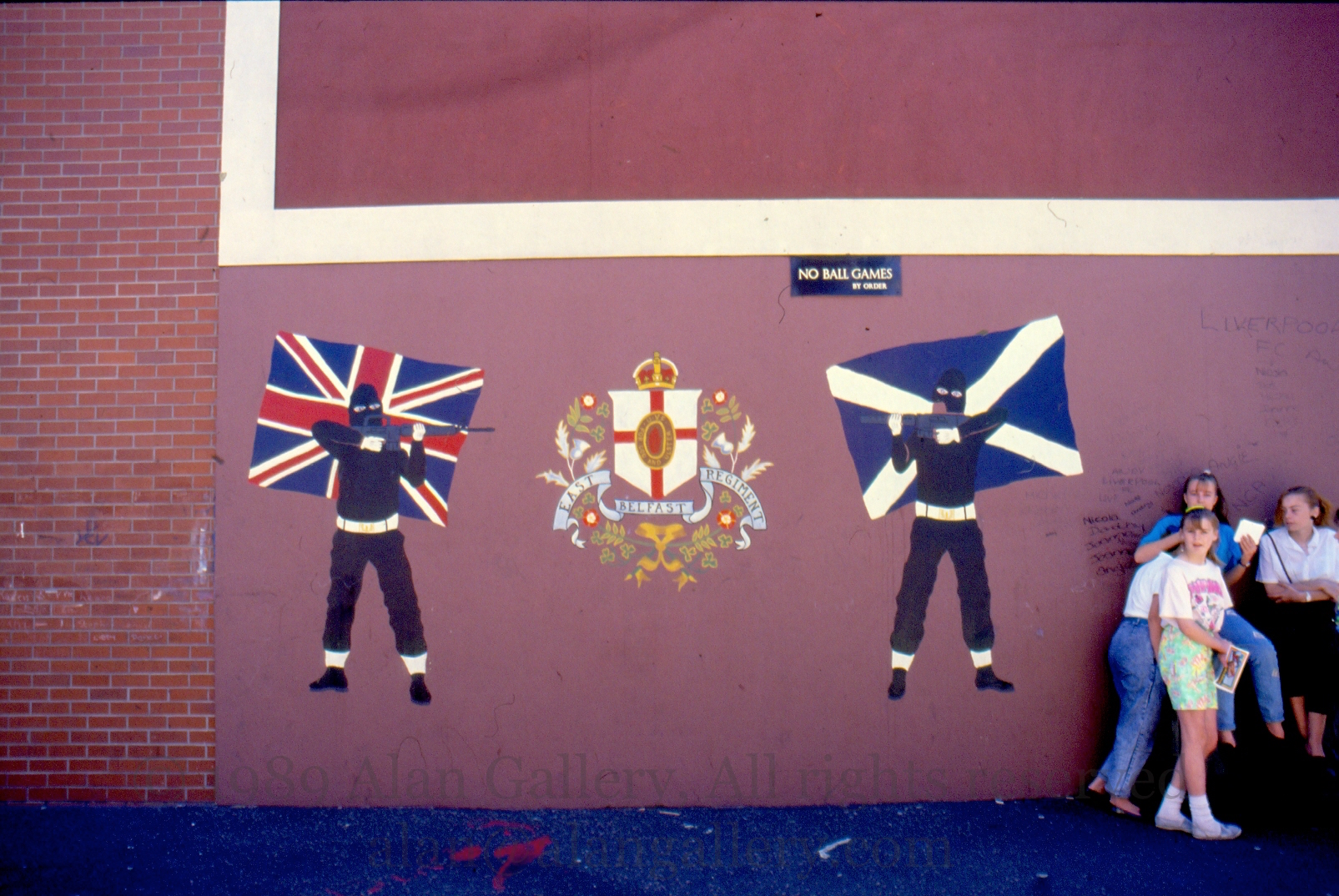
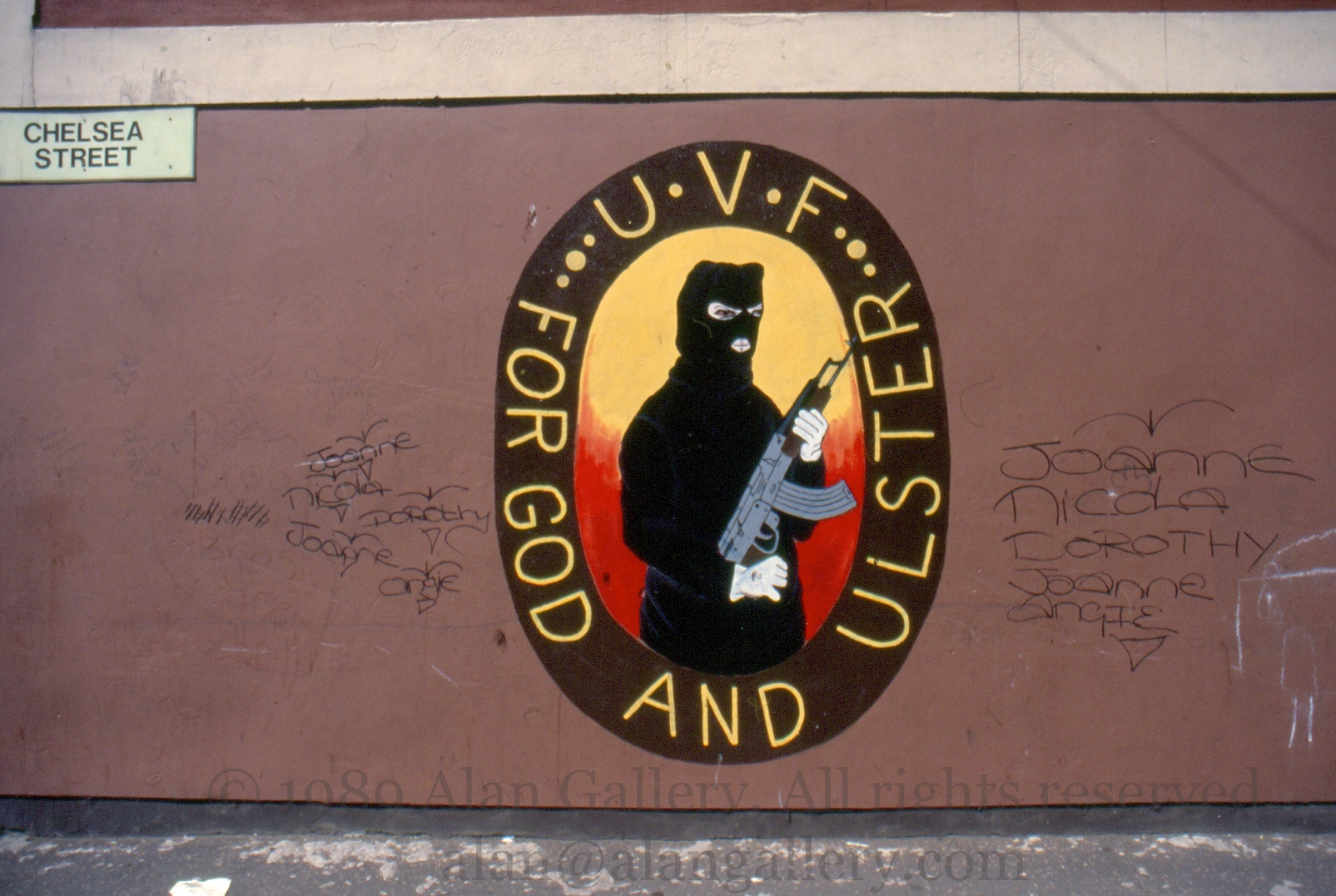
An ornate regimental (WWI) coat of arms, for the East Belfast regiment, with the emblem of the Ulster Volunteers symbol on an Ulster banner shield, topped by a crown and surrounded by an arrangement of roses, thistles, and shamrock. “Contemporised” by masked volunteers with weapons pointed, in front of Union flag and St Andrew’s Saltire. Chelsea Street, Belfast
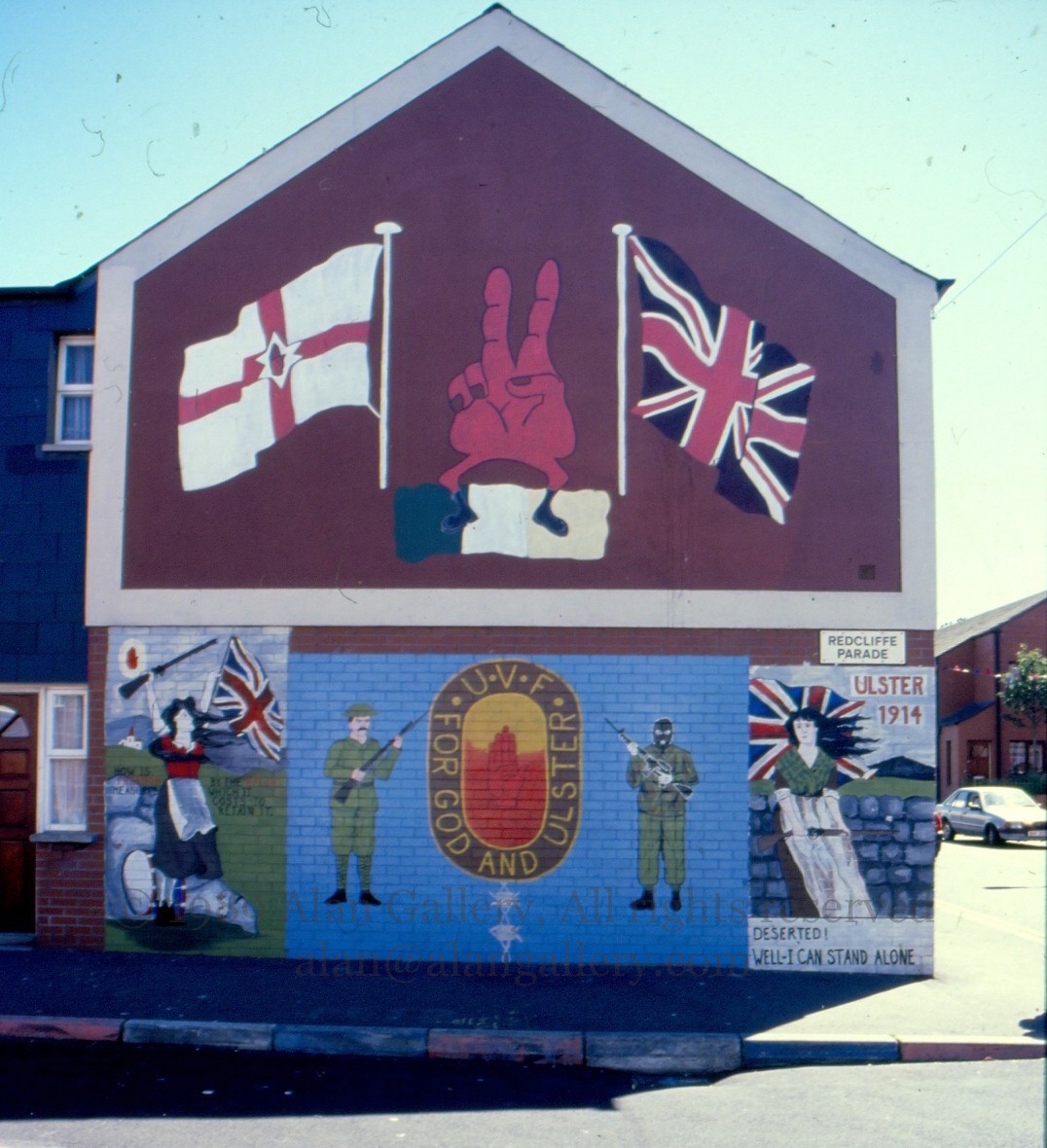
The bottom half of this mural in Redcliffe Parade, Belfast, shows UVF volunteers “then and now” (“Ulster 1914” during WWI and in contemporary times). On either side of that are (Protestant) women, on the left exhorting men to fight in WWI and on the right defending the homestead (i.e. the Protestant territories) against the threat of Irish nationalism while the men (and perhaps British support) are absent: “How is freedom measured? By the effort which it costs to retain it” and “Deserted! Well, I can stand alone.”
The upper portion shows a rare (though not unique) version of the red hand of Ulster, giving a “V for victory” salute (and so we can see nails on three digits) and dancing in boots on an Irish Tricolour which lies between an Ulster Banner and a Union flag.
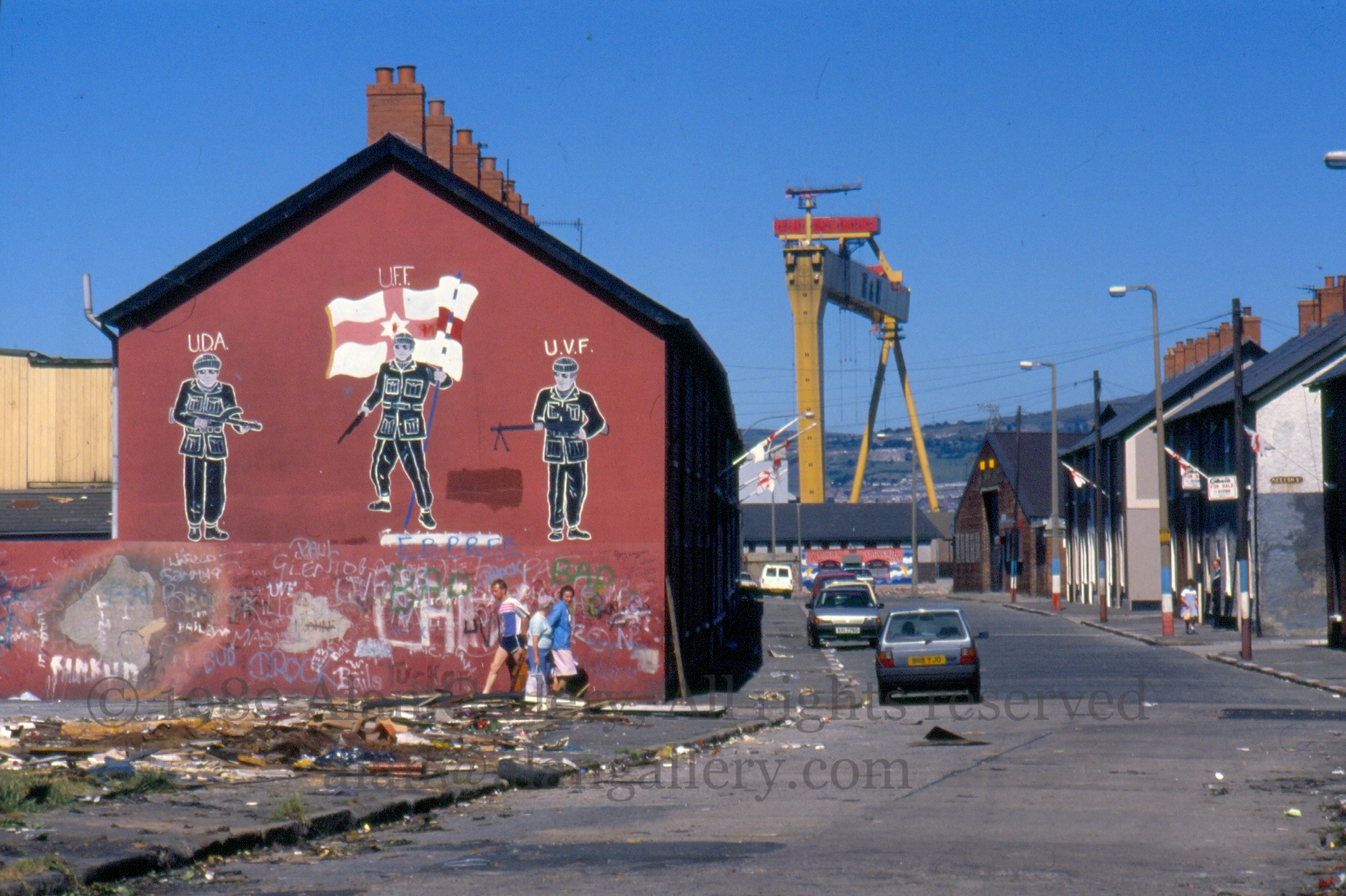
Volunteers from the UDA, UFF, and UVF, with unmasked faces, each carrying a weapon (and one Ulster Banner in the middle). Painted by Johnny Jamison Jr. Severn Street, Belfast.
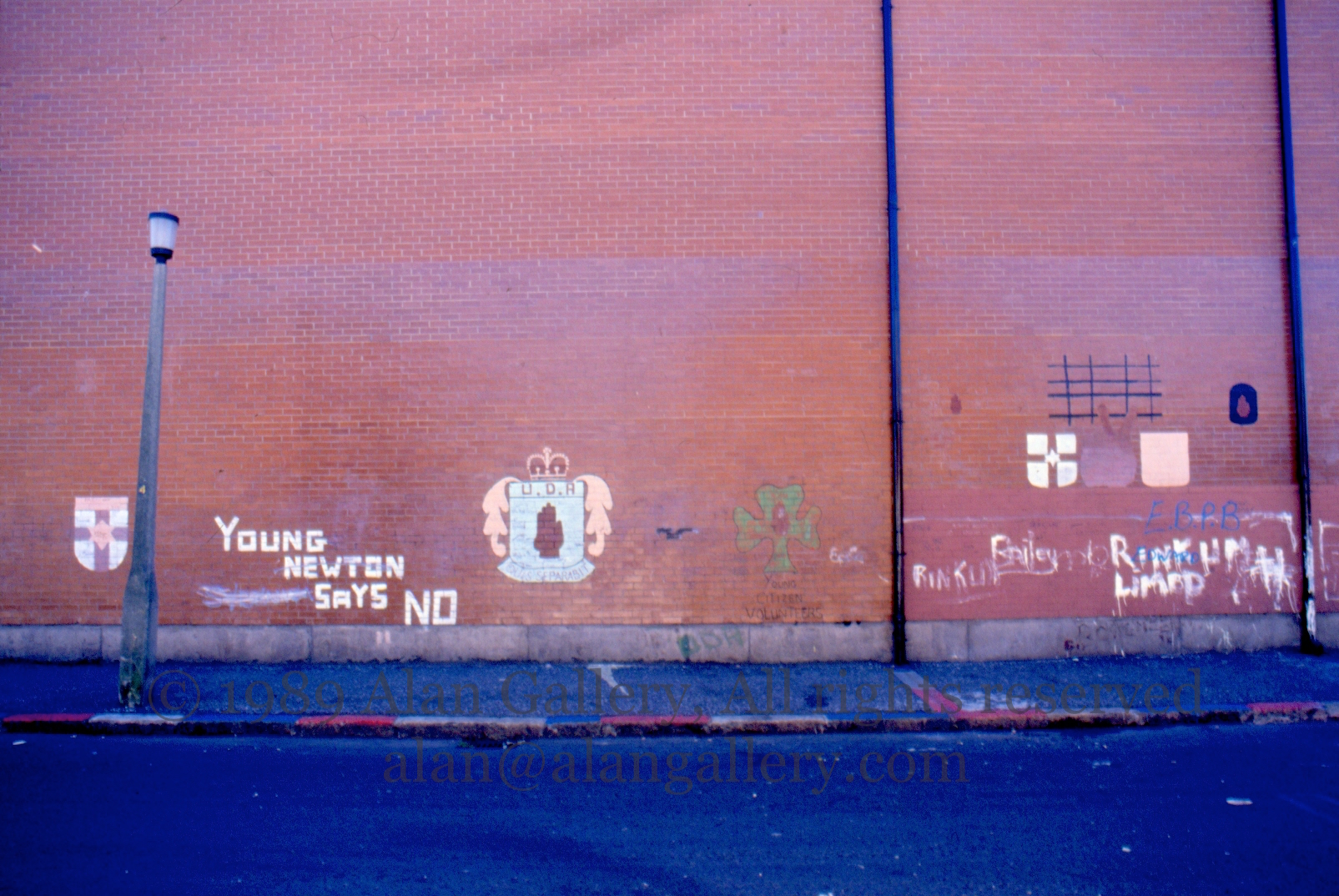
Young Newton is the Newtownards Road division of the Ulster Young Militants (UYM) and formerly a Tartan Gang. In this image we see UDA insignia from Severn Street, Belfast, as well as the shamrock of the (UVF-associated) YCV.
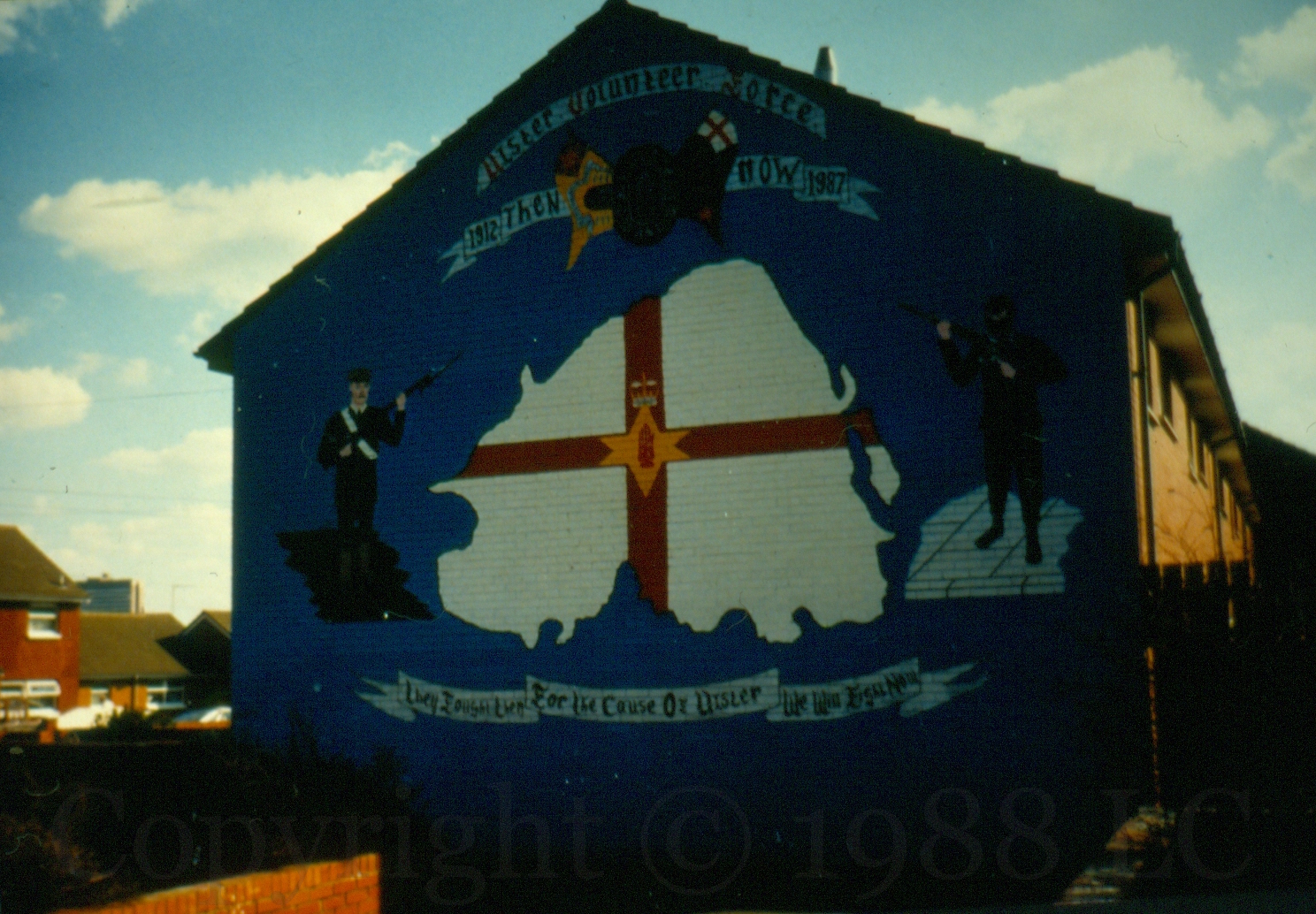
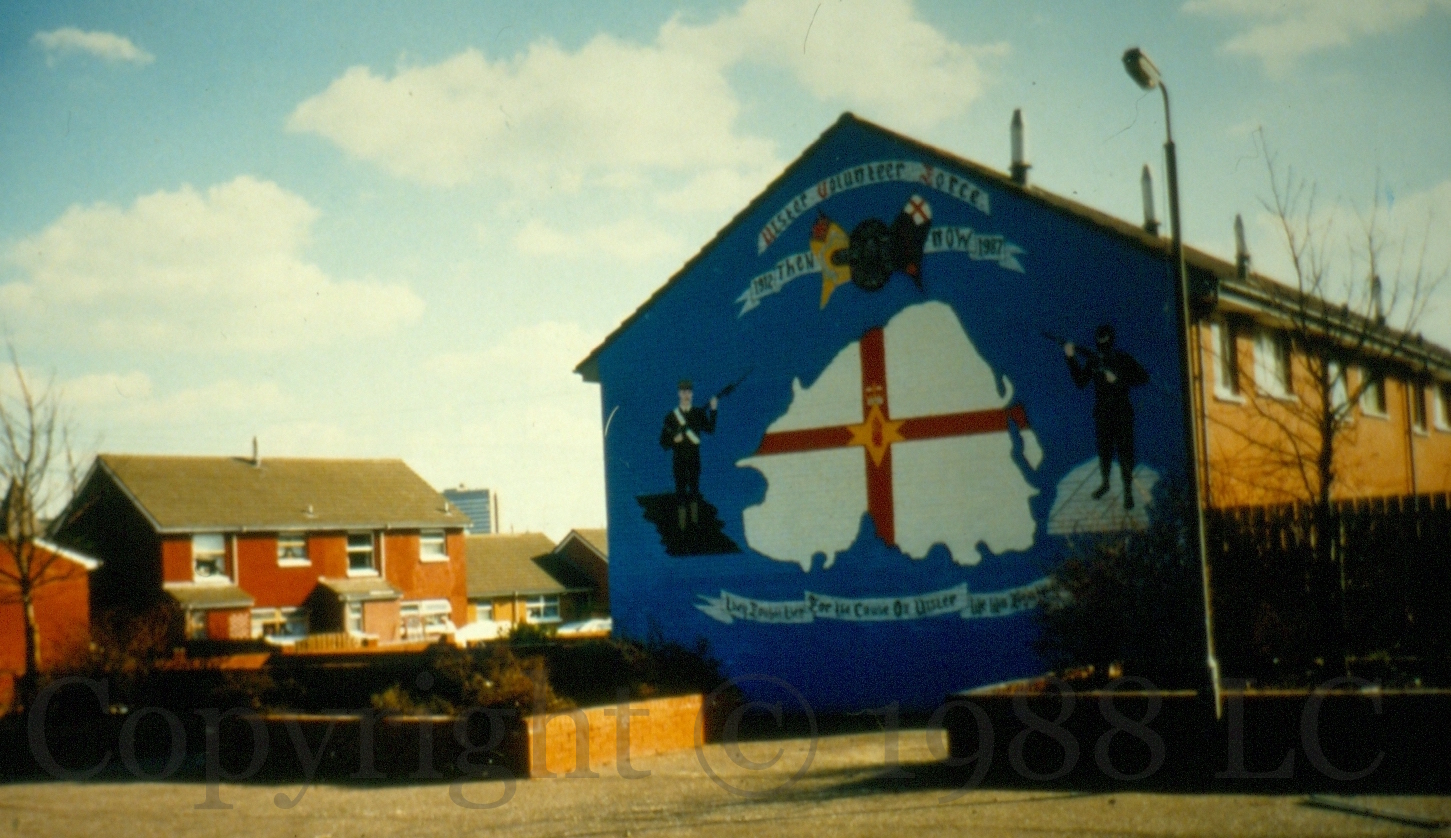
“They fought then for the cause of Ulster, we will fight now.” The 75th anniversary of the Ulster Volunteers is celebrated in this mural in Dover Place, west Belfast. On the left of the Northern Island is an Ulster Volunteer in period (1912) garb standing on a patch of ground, on the right, a modern (1987) paramilitary in hood and fatigues standing on a city footpath. The Ulster Volunteers as such did not fight for Ulster – they instead joined the British Army and fought “for King and Empire” in WWI, after which Home Rule was applied only to 26 counties of Ireland and Northern Ireland was created and remained within the UK.
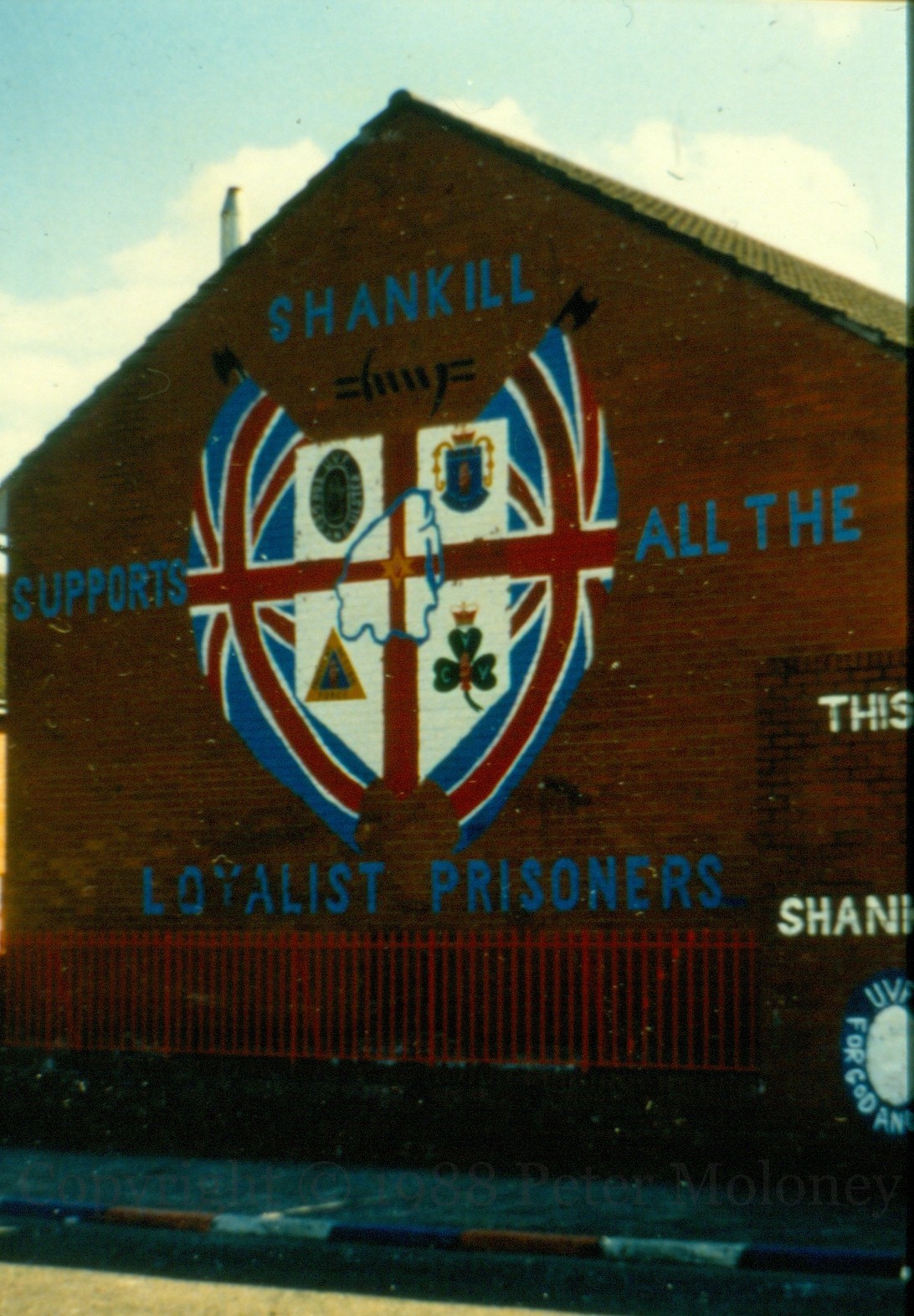
Both UVF and UDA emblems (as well as PAF and YCV) in the quadrants of an Ulster banner shield with Northern Island in the middle. Union flags on the side and barbed wire above. No 5 of 9 on the south side of Percy Place, Belfast.
On the left of the lightning bolt are the soldiers of the 36th Ulster division (U.V.F.) R.I.R (Royal Irish Rifles) on the western front in 1916; on the right are “UVF prisoners of war, Long Kesh”.
A similar board was painted in the UVF compounds of Long Kesh. Of it, Billy Hutchinson (in his 2011 piece “Transcendental Art“) said, “My favourite mural was one inspired by the British anti-war poet, Siegfried Sassoon. Suicide In The Trenches depicts a UVF volunteer split down the middle by a bolt of lightning. Half of him depicts a 36th Ulster Division soldier under heavy fire in a rainsoaked WW1 trench. The other half shows a ’70s volunteer incarcerated behind barbed wire and over-shadowed by watch towers.” (The piece – W2021.1.8 in the Ulster Museum collection – includes the last verse from Sassoon’s Suicide In The Trenches.)
Hutchinson also describes the importance of the Orange Cross welfare organisation in selling prisoner art produced inside the prison. Stevie McCrea of the RHC was killed in the Orange Cross in 1989 – see Stevie McCrea.