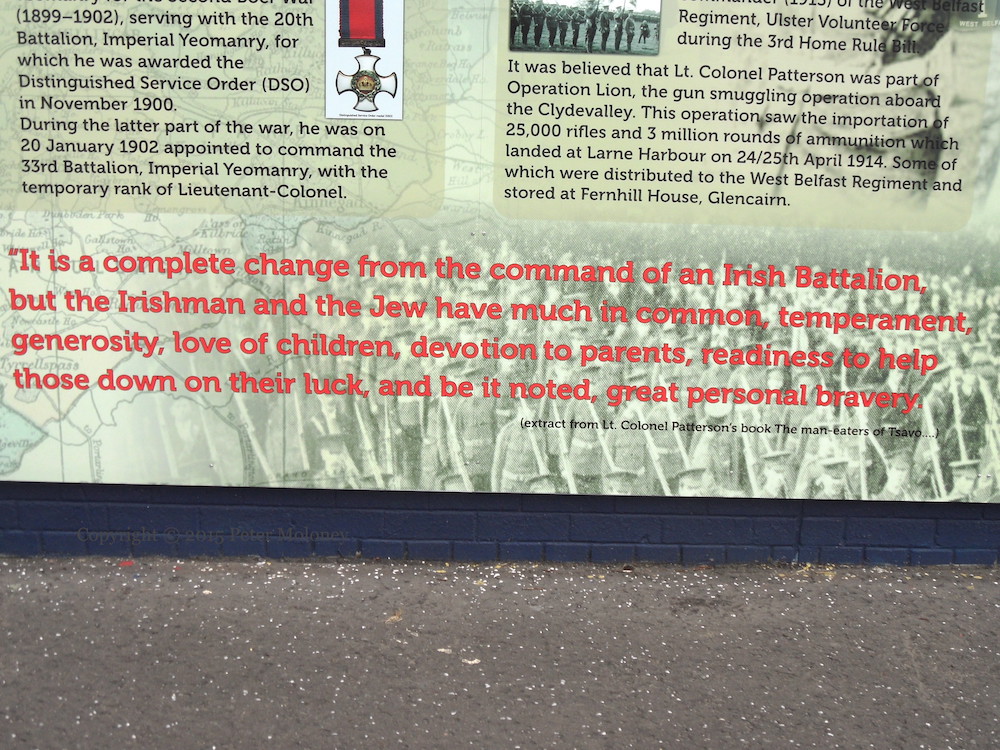
John Henry Patterson

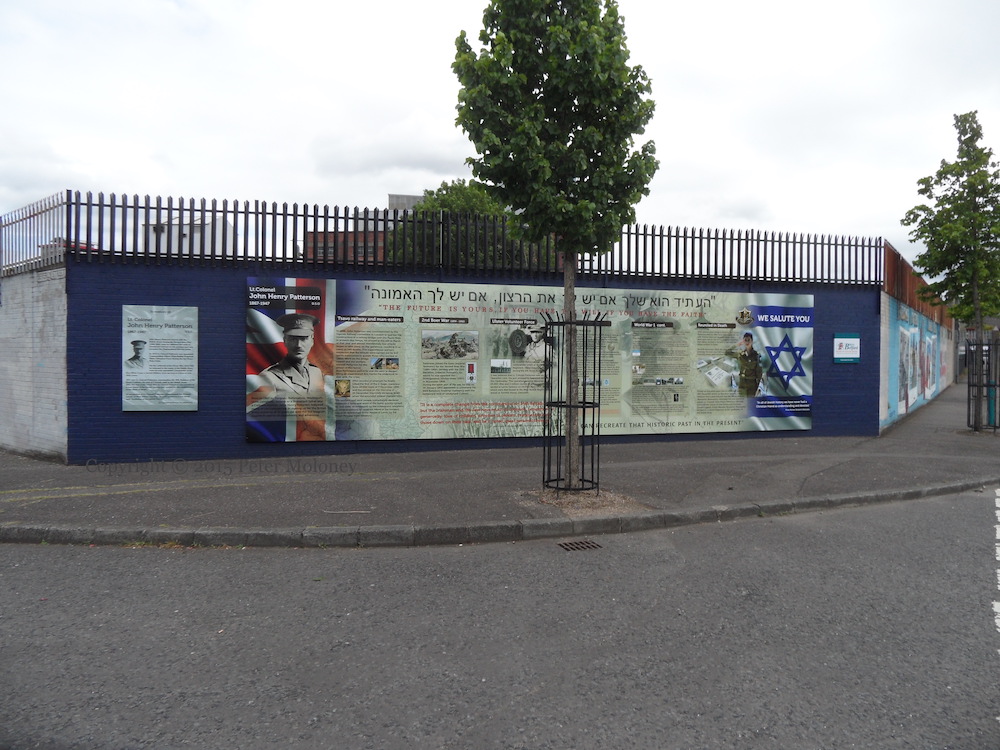
John Henry Patterson went from Ireland to Kenya, where he killed several lions after months of hunting. He wrote an account of the hunt ‘The Man-Eaters of Tsavo’ which has inspired three movies. The lions, named The Ghost and The Darkness, were both over nine feet in length. Back in Ireland he commanded a battalion of the UVF and was involved in the Larne gun-running of 1914: Operation Lion.

The final panel shows the star of David and a quote from Prime Minister Benjamin Netanyahu: “In all of Jewish history we have never had a Christian friend as understanding and devoted.” The interim panels described Patterson’s raising and leading of the Jewish battalions of the Royal Fusiliers in WWI. After dying in obscurity in Los Angeles in 1947, his remains were transported to Israel in December 2014 and reinterred (video). For more, including a recording of Patterson’s voice, see this BBC Magazine article.

“John Henry Patterson DSO 1867-1947. Born in 1867 in Forgney, Ballymahon, Westmeath (now Longford), Ireland to a Protestant father and a Catholic mother, John Henry Patterson followed many of his compatriots in signing up for the British Army enlisting at 17 years old with the 3rd Dragoon Guards in search of opportunity and adventure.”
“In 1898, John Patterson was commissioned by the Uganda Railway committee in London to oversee the construction of a railway bridge of the Tsavo River in present-day Kenya. He arrived at the site in March of that year and almost immediately lion attacks began to take place on the workforce, resulting in as many as 140 deaths. The superstitious workers suspected that the attacks were carried out by evil spirits summoned to punish those who worked at Tsavo. Work on the bridge ceased and the workers blamed Patterson for the arrival of this terror. Now Patterson’s authority and life were in danger, being an experienced lion hunter he undertook to deal with the crisis. After months of attempts he finally killed the first of the 2 huge, maneless lions on the night of 9 December 1898 and the second on the morning of 29 December (narrowly escaping death when the wounded animal charged him). The workers and local people immediately declared Patterson a hero, and word of the event quickly spread far and wide, as evidenced by the subsequent telegrams of congratulations he received. Word of the incident was even mentioned in the House of Lords, by the Prime Minister Lord Salisbury.”
“Patterson joined the Essex Imperial Yeomanry for the Second Boer War (1899-1902), serving with the 20th Battalion, Imperial Yeomanry, for which he was awarded the Distinguished Service Order (DSO) in November 1900. During the latter part of the war, he was on 20 January 1902 appointed to command the 33rd Battalion, Imperial Yeomanry, with the temporary rank of Lieutenant-Colonel. Lt. Colonel Patterson was appointed commander (1913) of the West Belfast Regiment, Ulster Volunteer Force during the 3rd Home Rule Bill. It was believed that Lt. Colonel Patterson was part of Operation Lion, the gun smuggling operation aboard the Clydevalley. This operation saw the importation of 25,000 rifles and 3 million rounds of ammunition which landed at Larne Harbour on 24/25th April 1914. Some of which were distributed to the West Belfast Regiment and stored at Fernhill House, Glencairn.”
“The Zion Mule Corps. Lt. Colonel Patterson rejoined the British Army in 1914, upon the outbreak of World War I, and saw service in Flander[s] before being sent to Egypt. In Alexandria he met Joseph Trumpeldor and Zeev Jabotinsky who were attempting to form a Jewish military force. By the end March 1915, Jewish volunteers from among deportees in Egypt had started training. The British military command opposed to participation of Jewish volunteers on the Palestinian front and suggested the volunteers serve as a detachment for mule transport. In 1915, Lt. Colonel Patterson was made commander of the approximately 750 man Zion Mule Corps, organized in Egypt in March, with a rank of “honorary Lieutenant Colonel.” Swearing in the new volunteers on March 31, 1915. Patterson wrote in his diary “never since the days of Judah Maccabee had such sights and sounds been seen and heard in a military camp – with the drilling of uniformed soldiers in the Hebrew language”. In April of 1915, after the Mule Corps had been in training for just 3 weeks, Lt. Colonel Patterson  landed with the corps at V Beach, Gallipoli. About half of the corps were seconded to the Anzacs, who treated them discourteously and had them shipped back to Alexandria, the rest under Lt. Colonel Patterson then landed at Cape Helles on April 27th where they saw action for the very first time, there the corps served with distinction out of the 300 men that landed, 14 were killed.”
“The Mule Corps disbanded in early 1916, Lt. Colonel Patterson returned to Ireland where he commanded the 4th Royal Irish Fusiliers and 5th Royal Dublin Fusiliers. In 1917, after 3 years of lobbying by the British Jewish community, and the likes Jabotinsky the British government finally agreed to the raising of a specifically Jewish unit to fight in the British Army in World War One against the Turks in Palestine/Israel. The force was to be part of the Royal Fusiliers and were given the battalion numbers 38th-42nd. The whole force became known as the Jewish Legion or colloquially as “The First Judeans” The most famous photograph of the men on their march shows Lt. Colonel Patterson clearly and proudly at the head of his men on his horse with one of his offices mounted behind him though the image is blurred has the Lt. Colonel clearly with a broad smile on his face. Indeed every man was smiling as they were lionised by the crowds before embarking on their journey to the Jordan Valley. In June 1918 38th Battalion began engaging the Ottomans some twenty miles north of Jerusalem the Legion also participated in the Battle of Megiddo in mid-September  1918 widely considered to have been one of the final and decisive victories of the Ottoman front. The legion’s mission was to cross the Jordan river. Jabotinsky led the effort. Later he was decorated and Major General Chaytor told the Jewish troops “By forcing the Jordan fords, you helped in no small measure to win the great victory gained at Damascus. During his time in command Lt. Colonel Patterson faced ongoing anti-semitism from superiors, peers and subordinates. His reaction to this engendered much respect from his men, who believed he had sacrificed promotion and position in his quest to ensure fair treatment of them.”
“After several years living in American Lt Colonel Patterson died on 18th June 1947 (aged 79), his wife Frances died just six short weeks later. Both were laid to rest in Los Angeles. Patterson had always wished to be laid to rest with his with fellow soldiers in Israel. On 10th November 2014, the date of his actual birthday, his wish was fulfilled, when his and Frances’s ashes were reunited with Israel. Finally as the ashes were laid to rest once again (4th December 2014); as the choir and the Israeli Defence Force paid tributes and the Prime Minister (Benjamin Netanyahu) extended his own personal salute, Lt. Colonel John Henry Patterson officially achieved the status of time honoured Christian Zionist Legend. Prime Minister Benjamin Netanyahu termed Lt. Colonel Patterson as the ‘godfather of the Israeli army’.
historic past in the present future is yours if you have the will faith david ben-gurion we salute you

Click image to enlarge
Copyright © 2015 Peter Moloney
M11947 M11948 M11949
M11959
M11950 M11951 M11952 M11957
M11953 M11954 [M11958] M11955 M11956
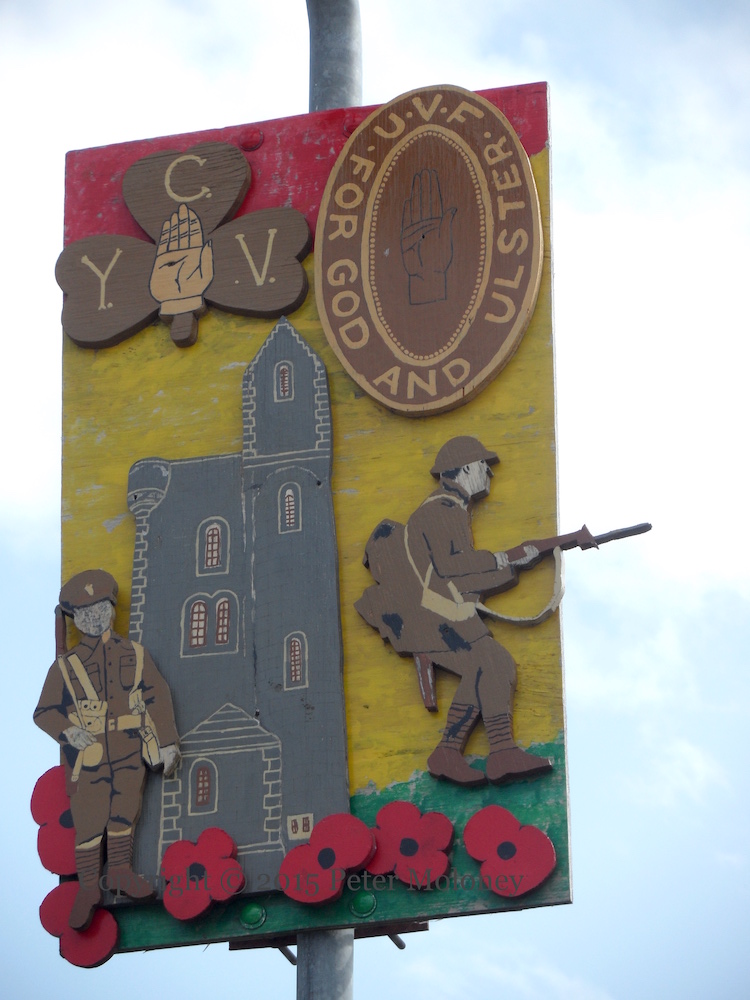
Ulster Tower

This pair of boards in Irvine Crescent, Enniskillen, is notable for their construction out of pieces of board that have been cut/carved before being layered onto a background board.

They both present the Ulster Volunteers/YCV of 1912 and WWI – in the first, two soldiers are placed alongside the Ulster Tower at Thiepval, France.

Click image to enlarge
Copyright © 2015 Peter Moloney
M11795 [M11796] [M11797] M11794

Armed Resistance Was The Only Resort

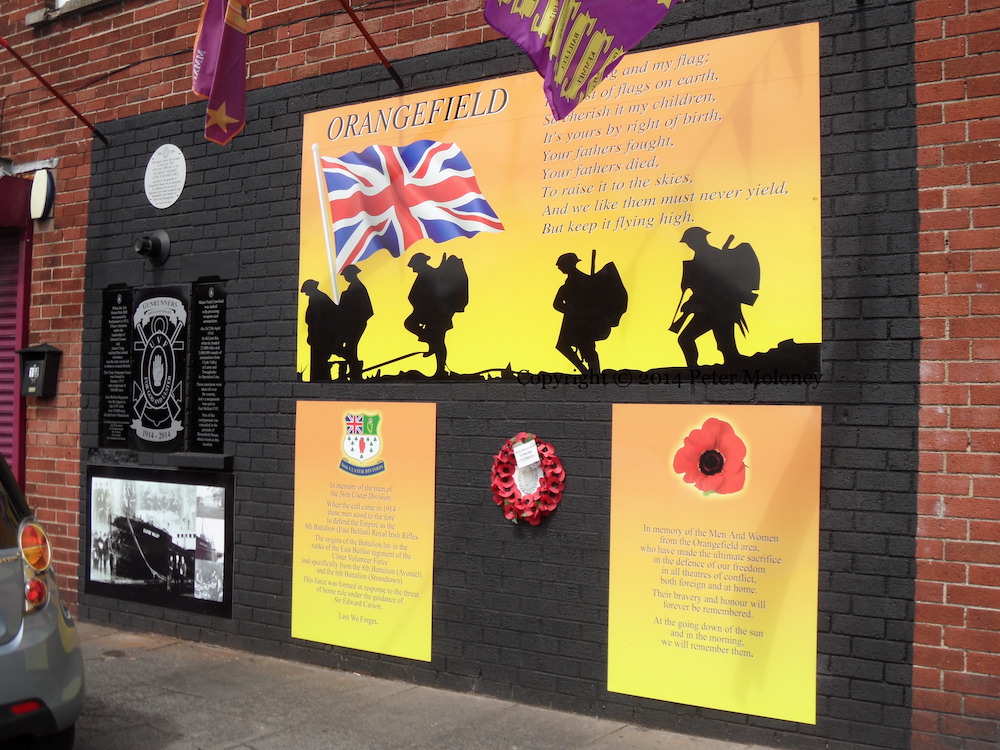
The boards on the left celebrate the 100th anniversary of the 1914 Clyde Valley gun-running; material from the operation was held for the East Belfast battalion of the Ulster Volunteers at Bloomfield House (web), site of these boards. See also: John Henry Patterson’s involvement in Operation Lion.

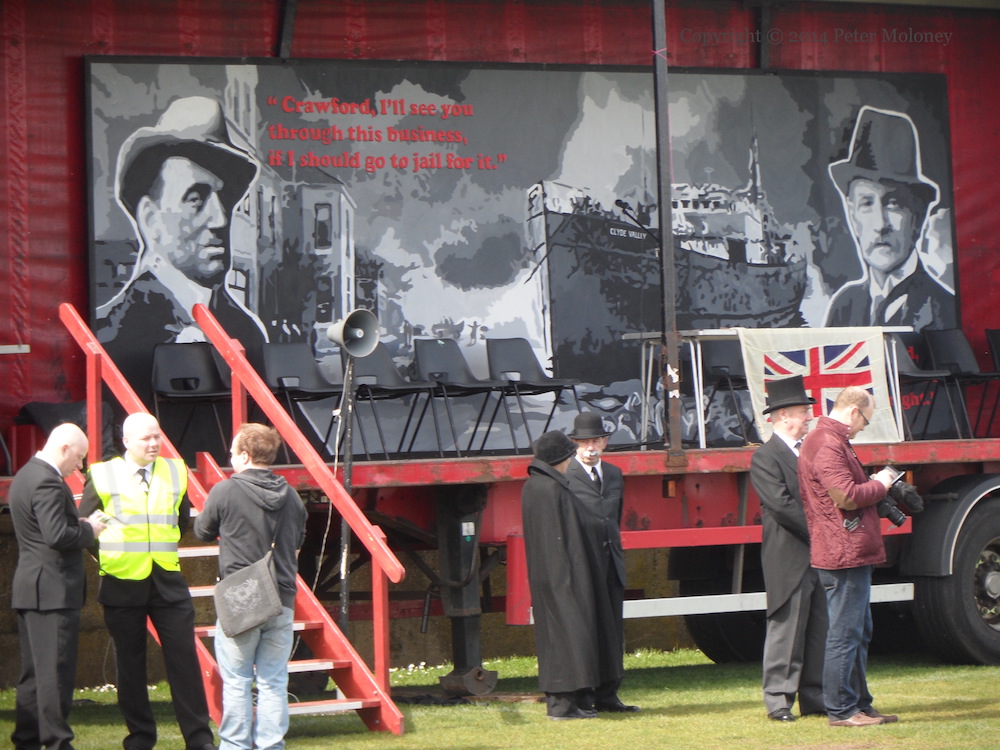
“When the 3rd Home Rule Bill was passed by Parliament in 1912, Ulster Unionists under the leadership of Edward Carson and James Craig realised that armed resistance was the only resort left to them to remain British. The Ulster Volunteer Force was formed in January 1913 and comprised of 100,000 men. East Belfast Regiment was the largest in the UVF with over 10,000 men divided into 6 Battalions: 1st. Ballynafeigh & Newtownbreda, 2nd. Willowfield, 3rd. Mountpottinger, 4th. Victoria, 5th. Avoniel, 6th. Strandtown & Knock. Major Fred Crawford was tasked with procuring weapons and ammunition. On 24/25th April 1914 he did just this when landed 25,000 rifles and 3,000,000 rounds of ammunition from Clyde Valley at Larne and Donaghadee in Operation Lion. These munitions were taken all over the country, and a consignment was sent to East Belfast UVF. Part of this consignment was concealed in the grounds of Bloomfield House, which stood on this location.”

“This plaque marks the occasion in early May 1914 when over 2,000 men of the East Belfast Regiment, Ulster Volunteer Force paraded to the grounds of Orangefield House for an inspection to celebrate the success of Operation Lion when weapons and ammunition were landed at Larne and Donaghadee. For God and Ulster.”

The boards on the right read: “‘Tis thy flag and my flag;/The best of flags on Earth,/So cherish it my children,/It’s yours by right of birth.//Your fathers fought,/Your fathers died,/To raise it to the skies,/And we like them must never yield,/But keep it flying high.” from The Union Jack, by Edward Shirley, in Little Poems For Little People, and “In memory of the men and women from the Orangefield area, who have made the ultimate sacrifice in the defence of our freedom in all theatres of conflict, both foreign and at home.” These memorial boards are to local men who “stood to the fore to defend the Empire as the 8th Battalion (East Belfast) Royal Irish Rifles” in the 36th division, formed from formed from the “8th Battalion (Avoniel) and the 6th Battalion (Strandtown)” of the Ulster Volunteers.

Grand Parade, east Belfast.

Click image to enlarge
Copyright © 2014 Peter Moloney
M11207 M11208 [M11209] [M11210] [M11211] M11212 M11213c

A Force For Ulster

Here are two new boards in the courtyard of the Rex Bar on the Shankill Road, describing the formation of the Ulster Volunteers (‘A Force For Ulster’) and commemorating the losses suffered by the 36th (Ulster) Division of the British Army, which the Volunteers became, at the Somme and in other battles, mowed down by “the Hun machine guns” (‘The Great War’).

‘A Force For Ulster’ includes photographs of the recent centenary re-enactments of the Balmoral Review, the Ulster Covenant, the formation of the Volunteers (“east” and “west”) and “Operation Lion” – more commonly known as the Larne Gun-Running.

According to the ‘The Great War’ board, 32,186 men from west Belfast were killed, wounded, or missing in the effort to “restore peace in Europe”. “To them bravery was without limit, to us memory is without end”. The board shows the Thiepval Memorial To The Missing Of The Somme against a background of portraits.

Click image to enlarge
Copyright © 2014 Peter Moloney
M11093 [M11094] [M11095] [M11096] [M11097] [M11098] [M11099] [M11100] [M11101] [M11102] [M11103] [M11104] [M11105] [M11106] [M11008] [M11009] [M11010] [M11011] [M11012] [M11013] [M11014] [M11015] [M11016] [M11017] [M11118]
M11007 [M11317] [M11318]

Gun-Running Centenary

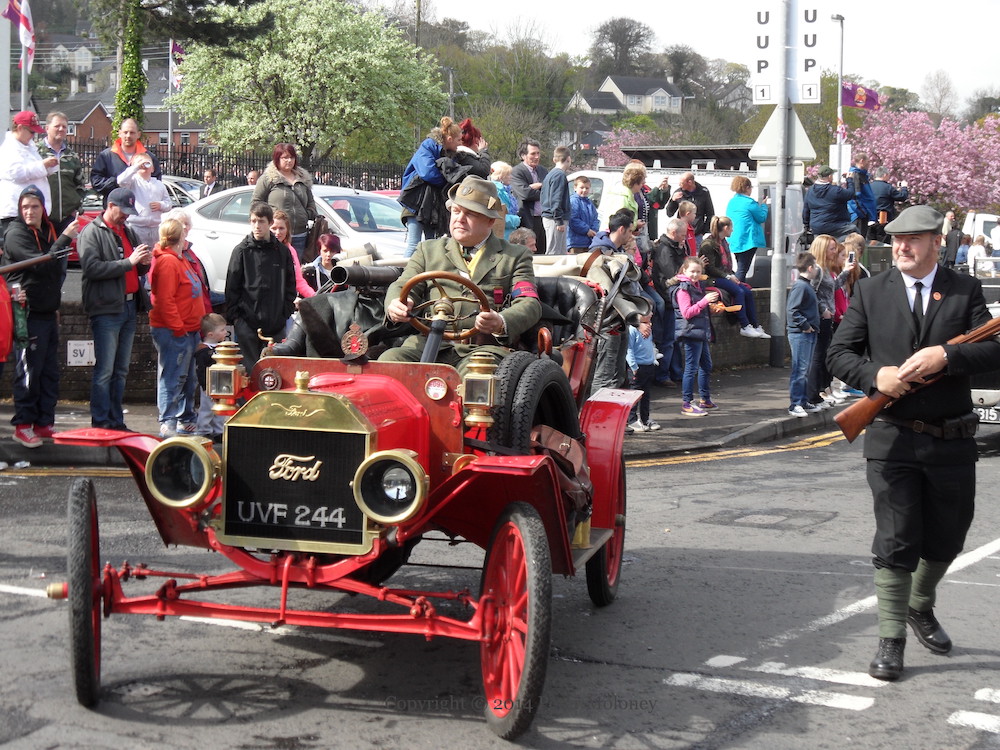
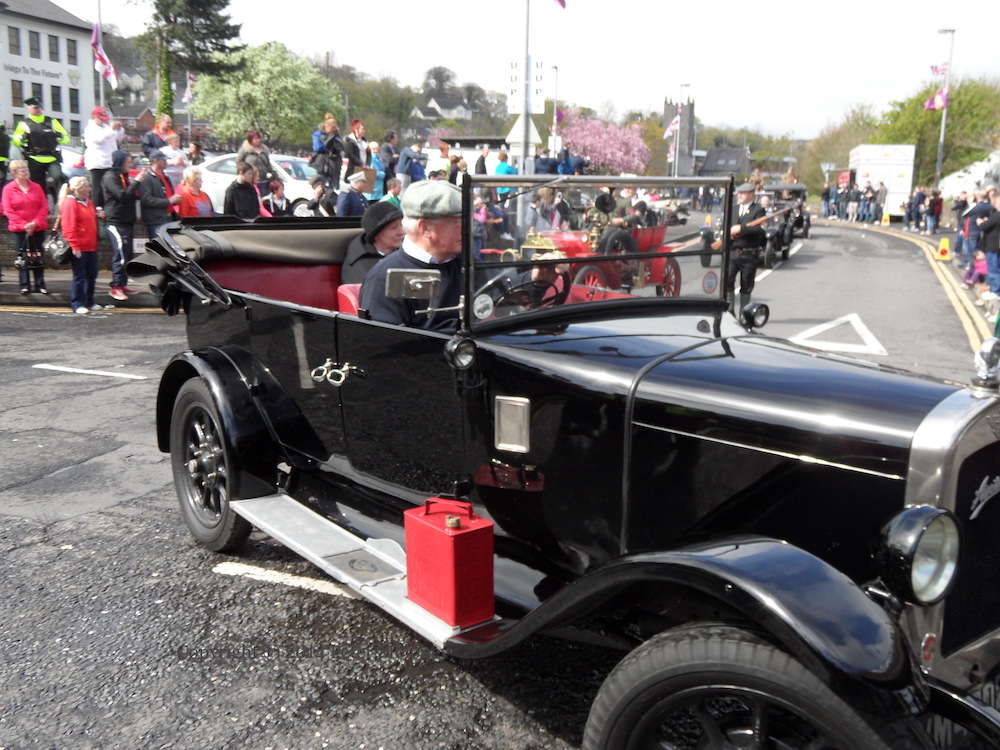
Here are a few images from the parade through Larne town (and speeches in Sandy Bay playing fields) to celebrate the centenary of the gun-running of April 24-25th, 1914, in which more than 30,000 rifles (rather than the Lewis gun and machine gun seen here) were smuggled into Ireland and dispersed to the various groups of Ulster Volunteers by horseless carriage (i.e. motor-car), in order to thwart the passage of the Home Rule bill.

(Here is a contemporary (1914) account from the (Adelaide) Journal. Here are video of the (2014) event: BBC | youtube | youtube)

Click image to enlarge
Copyright © 2014 Peter Moloney
[M10985] [M10986] M10988 M10989 M10987 M10990 [M10991] [M10992] M10993 M10994 [M10995] [M10996]

Secundus Ad Nullam

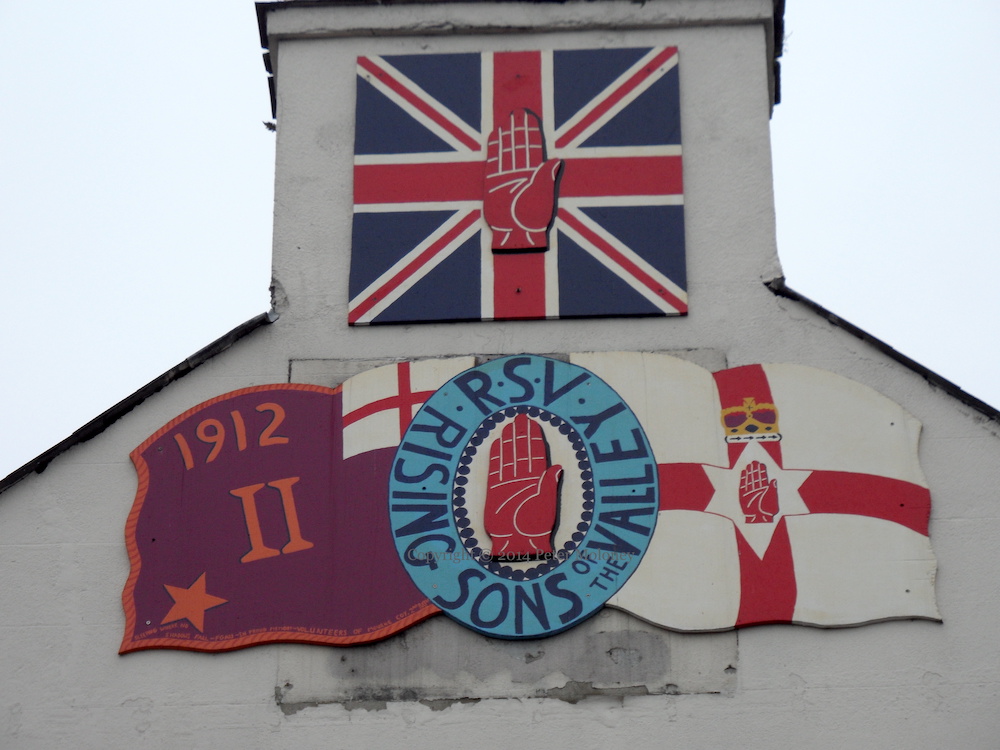
Boards of the Rising Sons Of The Valley (Fb), Mourne Young Defenders (Fb), and Pride Of Ballinran (Fb) flute bands in Kilkeel, County Down.

The left part of the RSV board shows the numeral “II” on a “1912” Ulster Volunteers flag. The 2nd County Down battalion of the 1912 Ulster Volunteers became (in 1914) the 16th RIR, the pioneer (engineering) battalion for the 36th Division (Long Long Trail).

The motto on the Ballinran board is “Secundus ad nullam”, which is a word-for-word mis-translation of “second to none”; properly it would simply be “nulli secundus”.

Harbour Road, Kilkeel

Click image to enlarge
Copyright © 2014 Peter Moloney
M10947 [M10948] [M10949]
M10944 [M10945] [M10946]
M10951 [M10943]

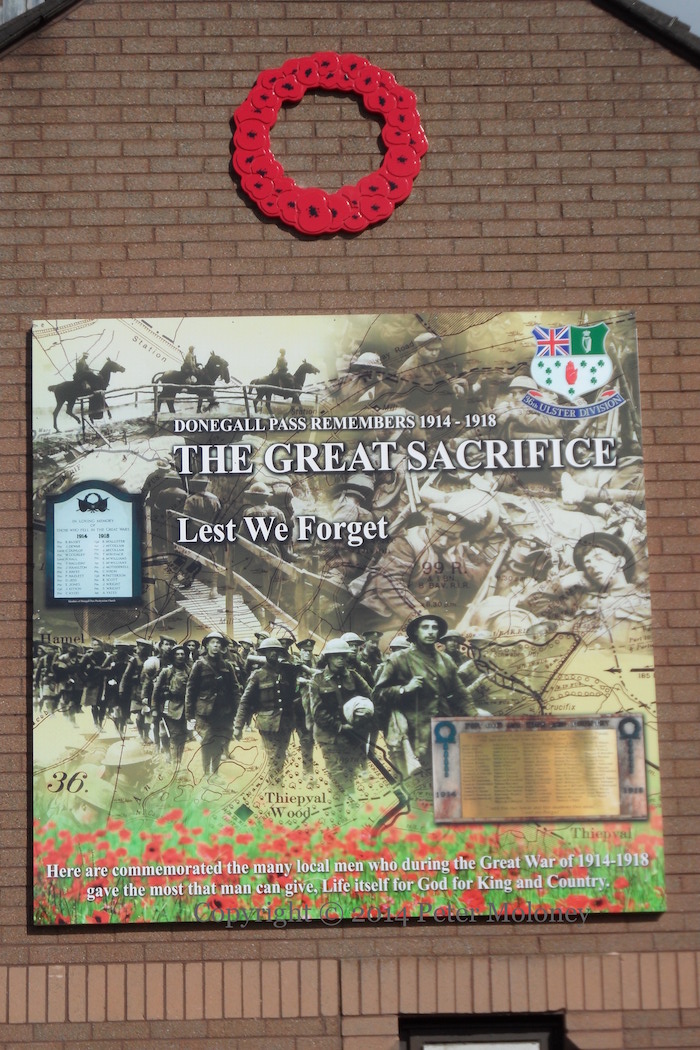
The Great Sacrifice

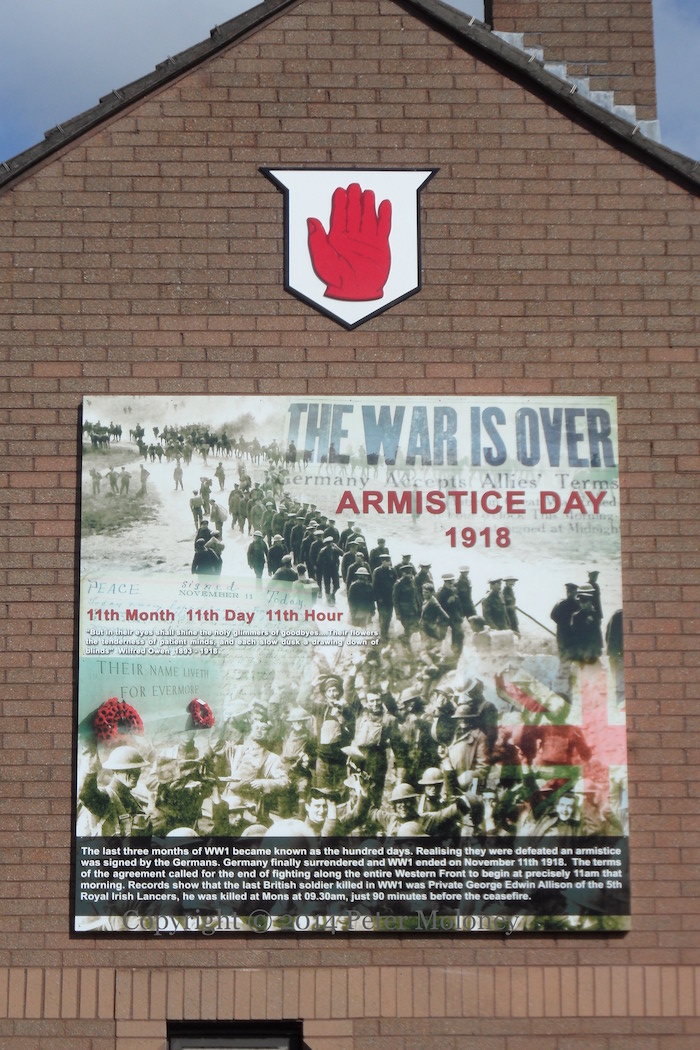
Here are three boards in Lindsay Street, south Belfast, chronicling the 1912 Covenant and the lives lost (by the 36th Division) in the Great War 1914-1918.

“It is needful that we knit together as one man, each strengthening the other, and not holding back of counting the cost” – Ulster [Unionist] Council Resolution 1912.” “Ulster’s solemn league and covenant. Ulster Day 28th September 1912.” The Council met on September 23rd and 471,000 people signed the covenant (figures here) on or around the 28th – Ulster Day – led by Sir Edward Carson.

“Donegall Pass remembers 1914-1918 – the great sacrifice. Lest we forget. Here are commemorated the many local men who during the Great War of 1914-1918 gave the most that man can give: life itself for God for King and Country.” With a map of the northern end of the Western Front and images of soldiers marching, on horseback, and in the trenches.

“The war is over. Armistice Day 1918. 11th month, 11th day, 11th, hour.” “But in their eyes shall shine the holy glimmers of goodbyes … Their flower the tenderness of patient minds, and each slow dusk a drawing down of blinds.” Lines from Wilfred Owens’ (1893-1918) ‘Anthem For Doomed Youth‘.

At the bottom: “The last three months of WWI became known as the hundred days. Realising they were defeated an armistice was signed by the Germans. Germany finally surrendered and WWI ended on November 11th 1918. The terms of the agreement called for the end of fighting along the entire Western Front to begin a precisely 11 am that morning. Records show that the last British soldier killed in WWI was Private George Edwin Allison of the 5th Royal Irish Lancers. He was killed at Mons at 09:30 am, just 90 minutes before the ceasefire.”

Click image to enlarge
Copyright © 2014 Peter Moloney
M10820 [M10821] [M10822] [M10823] [M10824] [M10825]
M10826 [M10827] [M10828] [M10829]
M10830 [M10830] [M10832]

Young Citizen Volunteers

These Kilburn Street boards commemorate the “Young Citizen Volunteers Of Ireland” and the battle of the Somme. The text in the side-wall board (shown below) is from the diary of a Somme soldier: “We surge forward. Bayonets sparkle and glint. Cries and curses rent the air. Chums fall, some without a word … and others … Oh, my God! May I never hear such cries again! There goes the YCV flag tied to the muzzle of a rifle. That man had nerve! Through the road just ahead of us we had crossed the sunken road. We could see khaki figures rushing the German front line. The Inniskillings had got at them.”

The larger board, on the right, describes the transition from rebels in 1912 to British Army soldiers in 1914: “On the 17th May 1914 the Young Citizen Volunteers became a battalion of the Belfast regiment of the Ulster Volunteer Force. This formed part of the Ulster Division authorised on 28th October 1914 which officially became the 14th battalion of the Royal Irish Rifles, part of the 109th brigade. The 14th saw action throughout the First World War.”

It includes a quote from Edward Carson, “You will find in your ranks men with the same ideals, men with the same loyalty and the same determination to uphold the rights of their country”, and a quote from VC winner William Fredrick McFadzean, “You people at home make me feel quite proud when you tell me I am the soldier boy of the McFadzeans. I hope to play the game and if I don’t add much lustre to it I certainly will not tarnish it.”

Click image to enlarge
Copyright © 2014 Peter Moloney
M10804 M10803 M10802
[M10805] [M10806] [M10807] [M10808] [M10809] [M10810] [M10811] [M10812]

100 Years Of The Covenant

The mural above uses the text of the Ulster Covenant, signed in September, 1912, as a backdrop to a composite of Edward Carson speaking and a row of Ulster Volunteers, formed in January 1913. (See Extramural Activity for the source photos.)

Alain Miossec has an image of the previous printed version, which is almost identical, apart from Stormont as a backdrop rather than the text of the Covenant.

Click image to enlarge
Copyright © 2014 Peter Moloney
M10774 [M10775]

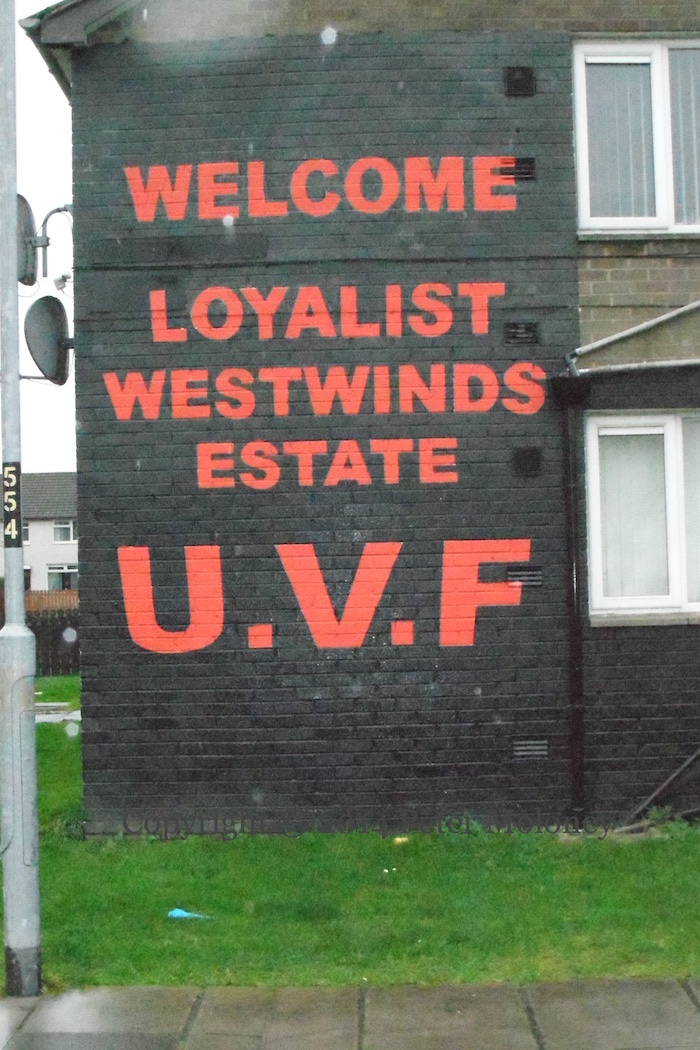
Loyalist Westwinds

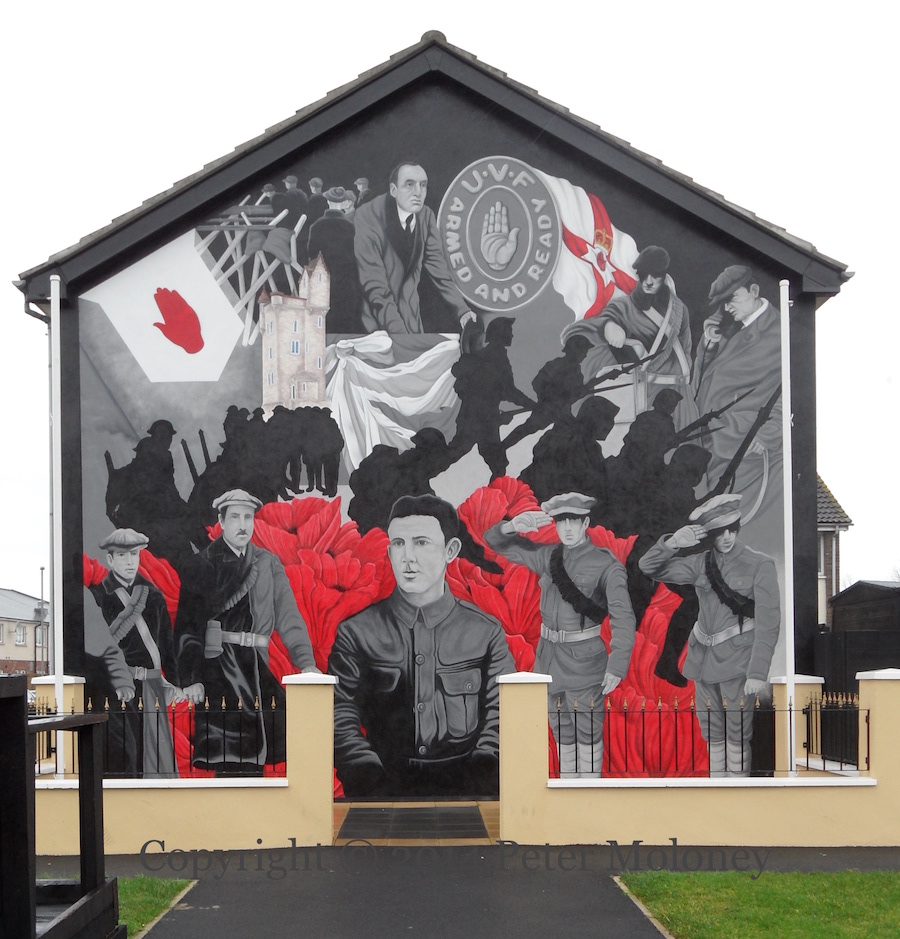
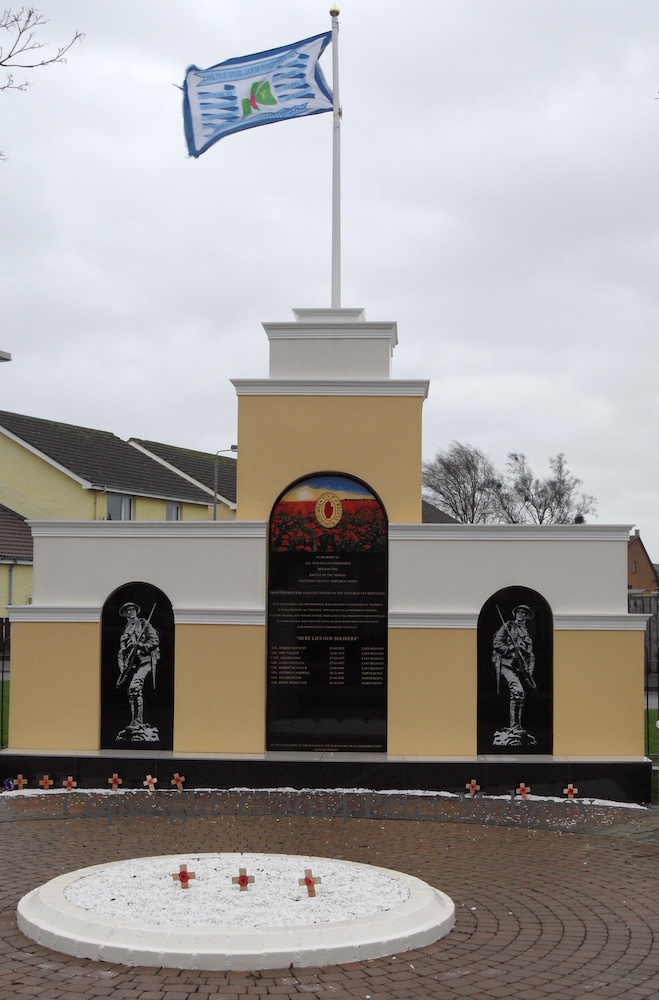
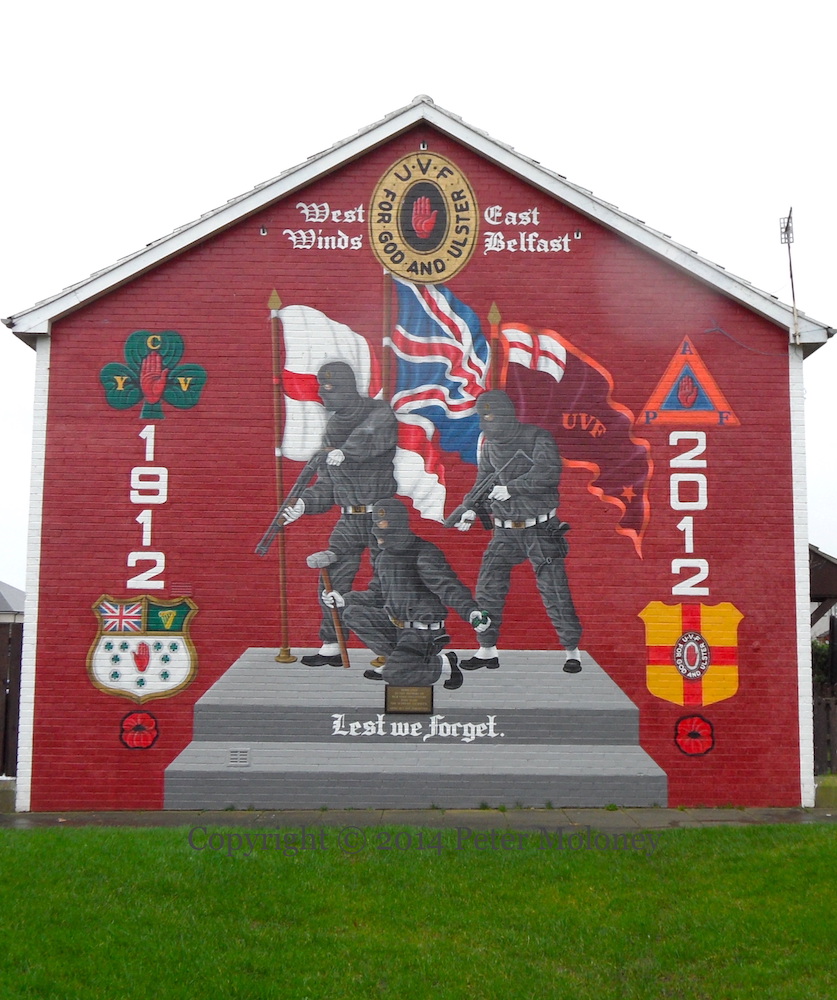
Here is a gallery of images from Westwinds estate in Newtownards, featuring (East Belfast) UVF murals and memorial gardens.

The newest one shows Carson signing the 1912 Covenant beneath a UVF emblem reading “Armed and ready”.

The one with some damage reads, “Our only crime was to serve you, the community and protect ‘our country’. Now times have changed. As a force, our belief is not only ‘for God and Ulster’ but to you, the community, ‘help us to help you’.”

The central stone in the memorial garden is dedicated to “all our fallen comrades both in the Battle Of The Somme and fight against republicanism”.

Click image to enlarge
Copyright © 2014 Peter Moloney
M10715 M10736
M10716 [M10717] [M10718] [M10719]
M10720 [M10721] [M10722] [M10723] [M10724] [M10725]
M10726 [M10727] [M10728]
M10729 [M10730] [M10731] [M10732] [M10733] [M10734] [M10735]