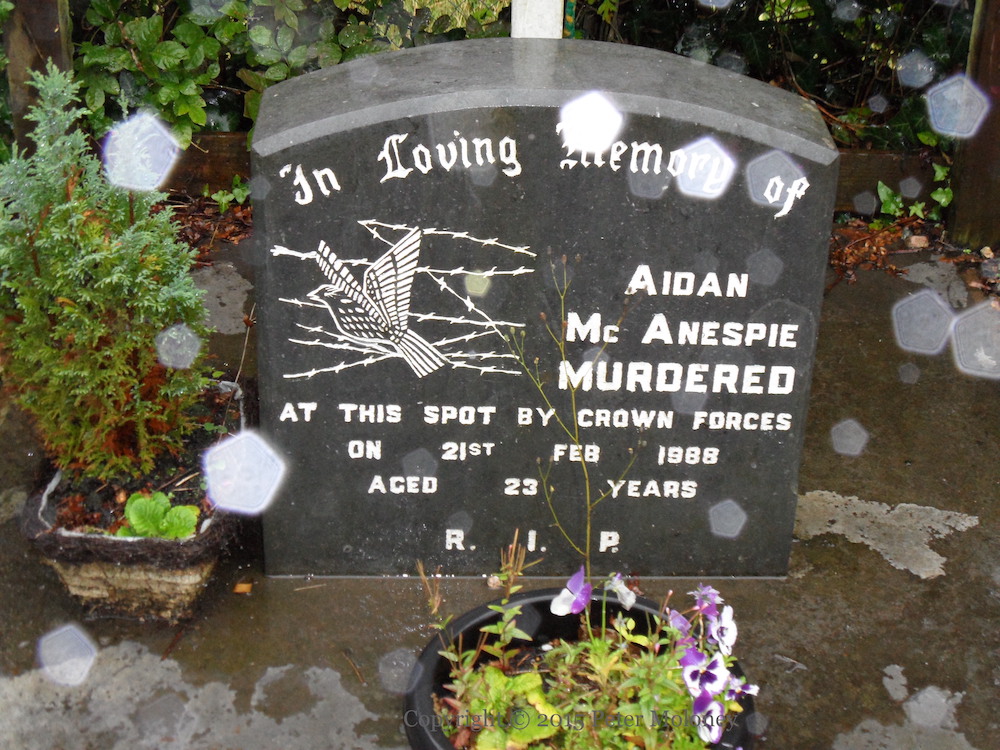
“In loving memory of Aidan McAnespie, murdered at this spot by crown forces, on 21st February 1988, aged 23 years. RIP”
In November 2022, Grenadier Guardsman David Holden was found guilty of McAnespie’s manslaughter (BBC), having been previously charged with manslaughter at the time of the incident, but not convicted (Lost Lives 2907).
Monaghan Road, Aughnacloy, Co Tyrone, near the grounds of Aghaloo O’Neill’s GAC.
The QR code in the second image takes one to an interactive walking tour (“Walk Of Truth”) of sites associated with the Ballymurphy Massacre; the walk was launched on August 8th, one of a number of Féile 2015 events (web) which included a photographic exhibition in St Mary’s and the march announced in the first image, from Springfield Park to O’Donnell’s GAA club.
“On March 10th 1971 at this place three young Scottish Soldiers of the Royal Highland Fusiliers were murdered by republican terrorists. Fusilier John McCaig aged 17, Fusilier Joseph McCaig aged 18, Fusilier Dougald McCaughey aged 22. Always in our hearts. Never forgotten.” The trio were were lured by the IRA from a city-centre pub to their deaths in Ligoniel in 1971 (WP). The stone is frequently vandalised (BelTel | BBC | STV | BBC).
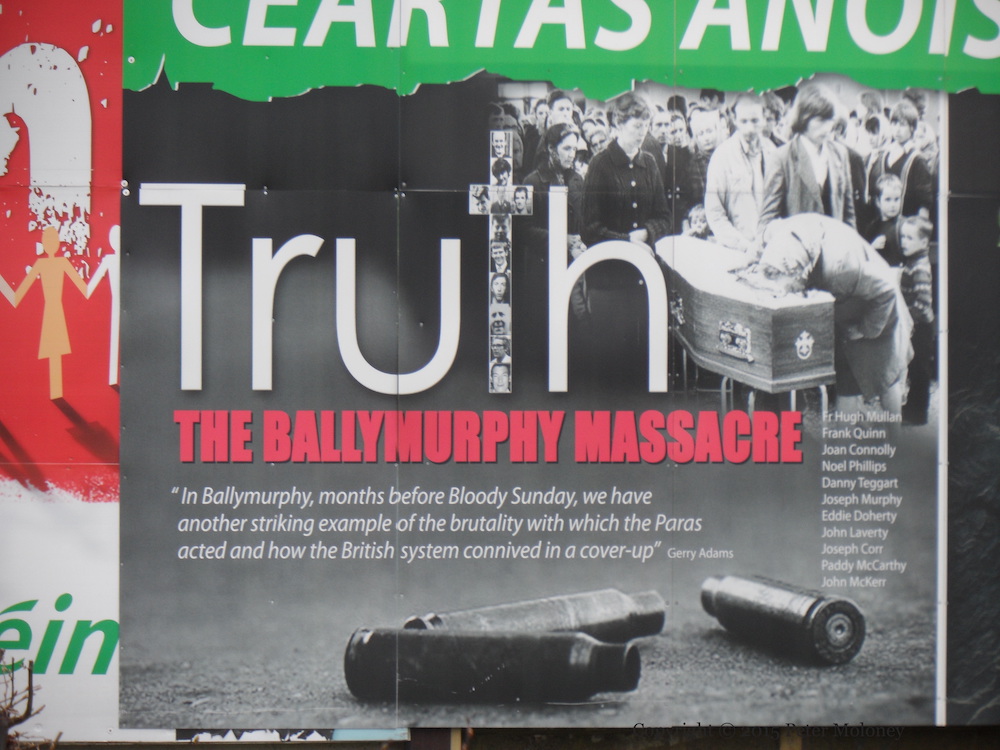
Three different campaigns for inquiries into deaths at the hands of British paratroopers are brought together into a single board on the site of the former Andersonstown RUC station (Visual History): the Ballymurphy Massacre of August, 1971, in which 11 were killed; the Springhill Massacre of July 1972, in which 5 were killed, and the killing of IRA volunteer Pearse Jordan, who, like the others, lived in the greater Ballymurphy area.
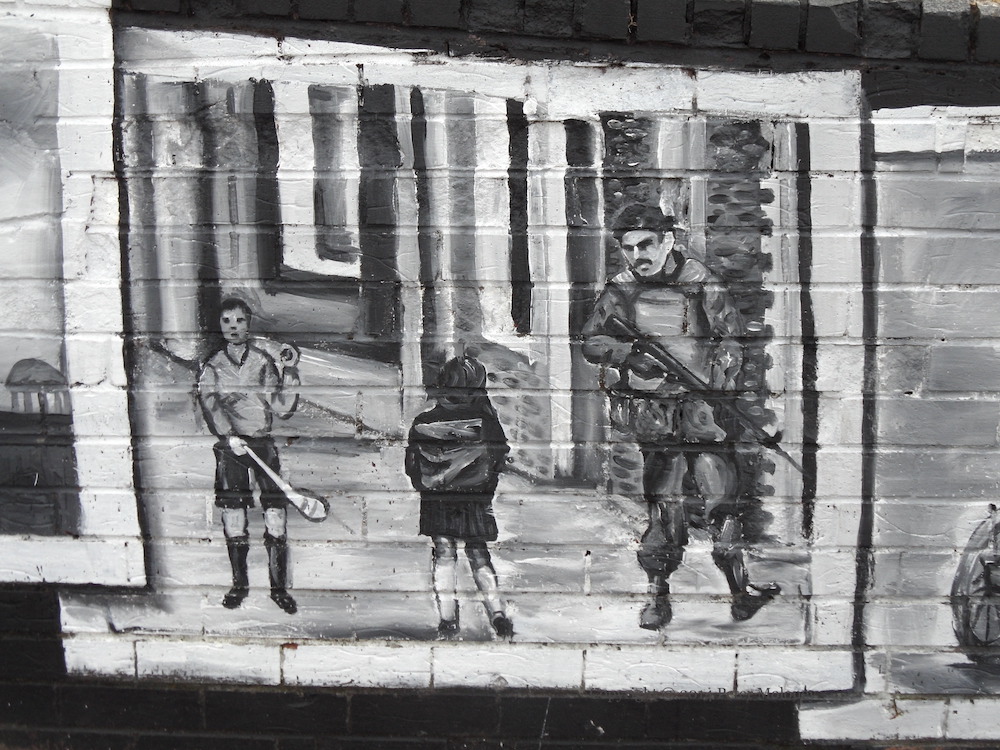
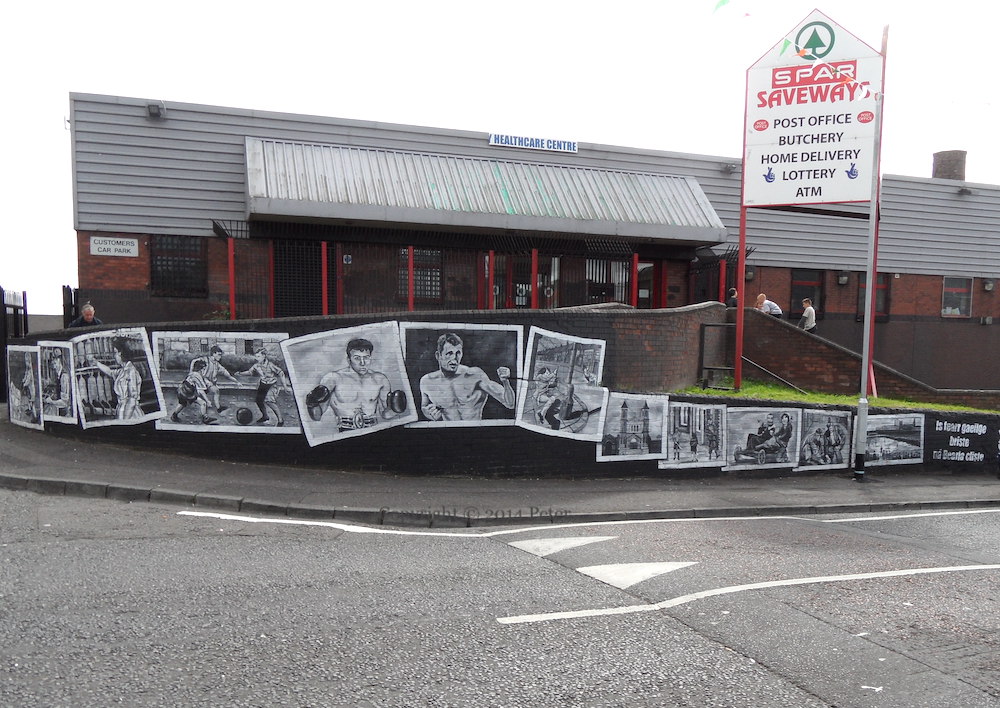
A British soldier patrols the streets while a girl walks home from school and a boy plays hurley. This is one of the panels in the long mural at the shops on Ardoyne Avenue.
The “Welcome” verbiage is just out of shot on the left-hand side; on the right is “Is fearr Gaeılge brıste ná Béarla clıste” [Broken Irish is better than clever English] and (out of shot) some Celtic knotwork. For close-ups of all of the panels, see Growing Up Too Fast.
“Belfast’s Bloody Sunday. On the 9th July 1972 the British Army murdered 5 Irish citizens and severely wounded 2 others. It’s time for the truth.”
This is a mural by Mo Chara Kelly (with DD Walker, Michael Kelly, and Ta Heath) commemorating the deaths of five people shot by British Army snipers in 1972: Paddy Butler (39), David McCafferty (15), Margaret Gargan (13), John Dougal (16), Fr Noel Fitzpatrick (40). The snipers fired from JP Corry’s timber yard (shown on the right) and at the time the Westrock bungalows were still standing (shown lower left).
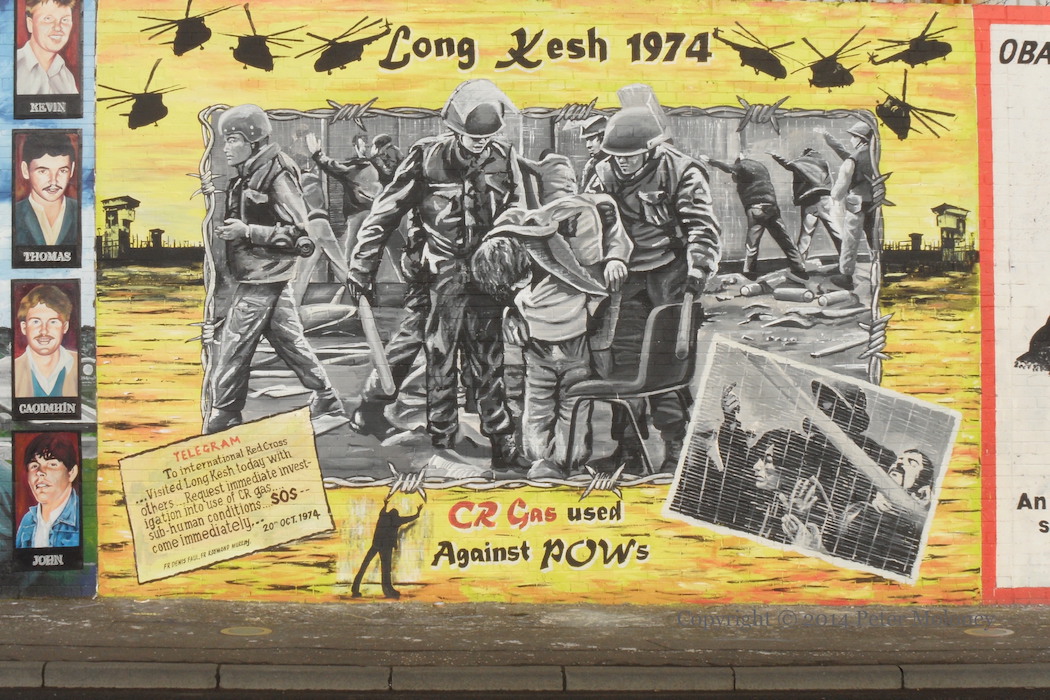
A new mural, above, on the International Wall commemorates the fortieth anniversary this year of the ‘Burning Of Long Kesh’ or the ‘Battle Of Long Kesh’, which took place on the night of October 15, 1974 and day of the 16th (when British Army units retook the camp).
The most comprehensive account available on-line of the conditions at the camp prior to the riot, the burning, and the battle on the morning of the 16th appears to be this 2004 piece in An Phoblacht by Joe Doherty and Christy Keenan. (For a virtual tour of the camp, see this video. Seamus Keenan’s Over The Wire (on again this month at the Derry Playhouse) attempts to recreate the scene.) Other accounts include those by Ronan Bennett, another inmate, in The Guardian. Here is a brief BBC News report from the 16th.
All accounts mention the use of gas and republican accounts state that CR was used on the morning of the 16th in addition to CS, dropped from helicopters as at the top of the mural. The Guardian, in 2005, confirmed that CR had been authorized for use in controlling riots and was available at the prison. CR is a carcinogen (WP) and in a post on his blog (now removed) Mairtin Óg Meehan suspects that exposure to CR is a cause of recent cancers among former prisoners.
In the lower left corner is a quoted telegram from Fr. Denis Faul, Fr. Raymond Murray: “To international Red Cross … Visited Long Kesh today with others … Request immediate investigation into use of CR gas … sub-human conditions … SOS … come immediately …” 20 Oct. 1974. These two wrote an 80-page report on the conditions at the camp following the event, entitled The Flames Of Long Kesh. See this 1999 An Phoblacht page for an image of the shelters constructed after the battle.
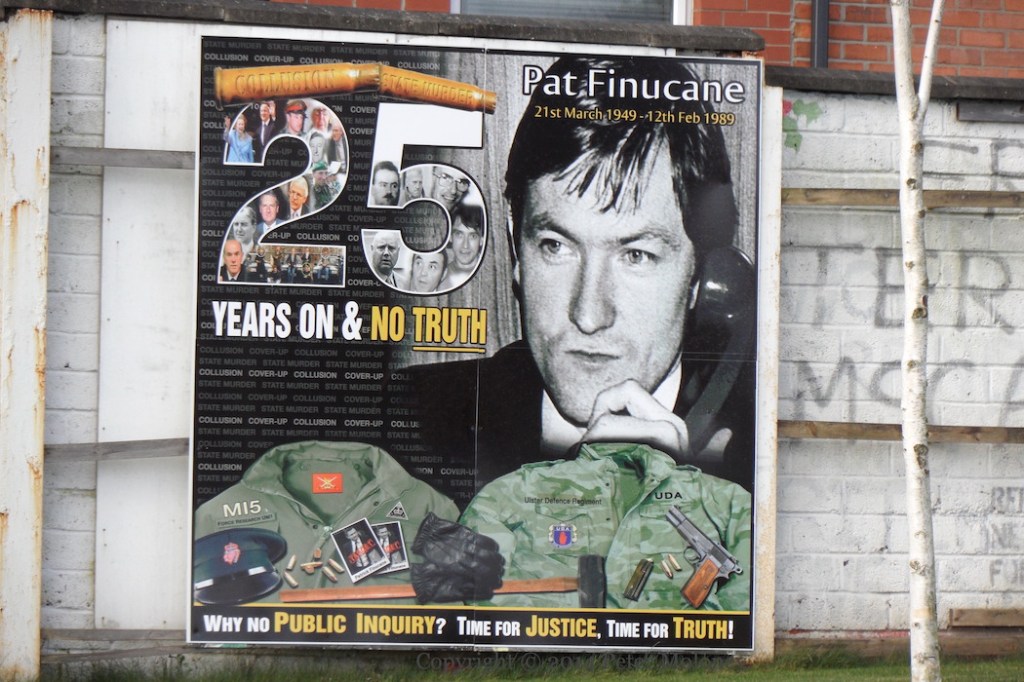
This board at the junction of the Falls and Glen roads (on the site of the former Andersonstown RUC station) commemorates the death of Pat Finucane (on February 12th, 1989), alleging collusion between the MI5, the UDA, the UDR, and the RUC, and asking for an inquiry.
“25 years on & no truth. Why no public inquiry? Time for justice, time for truth!”







 Peter Moloney Collection