Hunger Strikers Memorial

The hunger strikers memorial in Rossville Street, Derry, was launched in 2000. The central “H” carries the names of the ten deceased 1981 strikers, while the stones to either side carry the names of other republicans to have died on hunger strike: Thomas Ashe 1917, Michael Fitzgerald 1920, Joseph Murphy 1920, Terence McSwiney 1920, Joseph Whitty 1923, Denis Barry 1923, Andrew Sullivan 1923, Tony D’Aroy 1940, Jack McNeela 1940, Sean McCaughey 1946, Michael Gaughan 1974, Frank Stagg 1976.

Click image to enlarge
Copyright © 2001 Peter Moloney
M01549 M01553 M01554

Seán Keenan

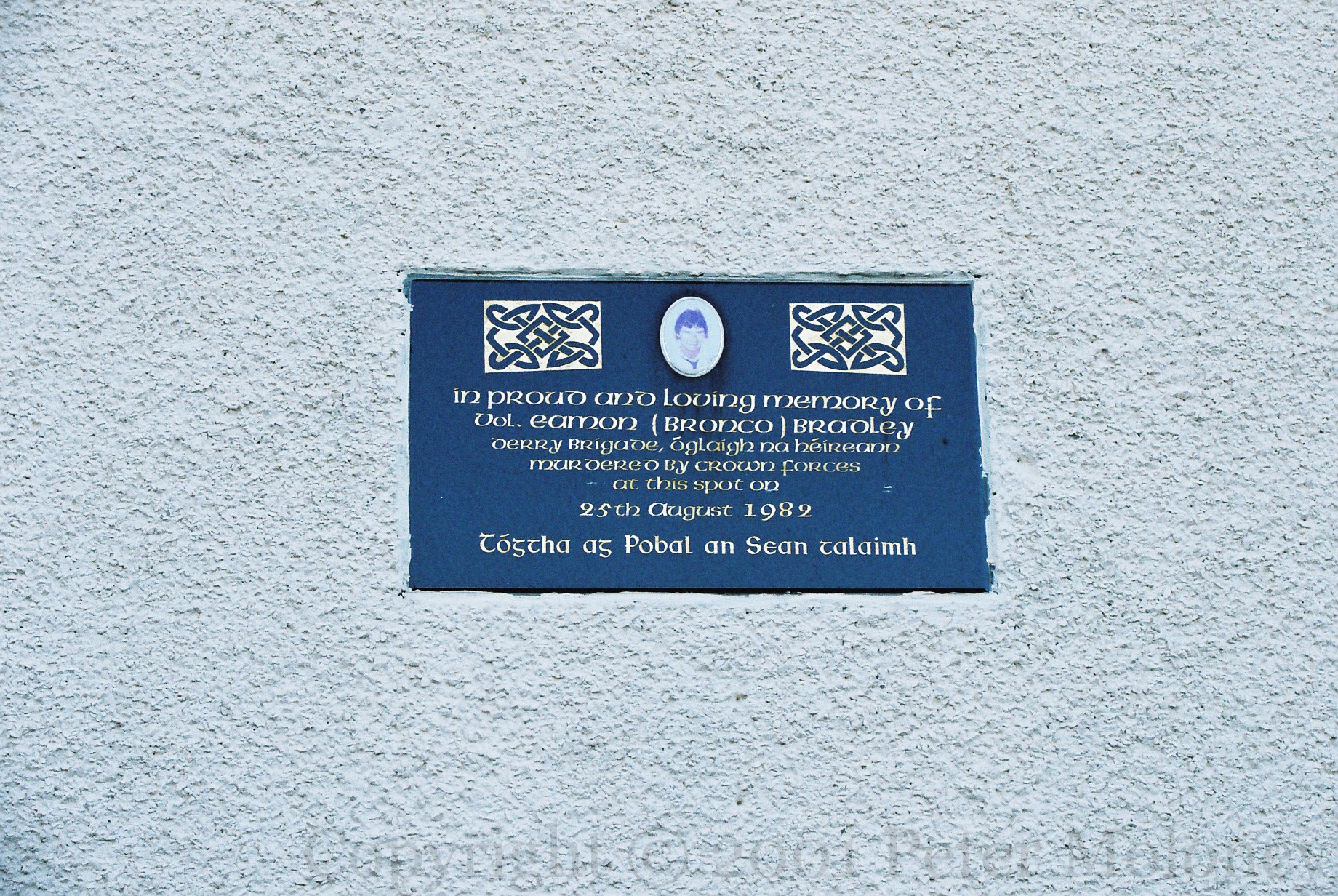
IRA volunteer Seán Keenan/Ó Cıanáın was interned on three different occasions and spent 15 years in prison without ever being convicted. In August 1969 (the Battle Of The Bogside) he was chairman of the Derry Citizens Defence Association. This bilingual memorial stone (though with more in English than Irish) is in Fahan Street, Derry

Click image to enlarge
Copyright © 2001 Peter Moloney
M01545 M01547

They Shall Not Pass

“In memory of their victims … they shall not pass.” An elaborate celtic cross in memory (i ndil cuimhne) of Troubles victims from Catholic south Belfast and a promise to block Orange Order parades in the lower Ormeau.

Farnham Street, south Belfast

Click image to enlarge
Copyright © 2001 Peter Moloney
M01536 M01535

Vote Sınn Féın

Both local elections and Westminster elections were held on June 7th 2001. The first three names are of local council areas and the vote is by preference (hence the “1”), ‘South Belfast’ is a Westminster seat. Sınn Féın took one seat in each of Balmoral and Laganbank.

Dromara Street, south Belfast

Click image to enlarge
Copyright © 2001 Peter Moloney
M01534

Theodore Roosevelt

“‘My forefathers were … the men who had followed Cromwell and who shared in the defence of Derry, and in the victories of Aughrim and the Boyne.’ – President Theodore Roosevelt, 20th US president, 1901-1904.” The “shutting of the gates” of Derry is represented in the bottom left.

The quote is derived from Volume 1, Chapter 5 of Roosevelt’s The Winning Of The West (available at Project Gutenberg), though he is describing the forefathers of the Scotch-Irish, rather than his own forefathers (who, as the name suggests, were Dutch).

He writes, “The Presbyterian Irish were themselves already a mixed people. Though mainly descended from Scotch ancestors—who came originally from both lowlands and highlands, from among both the Scotch Saxons and the Scotch Celts—many of them were of English, a few of French Huguenot, and quite a number of true old Milesian Irish extraction. They were the Protestants of the Protestants; they detested and despised the Catholics, whom their ancestors had conquered, and regarded the Episcopalians by whom they themselves had been oppressed, with a more sullen, but scarcely less intense, hatred. They were a truculent and obstinate people, and gloried in the warlike renown of their forefathers, the men who had followed Cromwell, and who had shared in the defence of Derry and in the victories of the Boyne and Aughrim.”

Some sources claim that an ancestor(s) on his mother’s side emigrated from Gleno, Co Antrim in 1729, but this seems to be her great-great-grandfather James, who was Scots (WP) but appears to have emigrated directly from Scotland, specifically Baldernock, in 1728 or 1729 (WikiTree | Friends Of Bulloch). The search for a connection continues, according to Irish Central.

This mural is one (and perhaps the first to be painted) in the series “From pioneers to presidents”. For more such murals, see the Visual History page about Ulster-Scots murals.

Replaces the King Billy mural in Wapping Lane, the Fountain, Londonderry.

Click image to enlarge
Copyright © 2001 Peter Moloney
M01532