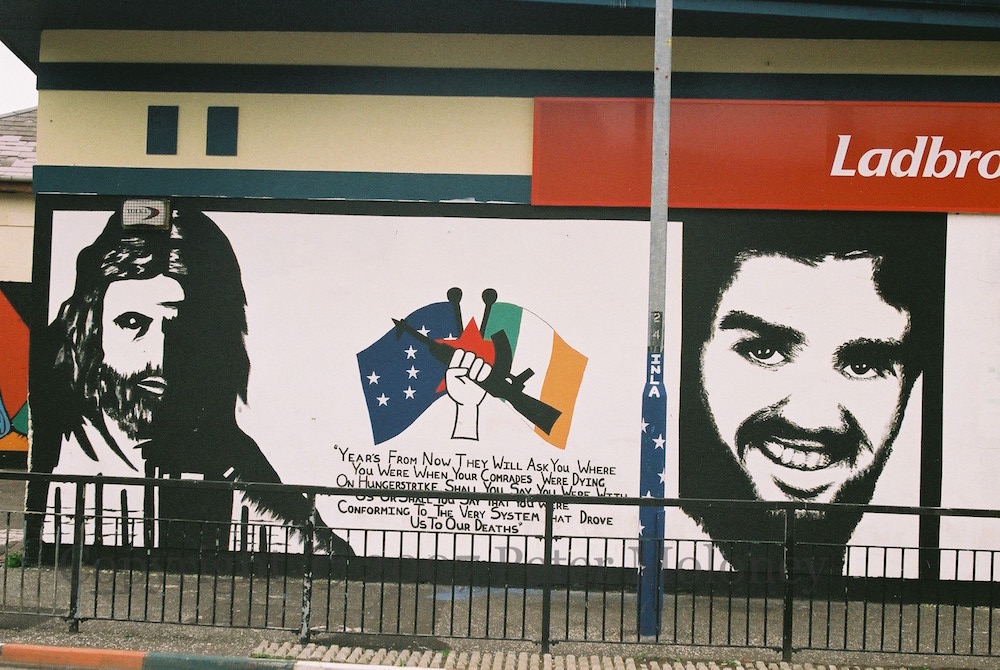
About 250 Communist brigadiers from Ireland went to Spain to fight for the Republicans against Franco’s Nationalists in the Spanish Civil War. “Por vuestra Libertad y la nuestra.”
The information board for this reproduction of Guernica is in Basque, Irish, and (lastly) English: “This mural of Picasso masterpiece Guernica was created by Danny Devenny and Mark Ervine, muralists from the two main communities in Belfast, in August 2007. Picasso painted Guernica over a period of three weeks in 1937 during the Spanish Civil War to protest the Nazi bombing of the Basque capital of Gernika (at the request of Franco’s forces) on April 26 that year which resulted in hundreds of deaths. Gernika was viewed as (and remains today) the town symbolising the Basque desire for freedom. Viewed as one of the 20th century’s greatest anti-war works of art. This work was sponsored by gasta.com and the newspaper publishers in Ireland and the Basque Country Belfast Media Group and Berria. 12 Lúnasa 2007.”
A UDA gunman welcomes you to the Kilcooley estate in Bangor. Ordinarily, the insignia of the Ulster Freedom Fighters would appear alongside those of the UDA and UYM, but in this mural, it is replaced by a map of the “home nations”; the Republic Of Ireland is presented in outline rather than by its flag.
Young Newton is the Newtownards Road division of the Ulster Young Militants (UYM) and formerly a Tartan Gang. This mural, however, is in Kilcooley estate, Bangor, indicating the close connection between the UDA in the estate and in east Belfast. (For a 2018 update, see Ulster Defence Unions.)
See previously: Young Newton Says No (1989) and Young Newton on the Newtownards Road (2005).
There was previously a wall to the right that read “Freedom Corner II” – see J0475.
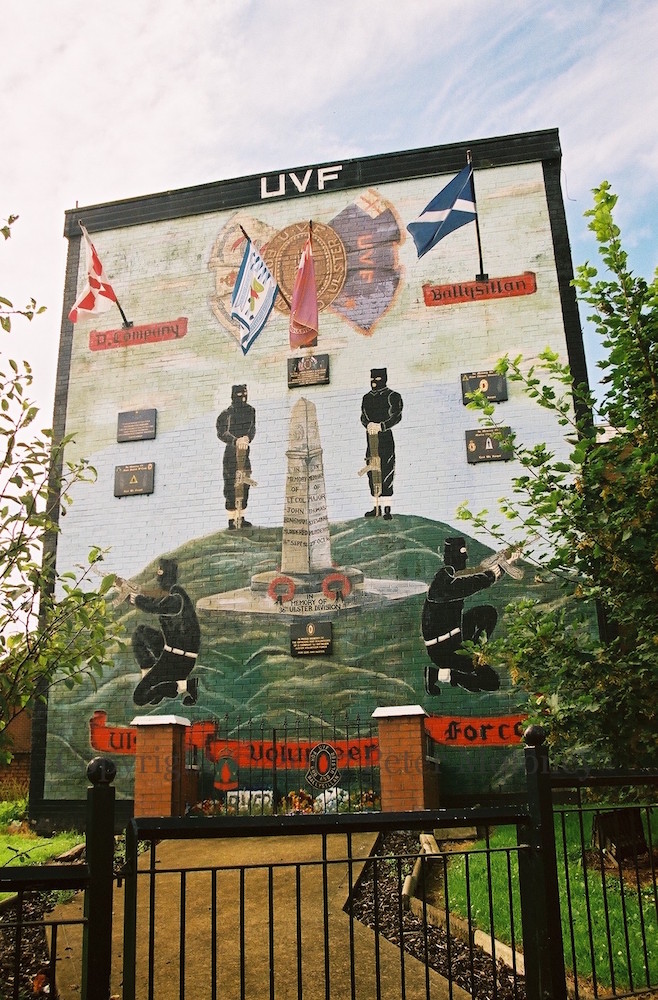
Three volunteers from [North Down] 2nd battalion, D company pose with assault rifles and pistol in this UFF mural in Inishargie Gardens in Bangor’s Kilcooley estate.
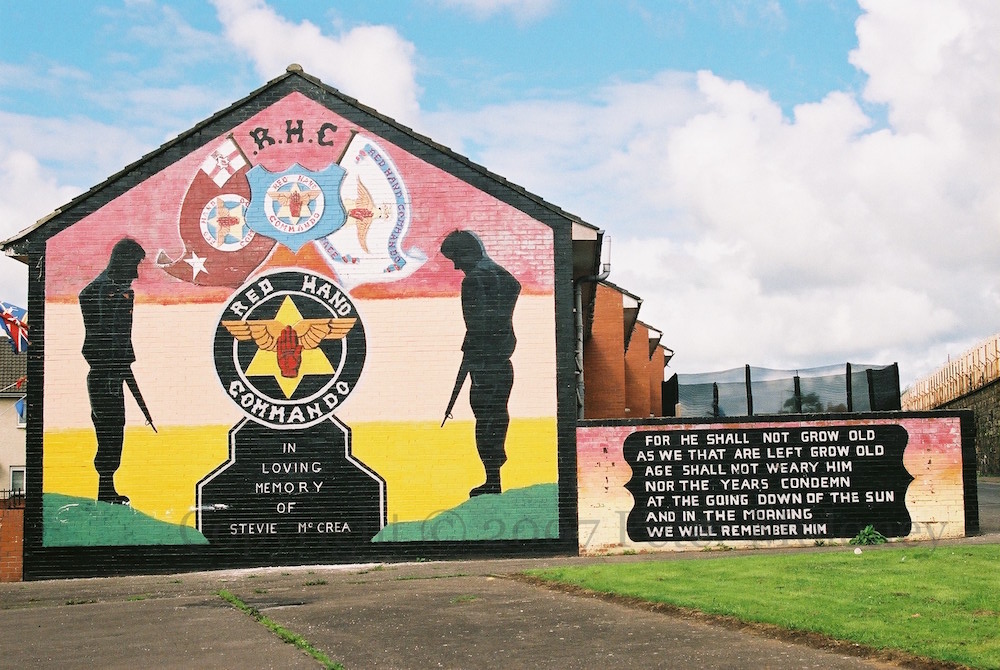
“It is not for glory or riches that we fight but for our people” (based on the Declaration Of Arbroath; see e.g. UDA 3rd Battalion) and “At the going down of the sun and in the morning we will remember them.” are familiar but “As poppy petals gently fall/Remember them who gave their all” here makes a very infrequent appearance. It comes from The UDR Soldier, by John Potter. The mural and stone thus link together the 36th (Ulster) Division of WWI, the UDR (1970-1992), and ‘D’ Company of the North Down Red Hand Commando.
Barbed wire divides the quadrants, with poppies providing an upper border and Ulster Banner and Union Flag below. In the top left is the A company mural from across the street. The bottom right reproduced (or at least is based on) an 1990s mural of the same name in Dover Place (lower Shankill) in Belfast. The other quadrants and centre contain images relating to the 36th (Ulster) Division and WWI. The two other images are from the low wall to the front right.
Soldiers from the 36th (Ulster) Division of the British Army participated in the Battle Of Albert on July 1st, 1916, the first battle in the Battle Of The Somme, which would continue until November 18th. In those four and half months more than one million soldiers were killed or wounded, including, on July 1st alone, about 60,000 British troops. The 36th (Ulster) Division, on the left flank, pushed ahead of other units and found itself unsupported; 5,240 of its soldiers died.