
“Honour Ireland’s dead – wear an Easter lily”. The Easter lily is to be pinned on – Provisional-style rather than the Official IRA’s stick-on lily.
Click image to enlarge
Copyright © 2009 Peter Moloney
M04948
“Honour Ireland’s dead – wear an Easter lily”. The Easter lily is to be pinned on – Provisional-style rather than the Official IRA’s stick-on lily.
Click image to enlarge
Copyright © 2009 Peter Moloney
M04948

Still going strong in 2009, the Ulster First Flute mural in Linfield Gardens, first seen in 1997.
Click image to enlarge
Copyright © 2009 Peter Moloney
M04938
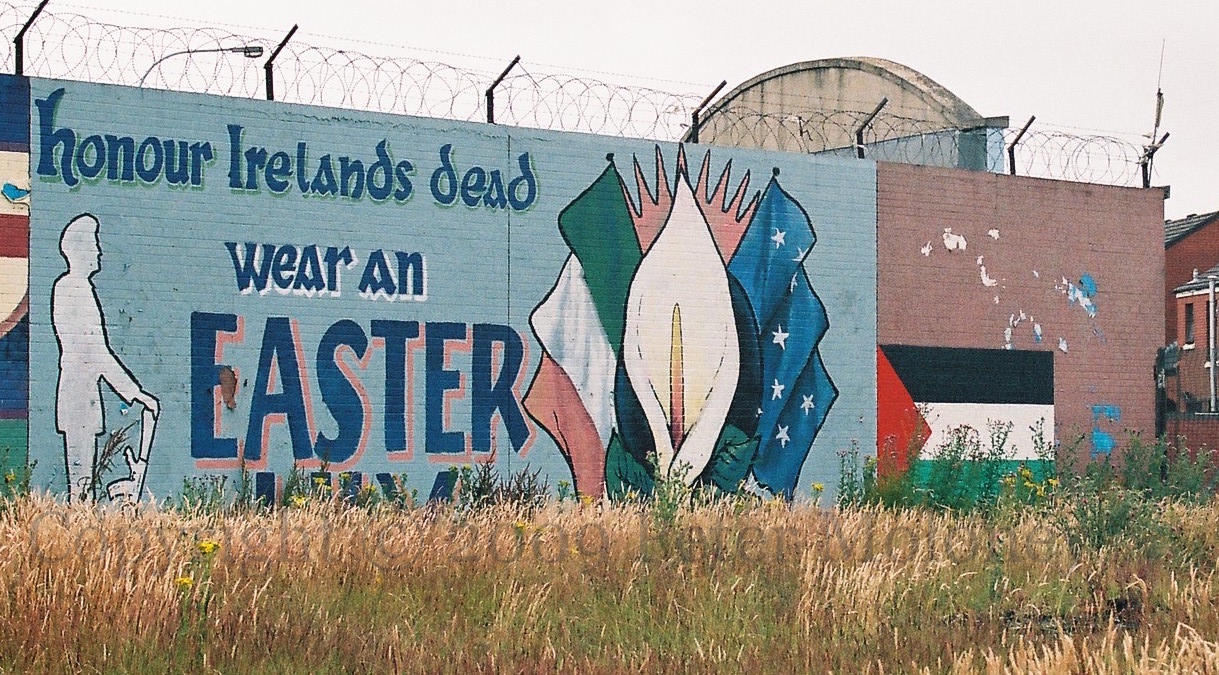
A Palestinian flag is added to the end of the Mountpottinger wall, next to Honour Ireland’s Dead.
Click image to enlarge
Copyright © 2009 Peter Moloney
M04918
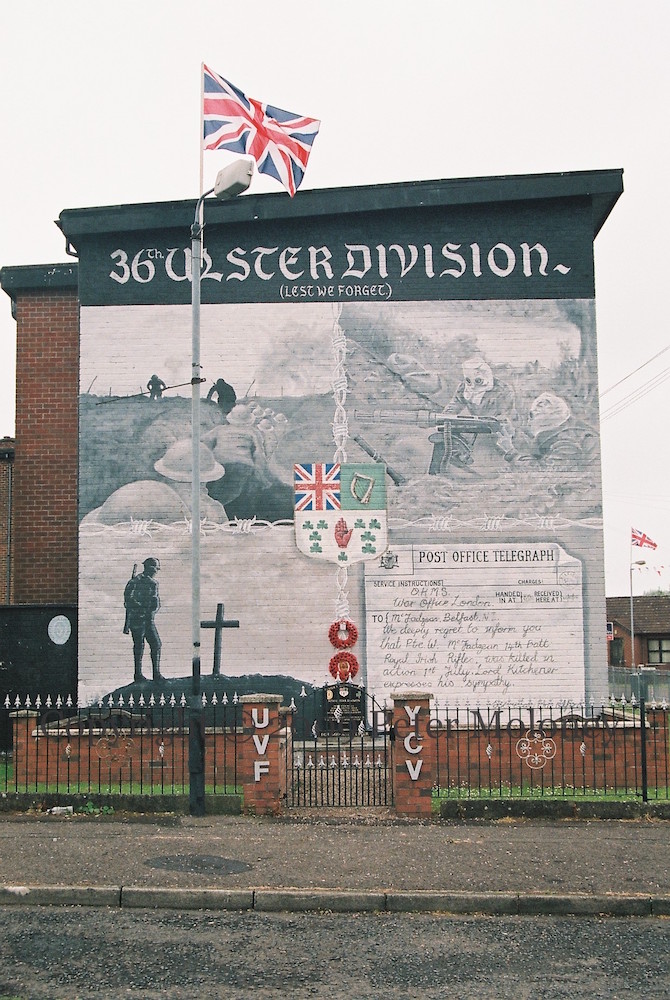
The plaques read “36th Ulster Division – dedicated to all our fallen comrades who made the ultimate sacrifice for their country. Greater love hath no man than to lay down his life for his friends. For God and Ulster.” and “From the officers and volunteers of East Belfast to commemorate the 90th anniversary of the Great War.” The quadrants of the mural show (clockwise) soldiers in the trenches, soldiers manning a machine-gun, the death telegraph for William MacFadzean, and a soldier reflecting on a grave. UVF YCV “Lest we forget”
Click image to enlarge
Copyright © 2009 Peter Moloney
M04913 [M04907] [M04908] [M04909] [M04910] [M04911] [M04912]
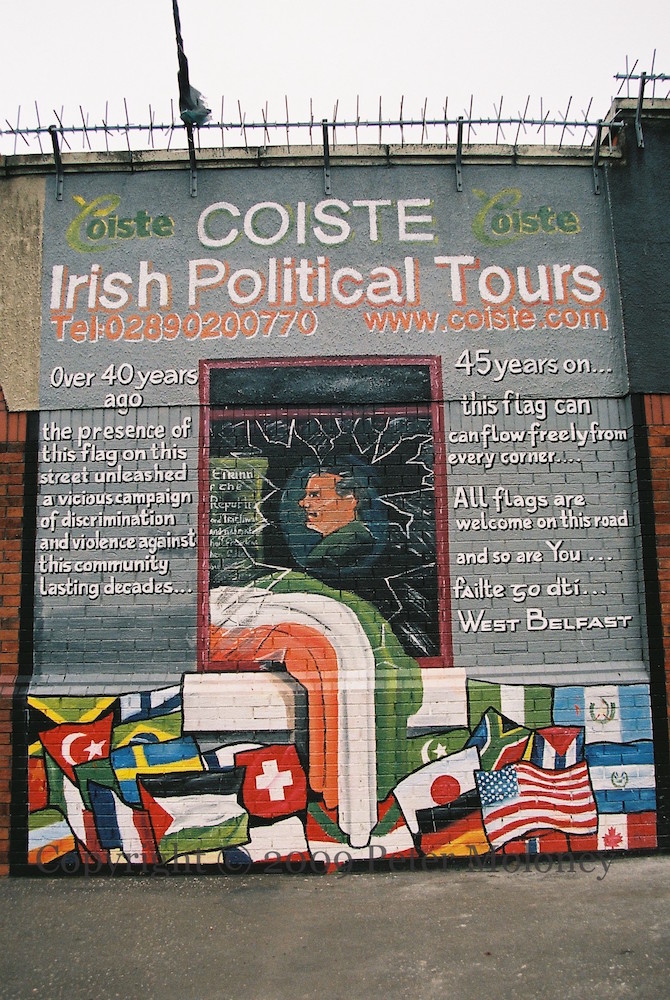
“Over 40 years ago, the presence of this flag on this street unleashed a vicious campaign of discrimination and violence against this community lasting decades … 45 years on this flag can flow freely from every corner… all flags are welcome on this road and so are you … fáılte go dtí west Belfast .” The incident referred to is the “Tricolour Riots” of the 1964 Westminster election campaign, in which the IRA’s Billy McMillen (shown in the middle) stood for office. Armed police raided his Divis Street headquarters and removed a Tricolour in the window. An Phoblacht has an account of the election and events. Here is news video from 1964 of charges subsequently brought against 70 people. The US Stars & Stripes is included prominently in the array of flags, but the Union Flag is absent. Coıste’s website is now coiste.ie rather than .com.
Click image to enlarge
Copyright © 2009 Peter Moloney
M04900 [M4897] [M04898] [M04899]

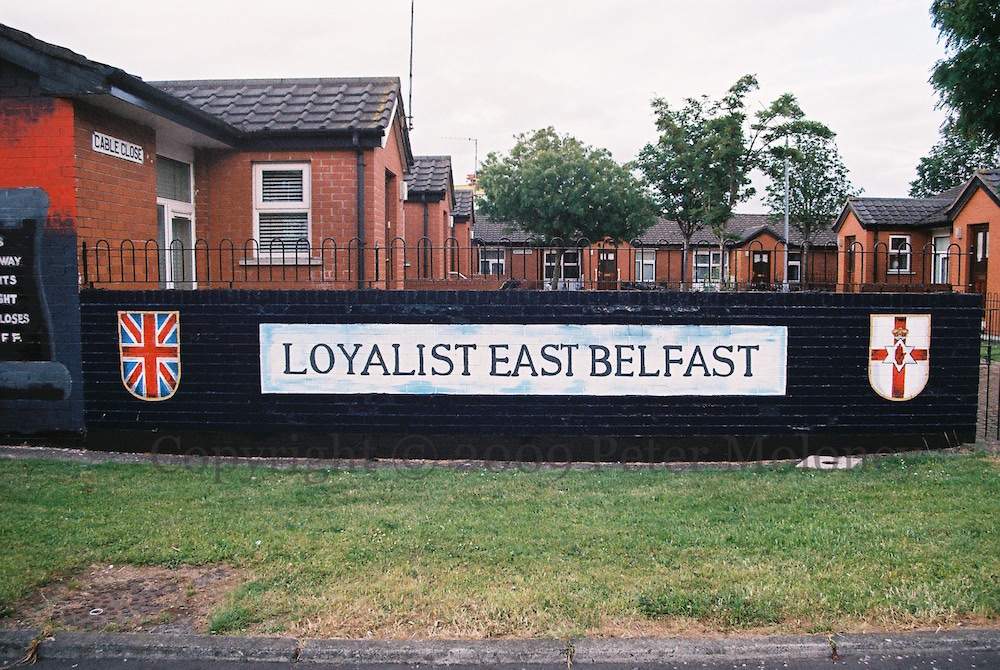
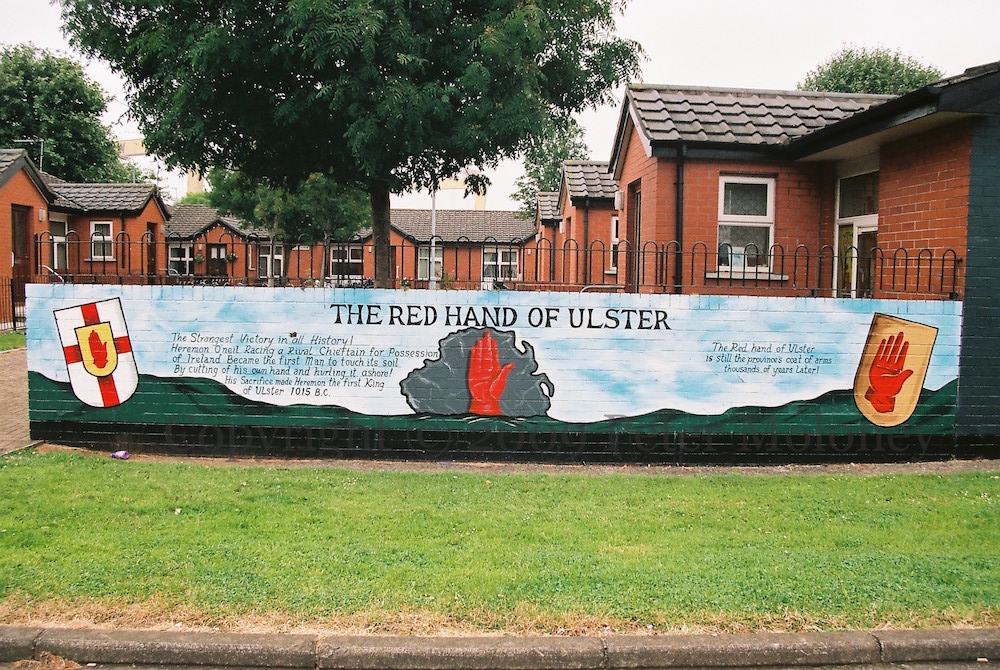
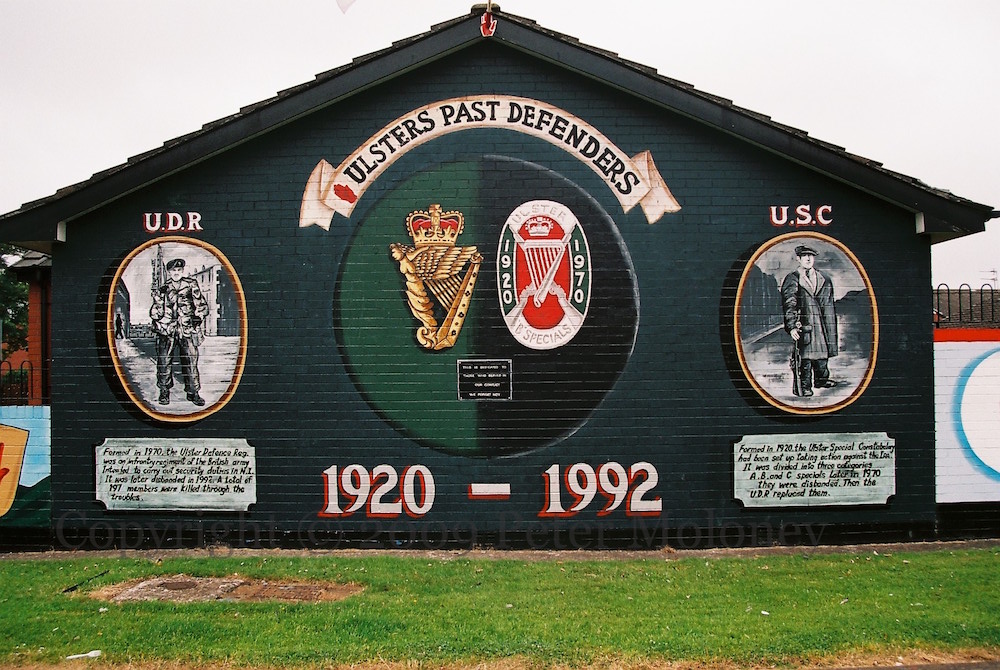
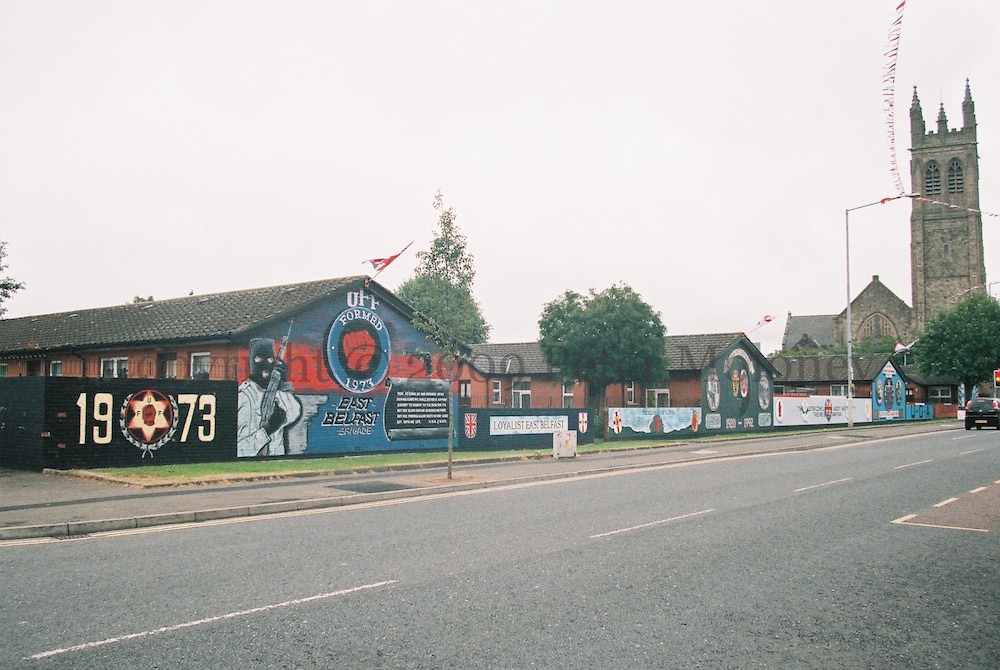
Here is a set of 2009 images of the left half of “Freedom Corner” on Newtownards Road.
Compared to the 2005 images:
the background of the UFF mural has been repainted;
“Loyalist East Belfast” replaces the letters “UFF”;
the Red Hand Of Ulster replaces “Feriens Tego” (From Ripley’s Believe It Or Not, 1953: “The strangest victory in all history: Heremon [Érımón] O’Neill racing a rival chieftain for possession of Ireland became the first man to touch its soil by cutting off his own hand and hurling it ashore! His sacrifice made Heremon the first king of Ulster, 1015 B.C. The red hand of Ulster is still the provinces coat of arms thousands of years later.” Most people believe it not.) Notice that outline is of the six-county Northern Ireland rather than of the historical Ulster;
and the “Ulsters Past Defenders” mural has been completely repainted with the emblems of the UDR and B-Specials at the centre (“This is dedicated to those who served in our conflict – we forget not”, “Formed in 1970, the Ulster Defence Reg. was an infrantry [sic] regiment of the British army intended to carry out security duties in NI. It was later disbanded in 1992. A total of 197 members were killed through the troubles”, “Formed in 1920, the Ulster Special Constabulary had been set up taking action against the IRA. It was divided into three categories A, B, and C specials. Later in 1970 they were disbanded. Then the UDR replaced them.”)
Click image to enlarge
Copyright © 2009 Peter Moloney
[M04877] [M04878] [M04879] [M04880] M04881
M04882
M04883
[M04884] [M04885] [M04886] [M04887] [M04888] [M04889] [M04890] [M04891] M04892
M04867 wide shot

The Victoria Cross shows a lion on top of the crown of St Edward. The medal has been awarded since 1856 for combat valour by British Army soldiers. The four faces are perhaps those of Cather, McFadzean, Quigg, and Bell (see the mural in Cappagh Gardens). Painted by Dee Craig in Pitt Park, east Belfast, as part of the Re-Imaging Communities programme (Irish Times), perhaps replacing J2585.
Click image to enlarge
Copyright © 2009 Peter Moloney
M04864 [M04859] [M04860] [M04862]

“The arming, the training, and the sacrifice of The People’s Army.” The arming (left) comes from the guns smuggled into Larne on the Clyde Valley. The training shown here (right) is probably Ballywalter. The sacrifice (bottom) is the 36th (Ulster) Division going over the top in James Beadle’s painting ‘Charge of the 36th (Ulster) Division, Somme, 1st July 1916’.
Inverary Drive, east Belfast
Click image to enlarge
Copyright © 2009 Peter Moloney
M04854 [M04855] [M04848] [M04849] [M04850] [M04851] [M04852] [M04853]

“”The Troubles” – During the “Troubles” there were several thousand people killed and many thousands injured. In order to justify the carnage and hurt caused republicans through their propaganda machine attempt to make out to the world that they were the victims, but the truth is somewhat different. The simple fact is that it was PIRA who murdered and maimed the vast majority of people[.] [N]umerous Sinn Fein-IRA members have blood on their hands[.] It is they who created many of the victims. Northern Ireland remains British. The democratic wish of the people is for peace. However[,] it is vital that as society moves forward to a new terror[-]free future that those who were murdered or injured are not forgotten. This mural recalls some of the misery inflicted[,] in order that the victims of republican terror are not forgotten. “Lest we forget.”” “We owe it to the future and the victims never to forget the past.” Individual panels recount the deaths at Hyde Park, Claudy, La Mon House, Ballymacarrett, Kingsmills [Kingsmill], and Birmingham. Derwent Street, Belfast. Sponsored by the East Belfast Historical And Cultural Society – see Visual History 10.
Click image to enlarge
Copyright © 2009 Peter Moloney
[M04832] [M04833] [M04834] [M04835] [M04836] [M04837] [M04838] [M04839] M04840
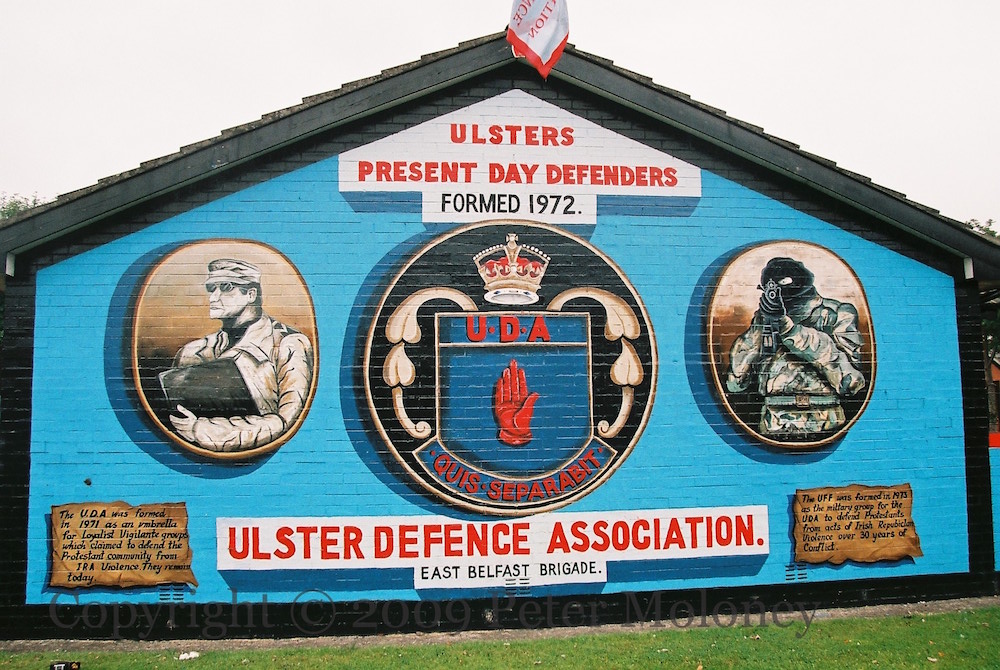
“The UDA was formed in 1971 as an umbrella for loyalist vigilante groups which claimed to defend the Protestant community from IRA violence. They remain today. The UFF was formed in 1973 as the mil[i]tary group for the UDA to defend Protestants from acts of Irish republican violence over 30 years of conflict.” It’s not clear what was “formed 1972”.
Previous versions of this mural put the UDA in parallel with an ancient “defender of Ulster from Irish attacks”, Cuchulainn.
Click image to enlarge
Copyright © 2009 Peter Moloney
M04825 [M04826] [M10892]
 Peter Moloney Collection