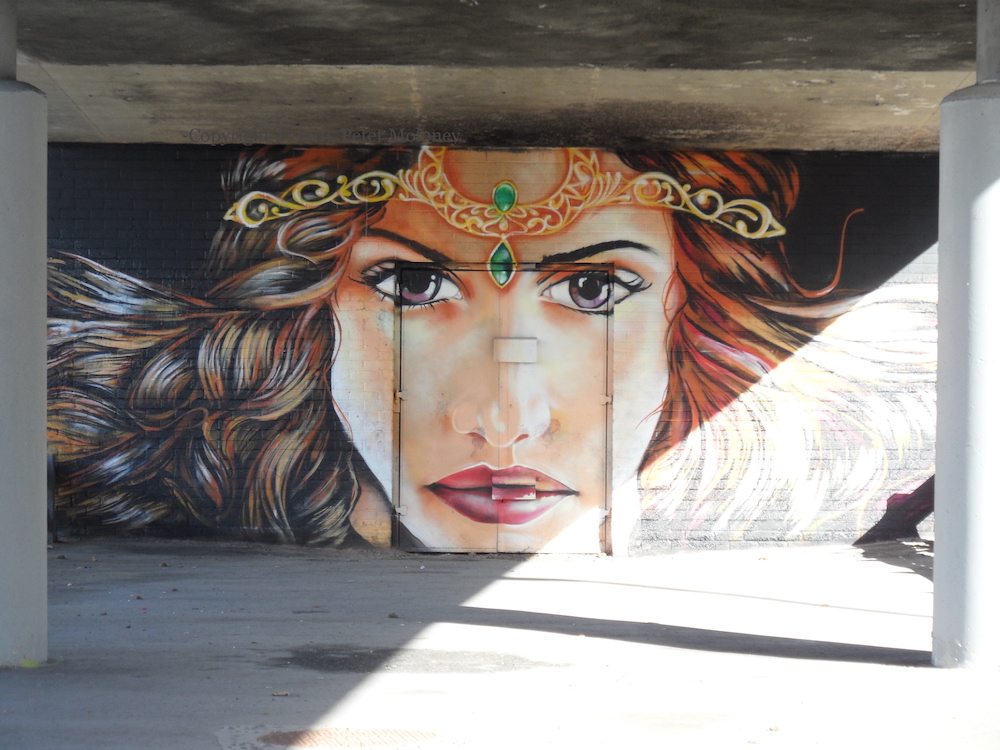
The Tullycarnet Flute Band mural on the electrical sub-station in Lochinver Drive, Tullycarnet, as been repainted/touched up (compare to 2013).
The plaques read: “In memory of Steven Dawson (Big Penny). Gone but not forgotten. A light shone in the night”, and “In memory of Joseph Baxter Corry (Joe). Gone but not forgotten. You’ll always be in our hearts. Farewell our absent friend.”
This is a new UDA mural in memory of John Gregg, “The Reaper”, who waged a campaign of terror against Catholics in south-east Antrim and was reputedly associated with British neo-Nazi groups. Gregg was gunned down in 2003, while returning from a Rangers match, as part of the power struggle with Johnny Adair.
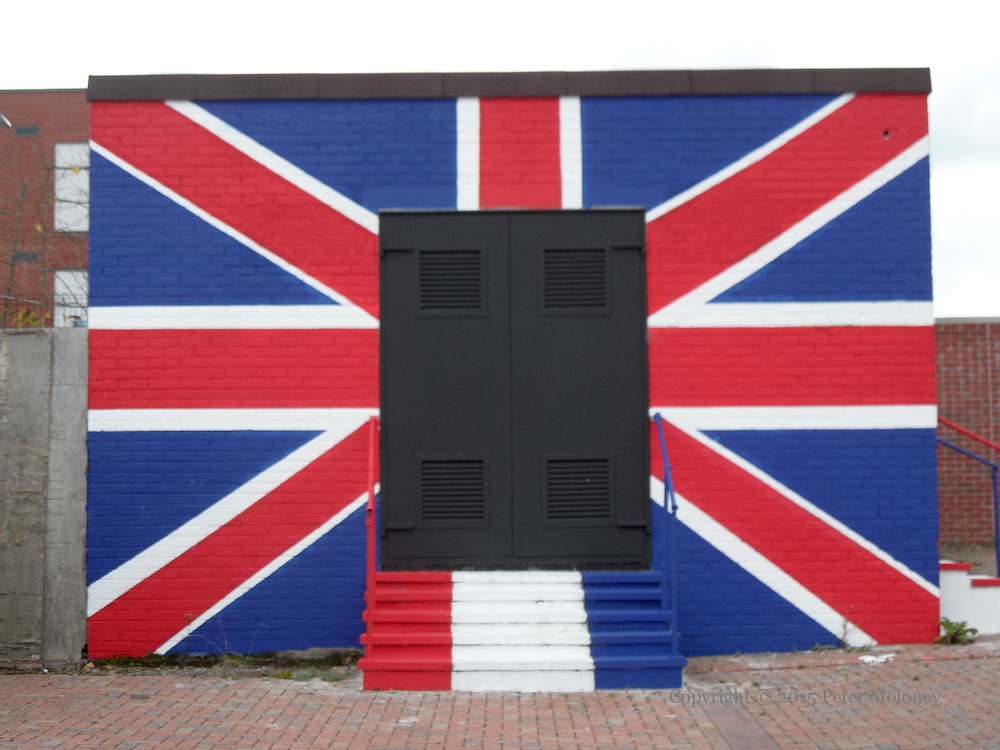
Nearby red-white-and-blue poles on Knockenagh Ave, Newtownabbey, are also shown.
The murals along east Belfast’s “Freedom Corner” (on the Newtownards Road) were repainted over the course of several months in 2015. These images are from a variety of dates in July and August; the ‘red hand’ piece is incomplete – for the finished work, see The Strangest Victory In All History.
The new pieces reproduce the previous ones in terms of theme: UFF/Young Newton at the ends, with the Past (Specials and UDR) and Present Defenders (UDA) in the middle – compare with the 2009 entries Freedom Corner | Ulster’s Present Day Defenders | Young Newton.
Genesis 35:11 reads (NIV) “And God said to him, “I am God Almighty; be fruitful and increase in number. A nation and a community of nations will come from you, and kings will be among your descendants.” The flags of Northern Ireland, Scotland, Wales, and England are joined in the mural above by those of Australia and (a simplified version of) the Falkland Islands (on the left) and New Zealand and Canada (on the right). The flag flying in the centre is the Royal Standard, flown on the building or vehicle where the monarch is.
The adjacent mural of army badges around a burial scene from the first world war features some lesser-seen items. On the left, alongside the Royal Irish Rifles (top left) and the (modern-day) Royal Irish Regiment (at the time of WWI the harp was plain and there was no garland), we see the emblem of the North Irish Horse, a cavalry unit in the Territorial Army. On the right, the emblem of the Royal Irish Rangers (which was folded into the Royal Irish Regiment in 1992) is joined by the star of the Irish Guards (above) and the emblem of the Ulster Special Constabulary or B-Specials (below). Only the Royal Irish Regiment and the Irish Guards remain as regiments of the British Army; “The Horse” now forms squadrons of other units. Of the six, four served in WWI; the B-Specials were formed in 1920 and the Rangers in 1968.
Above is King William III at the Battle of the Boyne in 1690.
This is a mural of King Niall (Nıall Caılle, Niall of the Callan) and Queen Macha. Niall was high king of Ireland (in competition with Fedelmıd of Munster WP) who held off the Vikings in the late 800s (WP) and died in 846 by drowning in the Callan river. Macha is a much earlier and mythological queen, and gives her name to the town: Ard Mhacha.
The central figures reproduce paintings by Jim Fitzpatrick (Visual History). The Niall figure comes from Nemed The Great but the Macha figure comes from a label Fitzpatrick produced in 1988 for Rosc “mead”, even though Macha (one of them, at least) was the wife of Nemed and there is a female figure in Nemed The Great.
Below the planets and stars, St Patrick’s (Catholic) Cathedral is on the left (WP) and St Patrick’s (CofI) Cathedral is on the right (WP).
In the border, clockwise from left to right, we see: the Tandragee Idol (WP), Naomh Bríd/St Brigid’s, St Patrick preaching the trinity, Irish dancing, Gaelic football, Armagh Harps, “Ard Mhacha”, the Armagh county crest in colour in the apex (Club & County), “Armagh”, Na Pıarsaıgh Óga, hurling/camogie, Cú Chulaınn’s, mummers (perhaps specifically the Armagh Rhymers), Jonathan Swift, a steam locomotive (perhaps representing the Armagh rail disaster of 1889, in which 80 people died WP); a vintage image of Callan Street is depicted along the bottom (History Armagh).
The side-wall features the word “welcome” in many languages, and Celtic knot-work surrounding an image of the Celtic Cross below St Patrick’s, perhaps inspired by this 1903 photograph (Flickr).
Painted by a crew of Belfast artists – Danny D and Mark Ervine, along with Lucas Quigley, Marty Lyons, Micky Doherty – organised by the Callan Street Residents’ Association, with funding from the European Union’s Peace III initiative.
This new mural pays tribute to two long-time residents of Clonard. On a good day, Noel Fitzpatrick, a cobbler with a little shop on the corner of Odessa and Clonard streets, would take his chair out into the street and play the uıleann pipes. Looking down from above is Alec Reid, the Redemptorist priest who spent 40 years at Clonard monastery and played an important role in the peace process. He died in 2013 at age 82. (WP)
Painted by Marty Lyons & Mickey Doc in Springfield Drive. For the large ‘flower’ mural to the left of this mural (which imitates the stained glass in the cathedral), see C01044.
This is a new mural from the 32 County Sovereignty Movement (web) on the international wall, Divis Street, (Visual History) with symbols of nationalism (the crests of the four provinces, the harp, the Tricolour), socialism (the plough in the stars) and support for republican POWs (the barbed wire).
Here is the new Patrick O’Connell, “Don Patricio”, mural at the bottom of the Whiterock. As a player, the Dublin-born O’Connell started with Belfast Celtic before moving on to various English and Scottish clubs, including a period at Manchester United at the time of WWI. He then went on to manage a string of Spanish clubs. As manager of Barcelona during the Spanish civil war, he accompanied the club on their tour of Mexico and the United States. The money from the tour saved the club from bankruptcy but 12 of the 16 players went into exile in Mexico and France. (WP) Barcelona returns to the US this month (2015-07) for games against the LA Galaxy, Manchester United, and Chelsea. (FCBarcelona)
The newspaper in the mural above crams all of this news onto one page: “Civil war erupts in Spain – Barcelona bombed”, “Football suspended – President [of FC Barcelona] Josep Sunyol assassinated” [by Franco’s troops] (WP); “Irishman O’Connell takes players on tour – FC Barcelona saved from extinction”; “Funds lodged in Switzerland”. In the bottom left-hand corner of the newspaper is Robert Capa’s famous photograph of ‘The Falling Soldier’, purporting to show a Republican soldier at the very moment he is struck by a bullet and dies. The image is now thought to have been staged (WP).
Next to O’Connell is Lionel Messi. The Argentinian forward is shown in front of the Spanish League cup, which Barcelona won this year (2014-2015) with a goal from “La Pulga” (“the flea”) – Messi is 5’7″ but four-time world player of the year.
The stands of three football stadiums are shown in the background of the mural: Belfast Celtic’s Celtic Park (“Paradise”), Manchester United’s Old Trafford, and Barcelona’s Camp Nou. The Old Trafford stands bear the emblems of the teams Patrick O’Connell played for and managed: Liffey Wanderers (whose shirt is also featured, on the left), Sheffield Wednesday, Hull City (The Tigers), Manchester United, Dumbarton, Real Racing Club de Santander, Real Oviedo, and Real Betis Balompié (also shirt on the right).
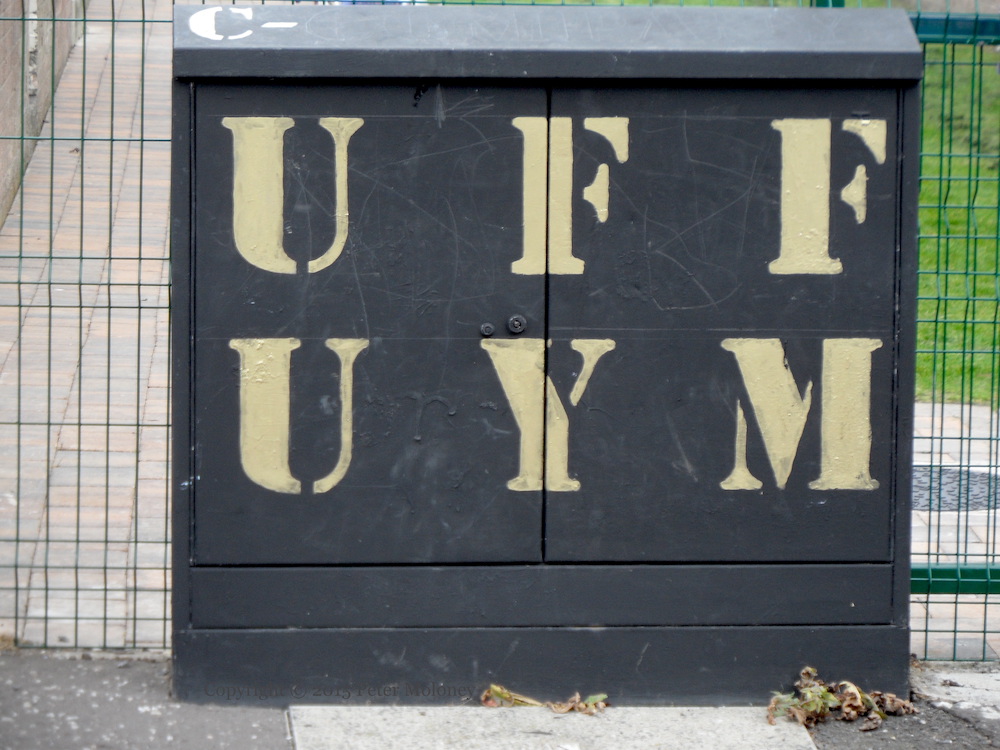
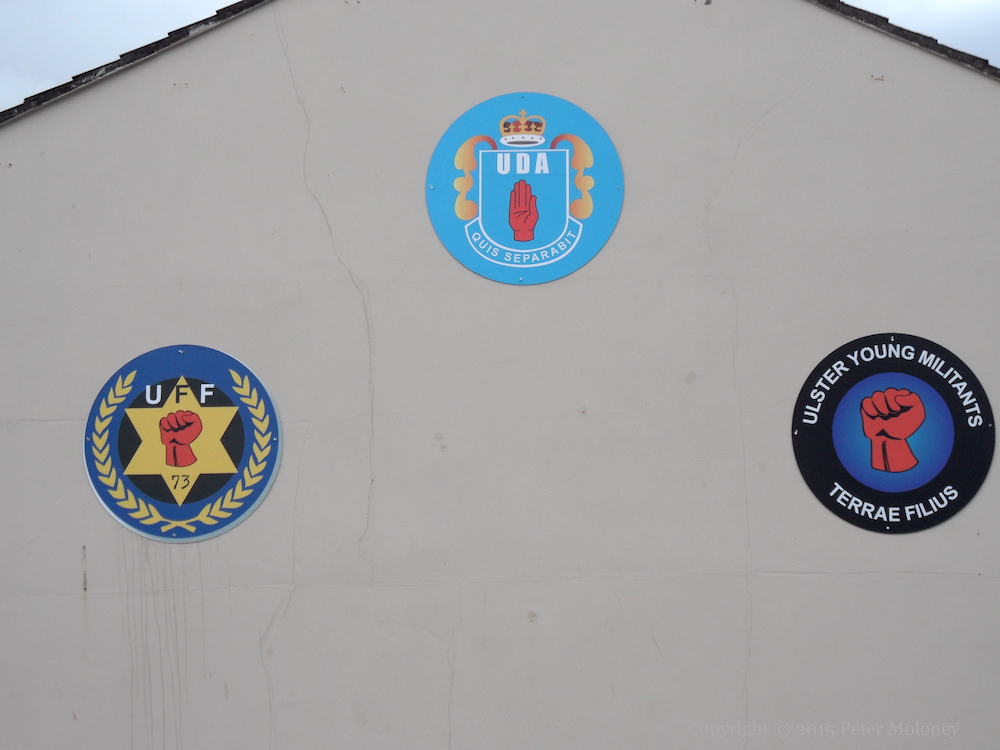
In this modified ‘School’ safety sign in the Lower Shankill estate, a mother and child with Orange Order collarettes go to school (under the watchful eye of the trio of UFF, UYM, and UDA boards seen in Loyalist Lower Shankill.)
(In 2000, a board reading “Drumcree” was placed over “School”. See J0585)
Here is a close-up of the the middle of the Hunger Strike board above the Clowney Street phoenix (which is the Oldest Mural in Belfast) seen previously in 2013.
For an image of the writing – “Bobby Sands murdered 1.17 am. 5th May 1981. ‘My position is in total contrast to that of an ordinary prisoner: I am a political prisoner.”” – see the Homer Sykes collection. The quotation is from Sands’s ‘The Lark And The Freedom Fighter’ (pdf).
For “Thirty thousand can’t be wrong” see this episode of Thames TV’s ‘TV Eye’ (youtube).