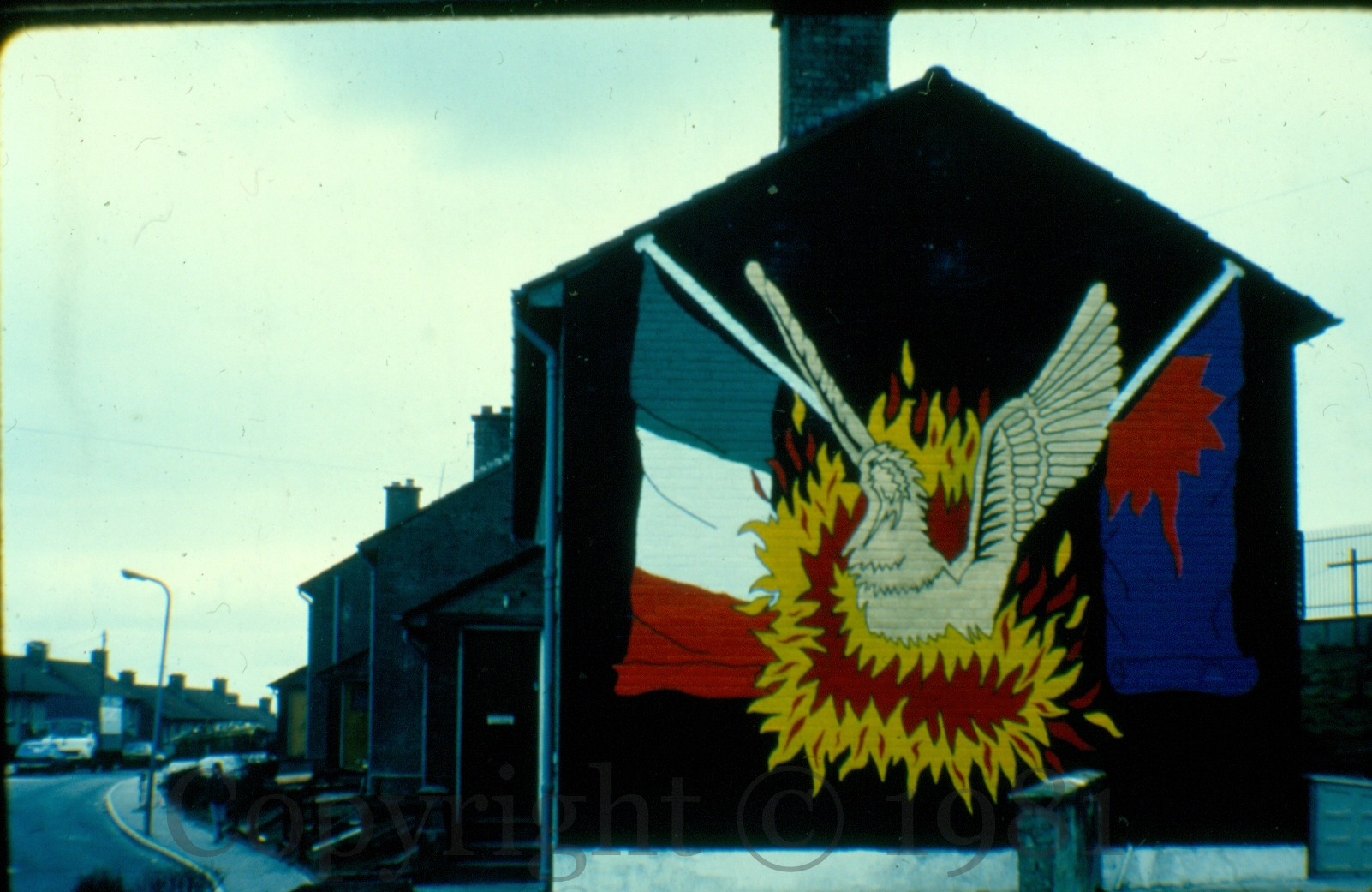
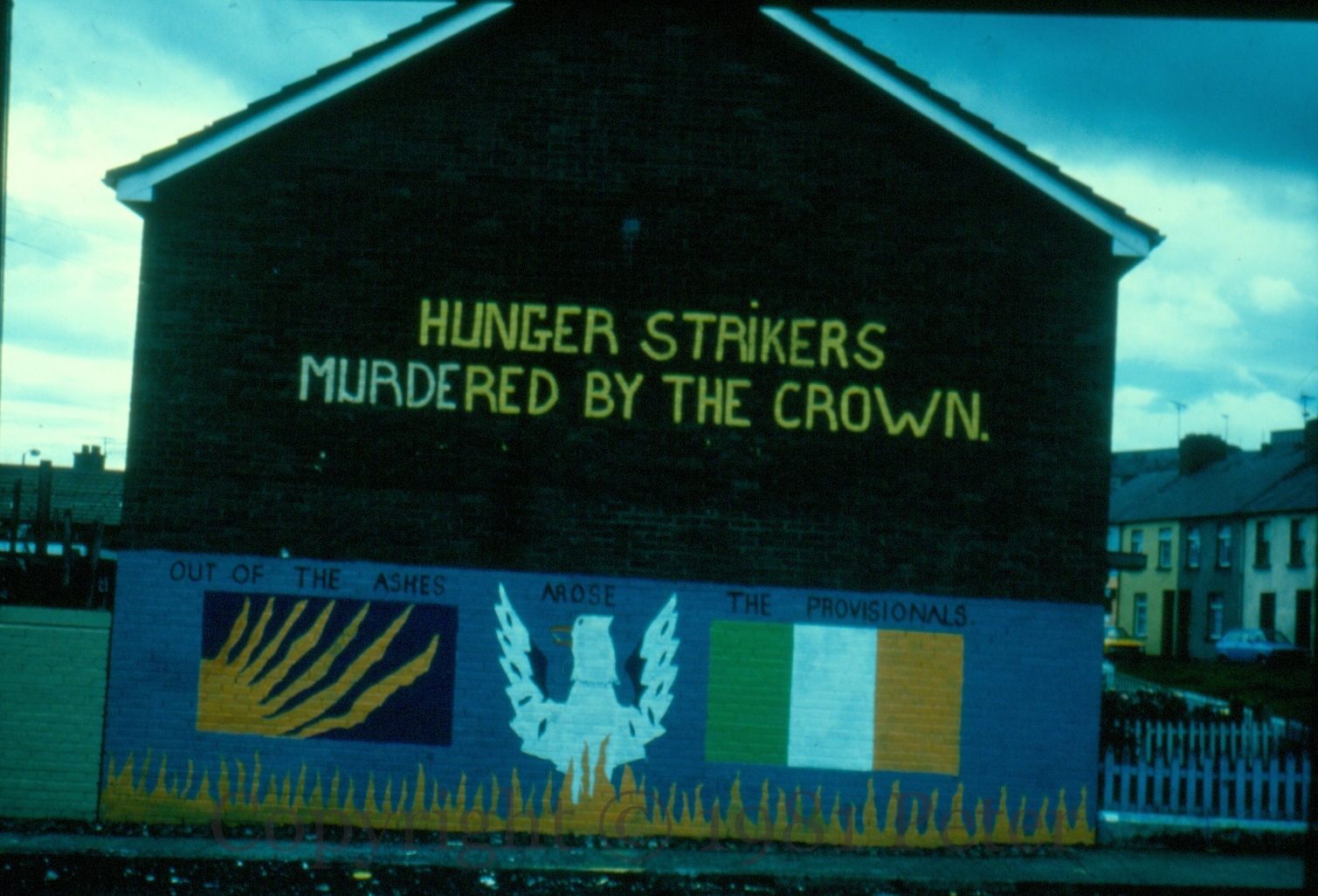
The previous street-level graffiti on Westland Street, Derry — for which see 1973’s PIRA Provos — is shown here being repainted with a series of three panels: a tricolour and starry plough, hands in chains, and H-block.
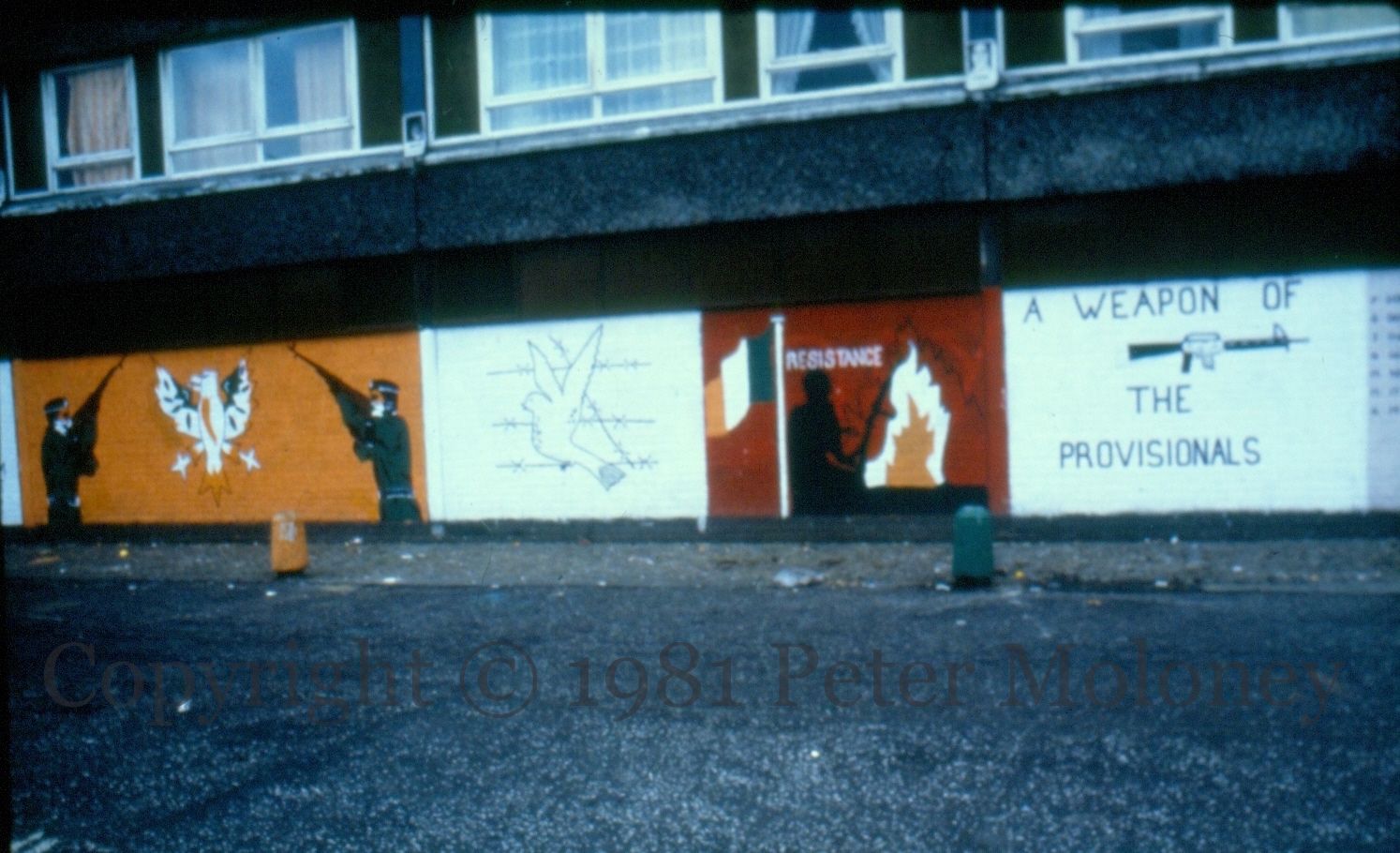
More panels from Rossville Street, Derry, this time showing volunteers firing over a phoenix, a lark in barbed wire, a volunteer kneeling by a fire and a tricolour on a flagpole, and an Armalite rifle with the words “A weapon of the provisionals”.
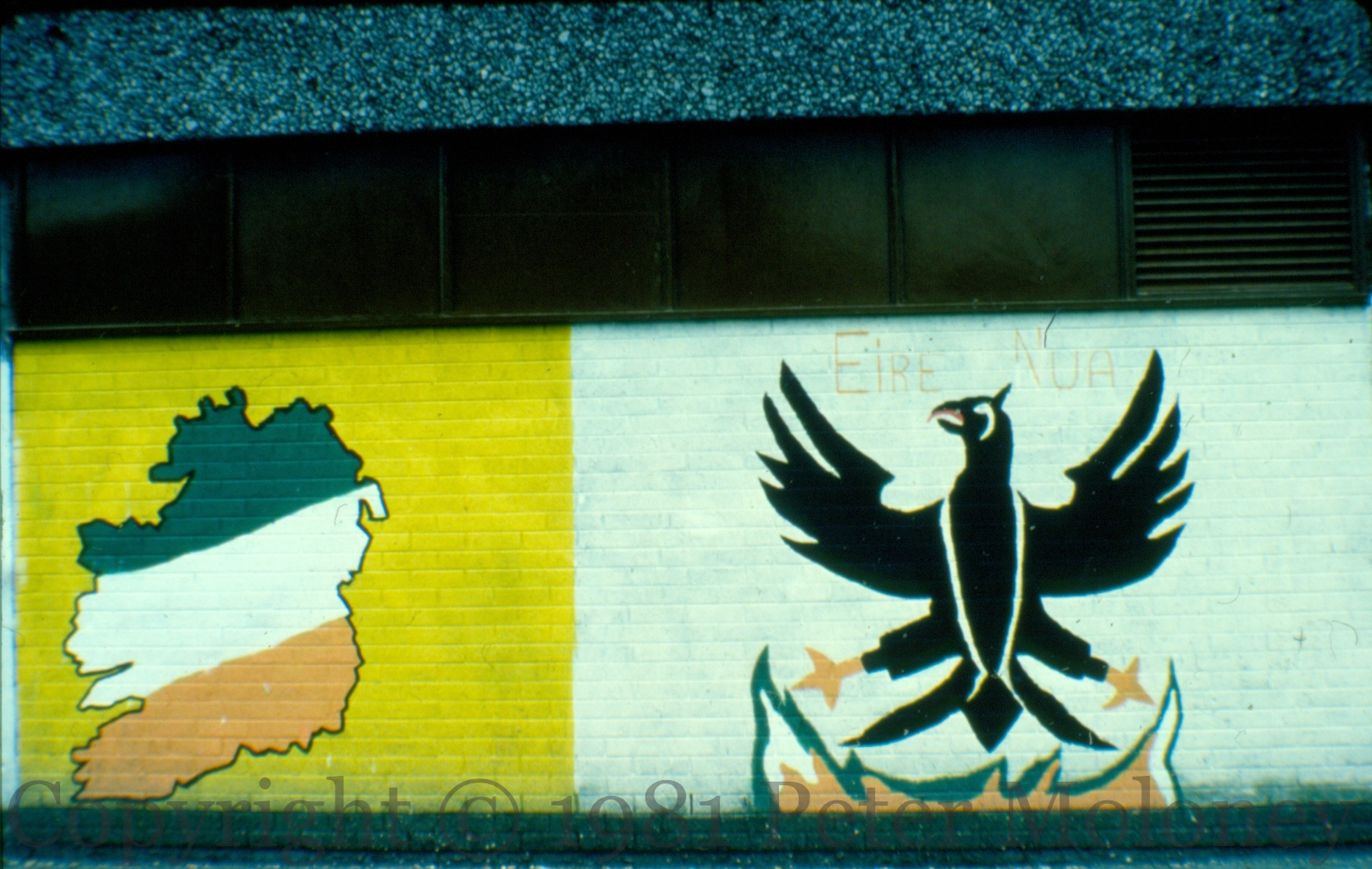
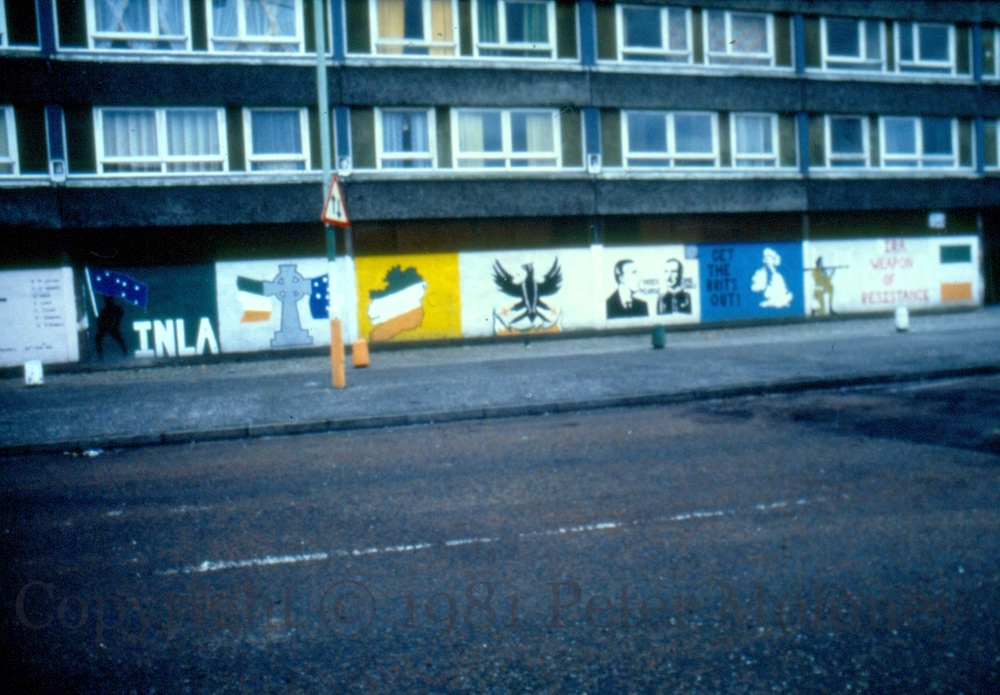
INLA and IRA murals on Rossville Street, Derry, including a volunteer waving the Starry Plough, a Celtic cross draped in the Irish tricolour and a Starry Plough, the island of Ireland in green, white, and orange, a phoenix, Pearse & Connolly, Thatcher-headed Britain biting/pulling on Ireland – “Get the Brits out!”, and the RPG as “IRA weapon of resistance”.
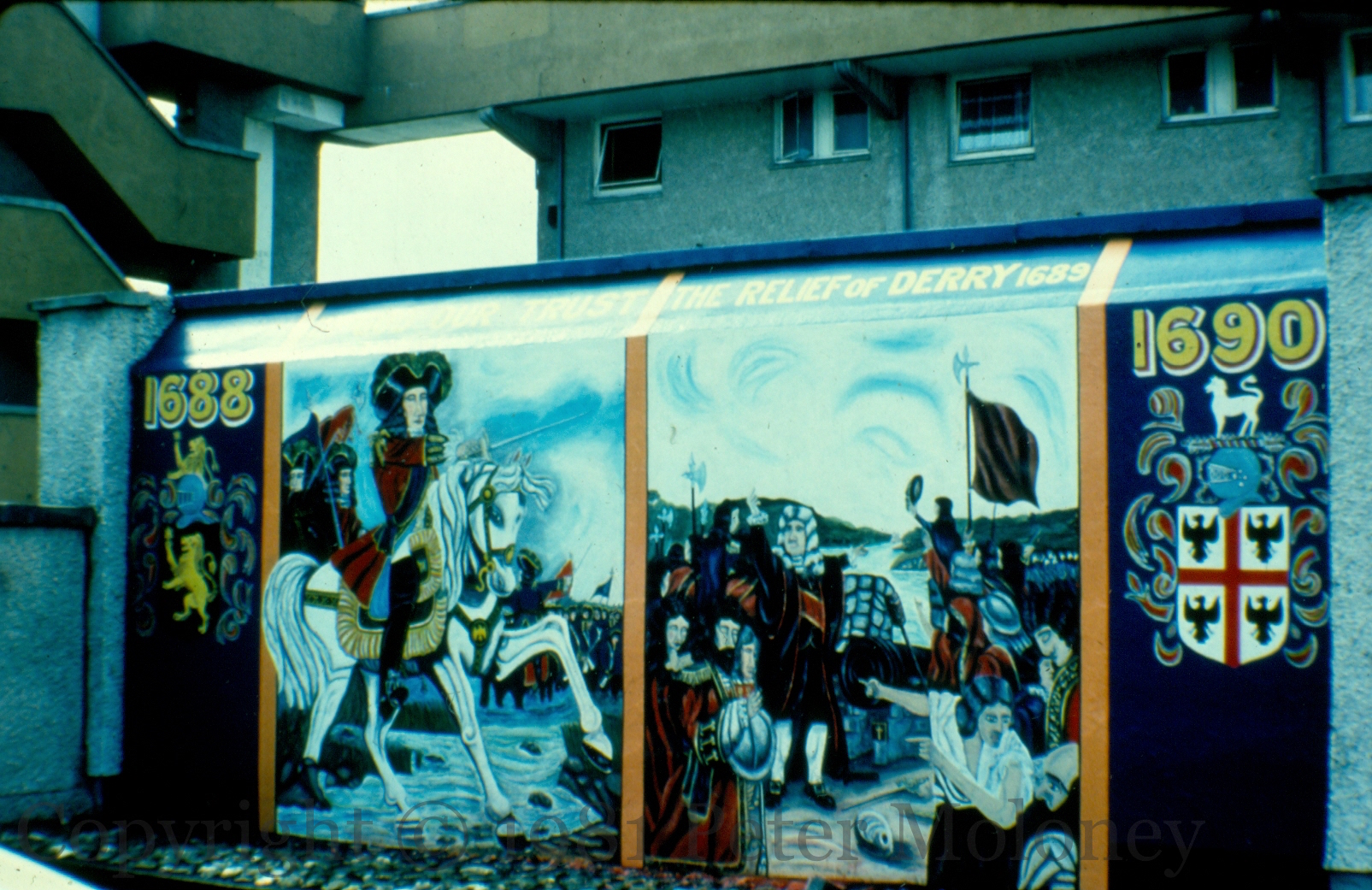
King Billy at the Battle Of The Boyne in 1690 and the Relief Of Derry in 1689. This is the “original” mural in its second location (scare-quotes around “original” because the mural was touched up annually).
This (second) location is still in The Fountain (as was the original location), but there is some confusion about the exact location in relation to the original location – they might be very close together. Please get in touch if you can describe this location in relation to the first.
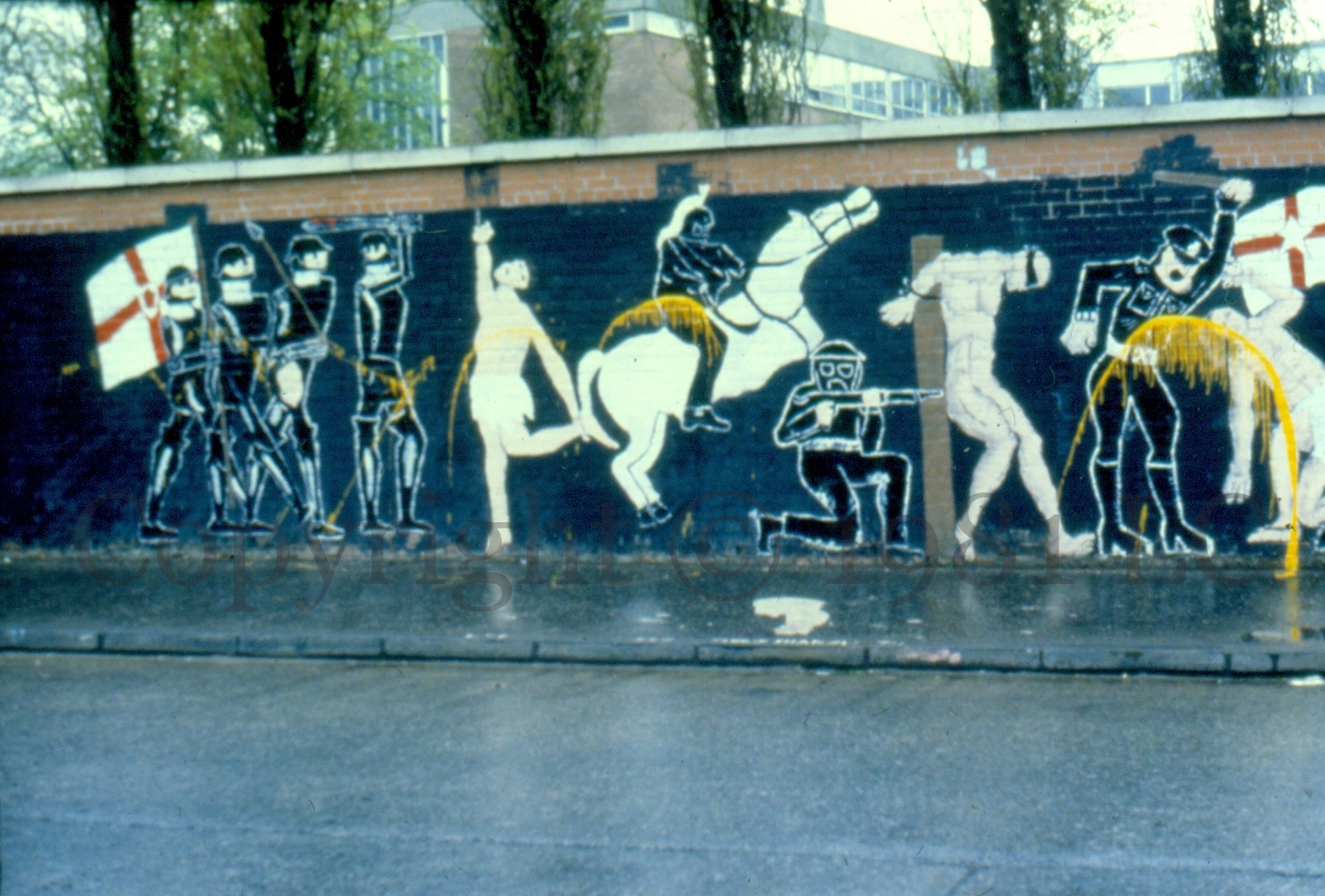
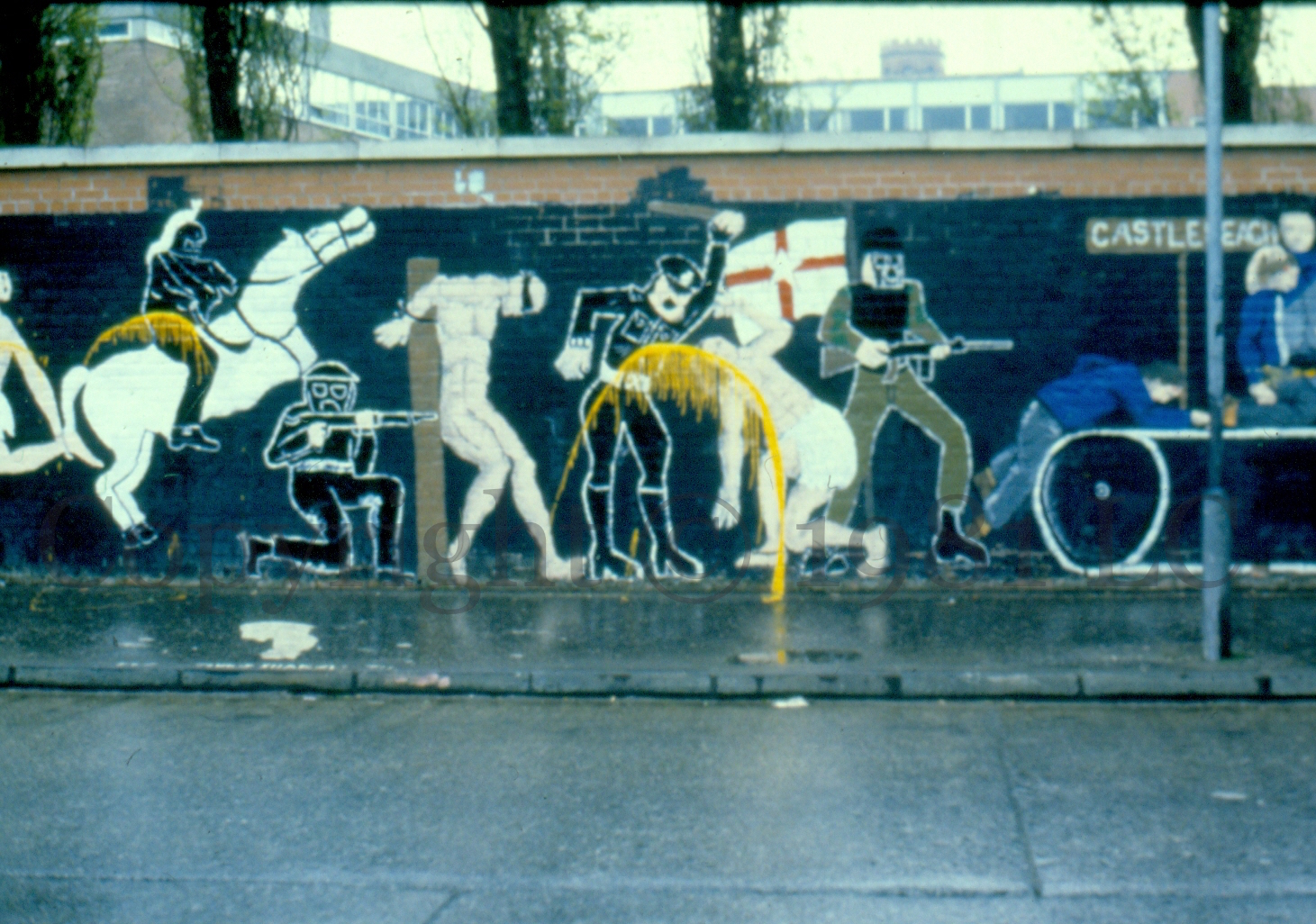
“English Out”: Britain in the form of a riot policeman batoning a bloodied Ireland was (and remains) the symbol of the Troops Out Movement, an British pro-(Irish-)Nationalist organisation founded in 1973. The image of Britain in riot gear beating Ireland with a truncheon first appeared in the Irish Citizen newspaper and was designed by Jack Clafferty (Red Mole).
“Sasanach” is one English person, whereas the sentiment is presumably that they [Sasanaigh] should all leave. But that doesn’t rhyme so well.
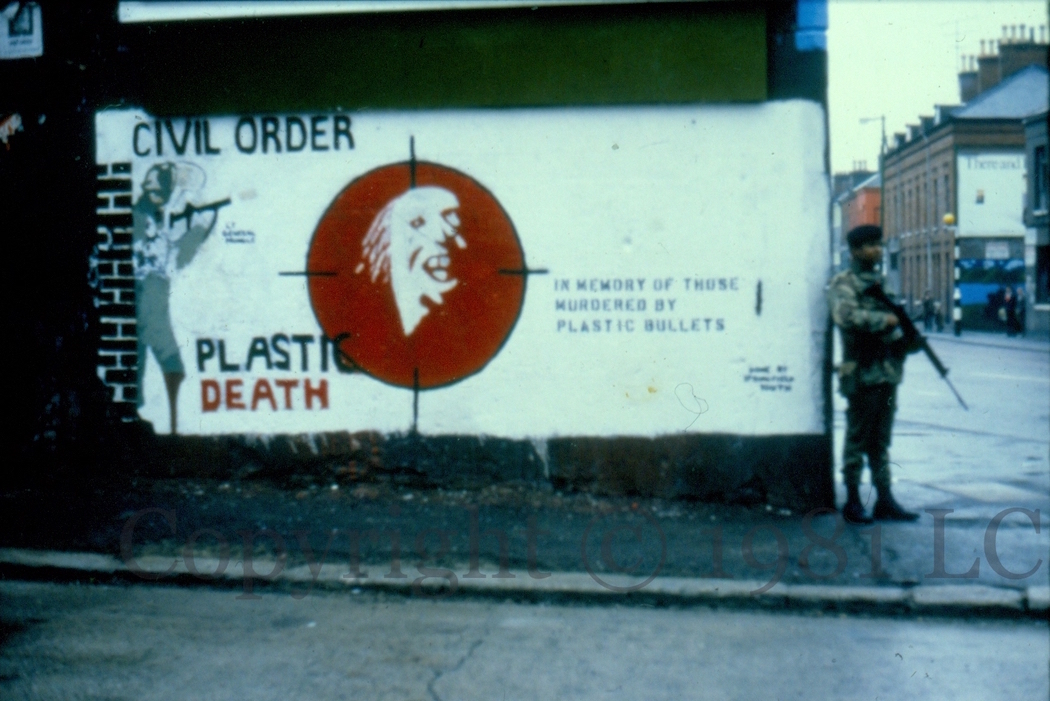
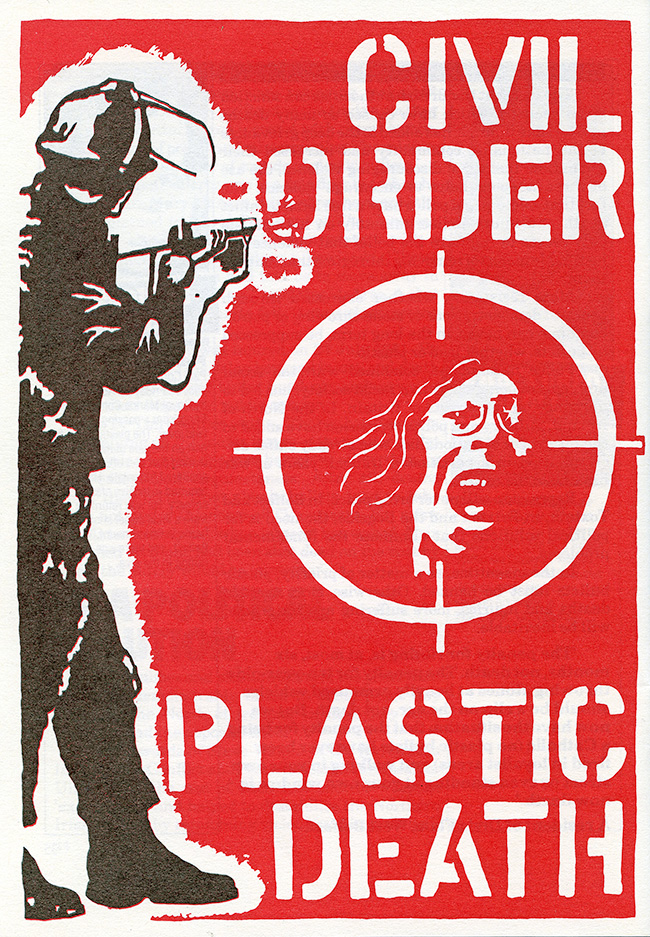
Civil Order, Plastic Death: “in memory of those murdered by plastic bullets”. A British Army soldier stands to the right of mural in (the old) Linden Street, next to the spot where Nora McCabe was shot in the back of the head by a plastic bullet by the RUC at 7:45 a.m. on July 9th, 1981, the day after hunger striker Joe McDonnell died. The poster on which the mural is based is below.
The soldier on the left was originally painted with boots on both feet (X05495) but repainted with a peg-leg after the IRA blew up the car of the Marine’s Commandant General Steuart Pringle on October 17th, 1981 – he lost his right leg (WP).
“Done by Springfield Youth [Against H-Block & Armagh]”
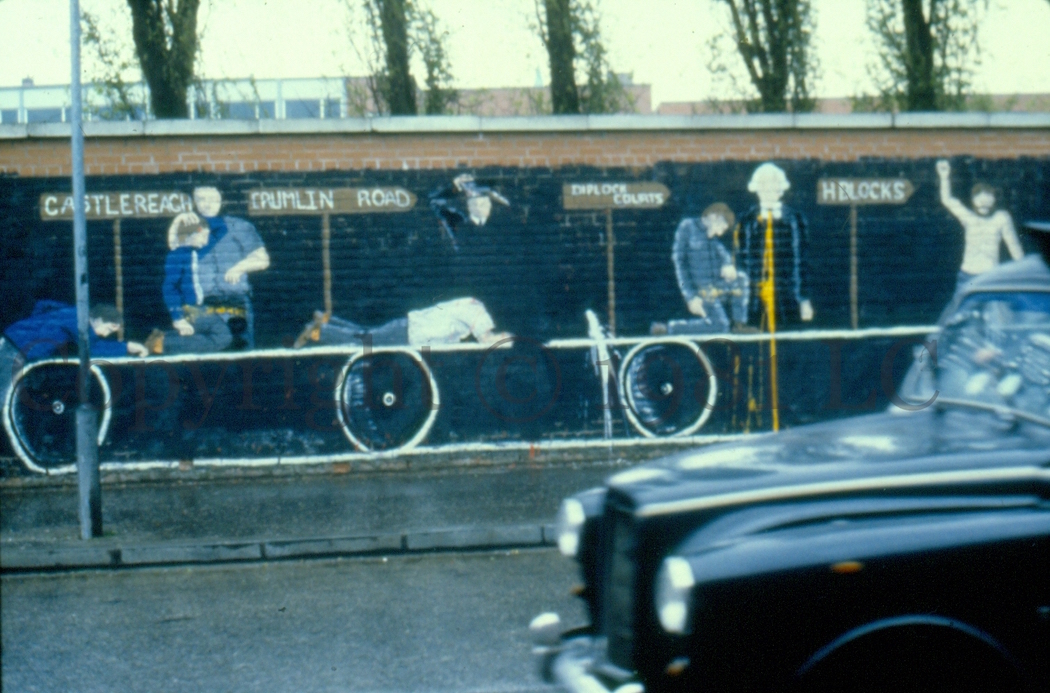
The conveyor belt of British justice is depicted as inexorably moving arrested republicans from questioning at Castlereagh to jail in Crumlin Road to sentencing in front of Diplock court to prison in the H-Blocks. (For a small board in Derry see The Conveyor Belt.)
Jeff Perks’s 1979 linotype “The Training Ground” was reproduced on Beechmount Avenue circa 1981. It depicts the history of the British Army in Ireland. Rolston (“Politics, Painting and Popular Culture: the Political Wall Murals of Northern Ireland”, Media, Culture and Society 9.1, 1987) claims (p. 19) that the image would have been familiar to nationalists from the cover of “Ireland: Voices For Withdrawal” (shown below). The baton-wielding policeman on the right was also reproduced in a famous 1996 Derry mural (“68-96 Nothing Has Changed” M01279).