“1st July 1916. Somme soldiers killed, wounded, missing, 36th (Ulster) Division, 32,186. To the memory and sacrifice of the brave young men from North Antrim who gave their lives with countless others at the Somme and other battles during the Great War 1914-18, to restore peace in Europe. To them bravery was without limit; to us memory is without end.”
“From North Antrim To Gettysburg. ‘On this July morning my heart recalls the summer fields of hame, the townland of my mother, the sound and smells of the lower meadow. These memories I carry into battle between the drum beats of my heart.’ John McPherson, Confederate soldier, Gettysburg July 1st 1863. This mural marks the Trans-Atlantic heritage of our ancestors who set out from these fields, shores and townlands to establish a new life, and in doing so, helped create the United States of America.”
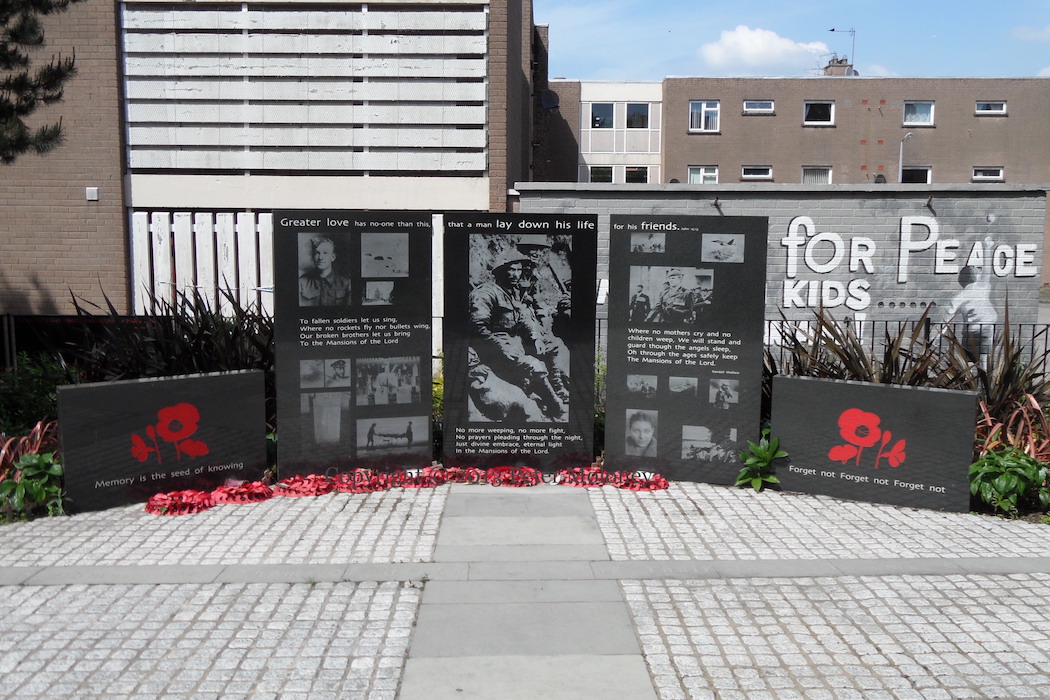
A three-stone memorial to army soldiers in Tullycarnet, featuring a line from the gospel of John (“Greater love has no-one than this, that a man lay down his life for his friends” 15:13) and a song by Randall Wallace for the 2002 movie We Were Soldiers called ‘The Mansions of the Lord’: To fallen soldiers let us sing, where no rockets fly nor bullets wing, our broken brothers let us bring, to the mansions of the Lord. No more weeping, no more fight, no prayers pleading through the night, just divine embrace, eternal light, in the mansions of the Lord. Where no mothers cry and no children weep, we will stand and guard though the angels sleep, Oh through the ages safely keep, the mansions of the Lord.”
By Ross Wilson with support from the International Fund For Ireland (IFI)
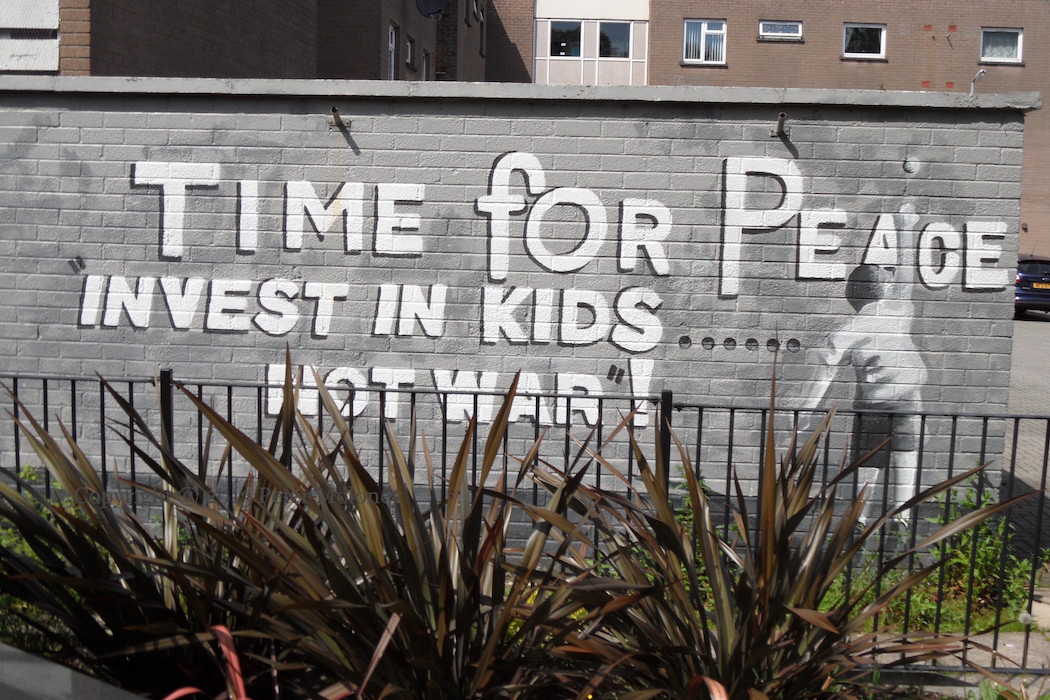
The garden of reflection is in front of a mural reading “Time for peace. Invest in kids … not war!”. The image of a boy playing with a ball against a wall is based on a 1994 photograph by Crispin Rodwell. The slogan in the photograph, originally, was “Time for peace; time to go” but for publication, as here, the second part was cropped out.
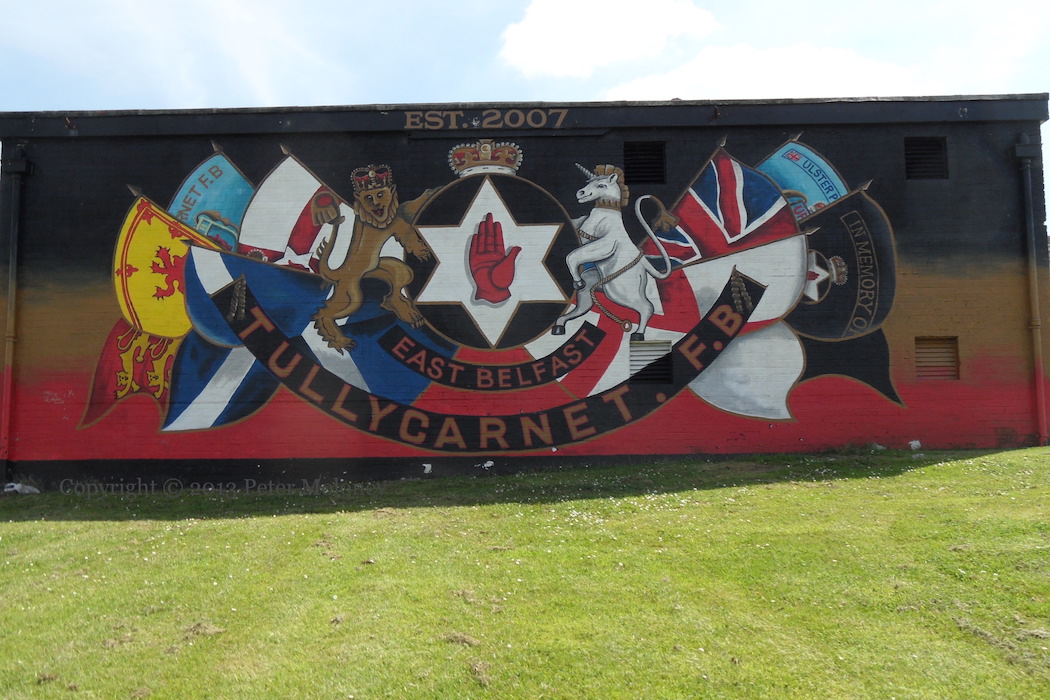
Tullycarnet Flute Band murals on the electrical sub-station in Lochinver Drive, Tullycarnet. The middle plaque reads “In memory of Steven Dawson (Big Penny) Gone but not forgotten. A light shone in the night” and the one to the right reads “In memory of Joseph Baxter Corry (Joe) Gone but not forgotten. You’ll always be in our hearts. Farewell our absent friend.”
The lion and the unicorn are from the UK coat of arms.
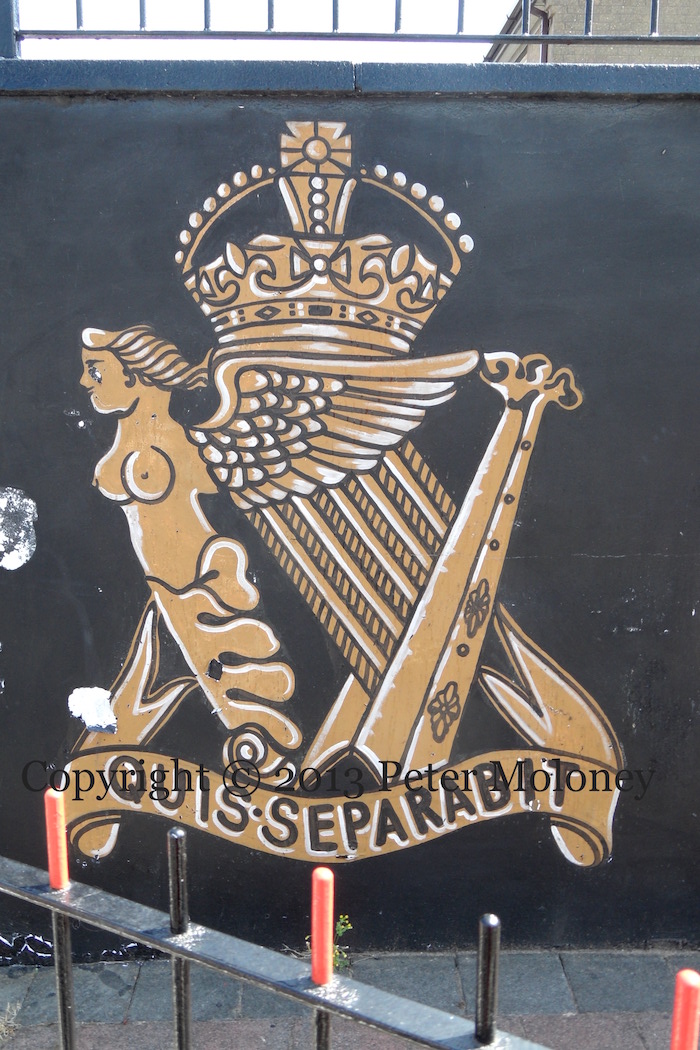
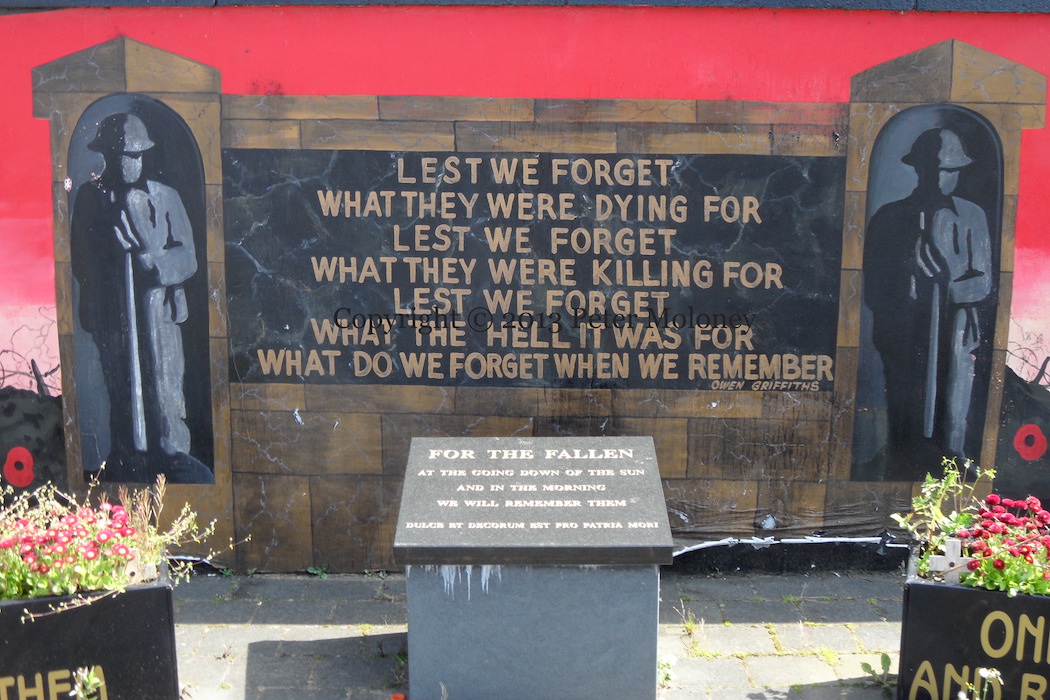
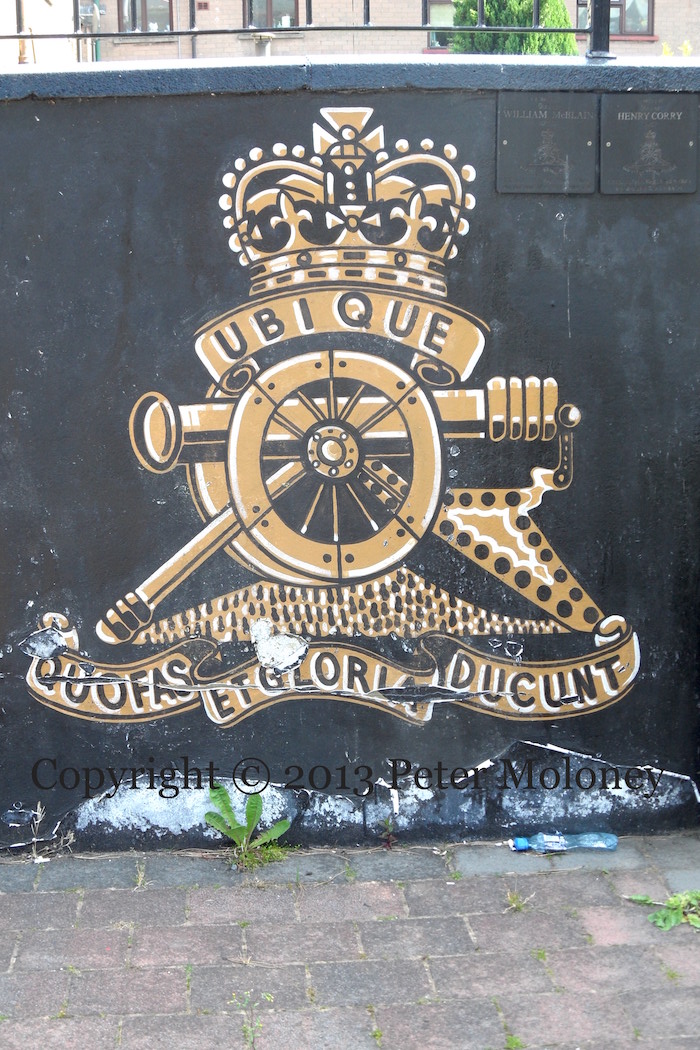
Two poems are featured prominently and another two alluded to in this Newtownards mural and memorial garden to WWI soldiers. The central panel features part of an anti-war work by by Owen Griffiths, Lest We Forget. Robert Laurence Binyon’s For The Fallen is featured on the stone, above a line of Latin from Horace’s Odes (III.2) – On Virtue(which most famously re-appears in Owen’s Dulce Et Decorum Est). On the left and right there appear the mottos of the Royal Irish Rifles – ‘Quis separabit’, which comes from Romans 8:35 – and the Royal Artillery – ‘Ubique – Quo Fas Et Gloria Ducunt’, which comes from Kipling’s Ubique.
For the (WWI) 13th battalion RIR, see Regimental List and similarly for the 16th (rather than the 17th) “Pioneers”. For the (WWII) 5th Anti-Aircraft battery, see Newtownards History.
“I am not an Ulsterman [but] yesterday, the 1st of July 1916, as I followed their amazing attack, I felt I would rather be an Ulsterman than anything else in the world.” The words of Captain Wilfrid (here given as “Wilfred”) Spender replace a Steeple Defenders board that has presumably fallen into disrepair alongside a board showing a soldier from the 36th Division running through no-man’s land (both seen previously in 2003 and 2009).
For a fuller quote, see X04435 from south Belfast.
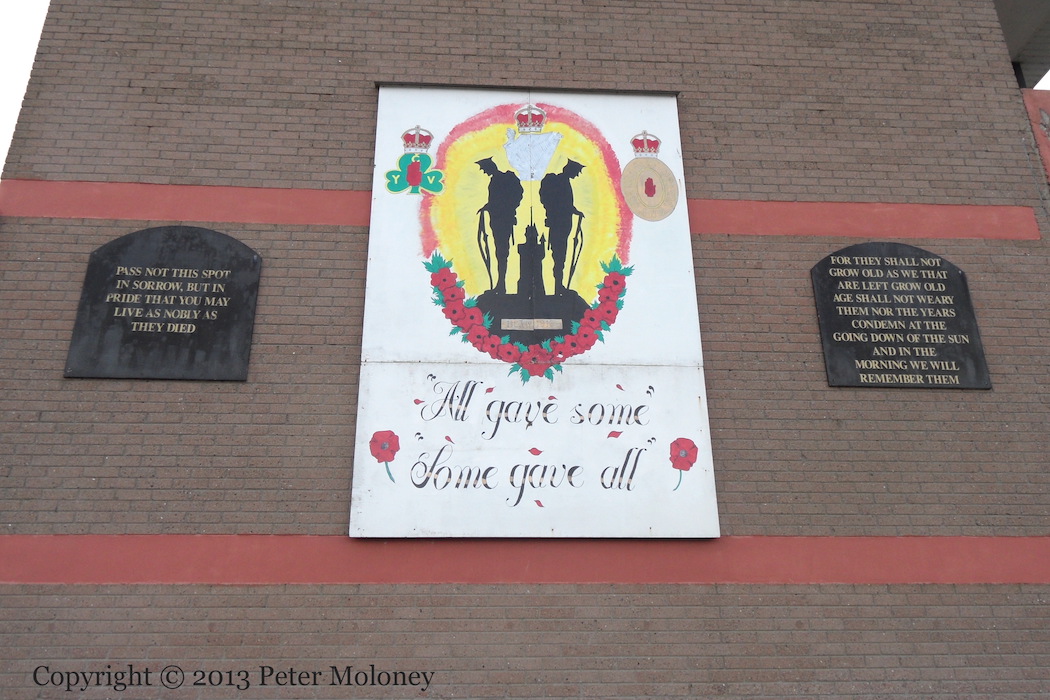
On the right: “They shall not grow old as we that are left grow old./Age shall not weary them nor the years condemn./At the going down of the sun and in the morning, we will remember them.” from Binyon’s For The Fallen.
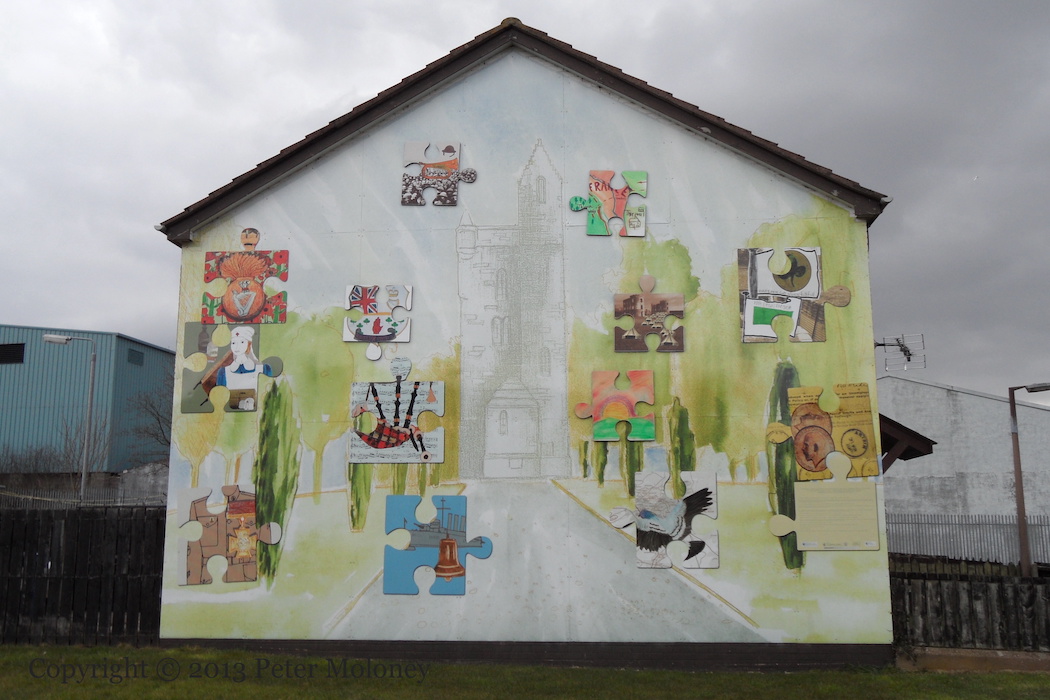
Ulster Tower in Thiepval, France, provides a background for 13 jigsaw pieces with partial images relating to the Great War, including a uniform with a Victoria Cross and badge of the 36th (Ulster) Division, the 10th (Irish) Division, the 16th (Irish) Division, and the Royal Irish Fusiliers (and a fourteenth piece for information).
Kilgreel Road, Antrim. The mural is more than a decade old and is bleached from the sun (the pinks were formerly brown); on the former site of The People’s Army (a UVF board).
“This artwork, commemorating the sacrifices made during the Great War and subsequent conflicts, was produced by the young people of Parkhall Youth & Community Club and was completed in 2010. It is part of a larger Re-imaging project undertaken by Parkhall Cultural Awareness Association & Parkhall Community Association. 14 jigsaw pieces are representated as that was the age of the youngest soldier to die on the Somme. The Royal Irish Fusiliers, who recruited in the Antrim area, served with the 10th Irish Division and 36th Ulster Division during World War I. The cap badge is surrounded with poppies. The poppy is an international symbol commemorating the sacrifices of members of the armed forces and of civilians specifically since the Great War. Birds were used extensively during World War I delivering important logistic message from the front line. HMS Antrim served in the Great War and survived. After the war she became the first ship to be fitted with an experimental sonar system in 1920. Her bell can presently be viewed in Antrim Civic Centre. The grounds of Shane’s Castle in Antrim were used as a training ground and a campsite for the 36th Ulster Division prior to their deployment to France. Of all bell tents and parachutes during the Great War 90% were made from Irish Linen. During the Great War a service man’s basic wage was one shilling a day (5 pence). The sound of the bugle was heard throughout each day in the trenches, starting with Reveille to rouse you from slumber. ‘Flowers of the Forest’, a powerful Scottish lament, is often played by a lone piper at services of Remembrance. “I am not an Ulsterman but yesterday, the 1st July, as I followed their amazing attack, I felt that I would rather be an Ulsterman than anything else in the world.” Extract from the speech by Captain Wilfred [Wilfrid] Spencer 2st July 1916. Men from the 36th Ulster Division received 9 Victoria Crosses. Women played a vital role in field hospitals during the Great War caring for the injured, from the front line. The flags of the 16th and 10th Irish Divisions. 36th Ulster division. The Ulster Tower is a memorial to the men of the 36th Ulster Division. It is situated near the entrance to Thiepval Wood, France.
While the demolition of the last house in the row is under way, the pair of boards on the gable wall (seen in 2012) has been mounted on some scaffolding, with their order reversed – Covenant Day on the left, Somme trench on the right.
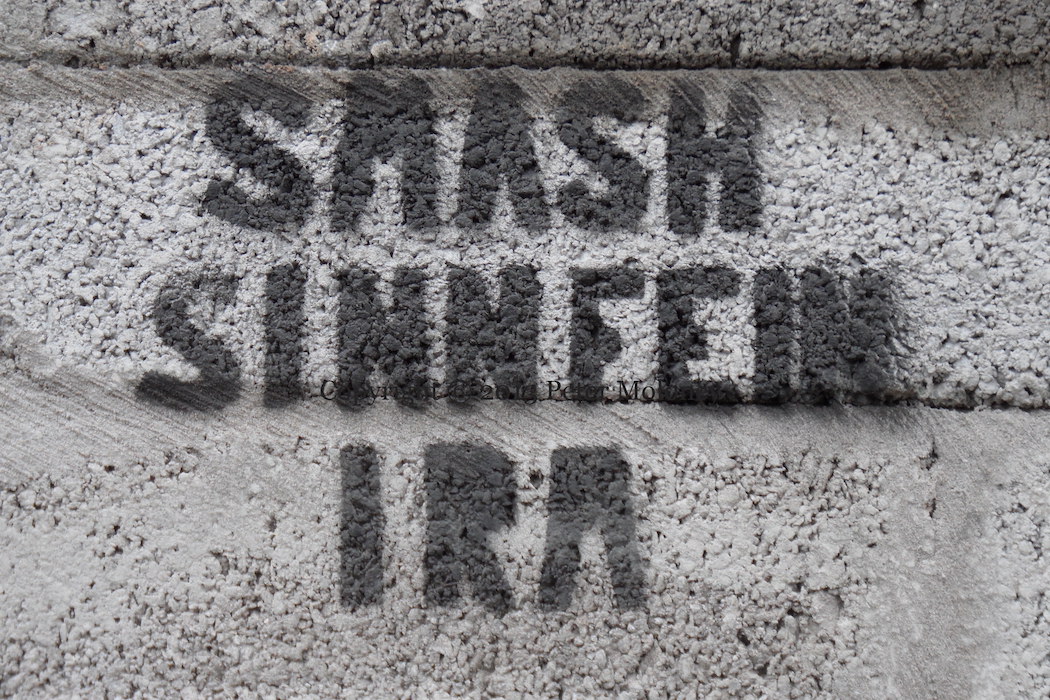
Also included is a “Smash Sinn Fein IRA” stencil in the area.








 Peter Moloney Collection