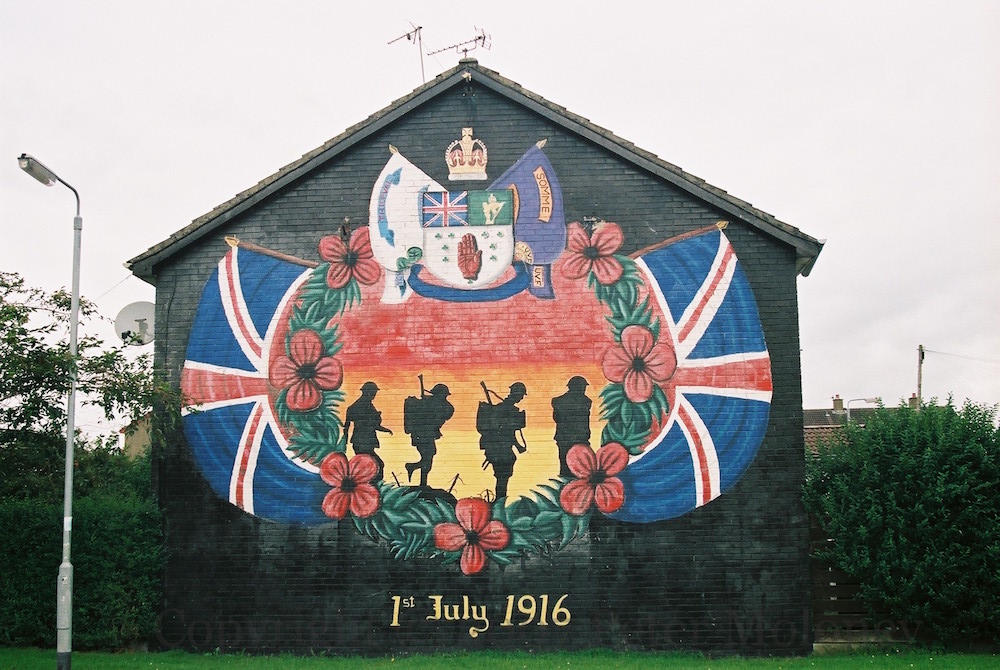
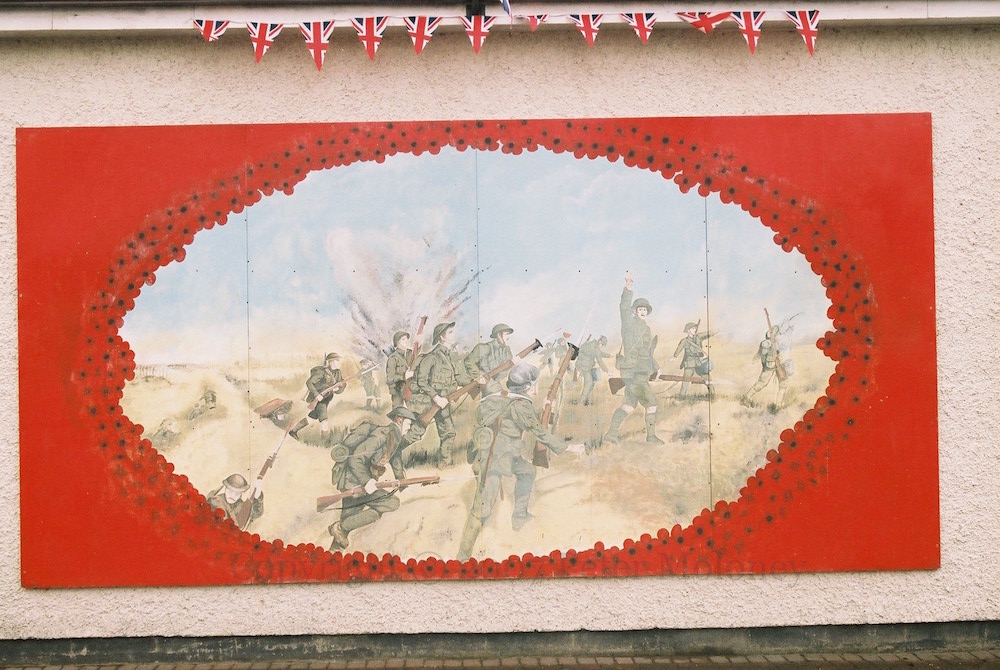
Soldiers from the 36th (Ulster) Division of the British Army participated in the Battle Of Albert on July 1st, 1916, the first battle in the Battle Of The Somme, which would continue until November 18th. In those four and half months more than one million soldiers were killed or wounded, including, on July 1st alone, about 60,000 British troops. The 36th (Ulster) Division, on the left flank, pushed ahead of other units and found itself unsupported; 5,240 of its soldiers died.
This Lord Street mural celebrates the accomplishments of the Northern Ireland soccer team: British champions in 1914, 1980, and 1984 – the last year the “Home Championship” was held and so the trophy (at left) is held by the IFA; World Cup qualifiers in 1958 (Sweden), 1982 (Spain), and 1986 (Mexico). The original trophy, by Jules Rimet, is shown in the third panel; it was kept by Brazil when it won for a third time in 1970. With sponsorship by the East Belfast Historical And Cultural Society. Replaces J2706 “Magnifico Viva Norn Iron”. The image of the Ulster Banner is from 2009; there is “IRA” graffiti in the top left.
The Orange Order was prevented from marching from Drumcree church (shown in the board) down the Garvaghy Road (in Portadown) by the RUC in the mid- to late-1990s, which the OO claimed impinged upon its “civil and religious liberty” (in the flag). The dispute was notable (among other reasons) for the emergence of Billy Wright (then a member of the UVF). Wright was unhappy with how the dispute was conducted and ultimately he and his unit were stood down (in 1996), and Wright went on to found the LVF.
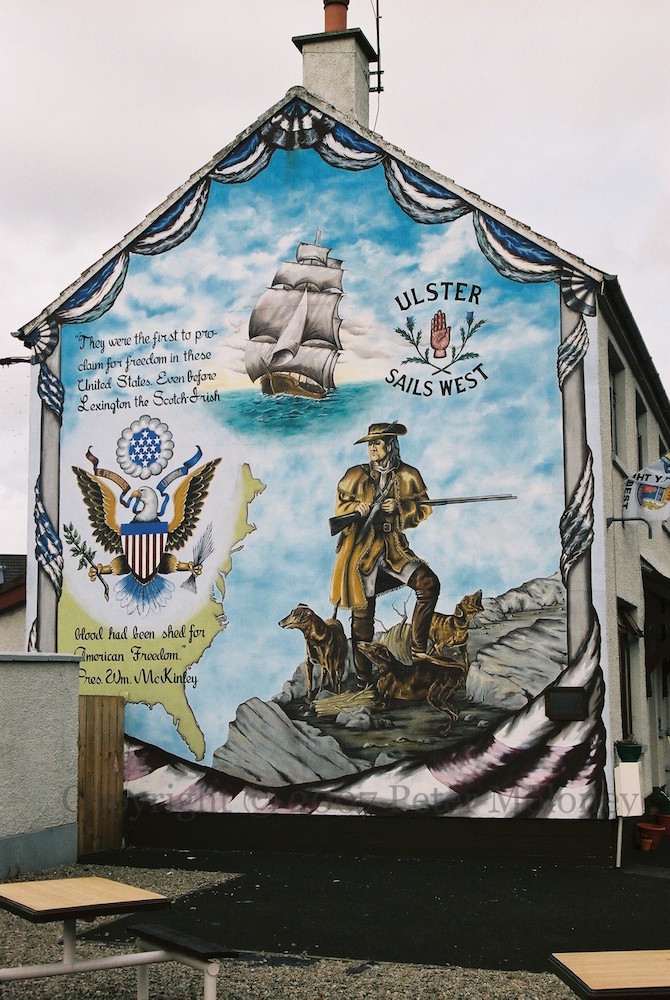
This Ballymoney mural goes all the way back to at least 2004 and to the wave of Ulster-Scots – or as here, “Scotch-Irish” – murals painted in PUL areas after the promotion of Ulstèr-Scotch as a parallel language to Irish by the Good Friday/Belfast Agreement.
As the Visual History page on Ulster-Scots Murals shows, most of these murals made a connection to (what would-become) the United States, to where about a quarter million people emigrated (WP). The mural is intended to tell a story of emigration (signified by the sailing ship), American independence (the McKinley quote), and American expansion (the frontiersman).
The Scotch-Irish were Presbyterians and supporters of breaking the ties to Great Britain. In 1893, Governor Of Ohio (and later US President) (Ulster Nation) William McKinley said, “They were the first to proclaim for freedom in these United States. Even before Lexington [i.e. the outbreak of the Revolutionary War, on April 19, 1775] the Scotch-Irish blood had been shed for American Freedom.” (According to William Marshall’s book Ulster Sails West, the battle McKinley is referring to took place on the Alamace river in North Carolina in 1771 (p. 29).)
The frontiersman on the right is generally taken to be David “Davy” Crockett, from the 1830s (Rolston in Al Jazeera | McCormick J2024); it is in fact a 1991 sketch of a generic frontiersman by David Wright (web), called “The Long Knife”, and the figure is referred to generically as “a trapper” by the artist (BBC).
None of the conquests of European-American colonists provides a good parallel to unionism, due to the complicated nature of political conflicts both there and here. The Americans, of course, threw off British rule in their revolution; Irish unionists want to remain part of the UK. And Crockett died in the Battle Of The Alamo in the Texas Revolution; that is, he died fighting for Texan independence from the Mexican government, which again doesn’t line up well with the desire of Irish unionists to remain part of the United Kingdom. (For another strained analogy involving the Scotch-Irish and US political history, see The War Of Northern Aggression and its discussion in the Ulster-Scots Murals page.)
The reason for its inclusion is the simpler idea that the Scotch-Irish are a rugged and feisty people who are not to be trifled with, whether in North America or Ireland.
Painted by Kenny Blair (Fb) in Hillview Avenue, Ballymoney; sponsored by the North Antrim Cultural And Musical Society and funded by the Heritage Commission. “Ulster Sails West” is the title of a 1943 book by WF Marshall (Isles Abroad).
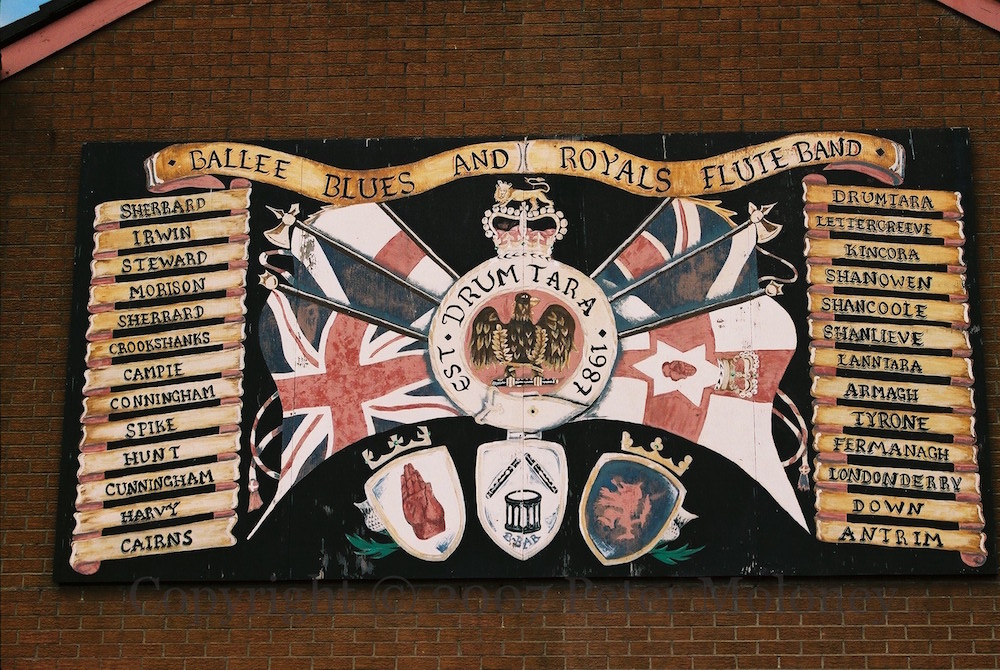
“Ballee Blues And Royals Flute Band, est. 1987” with a list of the Apprentice Boys (on the left) and (on the right) seven streets in the area (Drumtara, Lettercreeve, Kincora, Shanowen, Shancoole, Shanlieve, Lanntara) and the six counties of Northern Ireland. The emblem in the centre is the arm badge of the Blues & Royals (the British Army regiment), featuring the (French) Waterloo Eagle – here carrying a flute. The band does not appear to have persisted past 2012 has since changed its name – see comment below.




 Peter Moloney Collection