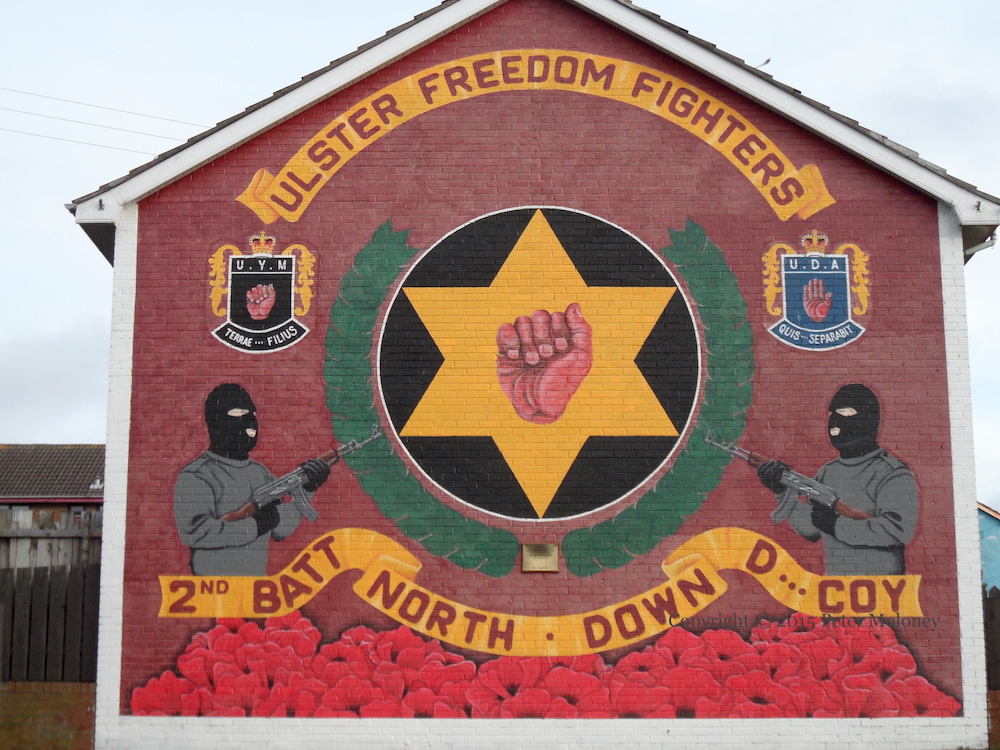
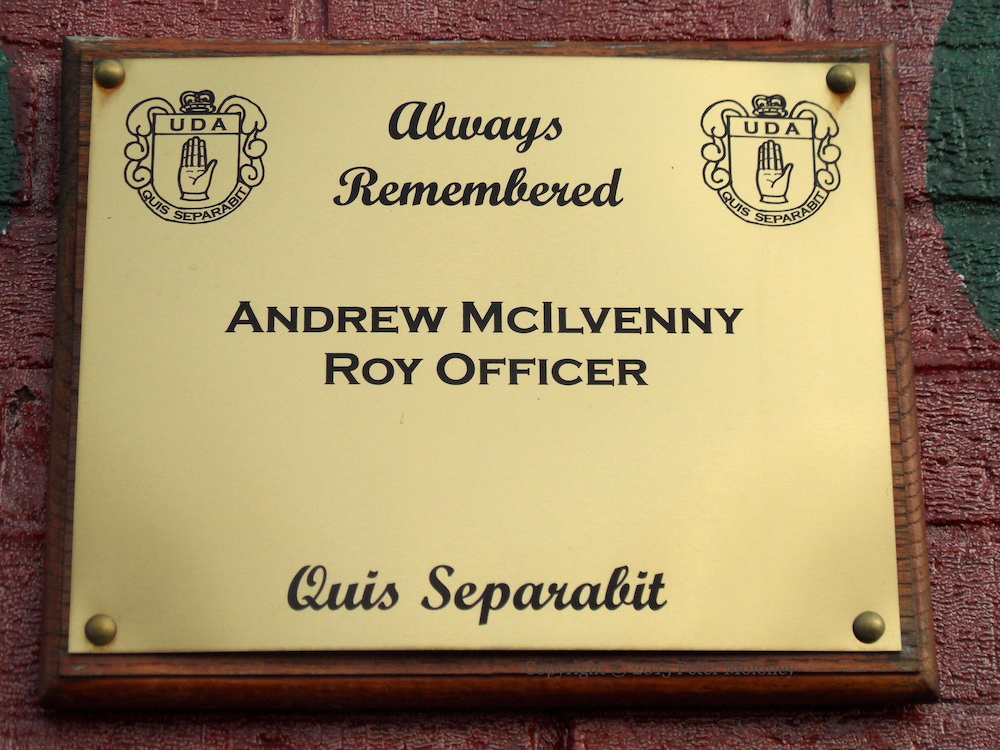
UFF/UDA/UYM (North Down, 2nd battalion, D company) memorial mural in Bloomfield estate, Bangor, to Andrew McIlvenny and Roy Officer, with hooded gunmen on a bed of poppies flanking the UFF clenched fist.
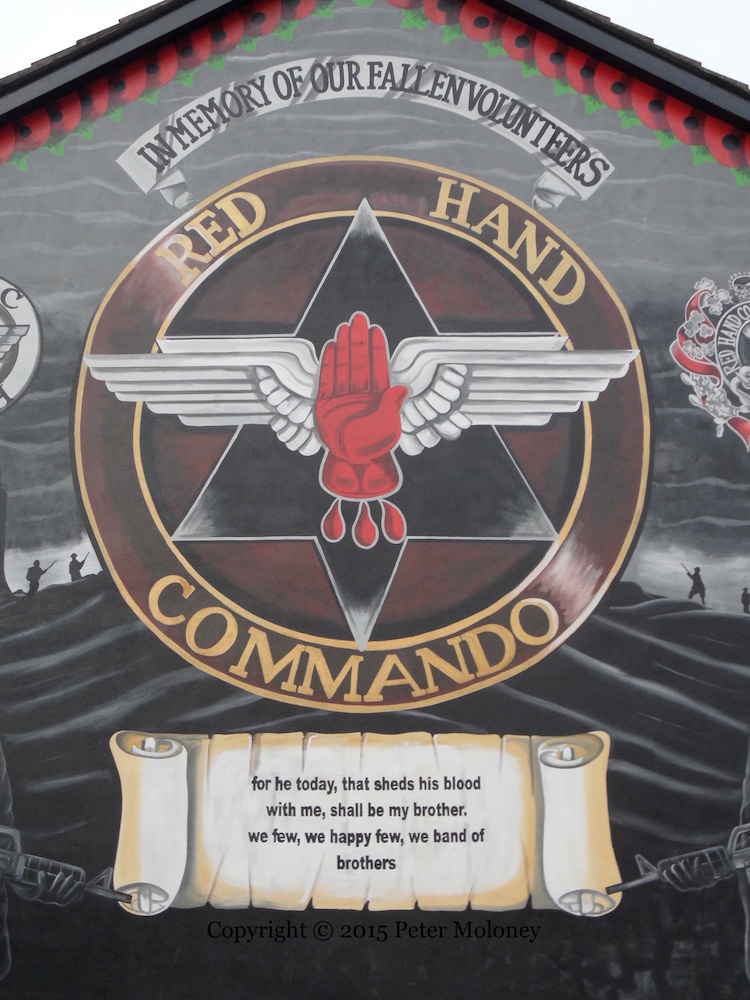
“For he today that sheds his blood with me shall be my brother. We few, we happy few, we band of brothers.” This is a new (July 2014) Red Hand Commando mural in Bangor with RHC Youth and Red Hand Comrades Association insignia against a backdrop of Thiepval Tower and the Somme, with masked gunmen in the foreground and a border of poppies.
The quote is from Shakespeare’s Henry V, act 4, though the lines are reversed (Folger).
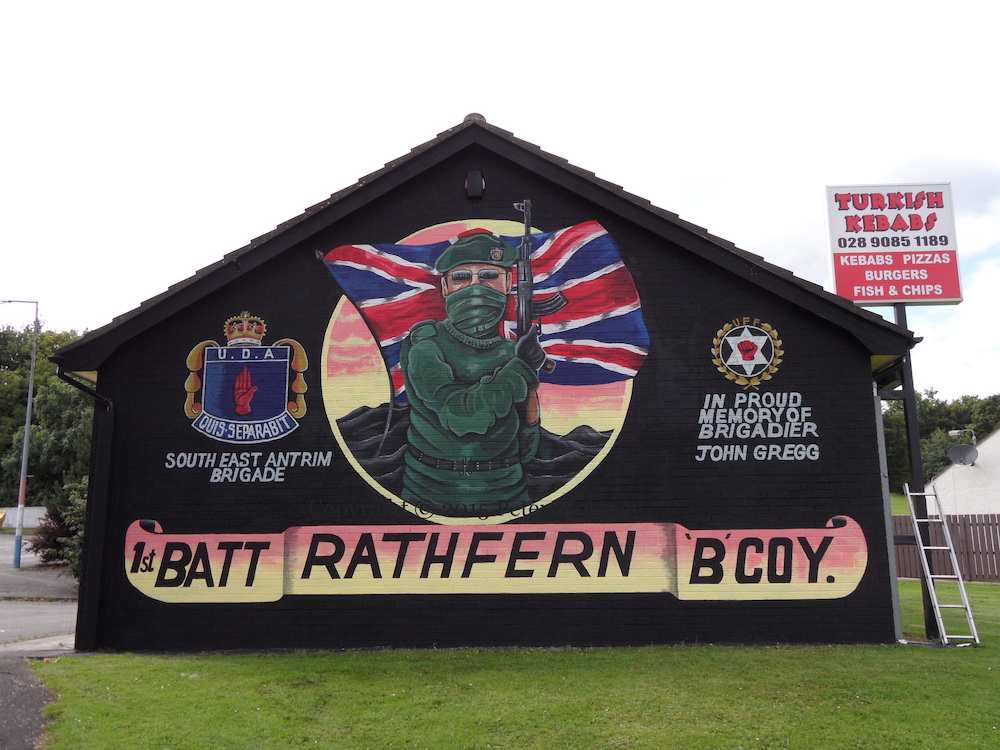
This is a new UDA mural in memory of John Gregg, “The Reaper”, who waged a campaign of terror against Catholics in south-east Antrim and was reputedly associated with British neo-Nazi groups. Gregg was gunned down in 2003, while returning from a Rangers match, as part of the power struggle with Johnny Adair.
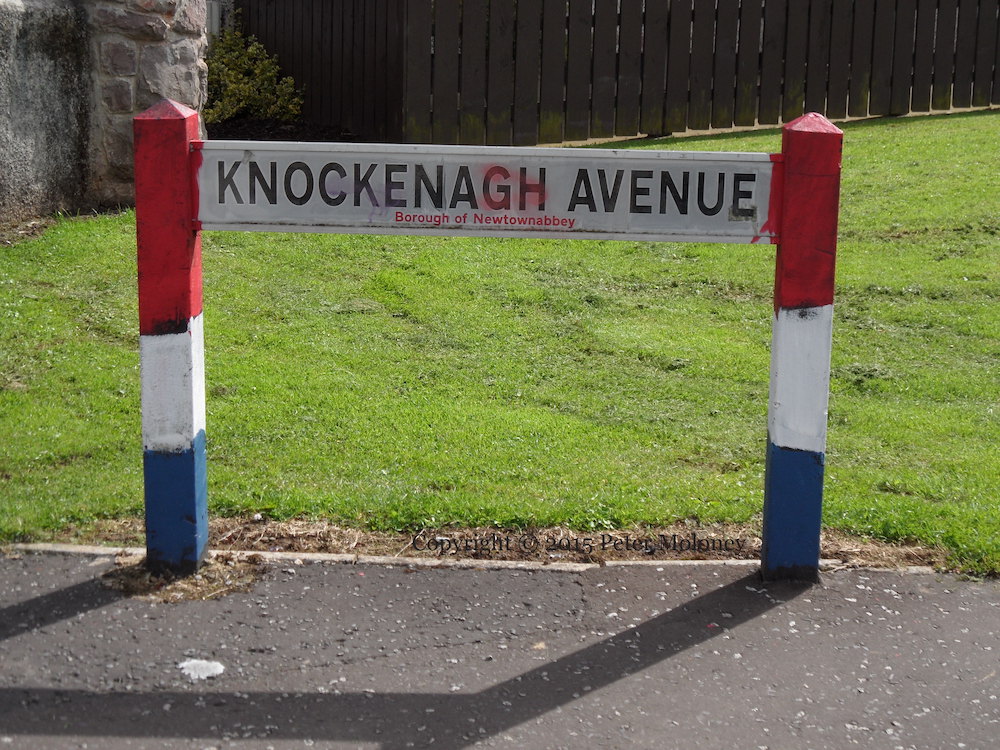
Nearby red-white-and-blue poles on Knockenagh Ave, Newtownabbey, are also shown.
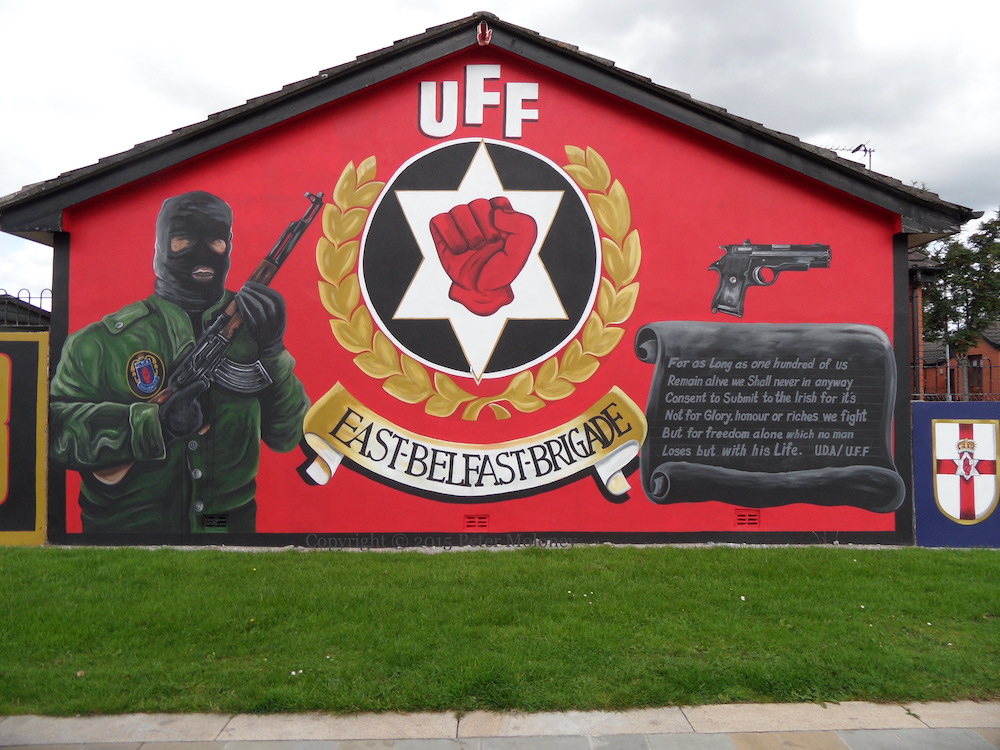
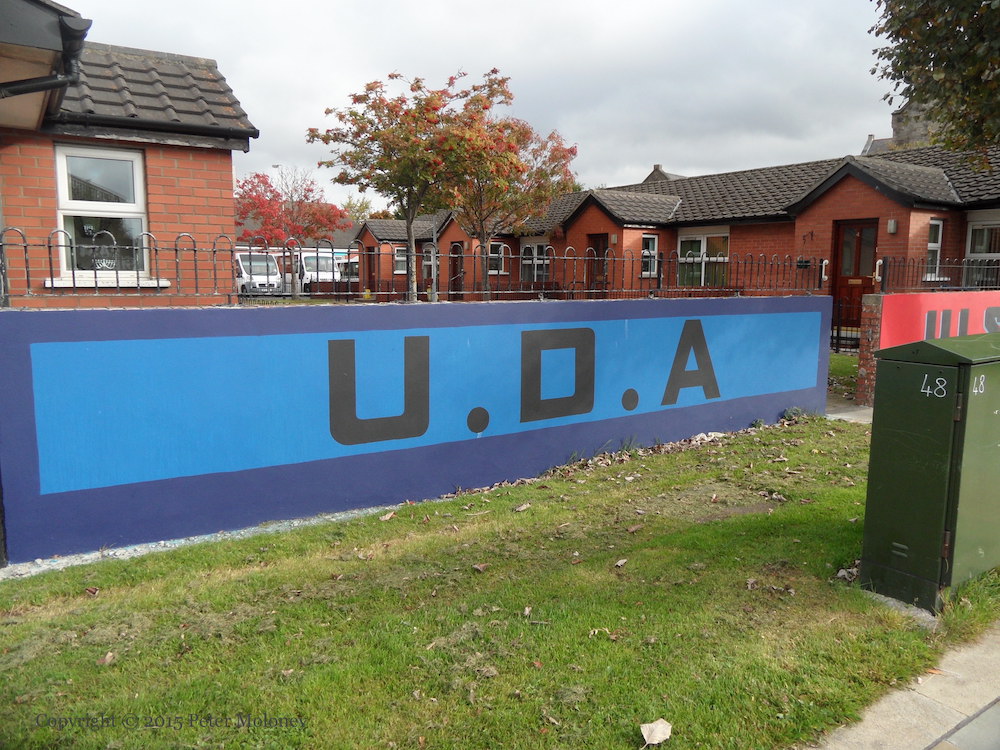
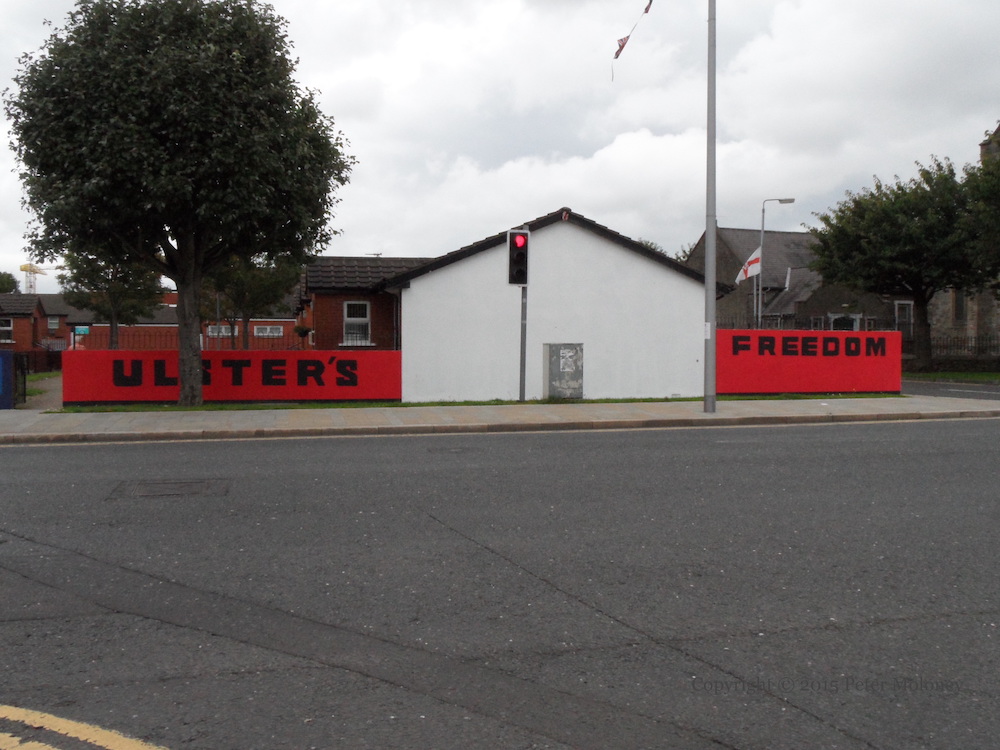
The murals along east Belfast’s “Freedom Corner” (on the Newtownards Road) were repainted over the course of several months in 2015. These images are from a variety of dates in July and August; the ‘red hand’ piece is incomplete – for the finished work, see The Strangest Victory In All History.
The new pieces reproduce the previous ones in terms of theme: UFF/Young Newton at the ends, with the Past (Specials and UDR) and Present Defenders (UDA) in the middle – compare with the 2009 entries Freedom Corner | Ulster’s Present Day Defenders | Young Newton.
First (left): the Derry branch of the 1916 Societies (Fb) is named after Sean Dolan, an IRA volunteer interned at the outbreak of WWII on the prison ship Al Rawdah (WP | saoırse32) before being moved to Crumlin Road gaol. He was released on grounds of ill health shortly before dying in 1941 at age 28 in Derry. The title of today’s post comes from Dolan’s gravestone, which is in Ardmore (findagrave).
It was the 1916 Societies that hoisted an Irish tricolour from the roof of Stormont in June 2015 (BBC).
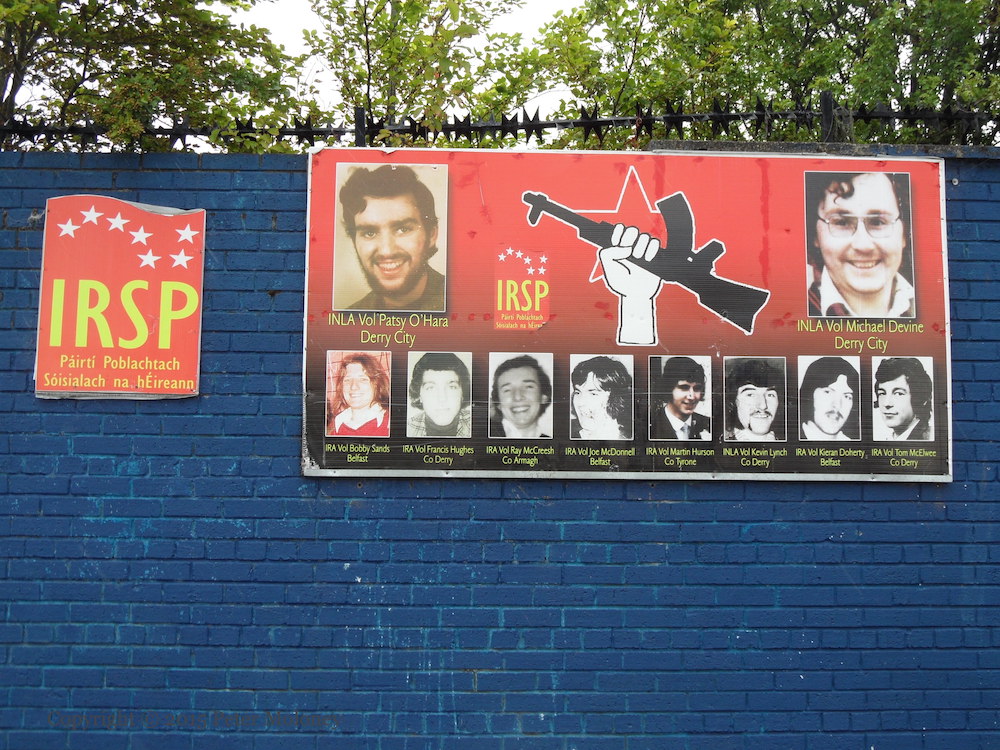
Second (right): two hunger-strikers from Derry, Patsy O’Hara and Michael Devine, were both members of the INLA; the third INLA hunger-striker was Kevin Lynch, from nearby Dungiven. The seven others who died were members of the IRA, whose political wing was Sınn Féın, while the IRSP (web), who sponsored this board, serve as the political face of the INLA.
This is a vintage cut-out in the Sunnylands estate (visible in 2008 Google Street View). The central board – a RHC emblem – had a plastic or paper layer between the star/wings and the circular back-board with red-white-and-blue colours and the words “Red Hand Commando” in a circle. The hooded gunmen on either side each appear to be a single, painted, carving.
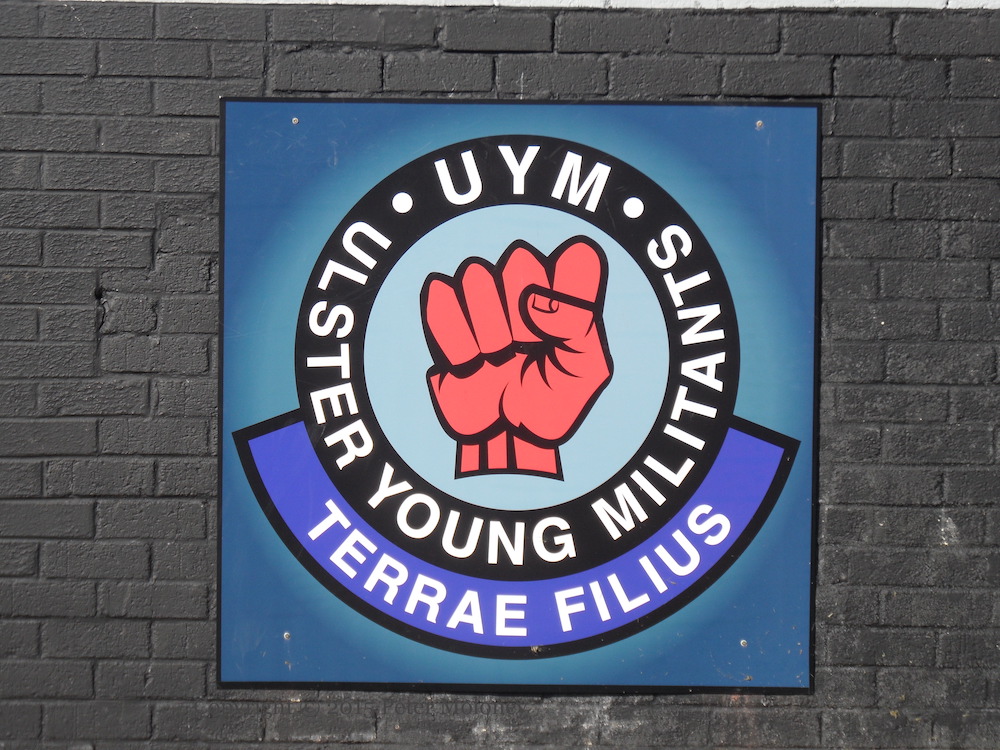
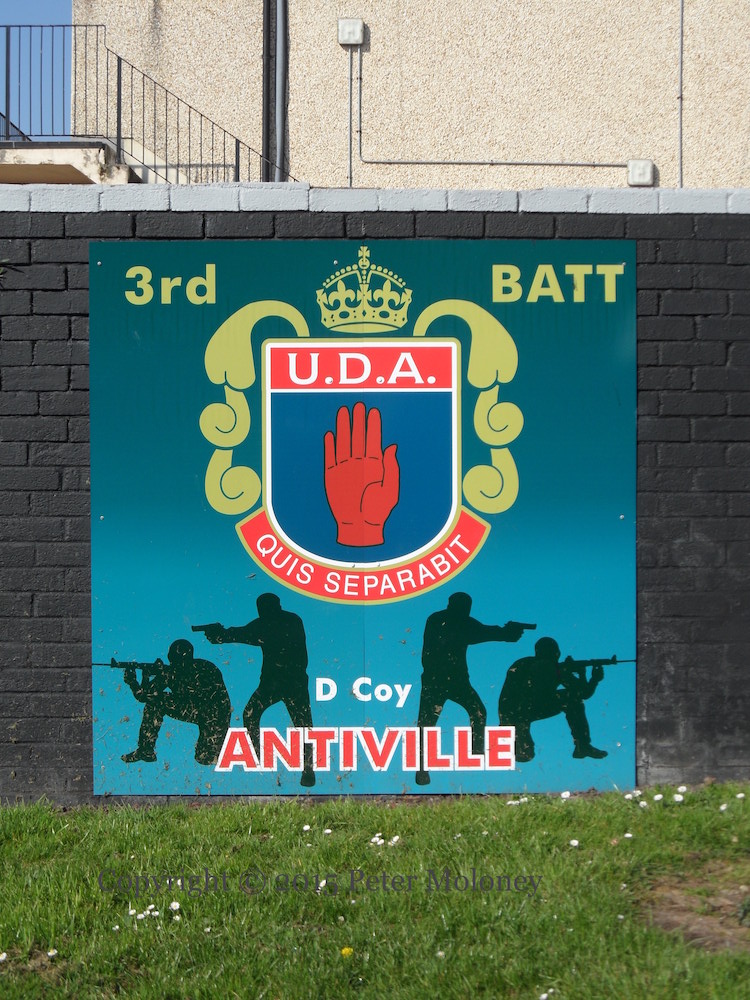
This is a very aggressive set of boards, in Hampton Crescent behind the Antiville (Larne) community centre: two of them show silhouetted UDA (3rd battalion, D company) gunmen in active poses, and another deploys the fearsome figure of Eddie The Head. Rather than the Union flag that he carries in other murals and on the original Iron Maiden album cover (see Eddie’s Visual History page), in this version “The Trooper” carries a UDA flag (with the UFF symbol also shown). “AYM” is presumably “Antiville Young Militants”.
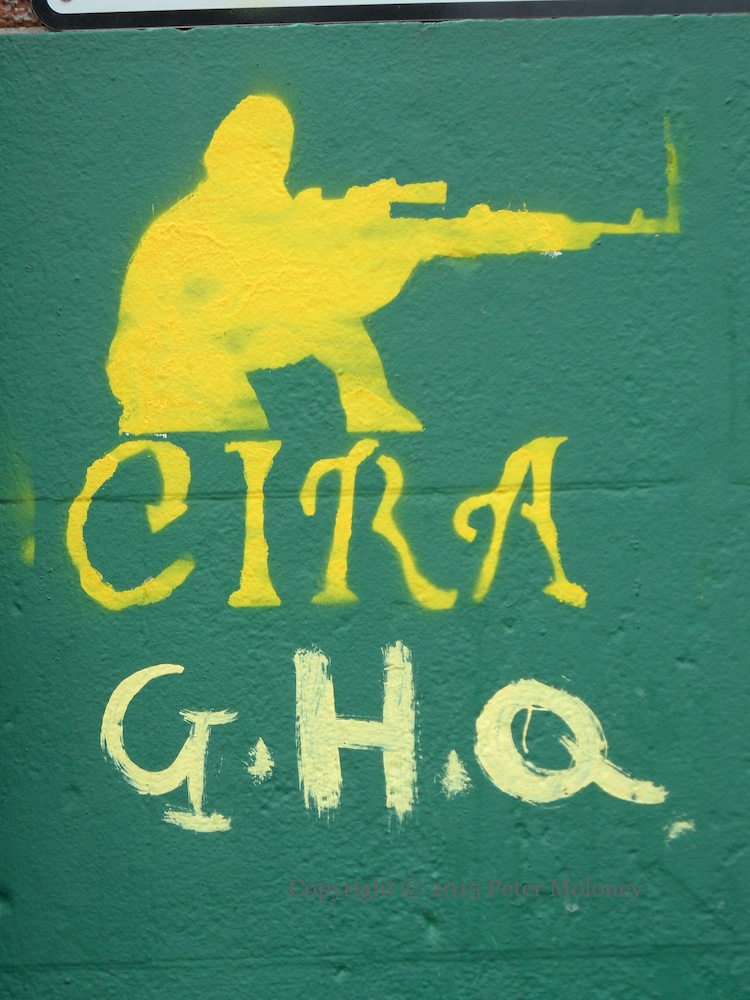
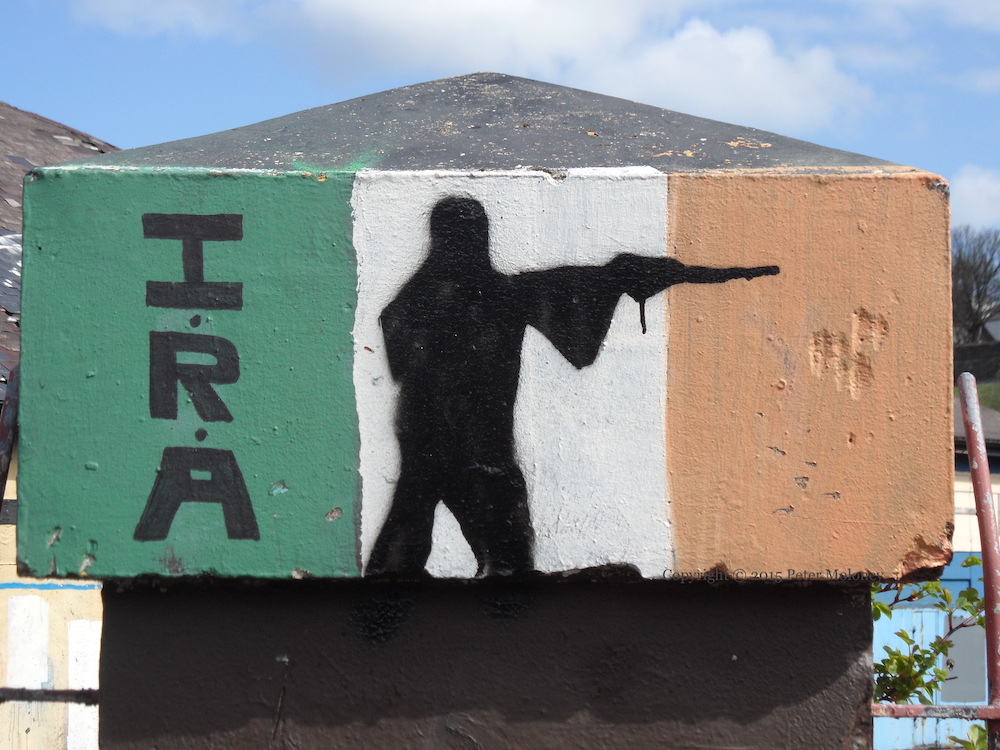
The stencil might be crude but the intent is clear: to suggest that the anti-Agreement IRA (probably the Continuity IRA, specifically) intend to continue the physical fight against British occupation.
Here are a number of republican pieces from Roslea/Rosslea, Co Fermanagh:
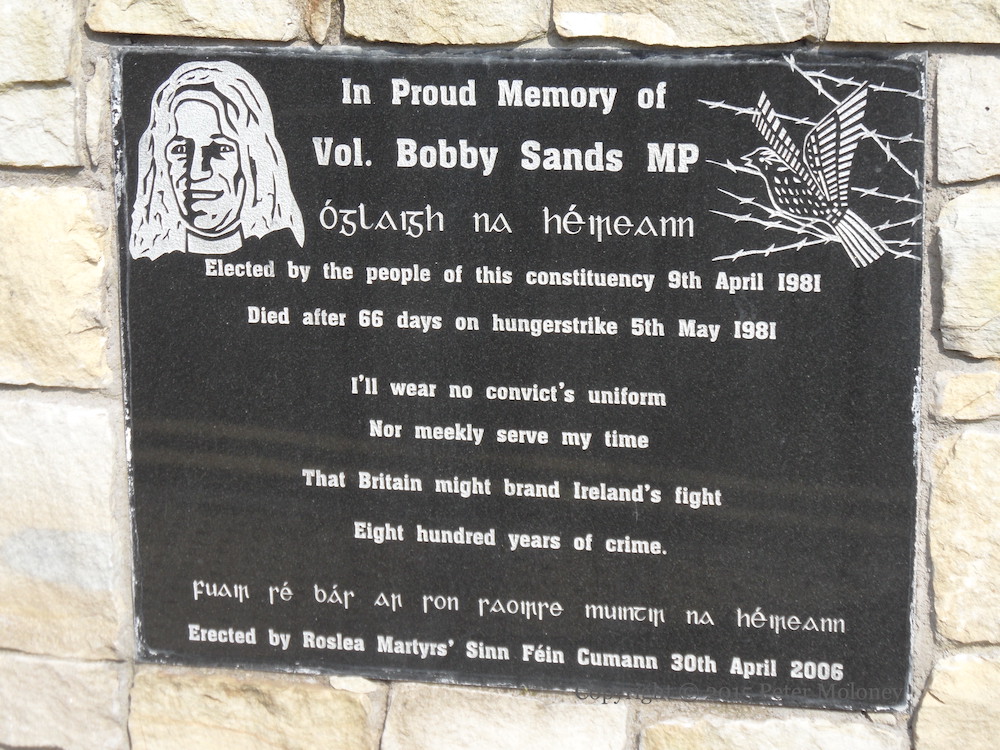
“In proud memory of Vol. Bobby Sands MP Óglaıgh Na hÉıreann. Elected by the people of this constituency 9th April 1981. Died after 66 days on hungerstrike 5th May 1981. ‘I’ll wear no convict’s uniform/Nor meekly serve my time/That Britain might brand Ireland’s fight/Eight hundred years of crime’. Fuaır sé bás ar son saoırse muıntır na hÉıreann.”
Sands’s poem The Rhythm Of Time is at the centre of portraits of the twelve dead hunger strikers in the Troubles era; the board was mounted in 2011 for the thirtieth anniversary of the 1981 strike. The text at the bottom includes this line: “The use of the hunger-strike by Irish republicans began when James Connolly, while imprisoned during the 1913 ‘lock-out’, went on hunger strike.”
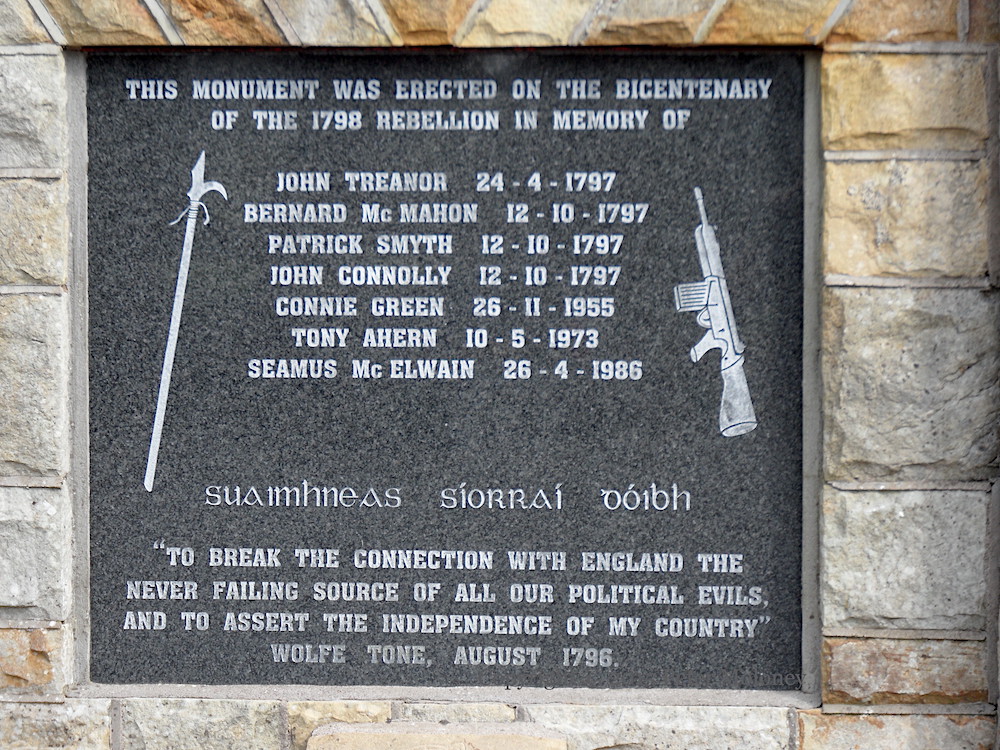
“This monument was erected on the bicentenary of the 1798 rebellion in memory of John Treanor 24-4-1797, Bernard McMahon 12-10-1797, Patrick Smyth 12-19-1797, John Connolly 12-10-1797, Connie Green 26-11-1955, Tony Ahern 10-5-1973, Seamus McElwain 26-4-1986. Suaımhneas síorraí dóıbh. [eternal rest [be] upon them] ‘To break the connection with England the never failing source of all our political evils, and to assert the independence of my country’ – Wolfe Tone, August 1796 [‘An Argument on Behalf of the Catholics of Ireland by a Northern Whig’, September, 1791]”














 Peter Moloney Collection