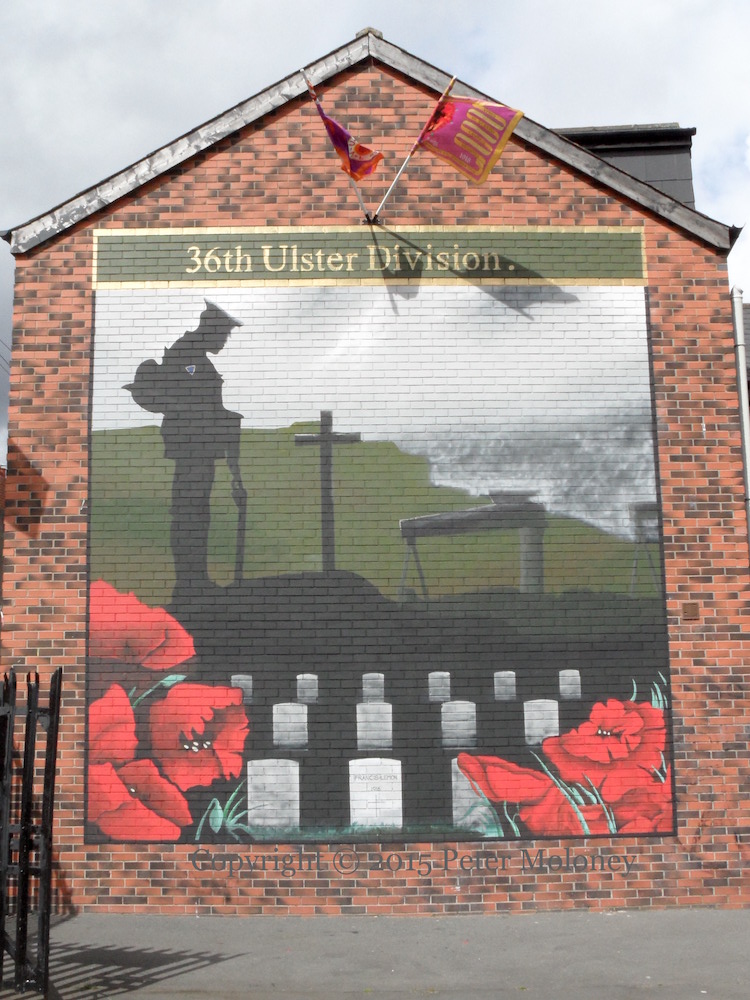
Samson and Goliath, the cranes of the Harland & Wolff shipyard in east Belfast, stand alongside crosses on the burial grounds of the 36th (Ulster) Division in Flanders (though Cave Hill might be in the background) in this Flora Street mural in east Belfast. UVF flags fly overhead.
On the headstone in the front-middle is written “Francis Lemon 1916”, perhaps this Francis Lemon, from Ballymacarrett, who died on July 2nd: FindAGrave | IWM.
This is a new (2015-05) mural in Flora Street, east Belfast.
There is a new ‘Young Conquerors flute band’ mural in Pine Street, south Belfast, connecting the band to local soldiers who died in WWI. (Previous mural.)
The photograph on the left of the main panel is of the original Donegall Pass Defenders flute band, which lasted a short time in the 1970s before the formation of the Conquerors in 1977 (Fb). On the right is the patch of the band.
The small board reads “DPYM” – perhaps “Donegall Pass Young Militia”
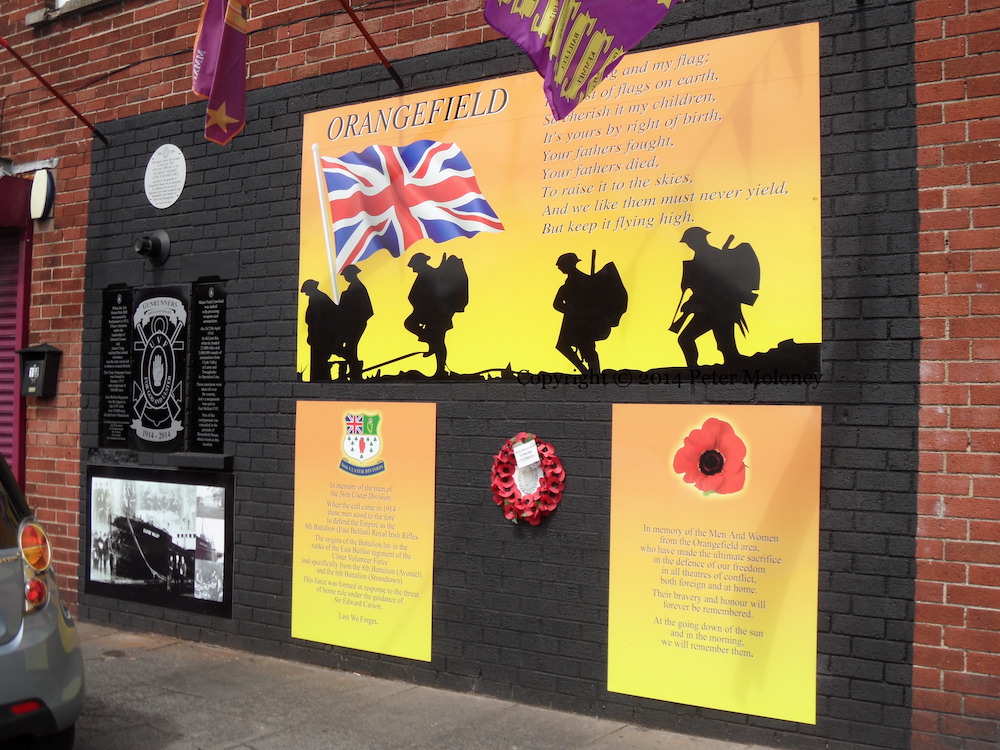
The boards on the left celebrate the 100th anniversary of the 1914 Clyde Valley gun-running; material from the operation was held for the East Belfast battalion of the Ulster Volunteers at Bloomfield House (web), site of these boards. See also: John Henry Patterson’s involvement in Operation Lion.
“When the 3rd Home Rule Bill was passed by Parliament in 1912, Ulster Unionists under the leadership of Edward Carson and James Craig realised that armed resistance was the only resort left to them to remain British. The Ulster Volunteer Force was formed in January 1913 and comprised of 100,000 men. East Belfast Regiment was the largest in the UVF with over 10,000 men divided into 6 Battalions: 1st. Ballynafeigh & Newtownbreda, 2nd. Willowfield, 3rd. Mountpottinger, 4th. Victoria, 5th. Avoniel, 6th. Strandtown & Knock. Major Fred Crawford was tasked with procuring weapons and ammunition. On 24/25th April 1914 he did just this when landed 25,000 rifles and 3,000,000 rounds of ammunition from Clyde Valley at Larne and Donaghadee in Operation Lion. These munitions were taken all over the country, and a consignment was sent to East Belfast UVF. Part of this consignment was concealed in the grounds of Bloomfield House, which stood on this location.”
“This plaque marks the occasion in early May 1914 when over 2,000 men of the East Belfast Regiment, Ulster Volunteer Force paraded to the grounds of Orangefield House for an inspection to celebrate the success of Operation Lion when weapons and ammunition were landed at Larne and Donaghadee. For God and Ulster.”
The boards on the right read: “‘Tis thy flag and my flag;/The best of flags on Earth,/So cherish it my children,/It’s yours by right of birth.//Your fathers fought,/Your fathers died,/To raise it to the skies,/And we like them must never yield,/But keep it flying high.” from The UnionJack, by Edward Shirley, in Little Poems For Little People, and “In memory of the men and women from the Orangefield area, who have made the ultimate sacrifice in the defence of our freedom in all theatres of conflict, both foreign and at home.” These memorial boards are to local men who “stood to the fore to defend the Empire as the 8th Battalion (East Belfast) Royal Irish Rifles” in the 36th division, formed from formed from the “8th Battalion (Avoniel) and the 6th Battalion (Strandtown)” of the Ulster Volunteers.
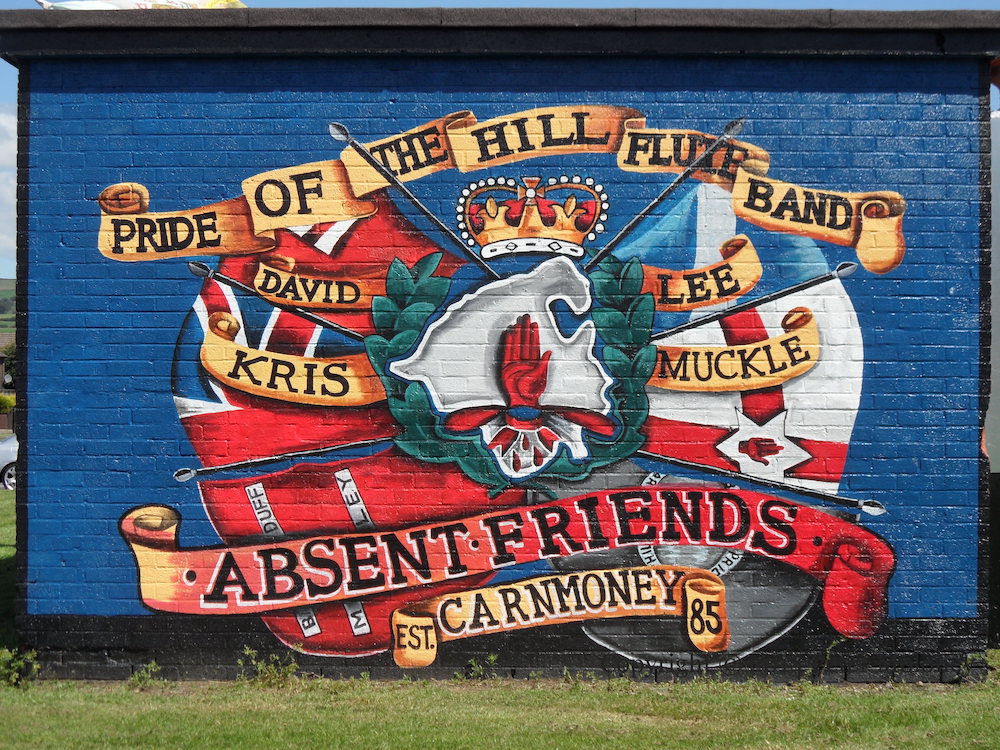
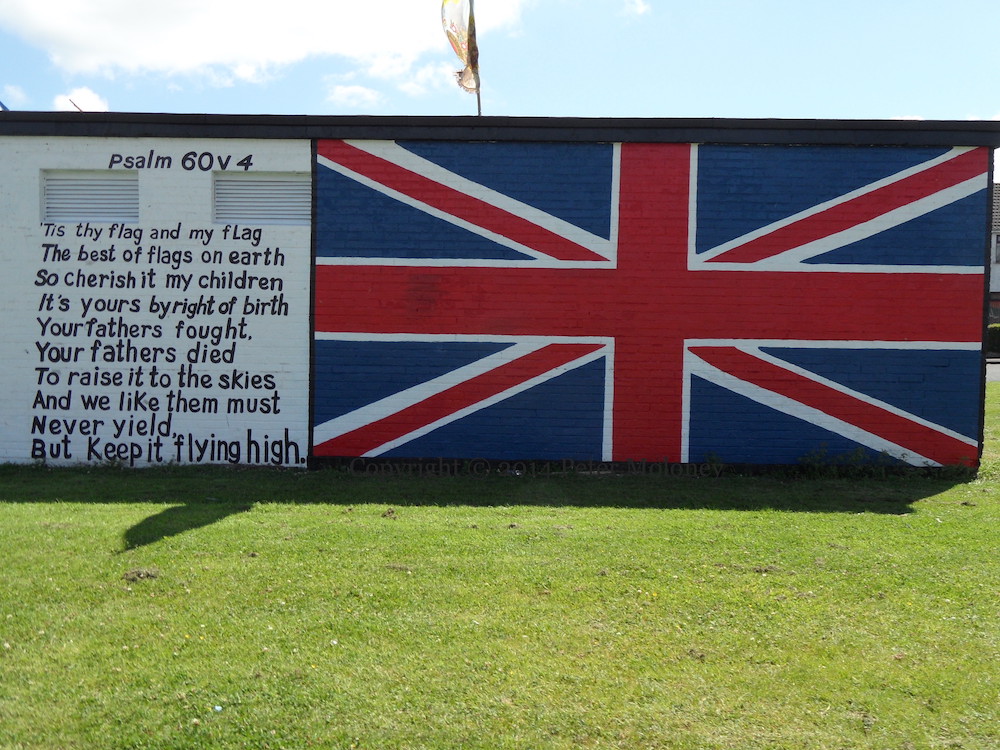
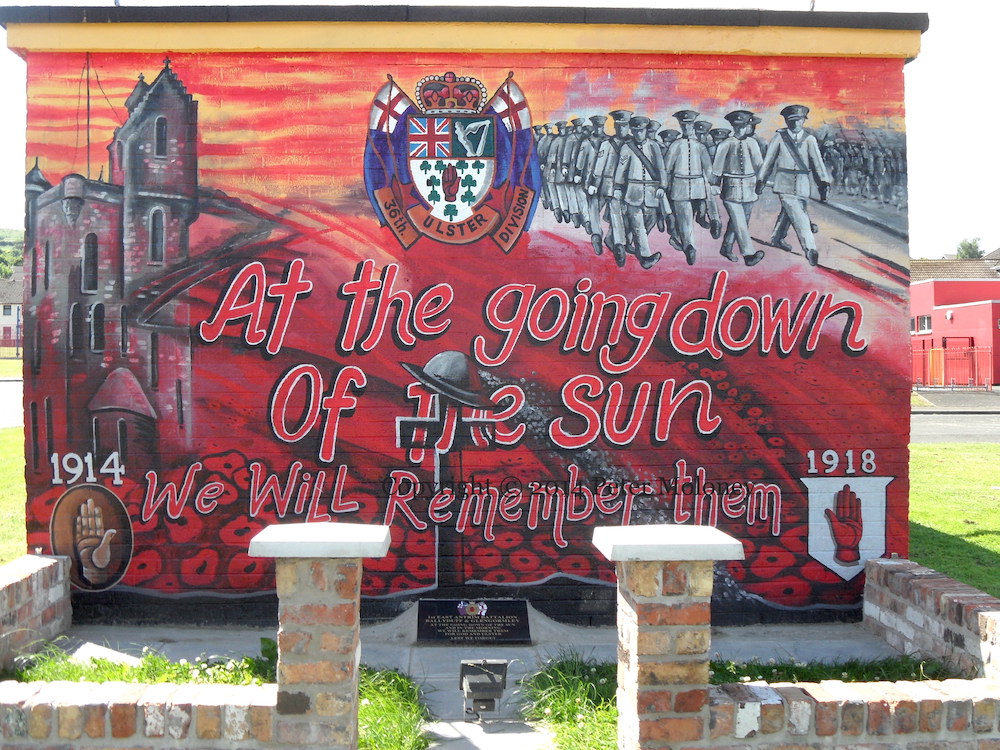
This large electrical sub-station, painted on all four sides, is in Ballyduff, Newtownabbey.
First: David Lee was a founder, in 1985, of Pride Of The Hill Flute Band in Carnmoney/Ballyduff. Kris Muckle – now deceased – was a long-time member. (Fb)
Second: Translations of Psalm 60.4 vary, but it is something like “You (the Lord) have given those who fear you a banner so that they will not flee before your arrows”, which might work quite well alongside a Union jack. But in fact, the lines on the side of the sub-station come do not come from Psalm 60.4; they are rather the first stanza of a 1902 poem (earliest found mention), The UnionJack, by Edward Shirley, in Little Poems For Little People:
‘Tis thy flag and my flag, the best of flags on earth; Oh, cherish it my children, for ’tis yours by right of birth. Your fathers fought, your fathers died, to rear it to the skies; And we like them will never yield, but keep it flying high.
Third and fourth: “They paid the ultimate sacrifice”. WWI soldiers from the 36th (Ulster) Division in relief against an orange sky (perhaps “at the going down of the sun”), picking their way across the battlefields of Flanders. The Ulster Memorial at Thiepval, which commemorates the 5,000 lost lives and more specifically the role of Orange Order members, is shown in the top left corner of the smaller wall. The plaque commemorates members of the modern UVF “1st East Antrim Battalion, Ballyduff & Glengormley”.
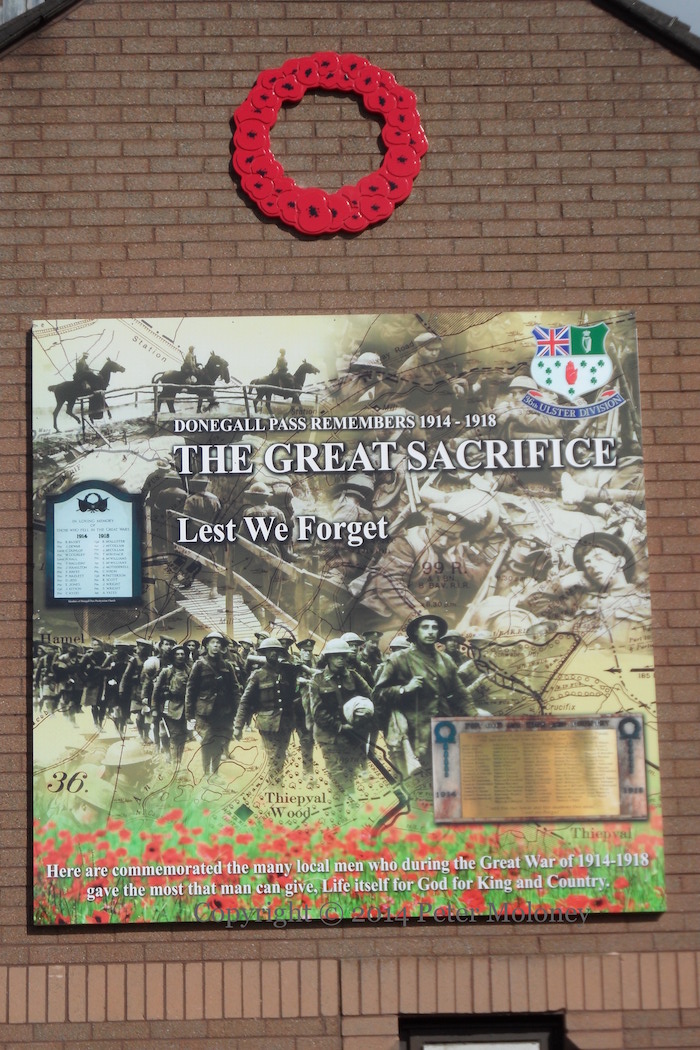
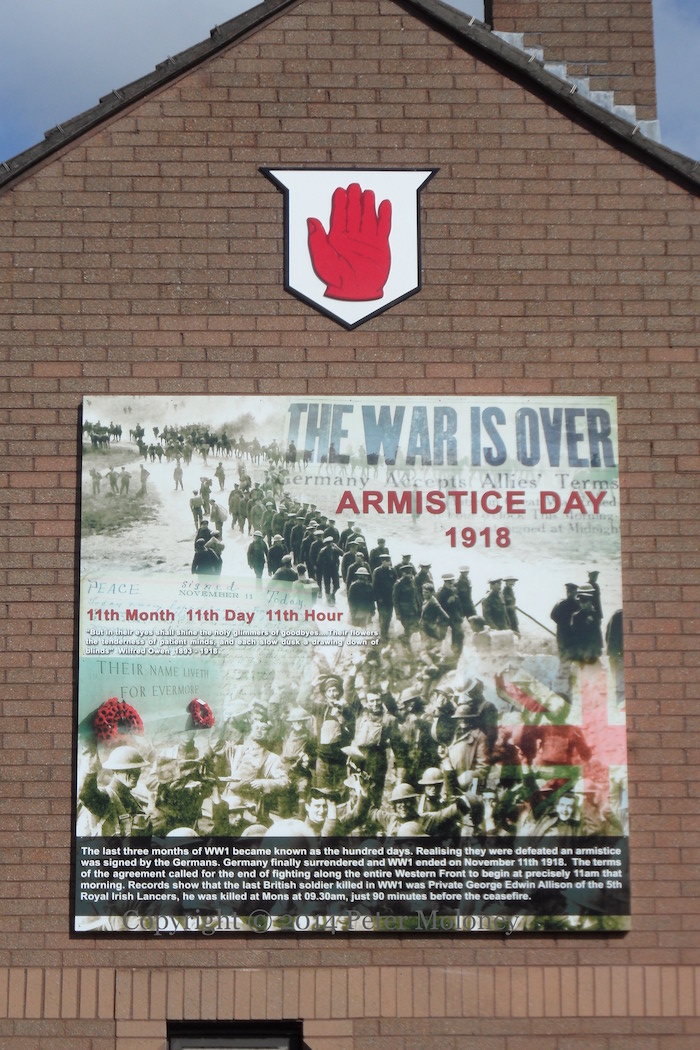
Here are three boards in Lindsay Street, south Belfast, chronicling the 1912 Covenant and the lives lost (by the 36th Division) in the Great War 1914-1918.
“It is needful that we knit together as one man, each strengthening the other, and not holding back of counting the cost” – Ulster [Unionist] Council Resolution 1912.” “Ulster’s solemn league and covenant. Ulster Day 28th September 1912.” The Council met on September 23rd and 471,000 people signed the covenant (figures here) on or around the 28th – Ulster Day – led by Sir Edward Carson.
“Donegall Pass remembers 1914-1918 – the great sacrifice. Lest we forget. Here are commemorated the many local men who during the Great War of 1914-1918 gave the most that man can give: life itself for God for King and Country.” With a map of the northern end of the Western Front and images of soldiers marching, on horseback, and in the trenches.
“The war is over. Armistice Day 1918. 11th month, 11th day, 11th, hour.” “But in their eyes shall shine the holy glimmers of goodbyes … Their flower the tenderness of patient minds, and each slow dusk a drawing down of blinds.” Lines from Wilfred Owens’ (1893-1918) ‘Anthem For Doomed Youth‘.
At the bottom: “The last three months of WWI became known as the hundred days. Realising they were defeated an armistice was signed by the Germans. Germany finally surrendered and WWI ended on November 11th 1918. The terms of the agreement called for the end of fighting along the entire Western Front to begin a precisely 11 am that morning. Records show that the last British soldier killed in WWI was Private George Edwin Allison of the 5th Royal Irish Lancers. He was killed at Mons at 09:30 am, just 90 minutes before the ceasefire.”
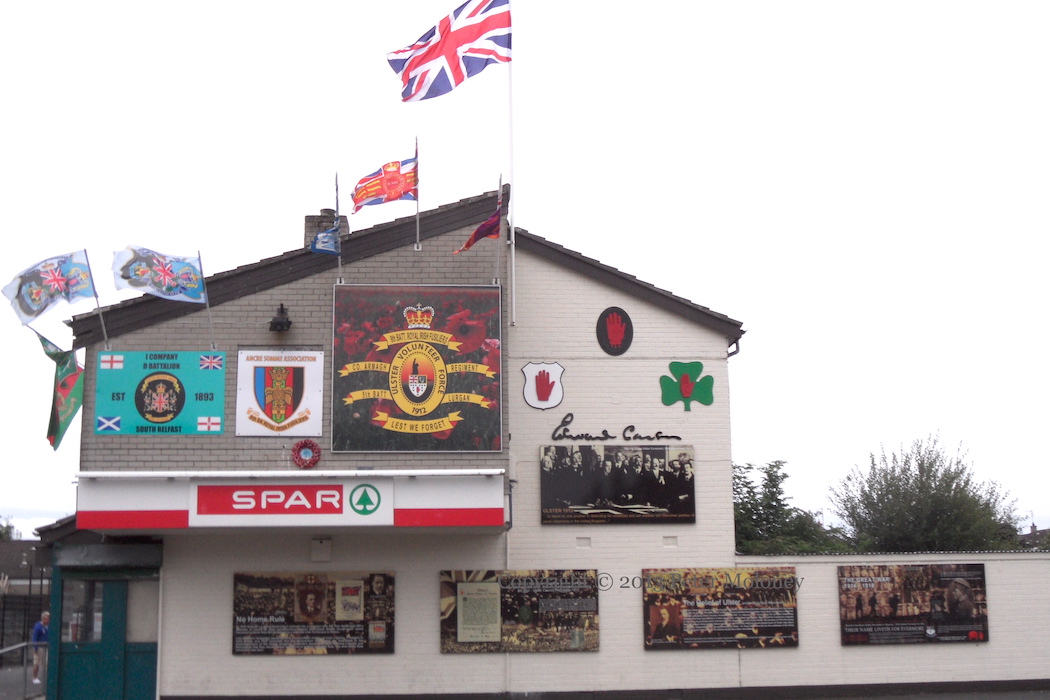
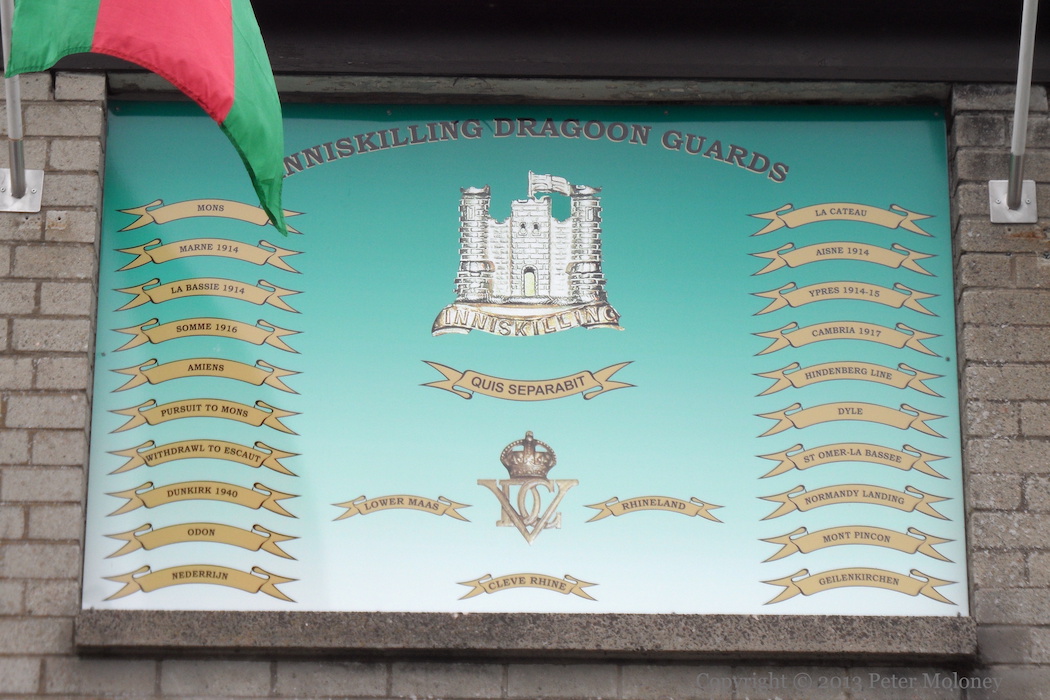
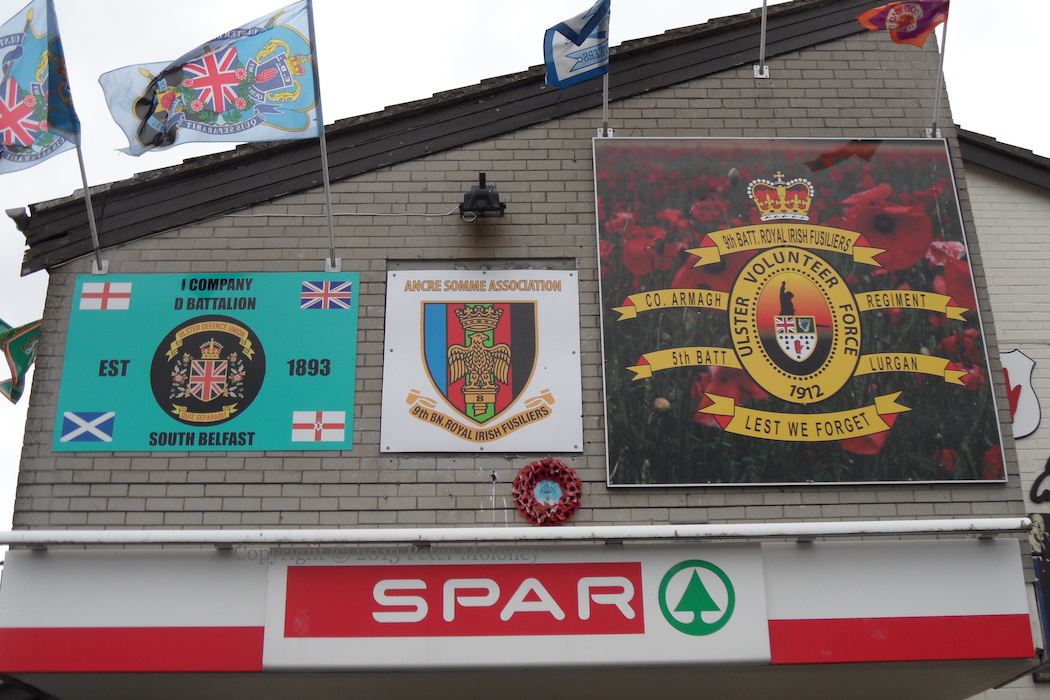
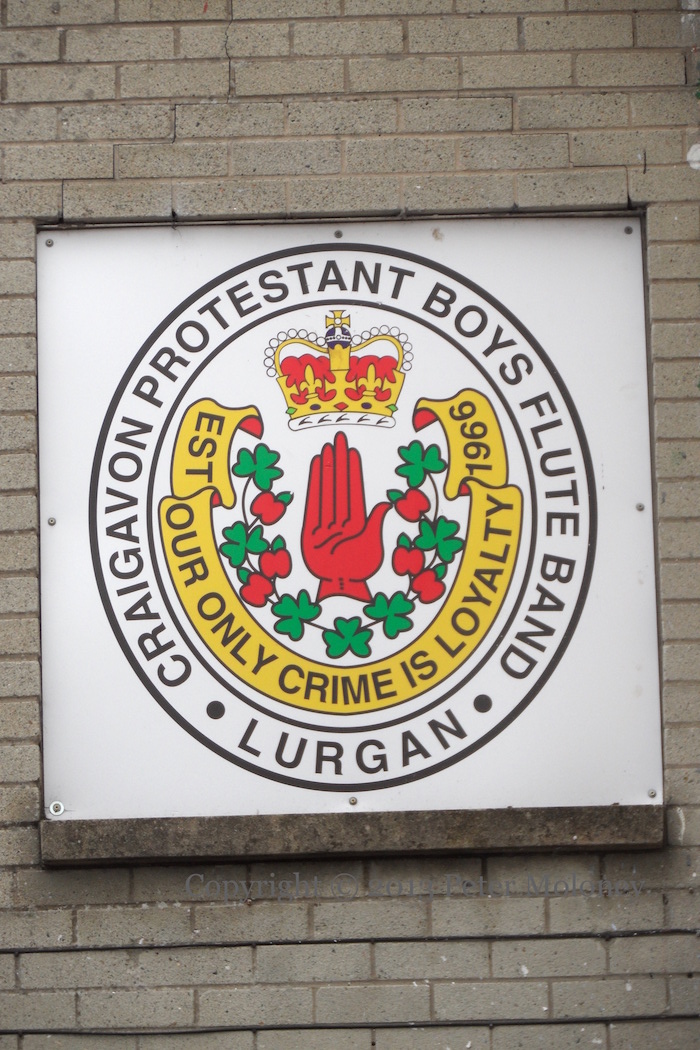
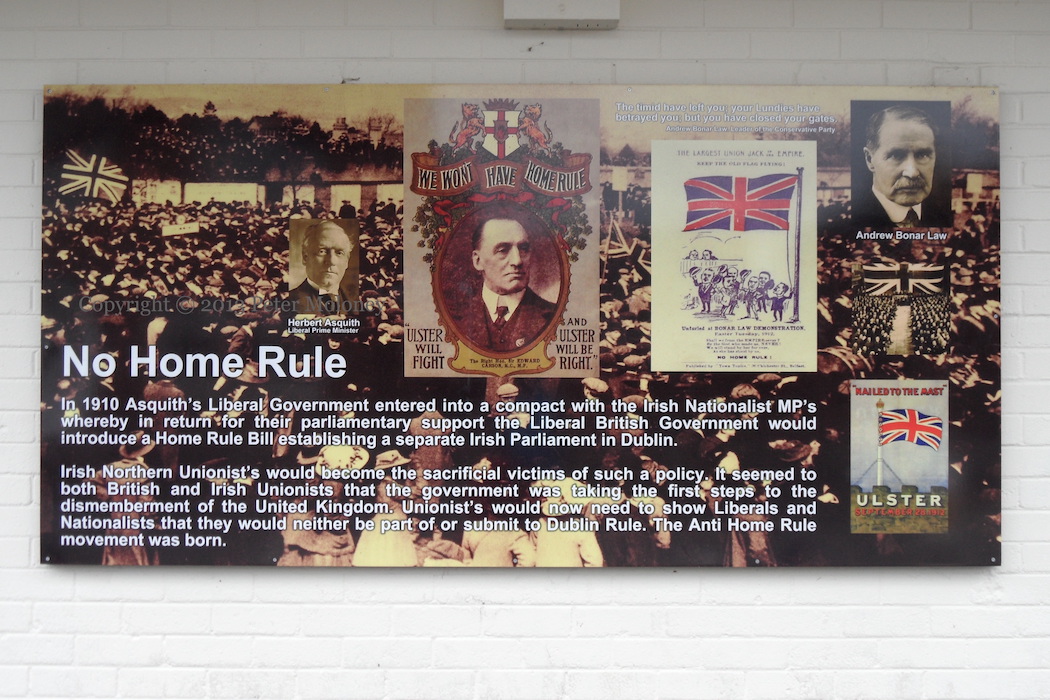
This is the scene at the junction of Pollock Drive and Mourne Road in Mourneview, Lurgan. The images, in order, show the top level of boards (including some on the sides of the building) and then the four along the bottom.
Top: (on side) Inniskilling Dragoon Guards | South Belfast UDA, B battalion, 1 company | Ancre Somme Association | 9th battalion Royal Irish Fusiliers | Craigavon Protestant Boys flute band (Fb) | Carson signing the Covenant in 1912 | (on side, above Mourneview Youth) Upper Bann Fusiliers flute band (Fb) | Upper Bann Fusiliers
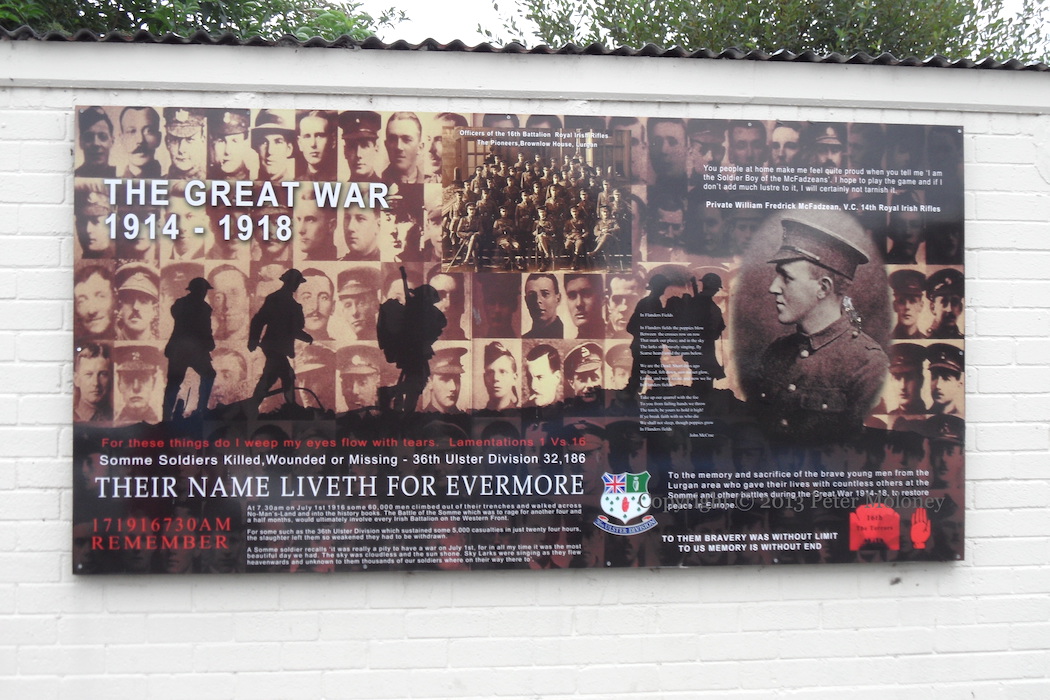
Bottom: No Home Rule including the unfurling of “The Largest Union Jack In The Empire” | The Covenant | The Relief Of Ulster including the Ulster Volunteers and the Larne gun-running | The Great War including the VC won by William MacFadzean – “To them, bravery was without limit; to us, memory is without end”.
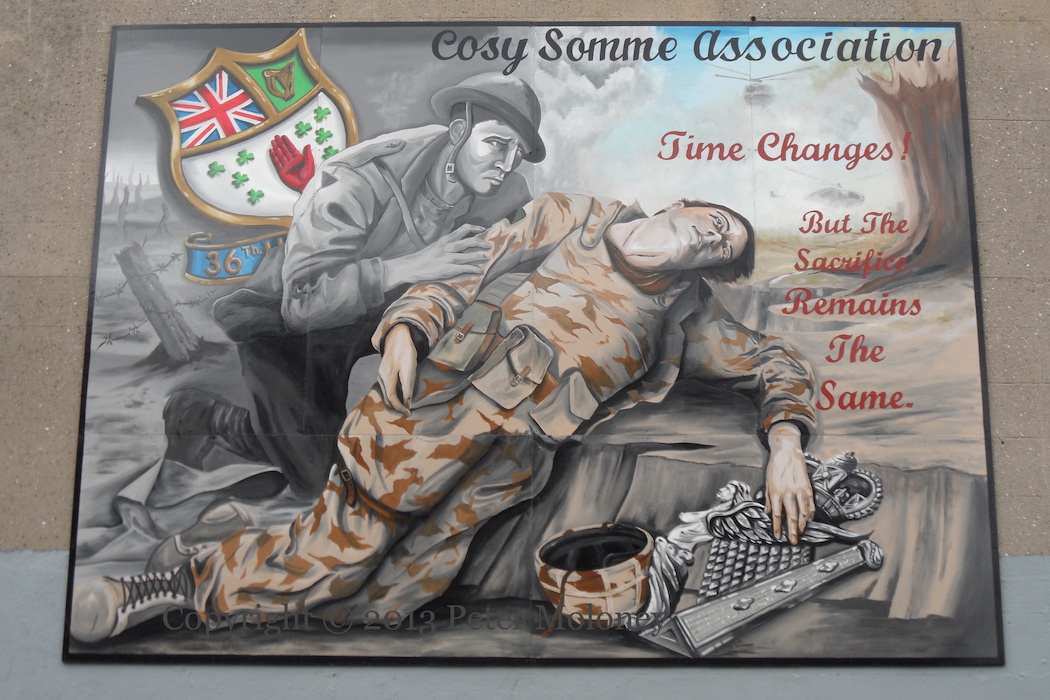
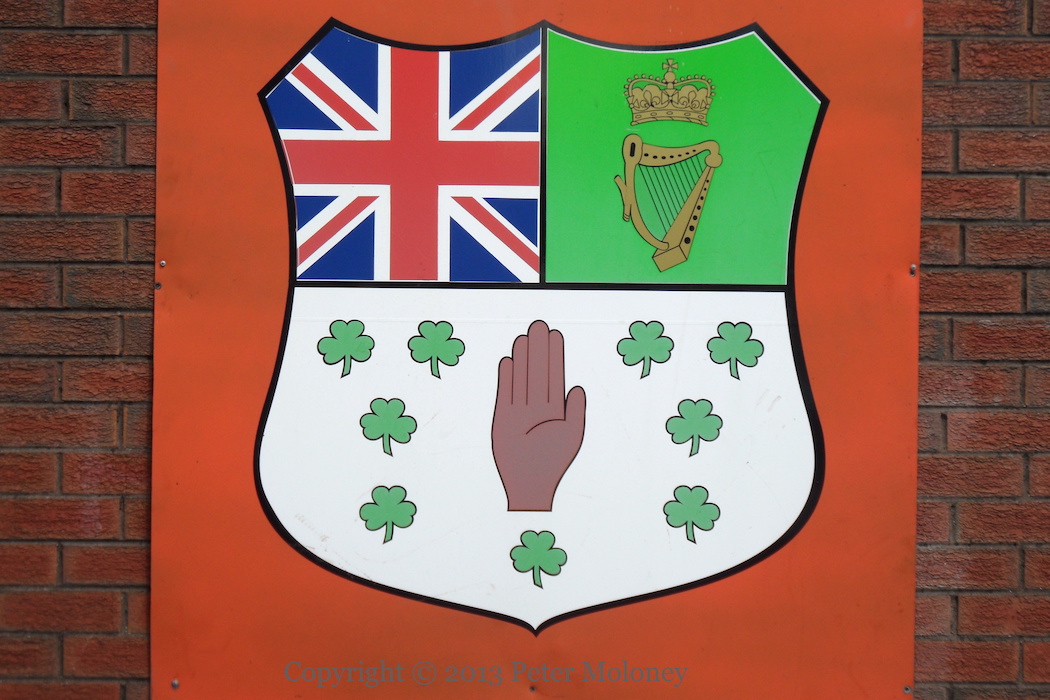
“Time changes! But the sacrifice remains the same.” Pictured is a board in Ogilvie Street in east Belfast, sponsored by the EU and the Cosy Somme Association, showing, in black and white, a WWI soldier, who is comforting another solider, in modern gear and in colour. The emblems of the 36th (Ulster) division and Royal Irish Rifles are also shown.
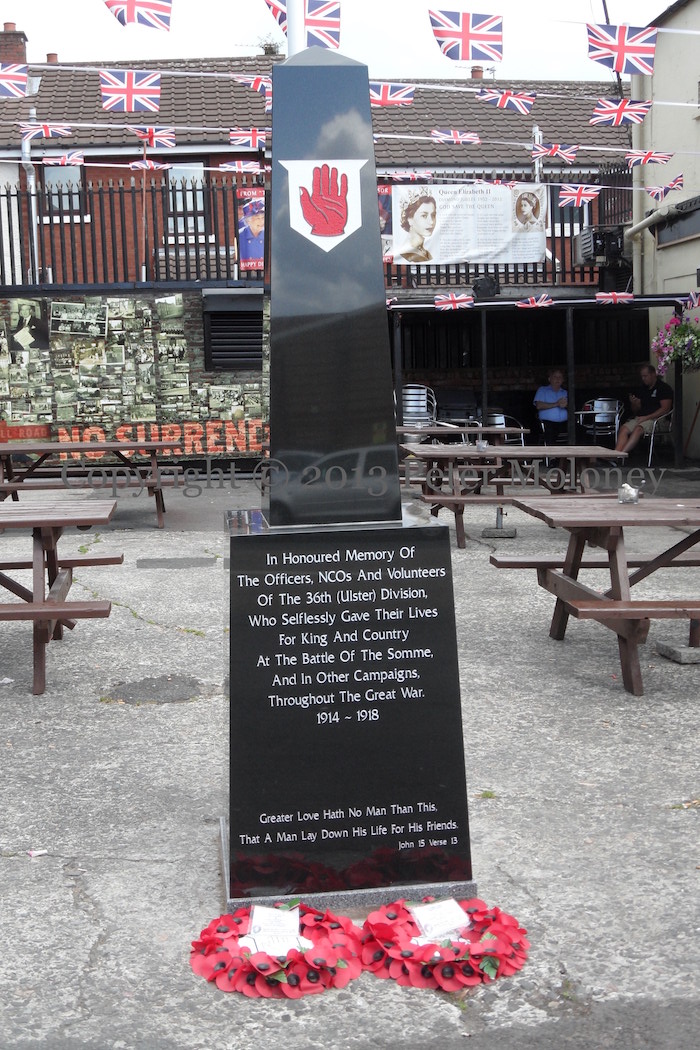
“In honoured memory of the offices, NCOs and volunteers of the 36th (Ulster) Division, who selflessly gave their lives for King and country at the battle of the Somme, and other campaigns, throughout the Great War 1914-1918. ‘Greater love hath no man than this, that a man lay down his life for his friends. John 15 Verse 13′”
The ‘No surrender’ photograph montage shows images of life on the Shankill, from the Home-Rule period onward. It includes various old murals (see Visual History 01) and a photo of Hugh Smyth (see Third-Class Citizens).
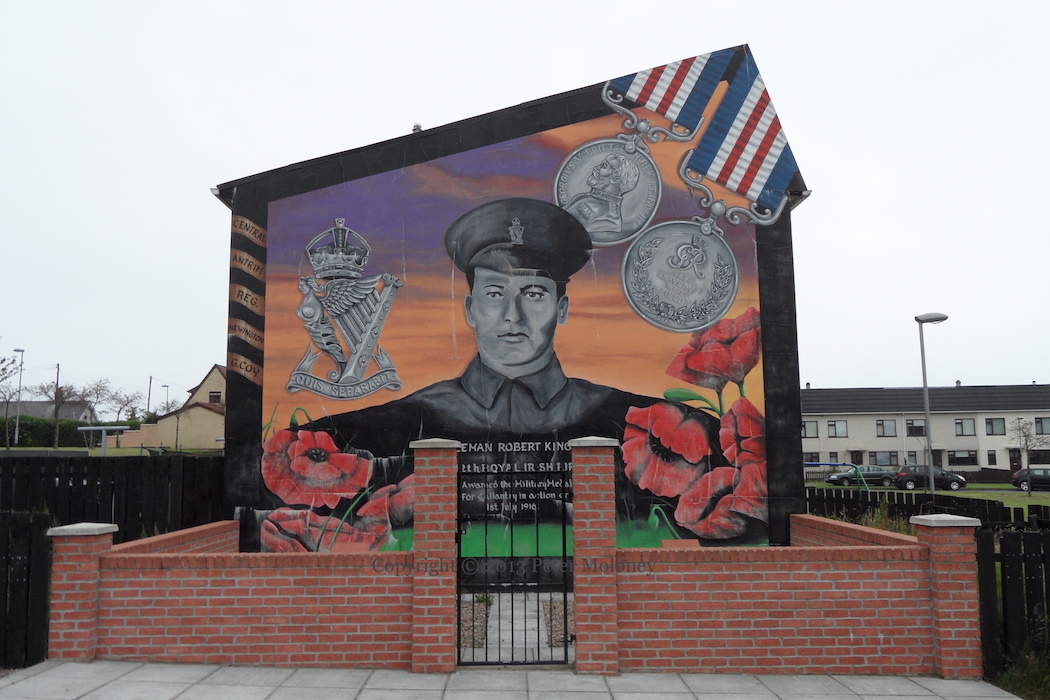
Robert King, of the 12th Royal Irish Rifles, who joined the army from the Ulster Volunteers, was “awarded the Military Medal for gallantry in action on 1st July 1916” at the Somme. The two sides of the medal are shown in the top right, with George V on one side and “for bravery in the field”. The 12th Rifles were drawn from the Central Antrim regiment of the Ulster Volunteers including the Newington area of Larne; King, however, was from Ship Street.
“1st July 1916. Somme soldiers killed, wounded, missing, 36th (Ulster) Division, 32,186. To the memory and sacrifice of the brave young men from North Antrim who gave their lives with countless others at the Somme and other battles during the Great War 1914-18, to restore peace in Europe. To them bravery was without limit; to us memory is without end.”













 Peter Moloney Collection