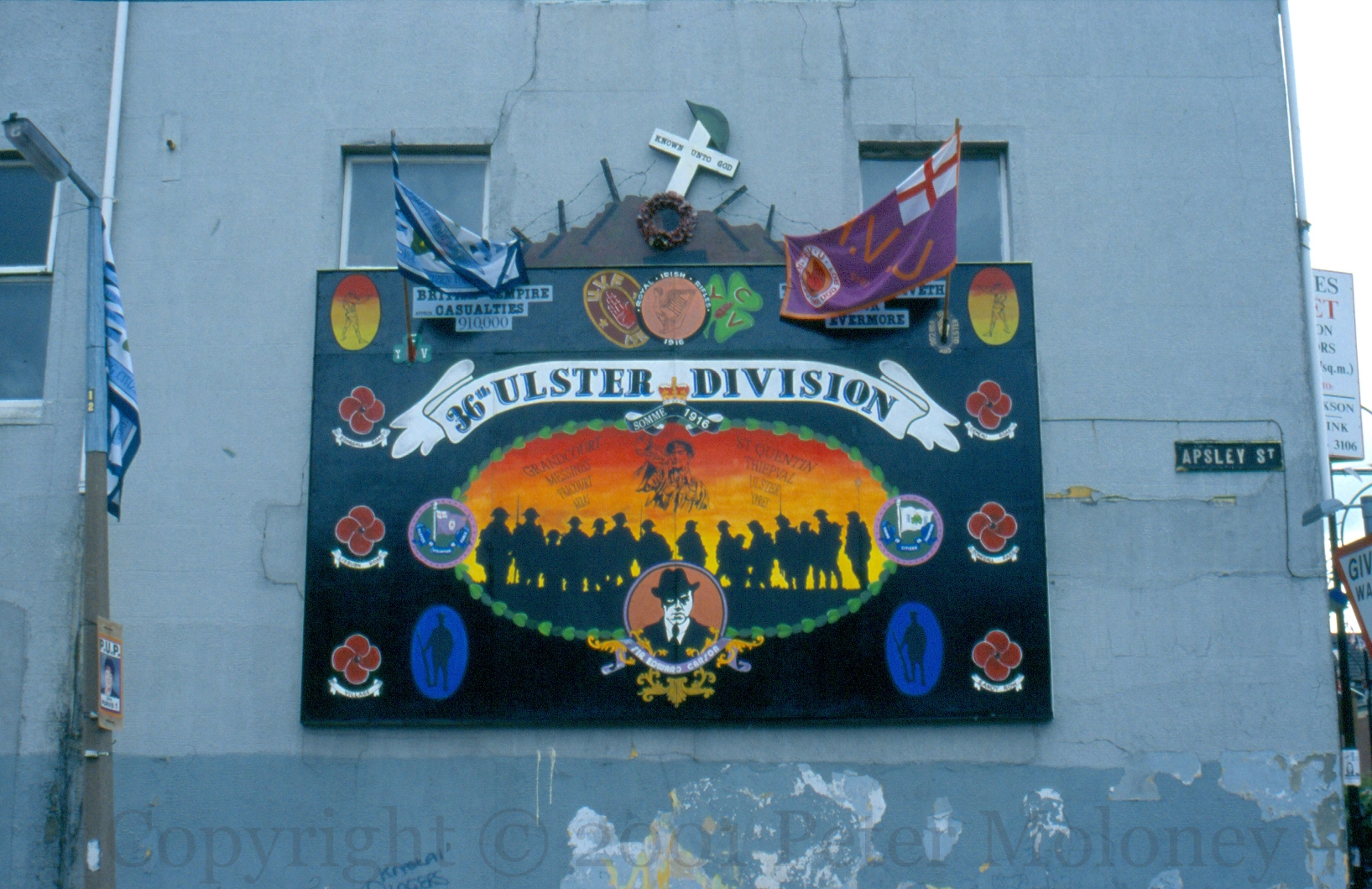
The apocryphal book of the Bible Ecclesiasticus reads “their bodies are buried in peace, but their name liveth for evermore” (44:14), which is here applied to 910,000 “British empire casualties” from the Great War, including the Ulster Volunteers and Young Citizen Volunteers raised by “Sir Edward Carson” which became the 36th (Ulster) Division and particularly the Royal Irish Rifles and fought at the Somme 1916.
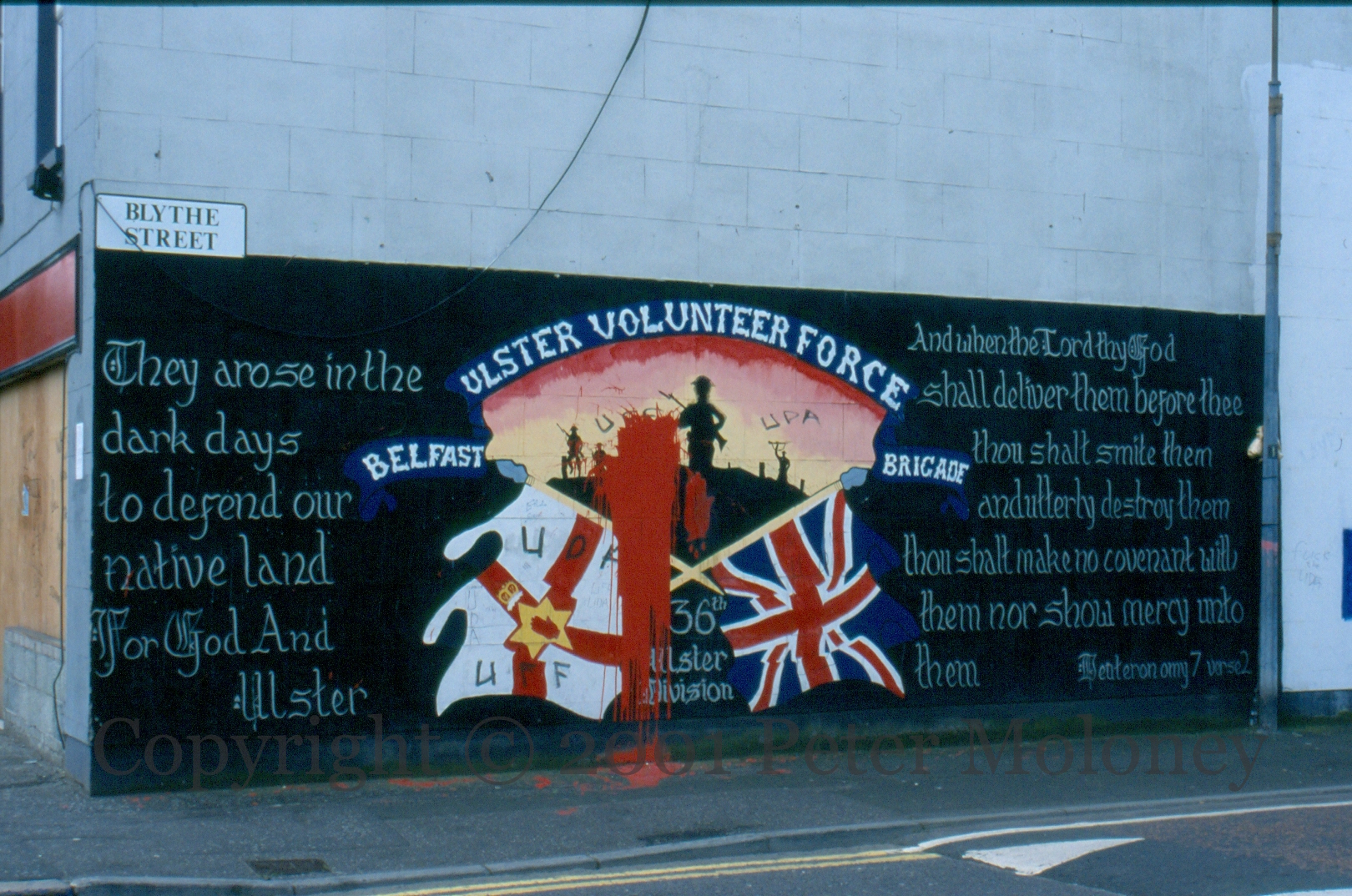
Paint-bombed mural to members of the Ulster Volunteer Force, Belfast Brigade, in the 36th (Ulster) Division, with (anachronistic) Ulster Banner and Union Flag: “they arose in the dark days to defend our native land for God and Ulster”, “And when the Lord thy God shall deliver them before thee, though shalt smite them and utterly destroy them, thou shalt make no covenant with them nor show mercy unto them – Deuteronomy 7 verse 2”.
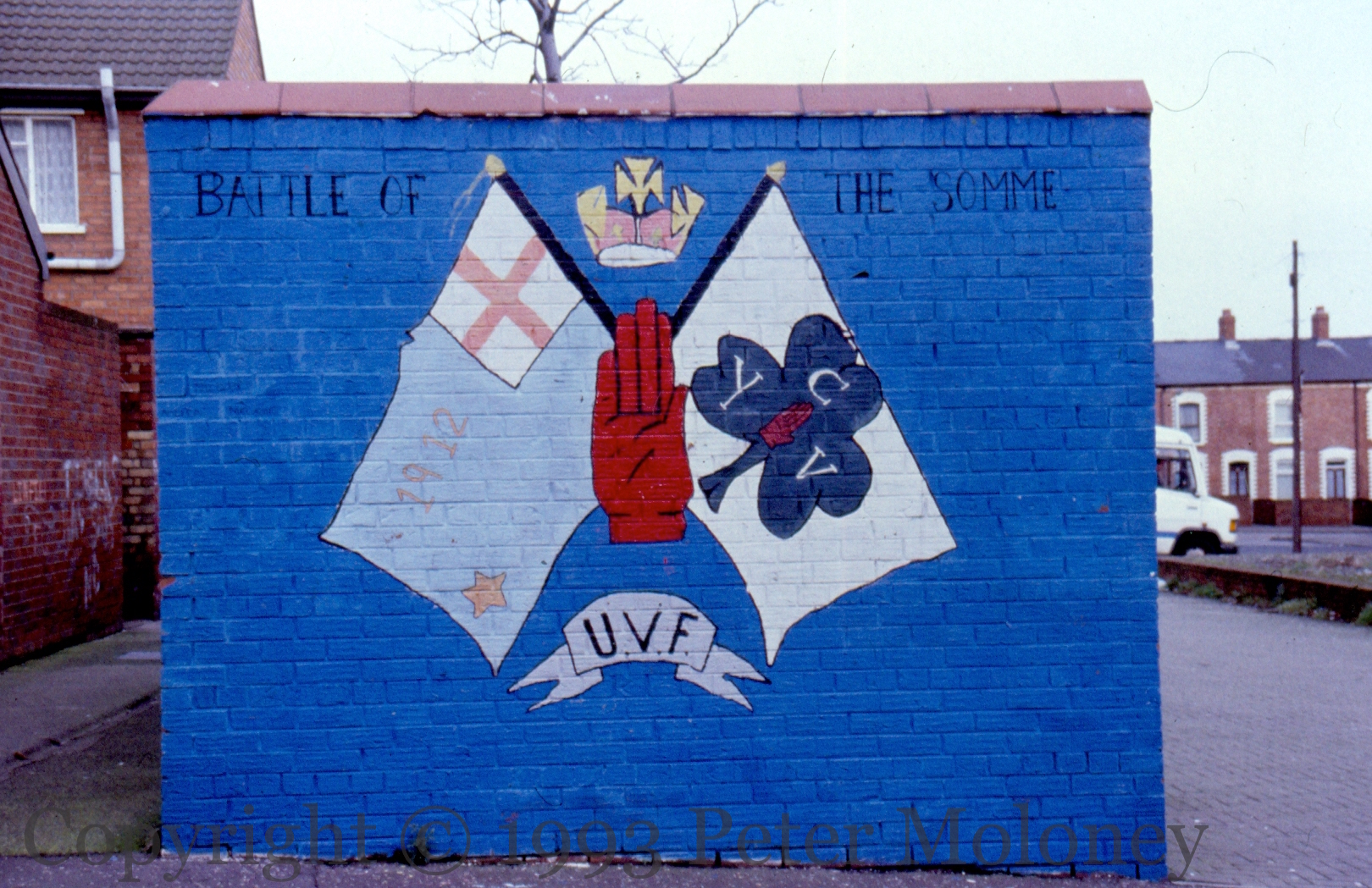
Mural to the memory of soldiers in the 36th (Ulster) Division and the Young Citizen Volunteers (whose emblem involves the shamrock and the words “In God our trust”) who died in World War 1.
City Walk (off Rowland Way), Sandy Row, south Belfast
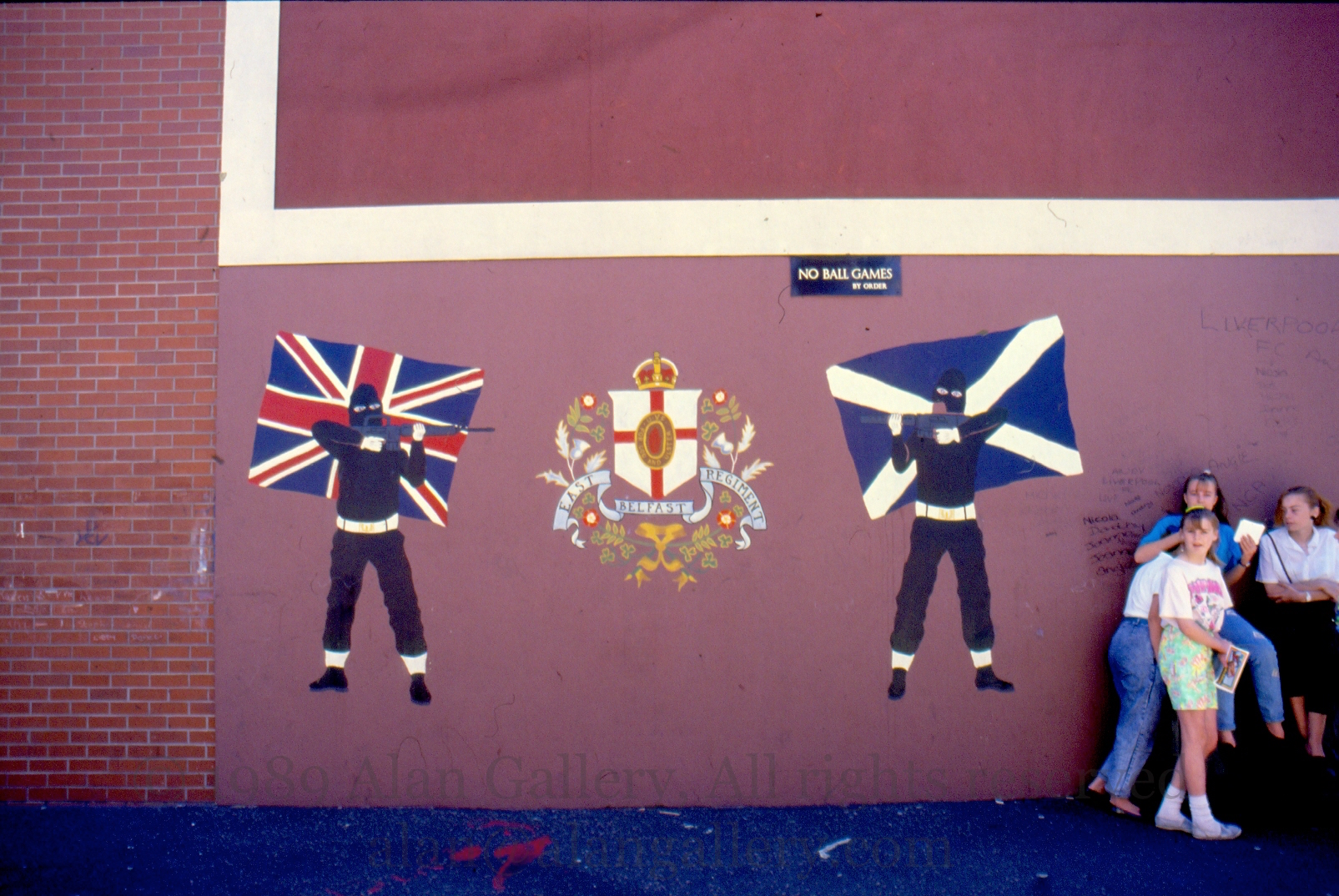
An ornate regimental (WWI) coat of arms, for the East Belfast regiment, with the emblem of the Ulster Volunteers symbol on an Ulster banner shield, topped by a crown and surrounded by an arrangement of roses, thistles, and shamrock. “Contemporised” by masked volunteers with weapons pointed, in front of Union flag and St Andrew’s Saltire. Chelsea Street, Belfast
The West Belfast Ulster Special Service Force (USSF) was a local Shankill unit within the West Belfast regiment of the Ulster Volunteers. It lost 90% of its men at the battle of Albert on July 1st, 1916. For more of its history see BygoneDays.
On the left of the lightning bolt are the soldiers of the 36th Ulster division (U.V.F.) R.I.R (Royal Irish Rifles) on the western front in 1916; on the right are “UVF prisoners of war, Long Kesh”.
A similar board was painted in the UVF compounds of Long Kesh. Of it, Billy Hutchinson (in his 2011 piece “Transcendental Art“) said, “My favourite mural was one inspired by the British anti-war poet, Siegfried Sassoon. Suicide In The Trenches depicts a UVF volunteer split down the middle by a bolt of lightning. Half of him depicts a 36th Ulster Division soldier under heavy fire in a rainsoaked WW1 trench. The other half shows a ’70s volunteer incarcerated behind barbed wire and over-shadowed by watch towers.” (The piece – W2021.1.8 in the Ulster Museum collection – includes the last verse from Sassoon’s Suicide In The Trenches.)
Hutchinson also describes the importance of the Orange Cross welfare organisation in selling prisoner art produced inside the prison. Stevie McCrea of the RHC was killed in the Orange Cross in 1989 – see Stevie McCrea.



 Peter Moloney Collection