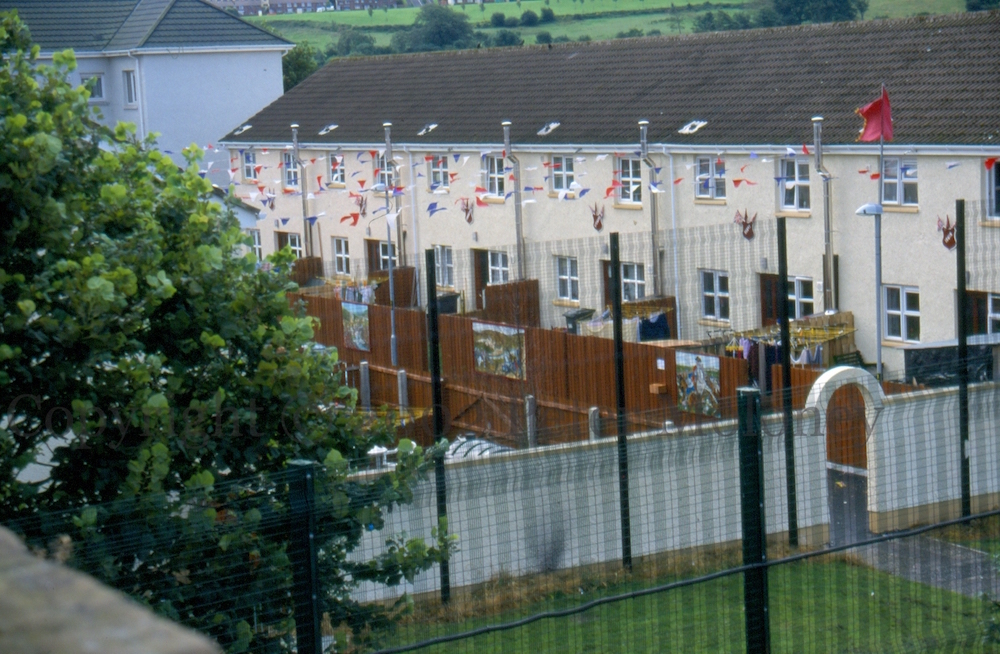
Residents of the upper Fountain decorate their houses with the names of the apprentice boys, with an arch over the gap in the inner “peace” line. Seen previously in 2002 and 2006.
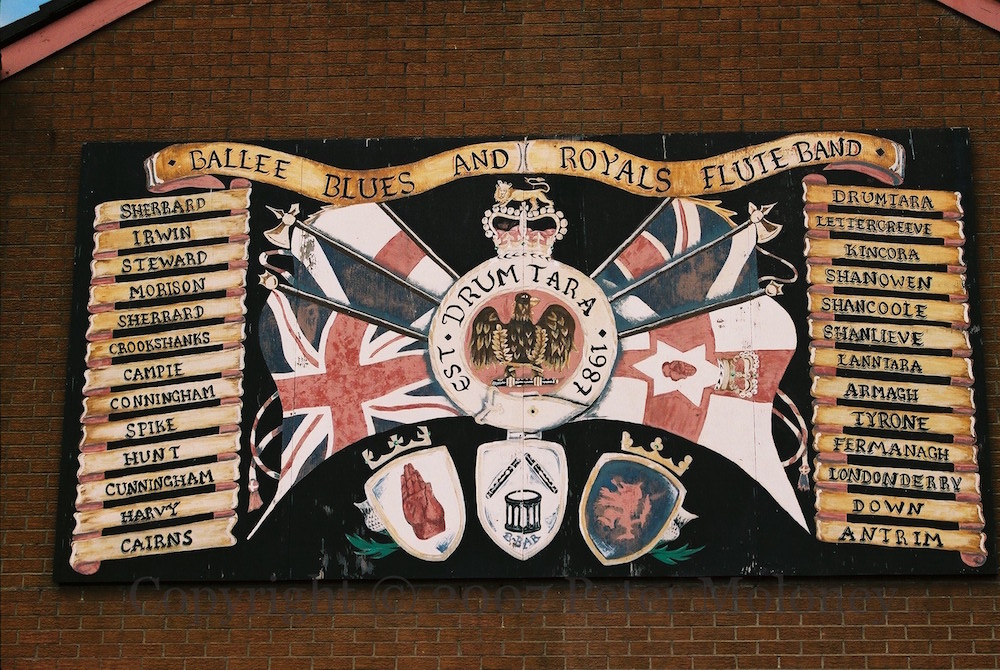
“Ballee Blues And Royals Flute Band, est. 1987” with a list of the Apprentice Boys (on the left) and (on the right) seven streets in the area (Drumtara, Lettercreeve, Kincora, Shanowen, Shancoole, Shanlieve, Lanntara) and the six counties of Northern Ireland. The emblem in the centre is the arm badge of the Blues & Royals (the British Army regiment), featuring the (French) Waterloo Eagle – here carrying a flute. The band does not appear to have persisted past 2012 has since changed its name – see comment below.
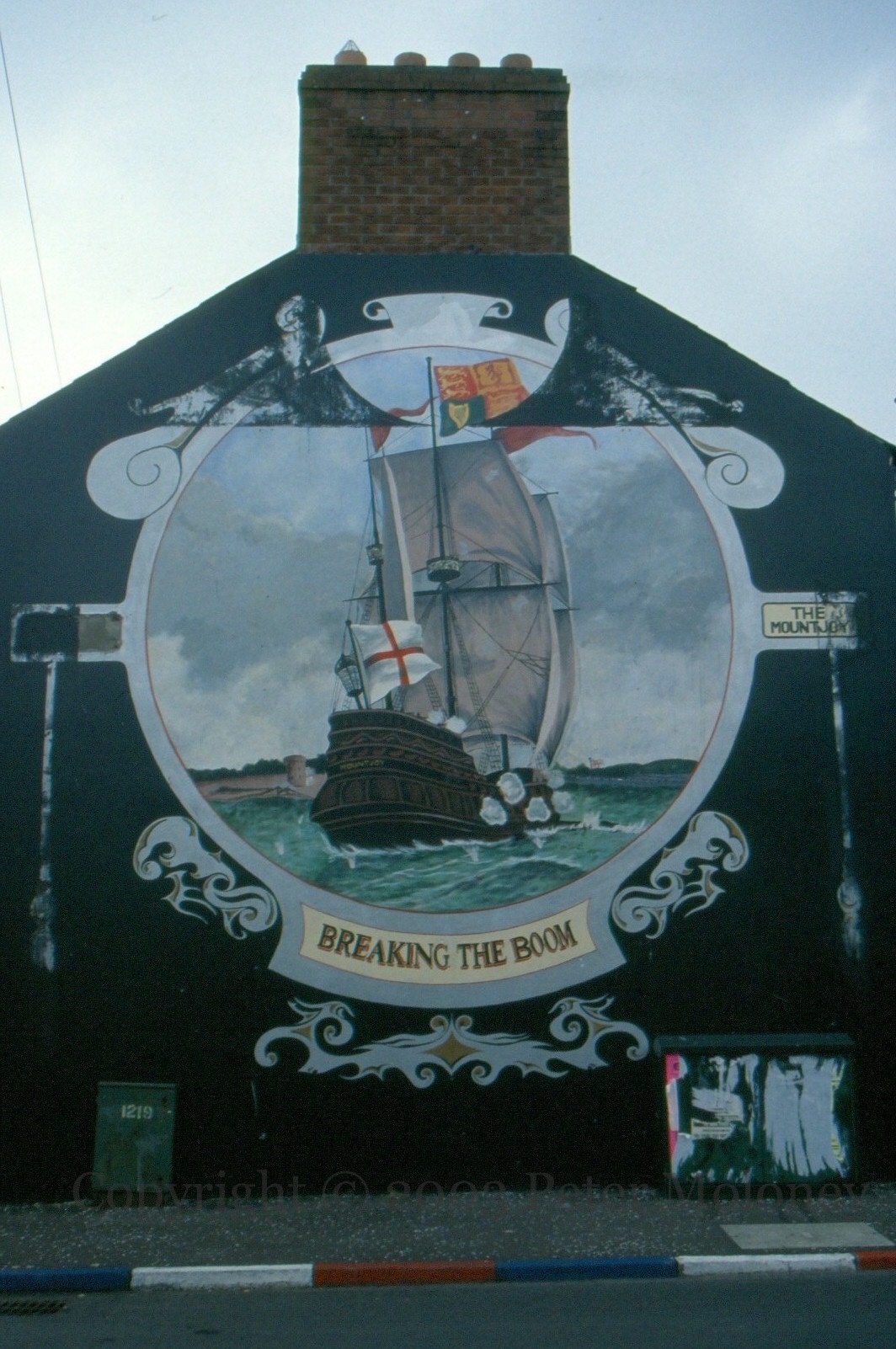
An information plaque is added to the “Breaking the boom” mural by Attitude Artwork in Roulston Avenue, Londonderry. This mural shows the Mountjoy in full sail. She was one of the ships which broke the timber boom across the Foyle to relieve the siege in 1689. This is one of a number of murals commemorating the 1689 siege in the Waterside and Fountain areas of the city. The mural was painted by local community artists Dee Logan, Mark Logan and Marty Edwards.” Seen previously in 2003.
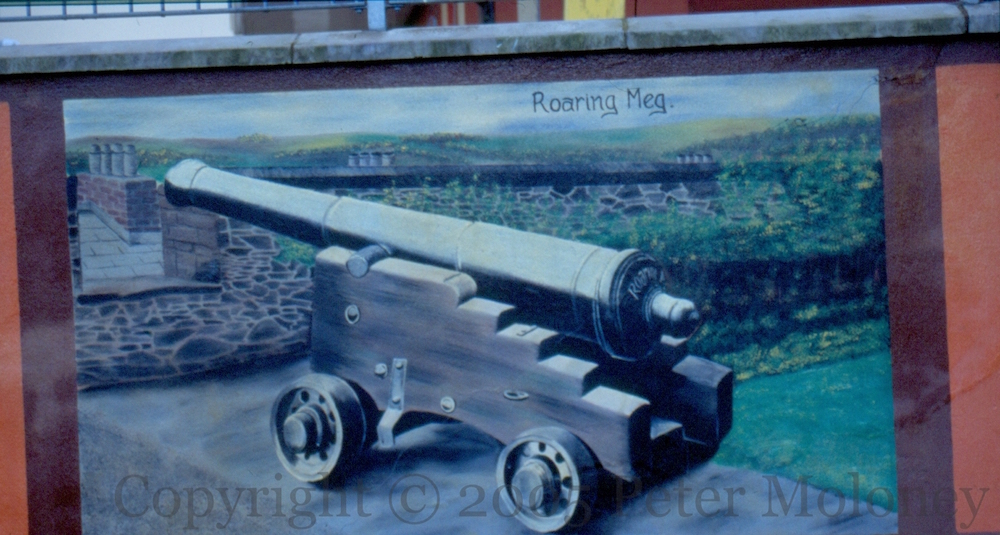
This series of five panels is outside the Cathedral Youth Club in The Fountain, Londonderry. In order, they show: a cry of “No Surrender” by the Apprentice Boys, Breaking The Boom, Walker’s Monument (to George Walker, governor during the siege and killed at the Boyne; the statue was blown up on 19730, Roaring Meg (the 1642 cannon), and the Cathedral (St Columb’s).
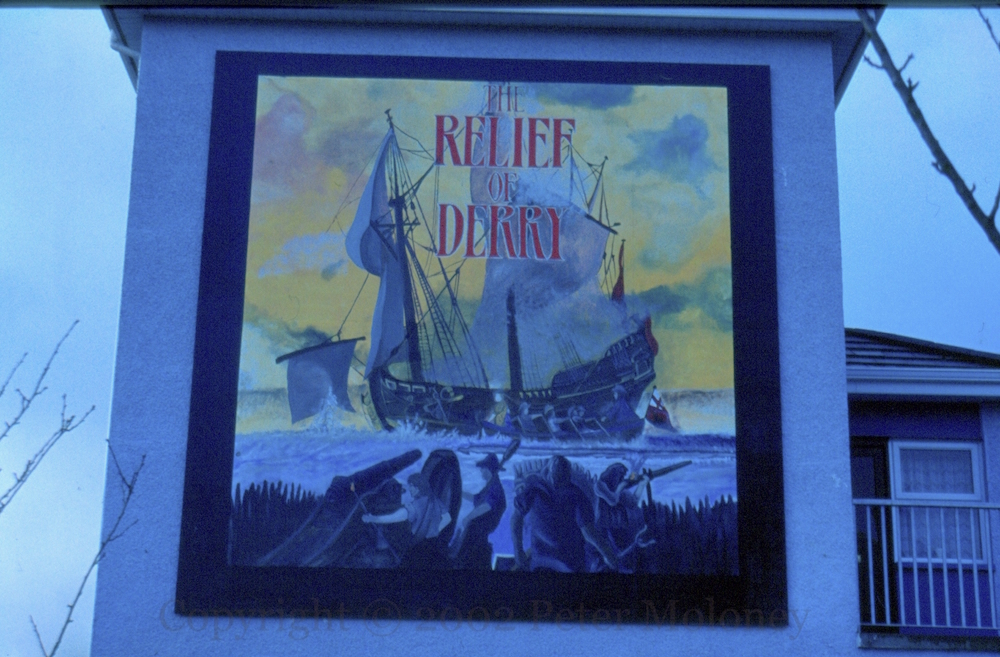
After three and a half months, from April 18th to July 30th, 1689, the Siege of Derry ended when two ships, the Mountjoy (shown here) and the Phoenix, broke through a timber boom that had been placed across the Foyle. Approximately half of the population of the city had died.
The siege of Derry began on December 7th, 1688 when thirteen apprentice boys – without official instruction – shut the gates of the city against the approaching Jacobite army of redshanks.
Each year the residents of the upper Fountain put the names of the 13 apprentice boys (and images related to the siege of Derry) on the backs and the garden fences of their homes.
The siege of Derry lasted from December 1688 until July 1689, the “relief of Derry” coming with the “breaking of the boom” across the river Foyle by the ship Mountjoy.
South Belfast MP Robert Bradford was assassinated by the Provisional IRA in Finaghy at a meeting with constituents; the caretaker of the community centre, Ken Campbell, was also killed by the fleeing attackers. In late 1981, with the hunger strikes having ended only a month before, the killing was noted around the world and raised fears of broad civil unrest (BBC | NYTimes).
“Vita, veritas, Victoria” [life, truth, victory] is the motto of Londonderry. Here we have “vita, veritas, victa” [life, truth, conquered; perhaps the intended meaning was “conquering” rather than the passive]. The crest is also not quite the crest of the Apprentice Boys, with a ship in the bottom right rather than a skeleton. Get in touch if you can resolve either discrepancy.