
“In glorious memory” of King William III of Orange, crossing the Boyne to defeat King James II and secure Ireland for England.
North Street, Ballymena
Click image to enlarge
Copyright © 2007 Peter Moloney
[M03554] [M03555] M03556
“In glorious memory” of King William III of Orange, crossing the Boyne to defeat King James II and secure Ireland for England.
North Street, Ballymena
Click image to enlarge
Copyright © 2007 Peter Moloney
[M03554] [M03555] M03556


King Billy takes centre stage in the Orange arch in Armagh, flanked a variety of Orange symbols such as crossed keys, compass and set square, cross and crown, an anchor, and a coffin. “FCH” (reading from the bottom up, as the ladder would be ascended) stands for “Faith, hope, charity” – I Corinthians 13:13 is read during initiation.
Click image to enlarge
Copyright © 2006 Peter Moloney
M03208 [M03209 ] [M03210] M03211 [M03212] [M03213] [M03236] [M03237]
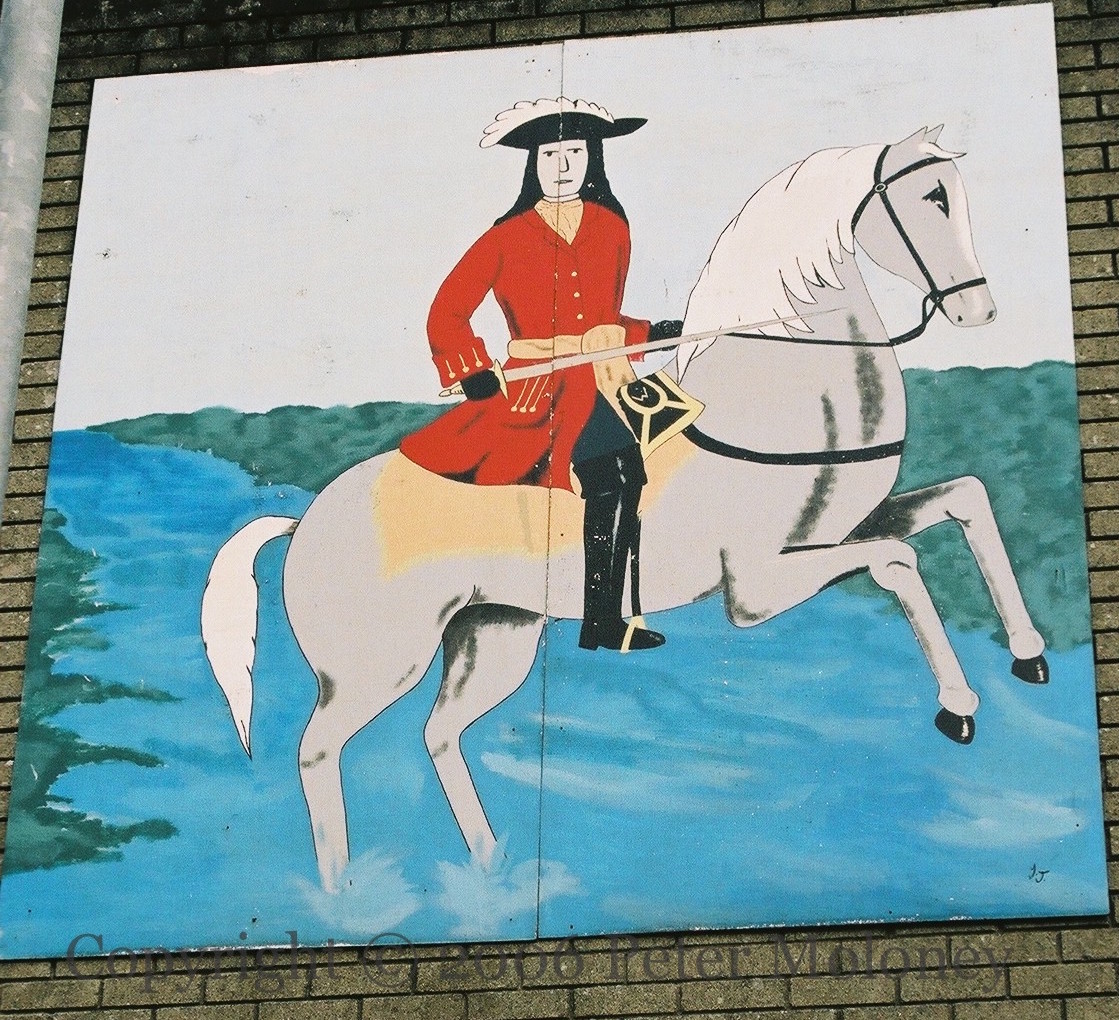
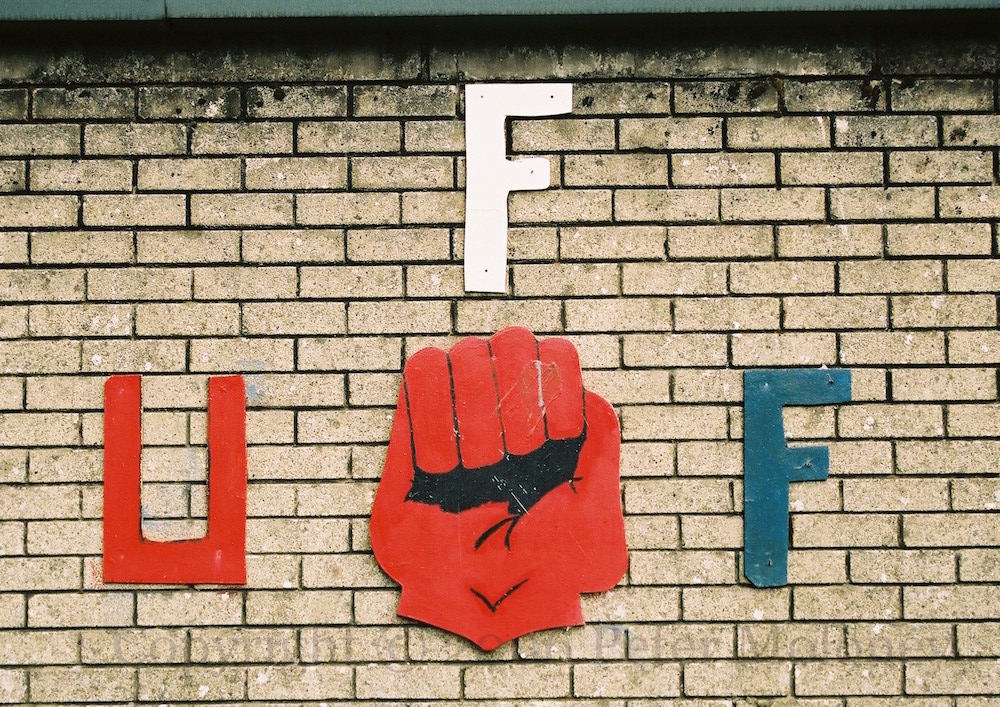
Here are two boards from behind Allen Interiors in Riverdale (Larne): King Billy crossing the Boyne and the UFF fist.
Click image to enlarge
Copyright © 2006 Peter Moloney
M02872 M02873

King Billy crossing the Boyne, with Schomberg dying in the foreground, making this a crude reproduction of Benjamin West’s 1780 painting ‘Battle Of The Boyne’. Second-in-command Schomberg had crossed the Boyne first and met his fate at the hands of Jacobite cavalry. Schomberg’s helper is perhaps George Walker, governor of Derry during the siege, who was shot and killed (reportedly) while attending to Schomberg – see George Walker in the Paddy Duffy collection.
Shankill Parade, west Belfast
Click image to enlarge
Copyright © 2005 Peter Moloney
M02475

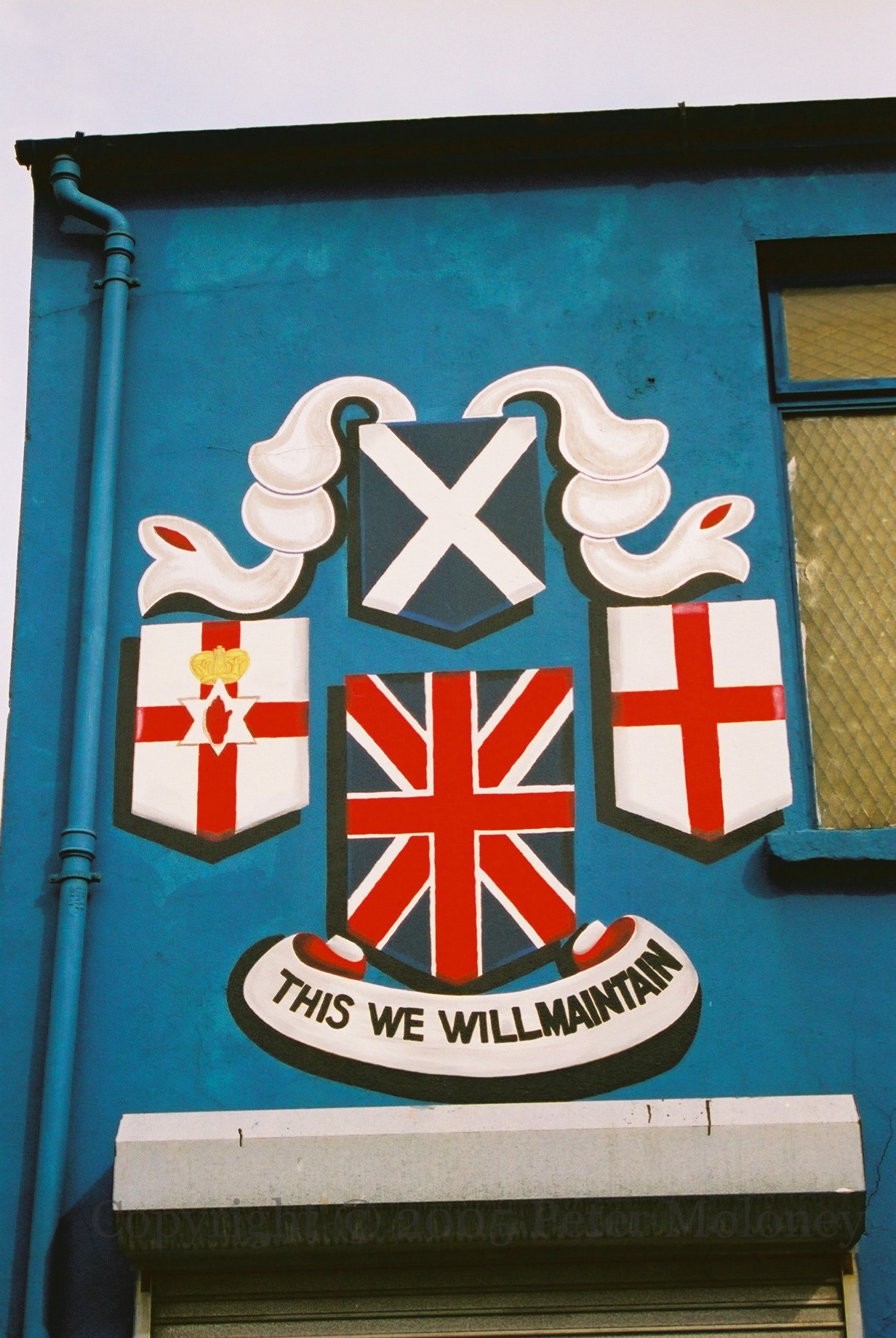

The King William III Prince of Orange mural is repainted and to it are added the UYM emblem and a set of flags of England, Scotland, and Northern Ireland. Most significantly, however, the modern-day gunman on the right has been replaced by another Williamite soldier. Seen previously in 1990 | 1991.
Blythe Street, Sandy Row, south Belfast
Click image to enlarge
Copyright © 2005 Peter Moloney
M02403 M02400 M02401
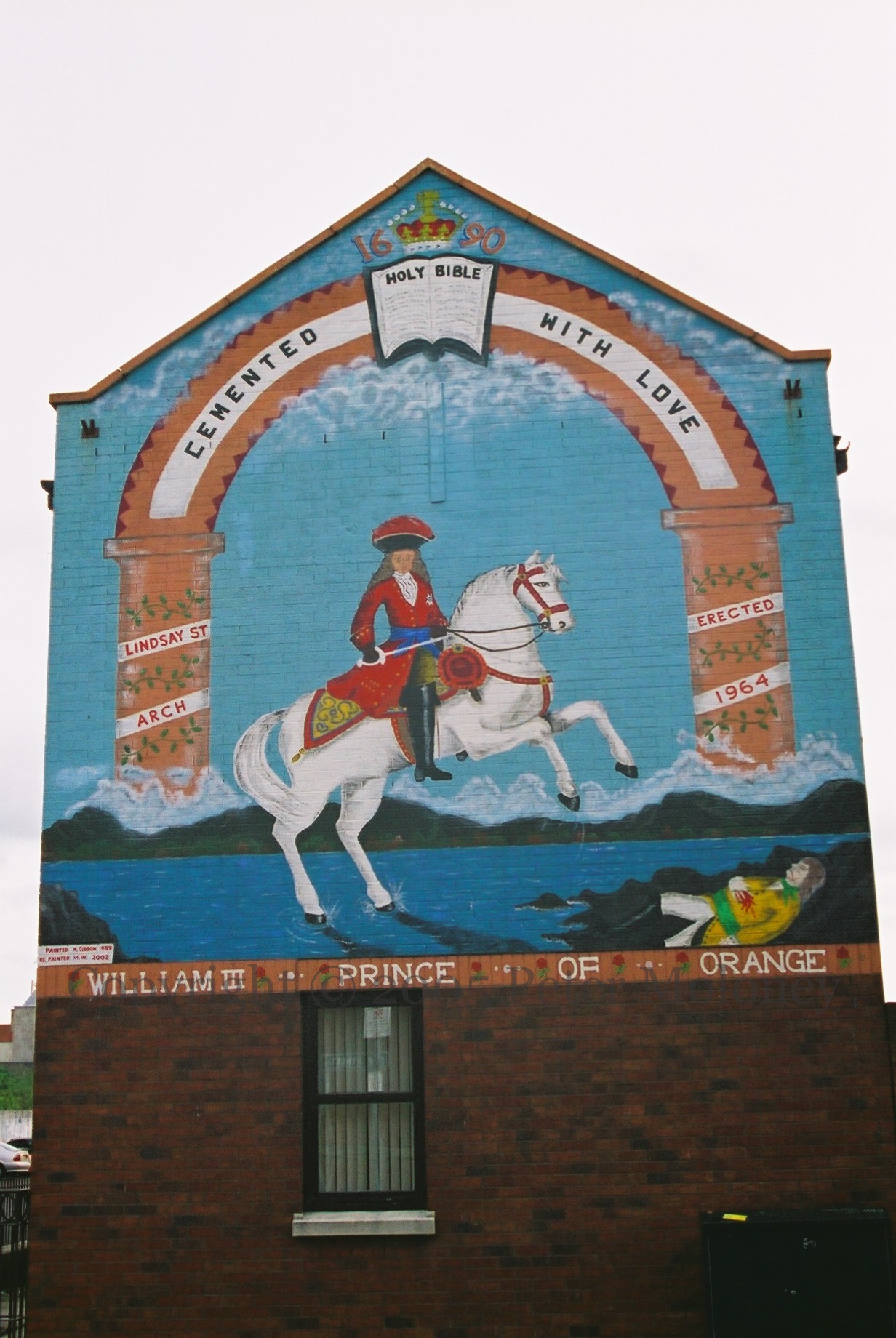
This is an image of the 2002 repaint, with the addition of the Lindsay Street Arch, crown and bible, and lower border, of the King William III, prince of Orange, mural in Elm Street, south Belfast. The original was painted in 1989.
Click image to enlarge
Copyright © 2005 Peter Moloney
M02395
Copyright © 2014 Peter Moloney
[M11050] [M11051] [M11052]
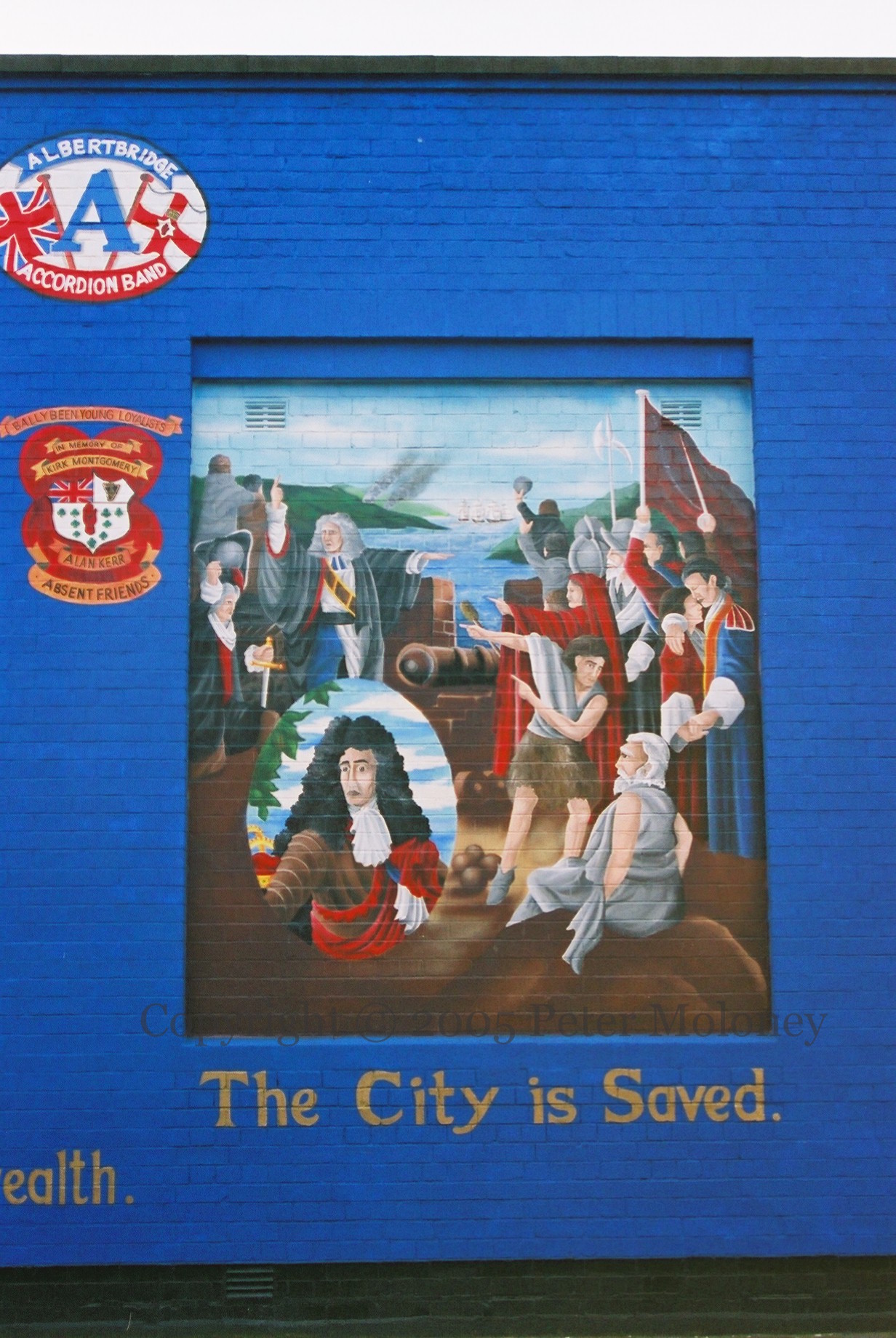
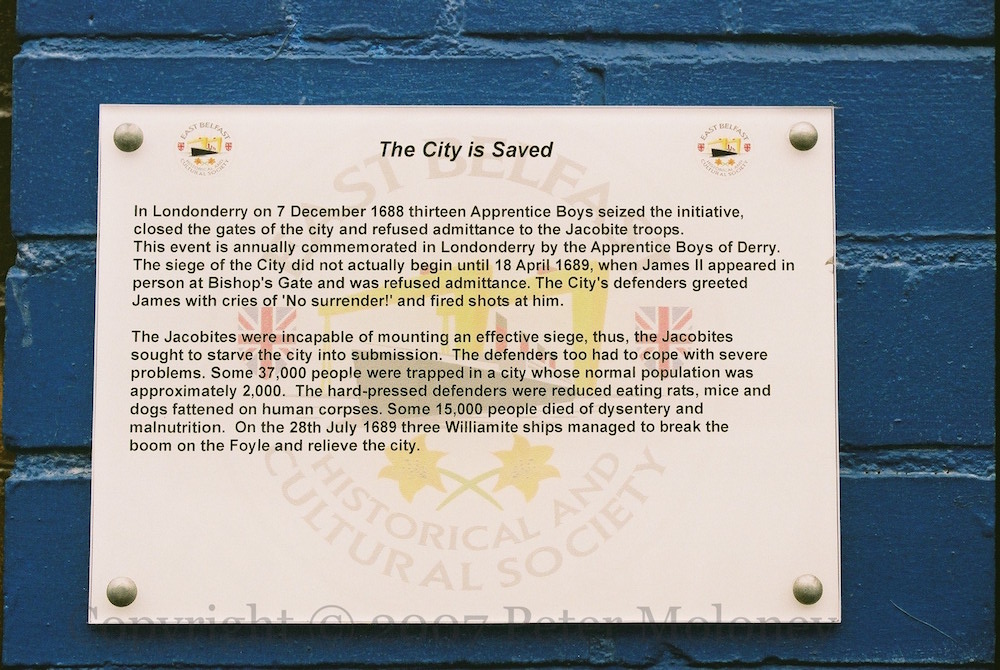
“In Londonderry on 7 December 1688 thirteen Apprentice Boys seized the initiative, closed the gates of the city and refused admittance to the Jacobite troops. This event is annually commemorated in Londonderry by the Apprentice Boys of Derry. The siege of the City did not actually begin until 18 April 1689,when James II appeared in person at Bishop’s Gate and was refused admittance. The City’s defenders greeted James with cries of ‘No surrender!’ and fired shots at him. The Jacobites were incapable of mounting an effective siege, thus, the Jacobites sought to starve the city into submission. The defenders too had to cope with severe problems. Some 37,000 people were trapped in a city whose normal population was approximately 2,000. The hard-pressed defenders were reduced to eating rats, mice and dogs fattened on human corpses. Some 15,000 people died of dysentery and malnutrition. On the 28th July 1689 three Williamite ships managed to break the boom on the Foyle and relieve the city.”
One of fourteen panels in Thorndyke Street, east Belfast. For a list of entries for each panel, see East Belfast Historical And Cultural Society.
Click image to enlarge
Copyright © 2005/2007 Peter Moloney
M02300 M03634
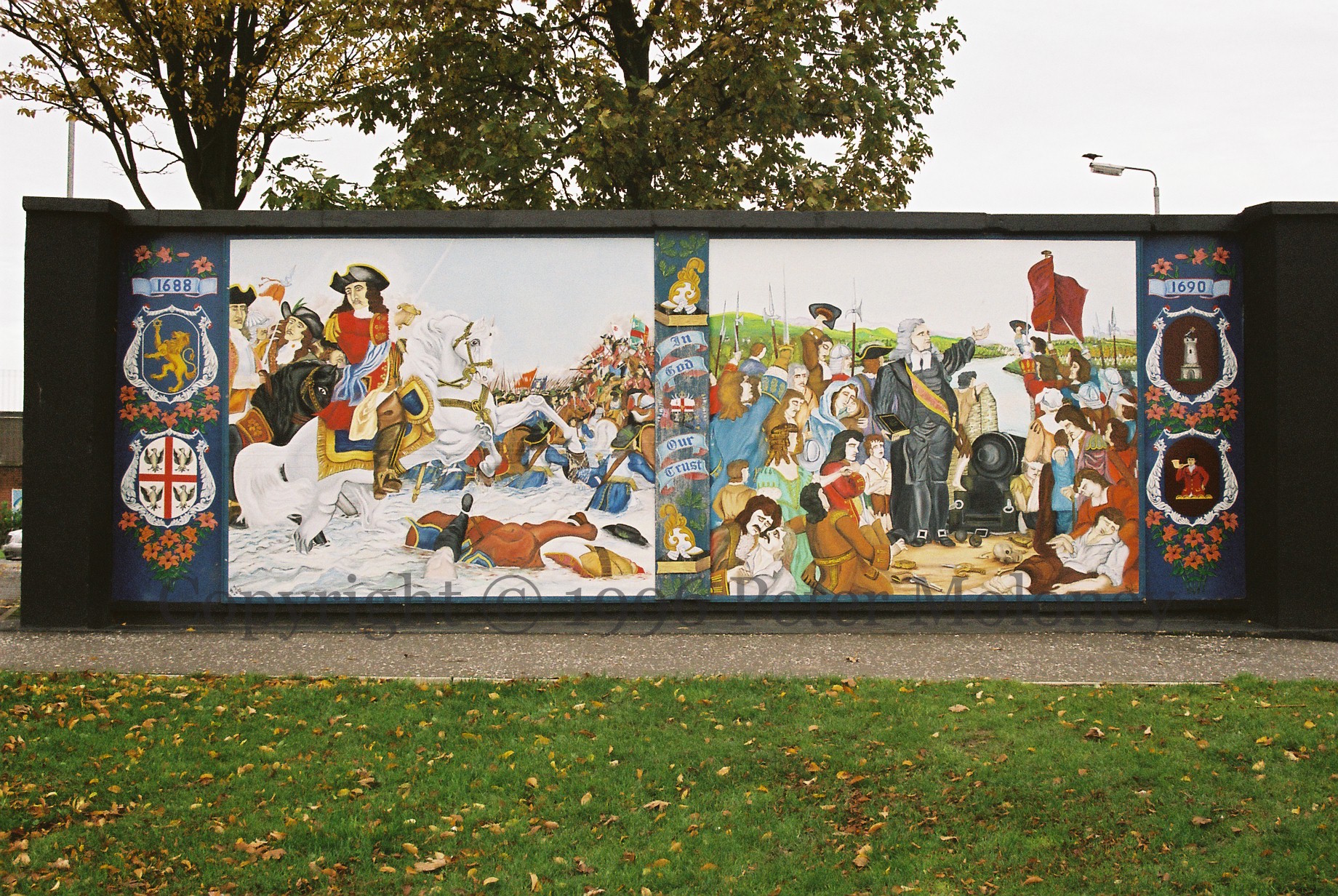
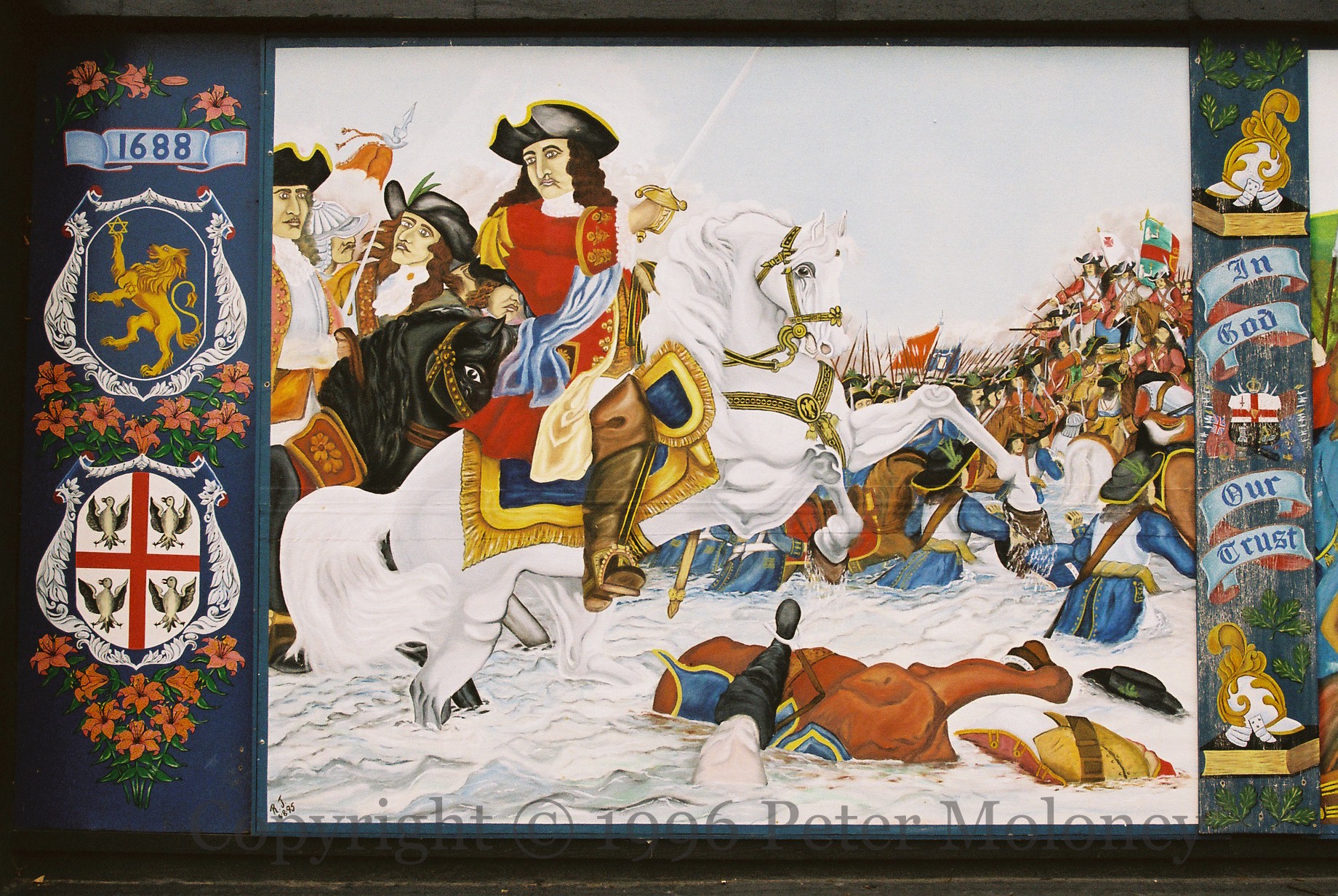
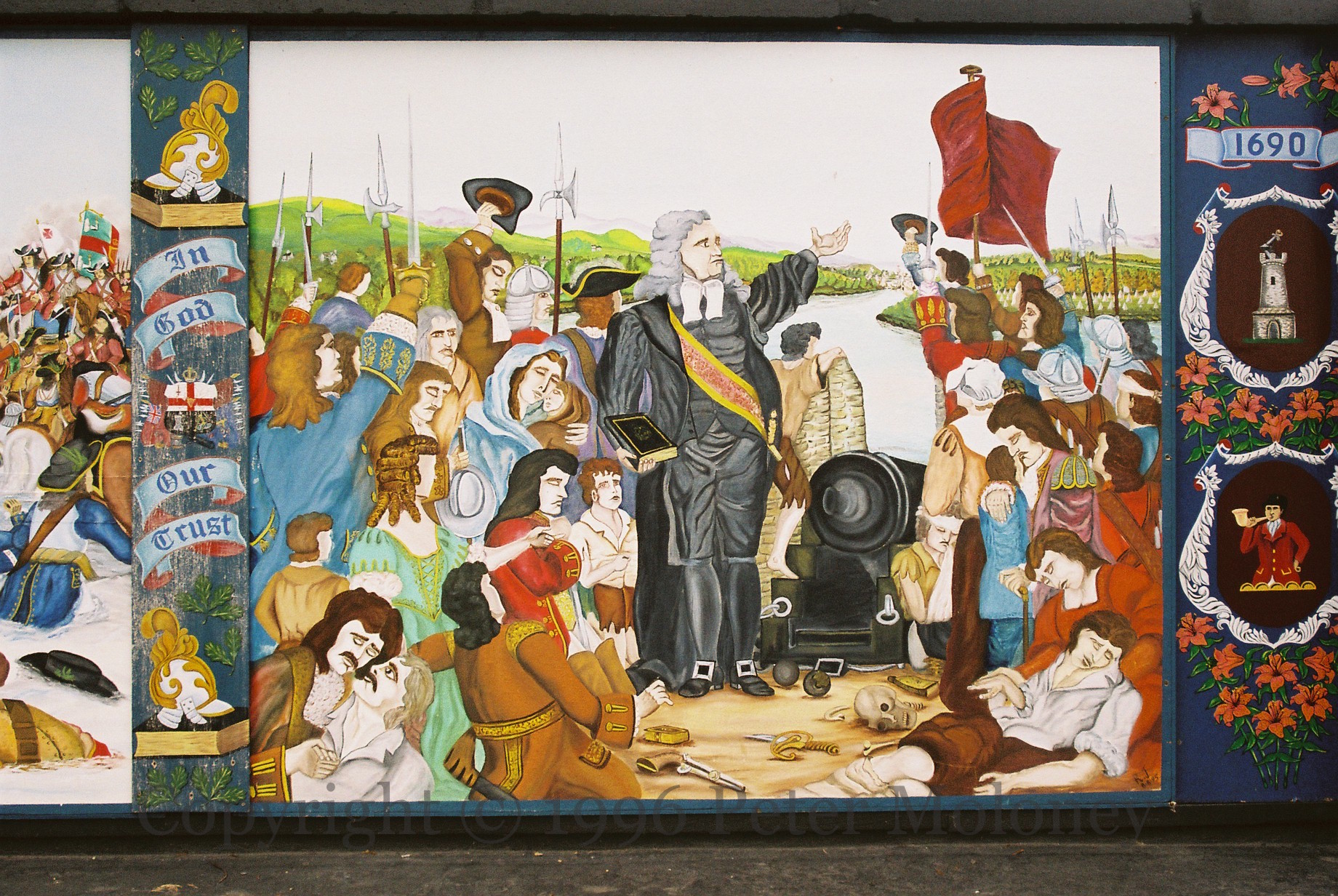
The repainted Jackson mural in the Fountain, Londonderry, with King William at the Boyne on the left and the Relief of Derry on the right. For much more, see the visual history of The Jackson Murals.
Click image to enlarge
Copyright © 1996 Peter Moloney
M01290 M01291 M01292

King Billy (William III Of Orange) on the wall in Inverary Drive, east Belfast, mounted on a white horse, pointing the way across the Boyne.
Click image to enlarge
Copyright © 1994 Peter Moloney
M01131
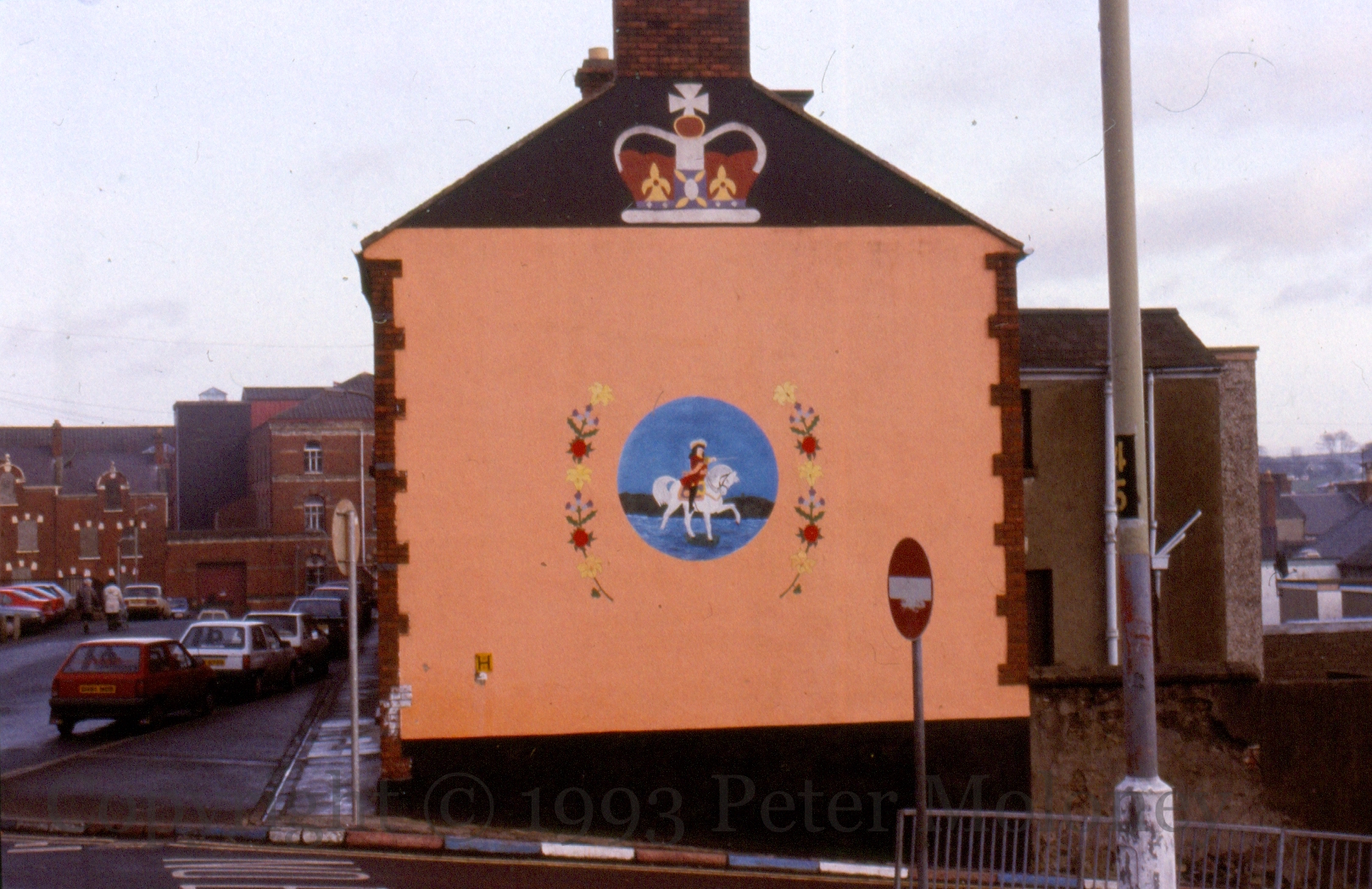
1993 image of William of Orange in Wapping Lane, the Fountain, Londonderry.
Click image to enlarge
Copyright © 1993 Peter Moloney
M01045
 Peter Moloney Collection