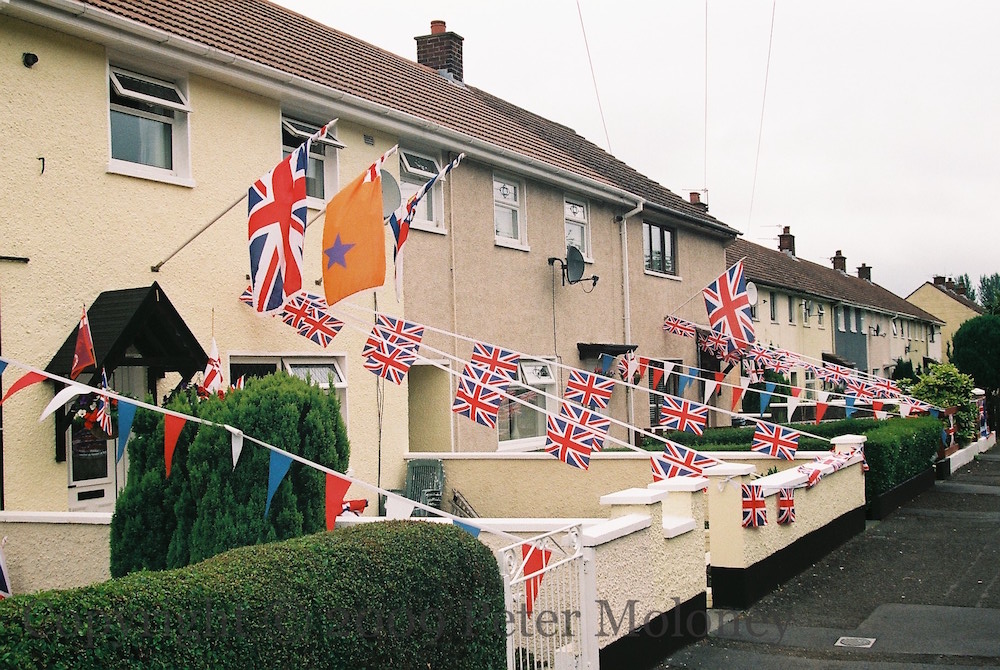
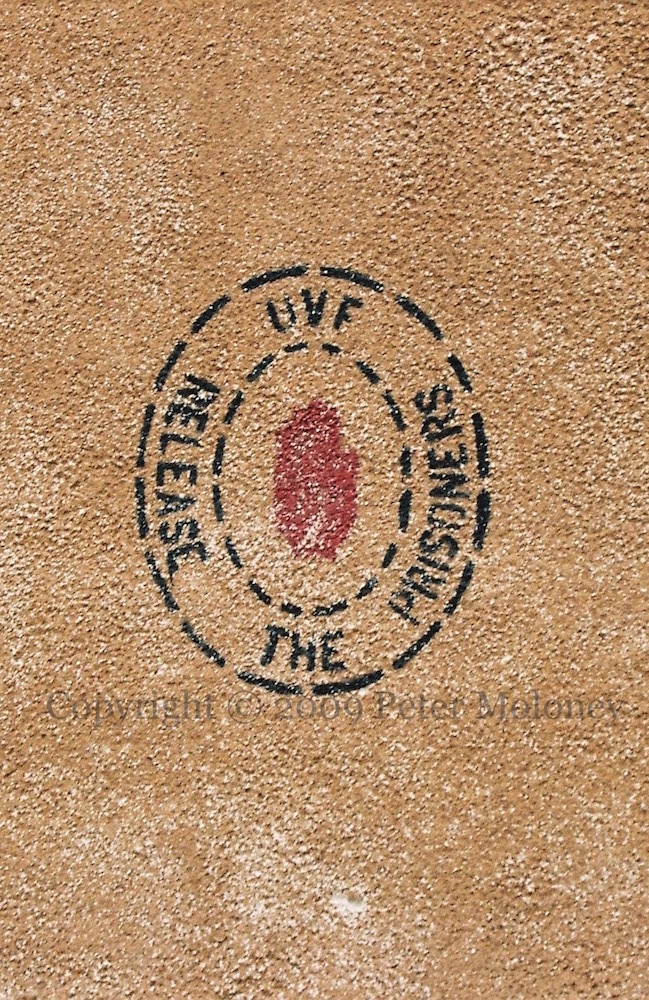
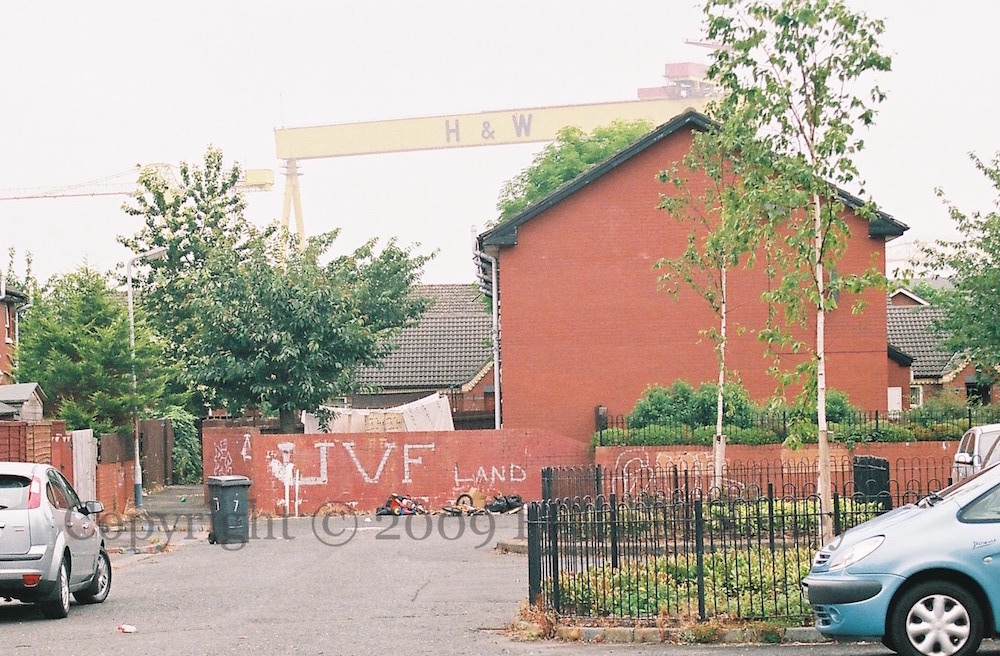
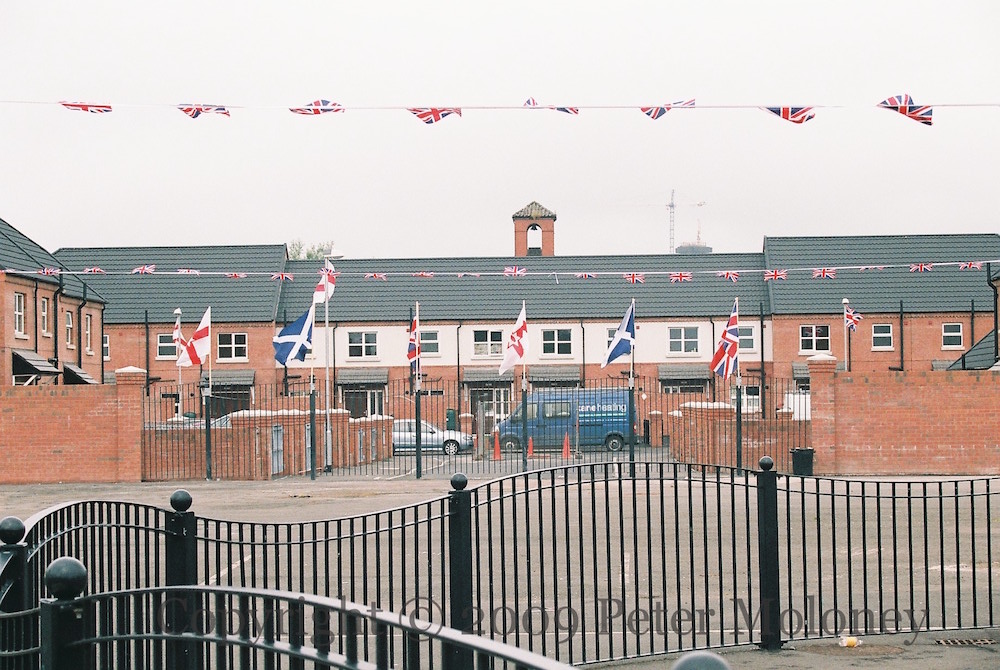
Clonduff prepares for Eleventh Night with a bonfire off Clonduff Drive and bunting in Tullyard Way. There are also nine (at least) vintage “UVF Release The Prisoners’ stencils in the area.
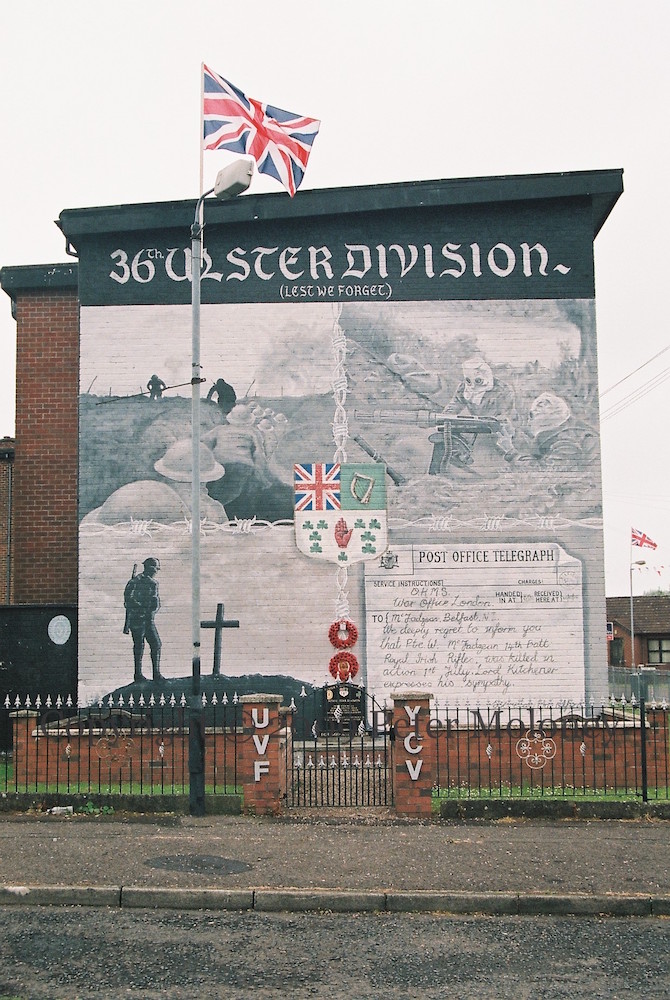
The plaques read “36th Ulster Division – dedicated to all our fallen comrades who made the ultimate sacrifice for their country. Greater love hath no man than to lay down his life for his friends. For God and Ulster.” and “From the officers and volunteers of East Belfast to commemorate the 90th anniversary of the Great War.” The quadrants of the mural show (clockwise) soldiers in the trenches, soldiers manning a machine-gun, the death telegraph for William MacFadzean, and a soldier reflecting on a grave. UVF YCV “Lest we forget”
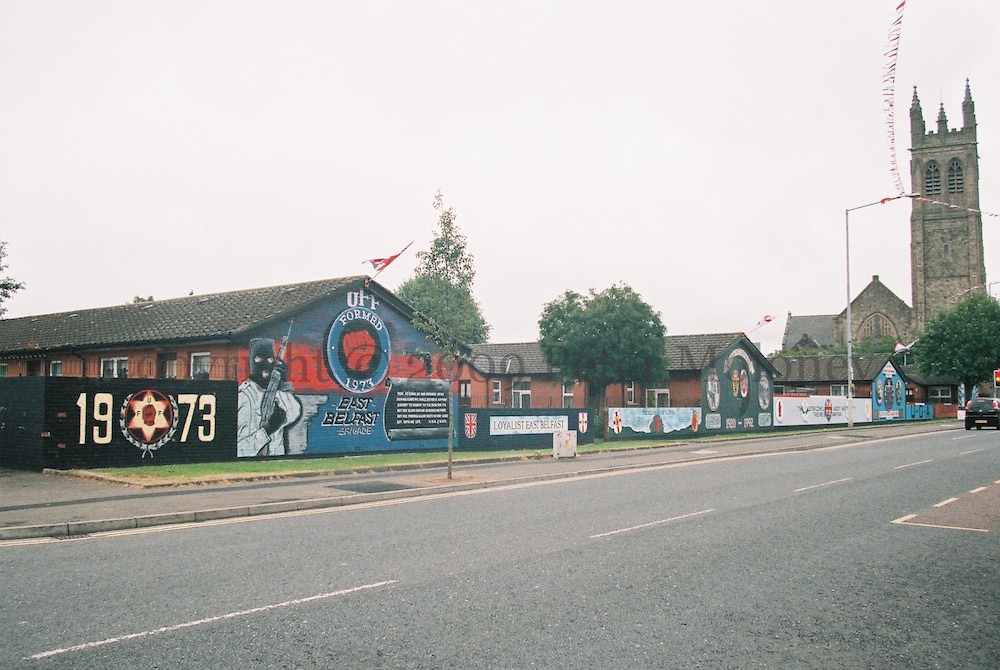
Here is a set of 2009 images of the left half of “Freedom Corner” on Newtownards Road.
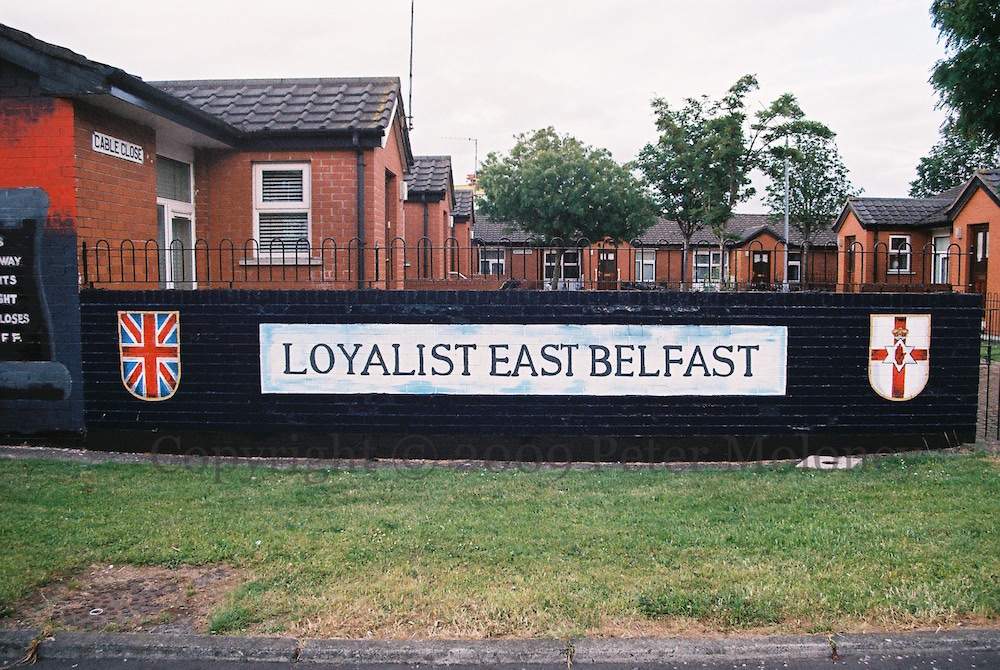
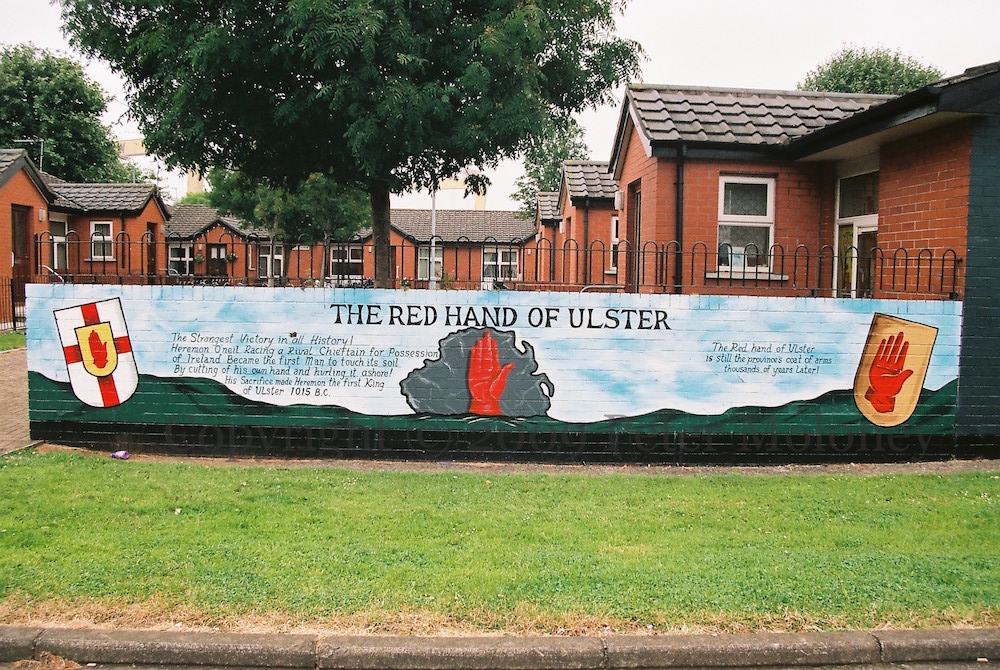
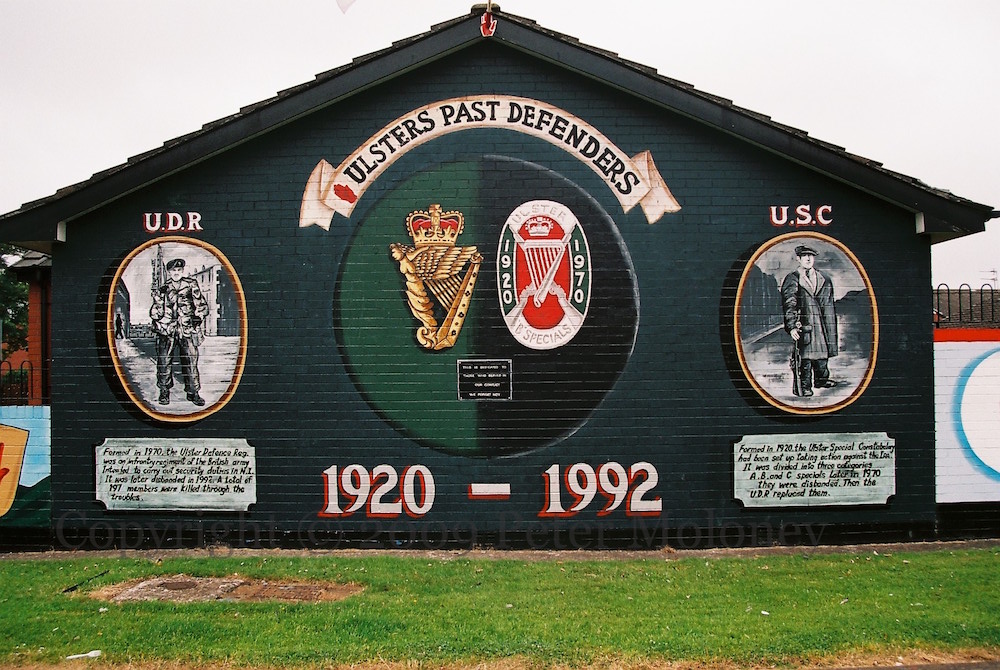
Compared to the 2005 images: the background of the UFF mural has been repainted; “Loyalist East Belfast” replaces the letters “UFF”; the Red Hand Of Ulster replaces “Feriens Tego” (From Ripley’s Believe It Or Not, 1953: “The strangest victory in all history: Heremon [Érımón] O’Neill racing a rival chieftain for possession of Ireland became the first man to touch its soil by cutting off his own hand and hurling it ashore! His sacrifice made Heremon the first king of Ulster, 1015 B.C. The red hand of Ulster is still the provinces coat of arms thousands of years later.” Most people believe it not.) Notice that outline is of the six-county Northern Ireland rather than of the historical Ulster; and the “Ulsters Past Defenders” mural has been completely repainted with the emblems of the UDR and B-Specials at the centre (“This is dedicated to those who served in our conflict – we forget not”, “Formed in 1970, the Ulster Defence Reg. was an infrantry [sic] regiment of the British army intended to carry out security duties in NI. It was later disbanded in 1992. A total of 197 members were killed through the troubles”, “Formed in 1920, the Ulster Special Constabulary had been set up taking action against the IRA. It was divided into three categories A, B, and C specials. Later in 1970 they were disbanded. Then the UDR replaced them.”)
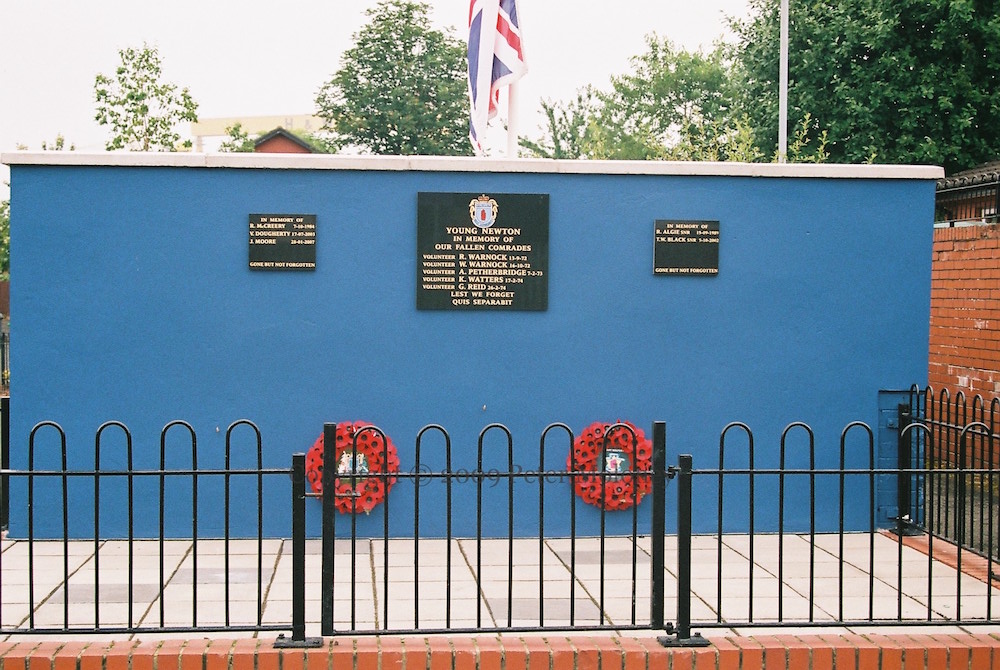
From left to right the plaques read: “In memory of R McCreery 7-10-1984, V Dougherty 17-07-2003, J Moore 28-01-2007. Gone but not forgotten.”, “Young Newton. In memory of our fallen comrades Volunteers R Warnock 13-9-72, W Warnock 16-10-72, A Petherbridge 7-2-73, K Watters 17-2-74, G Reid 26-2-74. Lest we forget. Quis separabit.”, “In memory of R Algie Snr 15-09-1989, TW Black Snr 5-10-2002. Gone but not forgotten.” With Young Newton and UFF wreaths. Young Newton was an east Belfast “tartan” gang (History Ireland) and then part of the UYM (WP).
East Belfast is a patchwork of paramilitary territories. Western east Belfast (Ballymacarrett) is UVF territory but this is perhaps the eastern limit of this particular enclave, next to the UDA memorial and “Freedom Corner”.
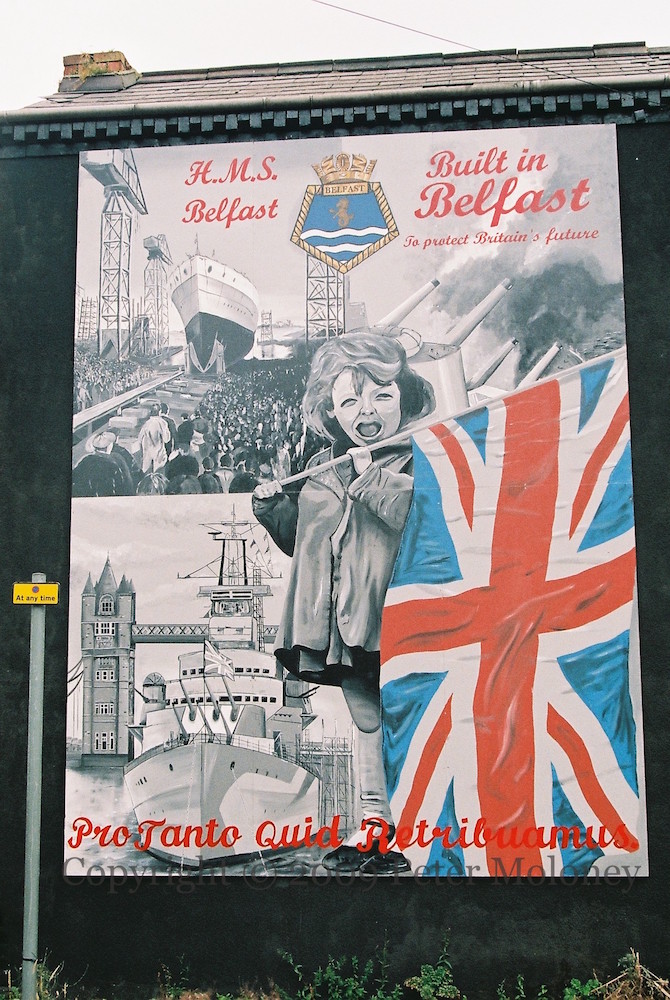
“HMS Belfast – built in Belfast to protect Britain’s future. Pro tanto quid retribuamus. [What shall we give in return for so much? – the motto of Belfast city]”. The mural shows HMS Belfast being launched on March 17, 1938. Tower Street, Belfast. After serving in WWI and Korea, the ship is now a tourist attraction in London.
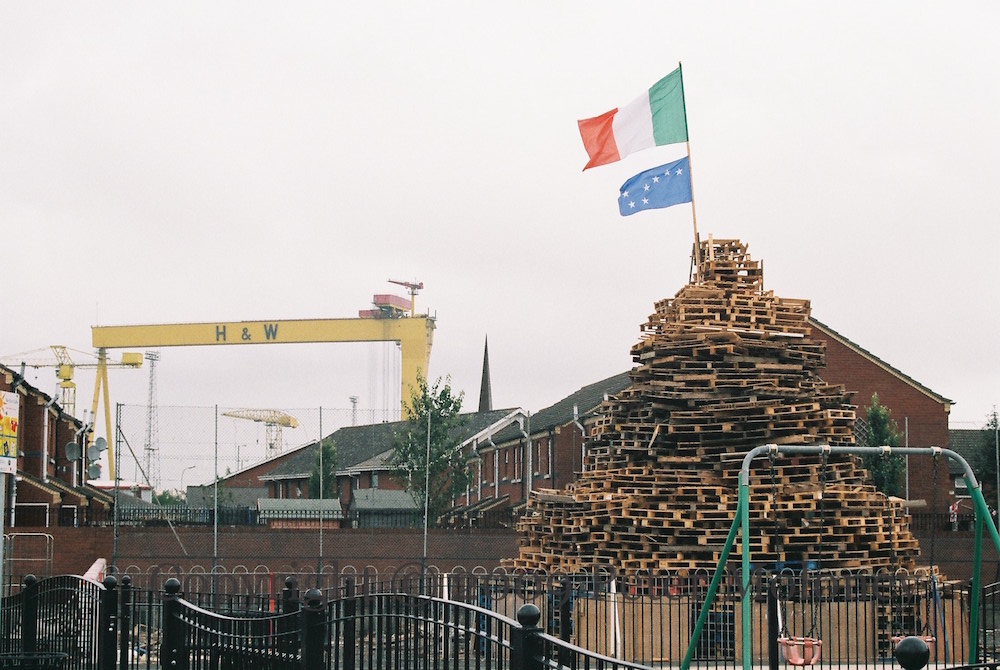
The Irish Tricolour and the Starry Plough (of Connolly’s Irish Citizen Army) stand atop the bonfire in Pitt Park, east Belfast, ready for burning. The UK, Scottish, and Northern Irish flags on the ground will survive the holiday.
The Victoria Cross shows a lion on top of the crown of St Edward. The medal has been awarded since 1856 for combat valour by British Army soldiers. The four faces are perhaps those of Cather, McFadzean, Quigg, and Bell (see the mural in Cappagh Gardens). Painted by Dee Craig in Pitt Park, east Belfast, as part of the Re-Imaging Communities programme (Irish Times), perhaps replacing J2585.
“The arming, the training, and the sacrifice of The People’s Army.” The arming (left) comes from the guns smuggled into Larne on the Clyde Valley. The training shown here (right) is probably Ballywalter. The sacrifice (bottom) is the 36th (Ulster) Division going over the top in James Beadle’s painting ‘Charge of the 36th (Ulster) Division, Somme, 1st July 1916’.
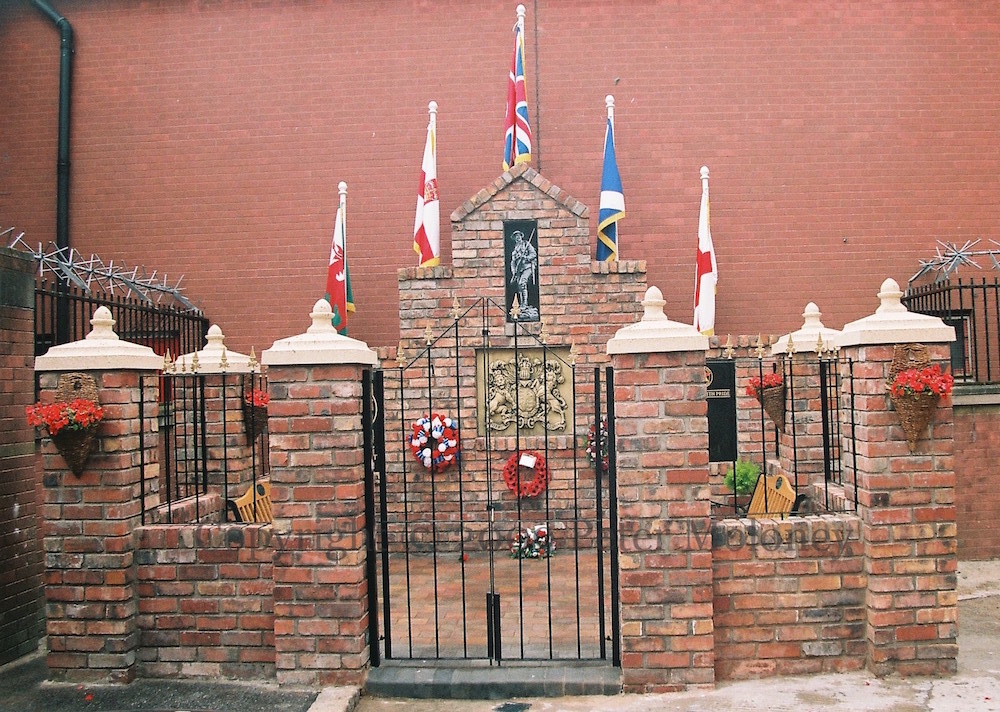
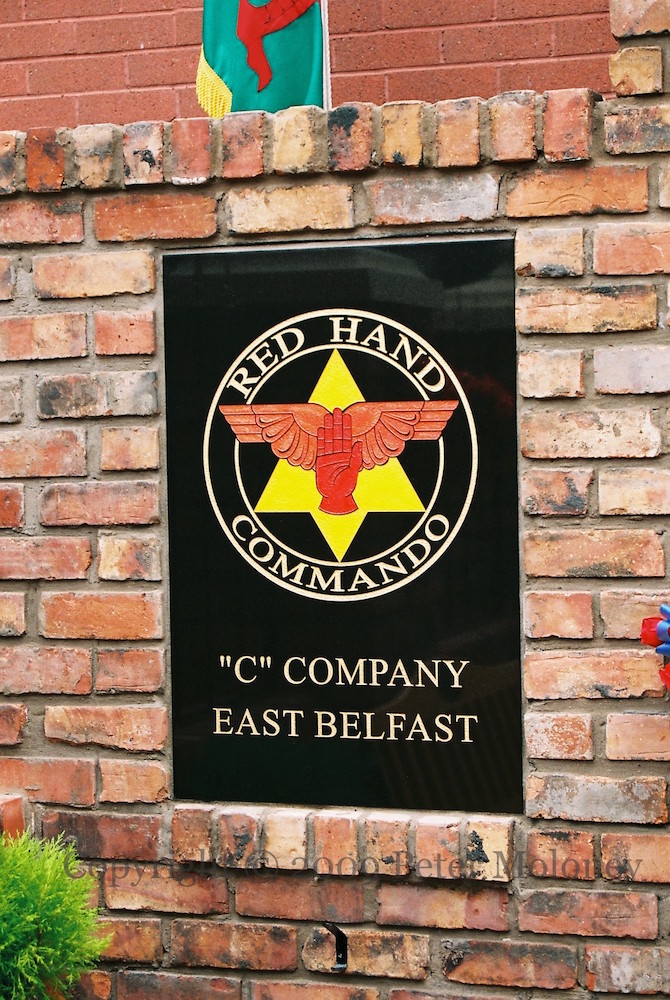
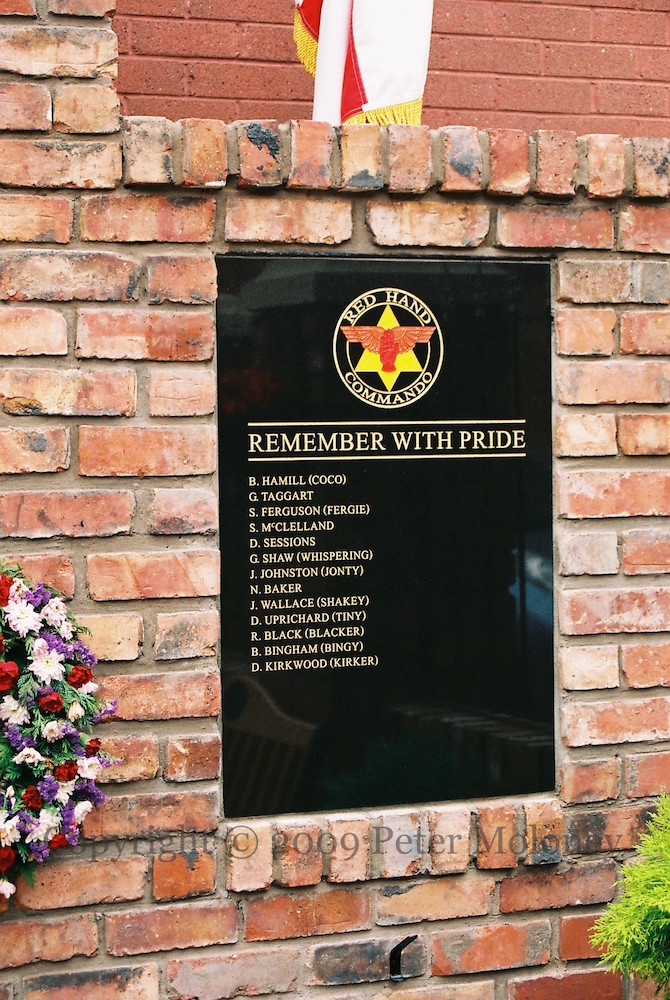
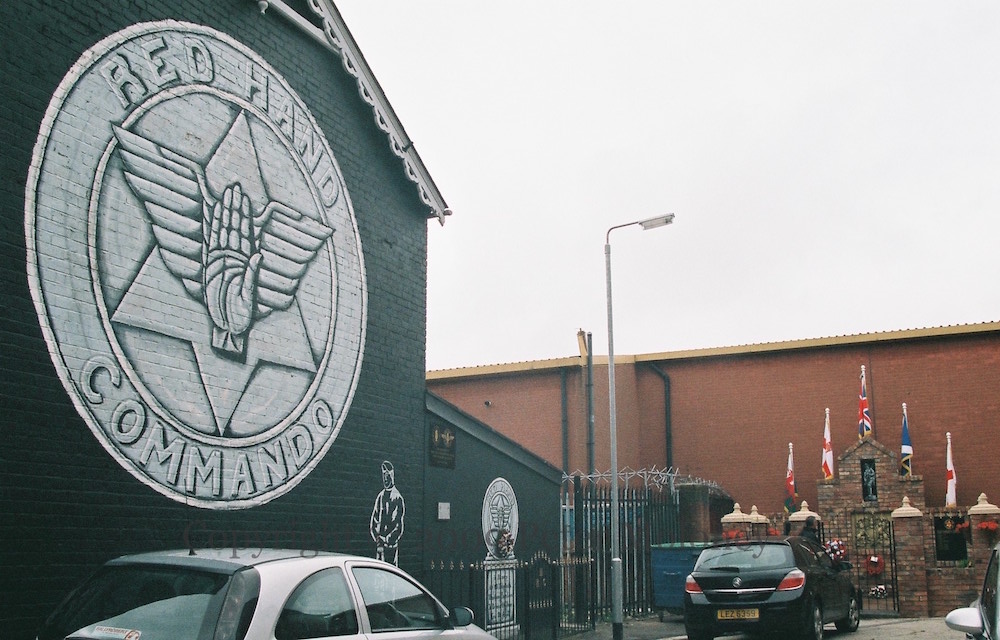
A new memorial garden joins the RHC mural in (the old) Hunt St (off Newtownards Road). “Remember with pride: B. Hamill, G. Taggart, S. Ferguson, S. McClelland, D. Sessions, G. Shaw, J. Johnston [“Johnstone” on the mural plaque], N. Baker, J. Wallace, D. Uprichard, R. Black, B. Bingham, D. Kirkwood.” These are all modern-day volunteers. The soldier in the middle is from WWI. “Dieu et mon droit.”
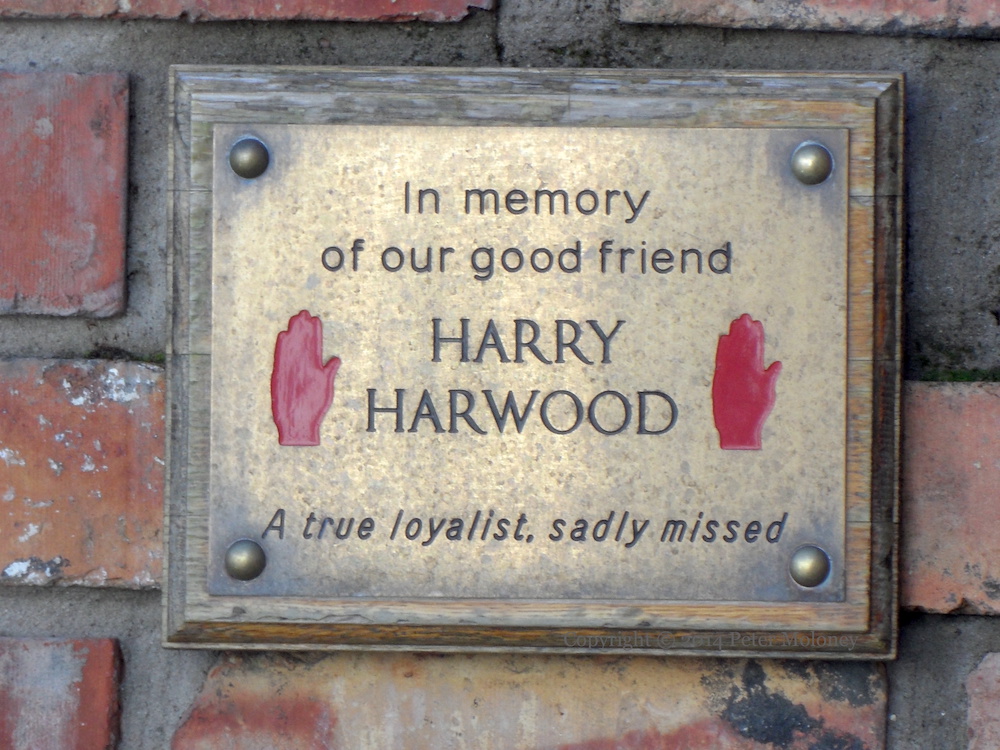
2014 images show “Ed McKay, P. McClenaghan, and R. Ferguson” added to the main plaque, and a small plaque to Harry Harwood “a true loyalist, sadly missed”





 Peter Moloney Collection