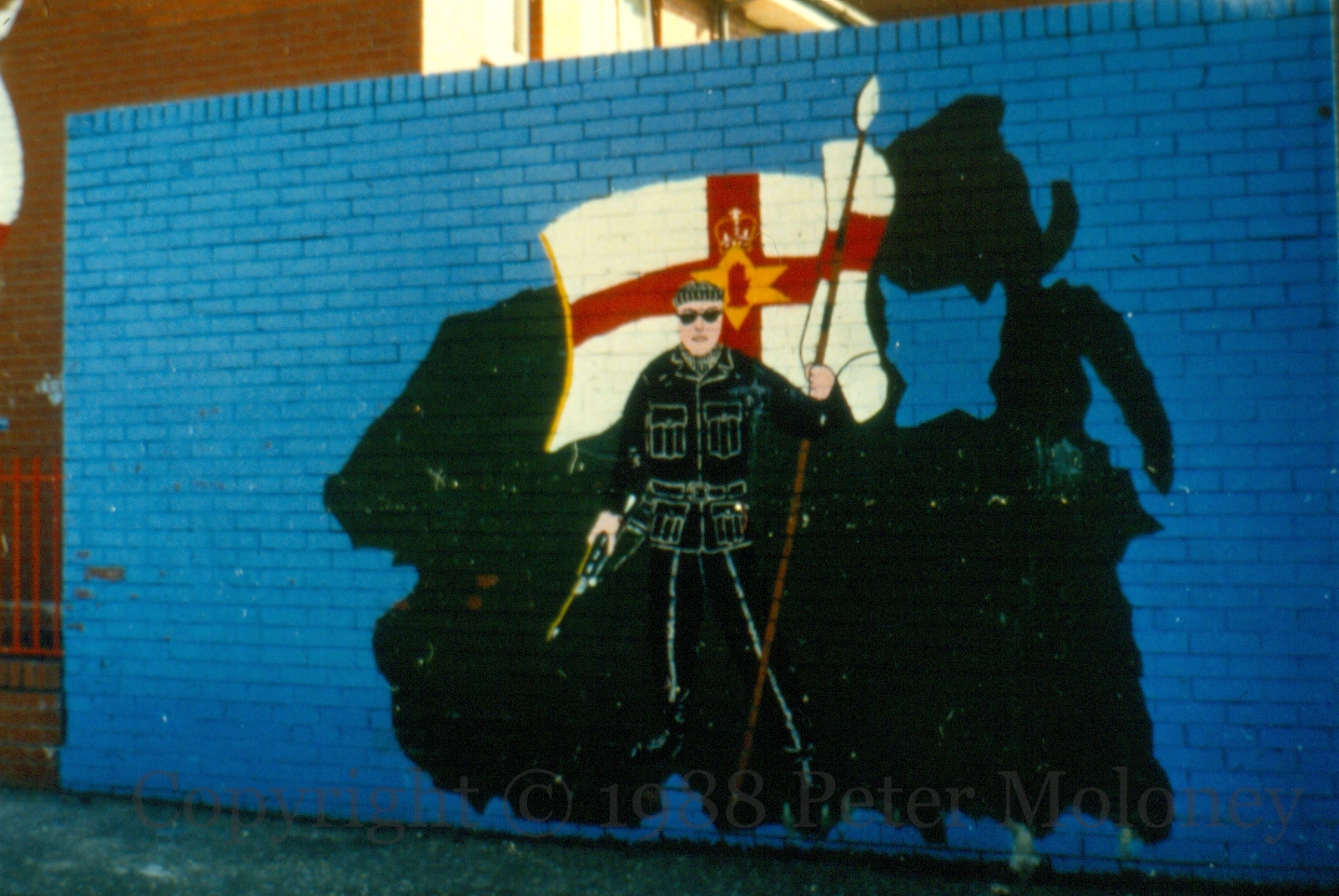
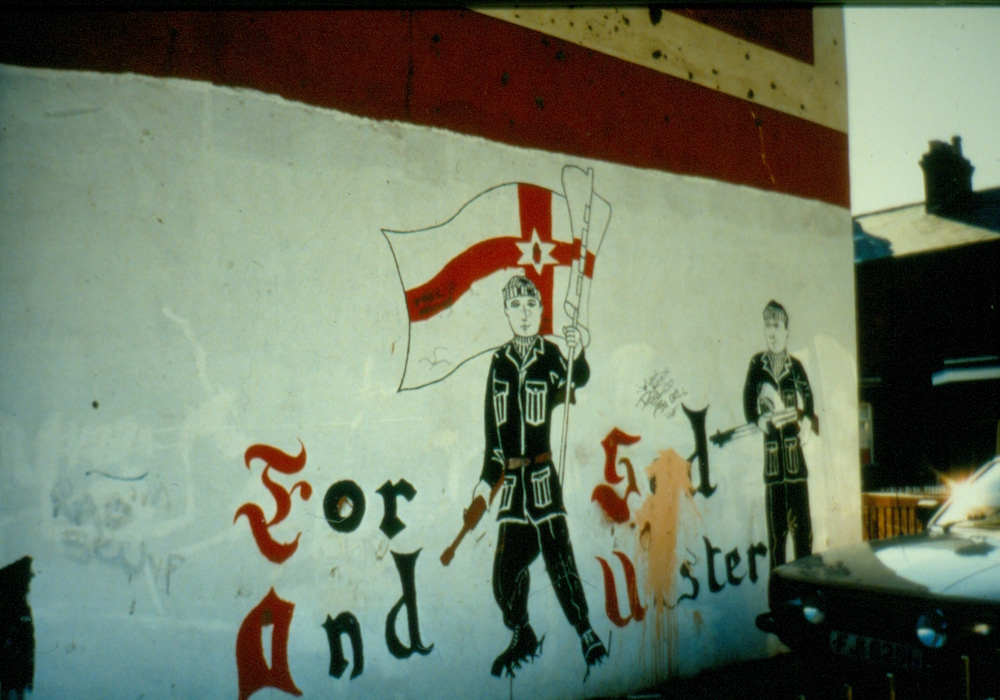
Percy Place, No 2 of 9. Loyalist paramilitary volunteer (perhaps based on Gusty Spence) with an Ulster banner in one hand and an automatic rifle in the other, standing on an unattached Northern Ireland.
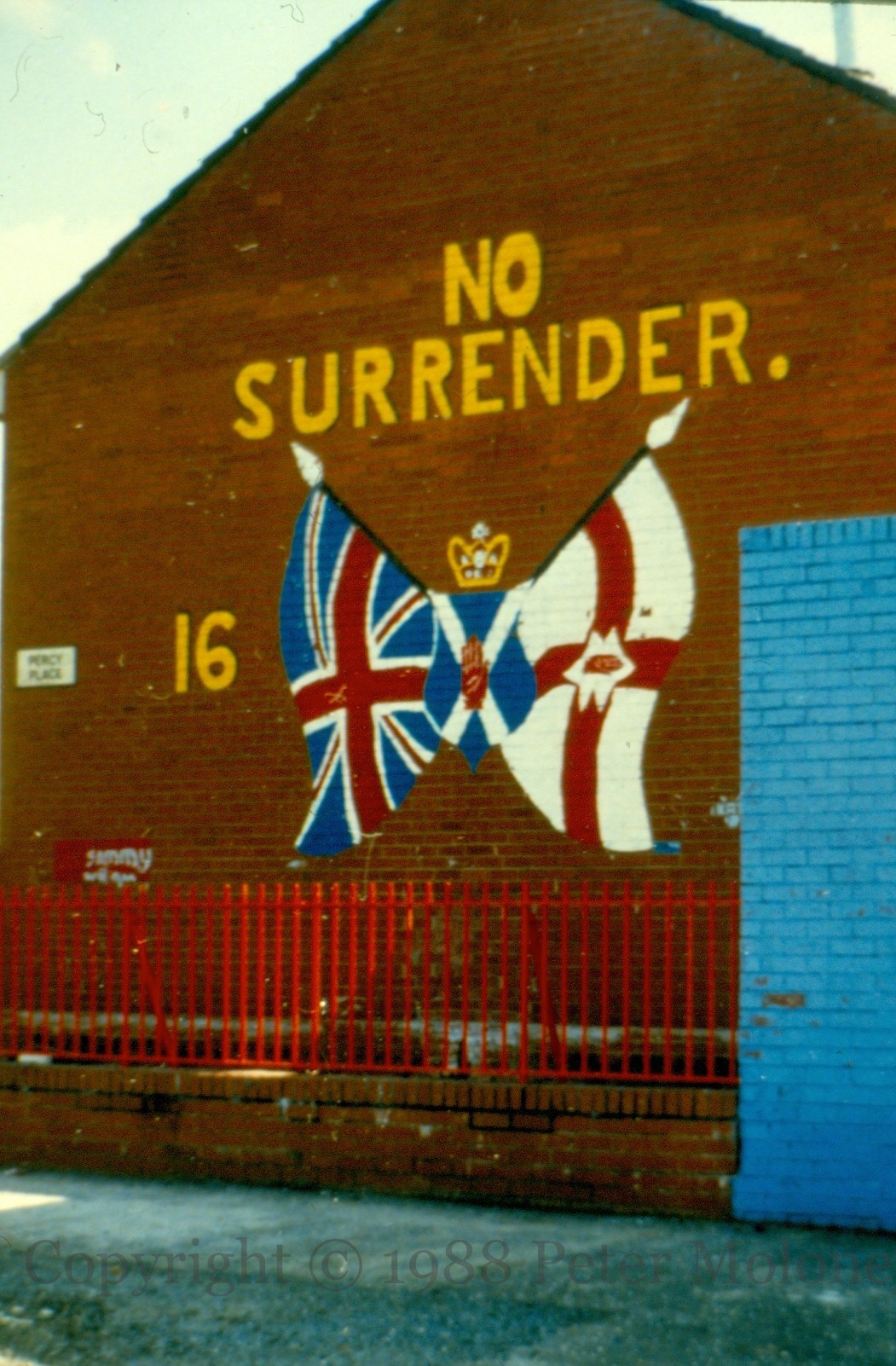
The left-most mural (No. 1 of 9) in Percy Place, Belfast. The central motif of a red hand on a Saltire is unusual. 1690 is the date of King William III’s victory at the Battle of the Boyne.
On the left of the lightning bolt are the soldiers of the 36th Ulster division (U.V.F.) R.I.R (Royal Irish Rifles) on the western front in 1916; on the right are “UVF prisoners of war, Long Kesh”.
A similar board was painted in the UVF compounds of Long Kesh. Of it, Billy Hutchinson (in his 2011 piece “Transcendental Art“) said, “My favourite mural was one inspired by the British anti-war poet, Siegfried Sassoon. Suicide In The Trenches depicts a UVF volunteer split down the middle by a bolt of lightning. Half of him depicts a 36th Ulster Division soldier under heavy fire in a rainsoaked WW1 trench. The other half shows a ’70s volunteer incarcerated behind barbed wire and over-shadowed by watch towers.” (The piece – W2021.1.8 in the Ulster Museum collection – includes the last verse from Sassoon’s Suicide In The Trenches.)
Hutchinson also describes the importance of the Orange Cross welfare organisation in selling prisoner art produced inside the prison. Stevie McCrea of the RHC was killed in the Orange Cross in 1989 – see Stevie McCrea.
The Ulster Banner, Union flag, St Andrew’s Saltire and the UVF’s own flag stand around the UVF red hand emblem (For God and Ulster, 1912), next to an LPOW hand in barbed wire.
The wide shot shows the accompanying YCV shamrock and an in-progress painting of the emblem of the 36th (Ulster) Division. For the completed version, see 1993.
Crumlin Road, Belfast, at Queensland and Tasmania streets.
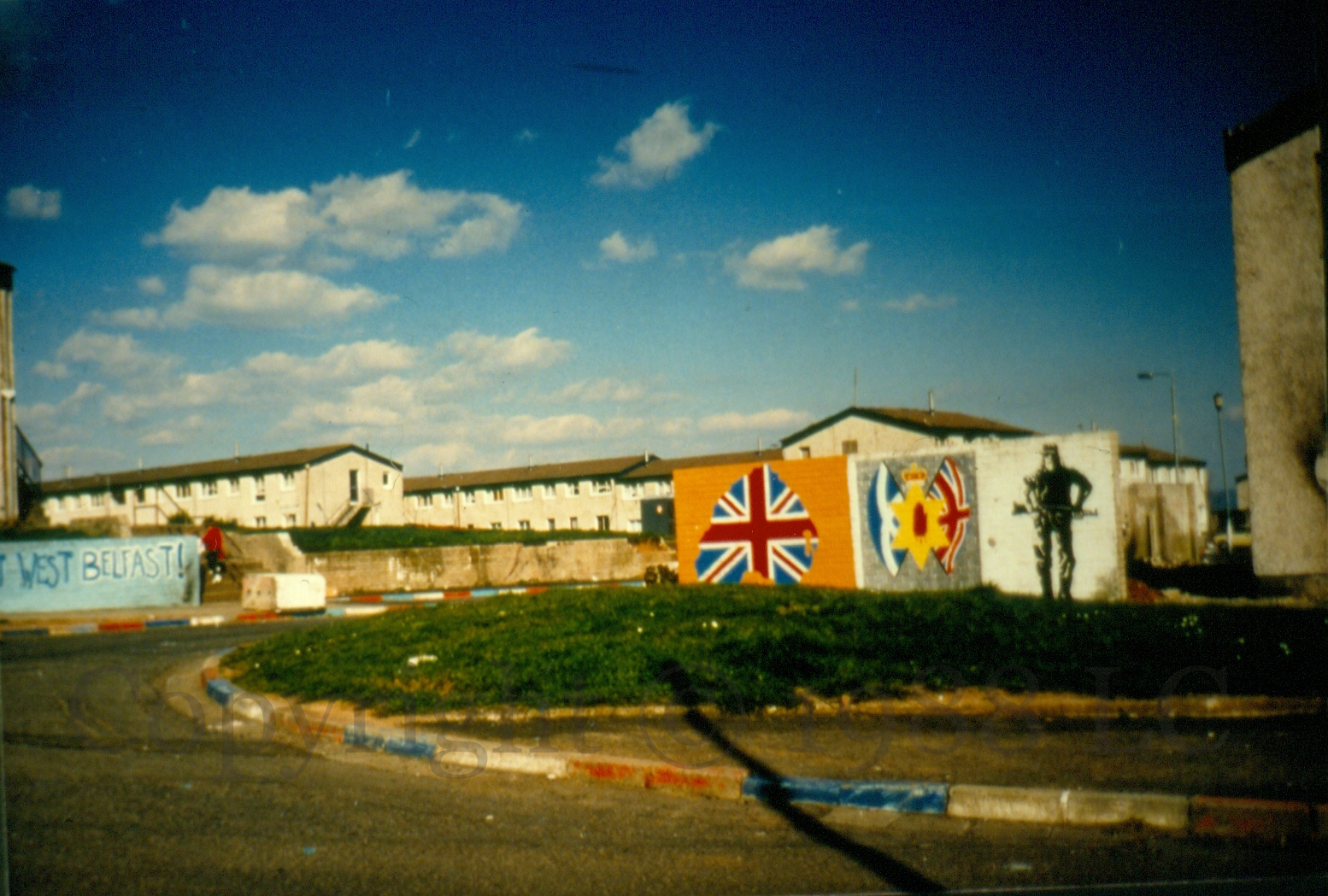
Three loyalist murals side-by-side: the Union jack in the shape of Northern Ireland, a red hand of Ulster and crown on the six-pointed star, between St Andrew’s Saltire and the Union flag, and a (UDA?) volunteer with rifle.
Location unknown — perhaps the old Shankill Parade?
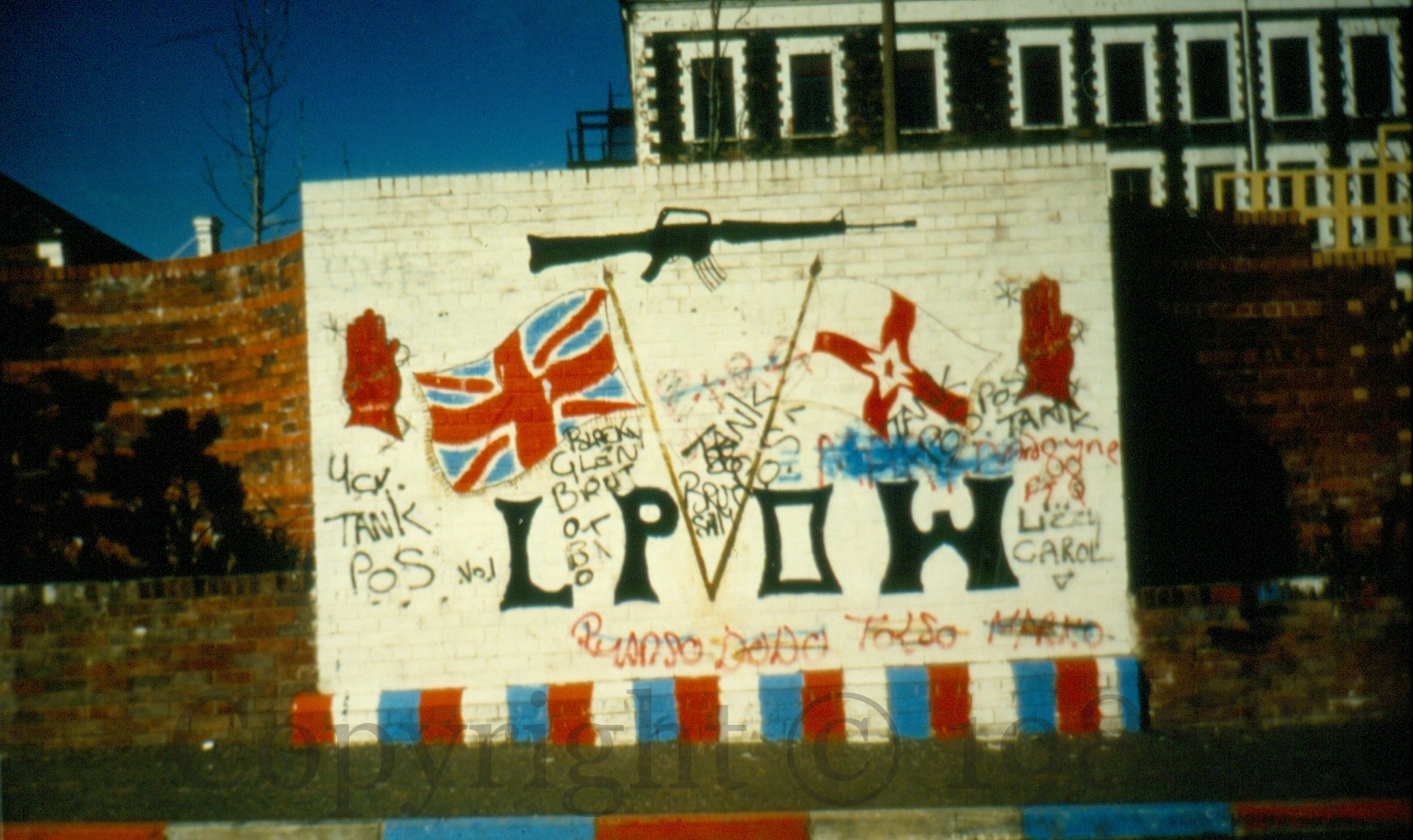
Loyalist prisoners of war (LPOW) mural in Rosebank Street, Belfast, with red hands wrapped in barbed wire, the Union flag and Ulster banner, under an assault rifle.
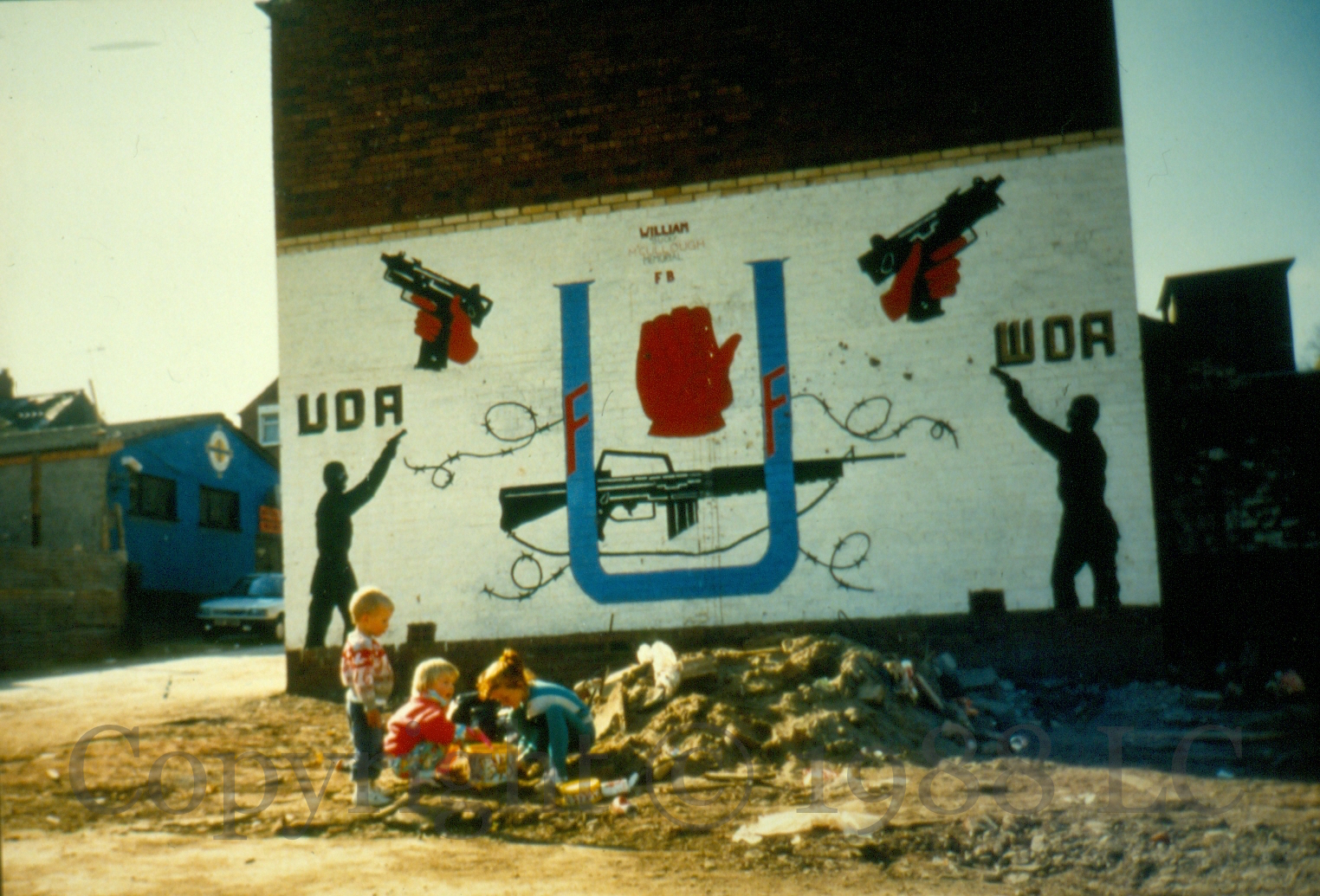
UDA/UFF/WDA (Woodvale Defence Association) and William “Bucky” McCullough Memorial Flute Band mural, with silhouetted volunteers, images of various weapons (held in red hands), and barbed wire.
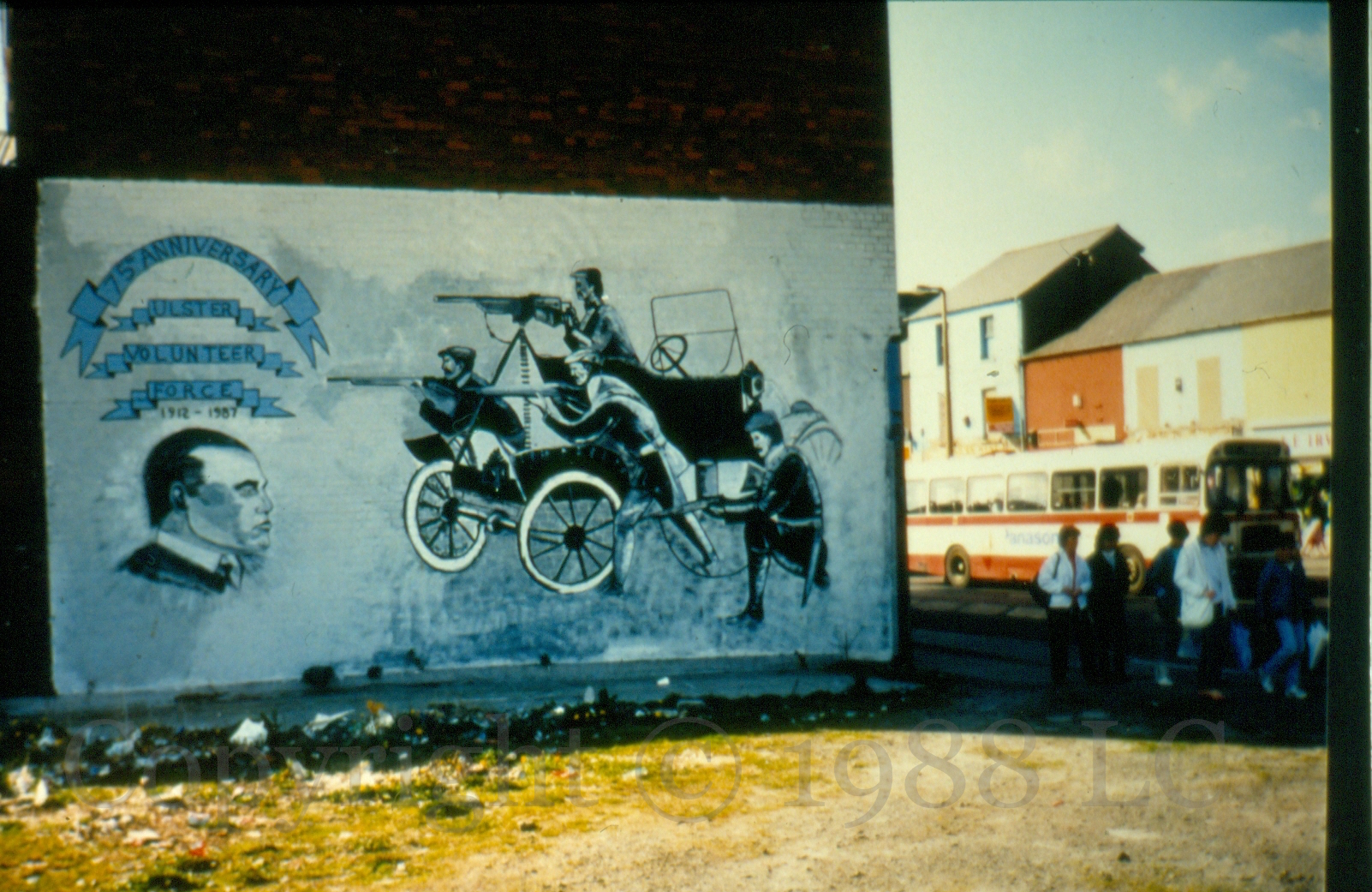
This mural celebrates the 75th anniversary of the Ulster Volunteers, 1912 – 1987, with a portrait of Edward Carson and a rifle mounted on the back of a car (based on a photograph from 1914).
Shankill Road (on the wall of (what is now) the PUP offices, just west of the current Bayardo memorial), west Belfast.
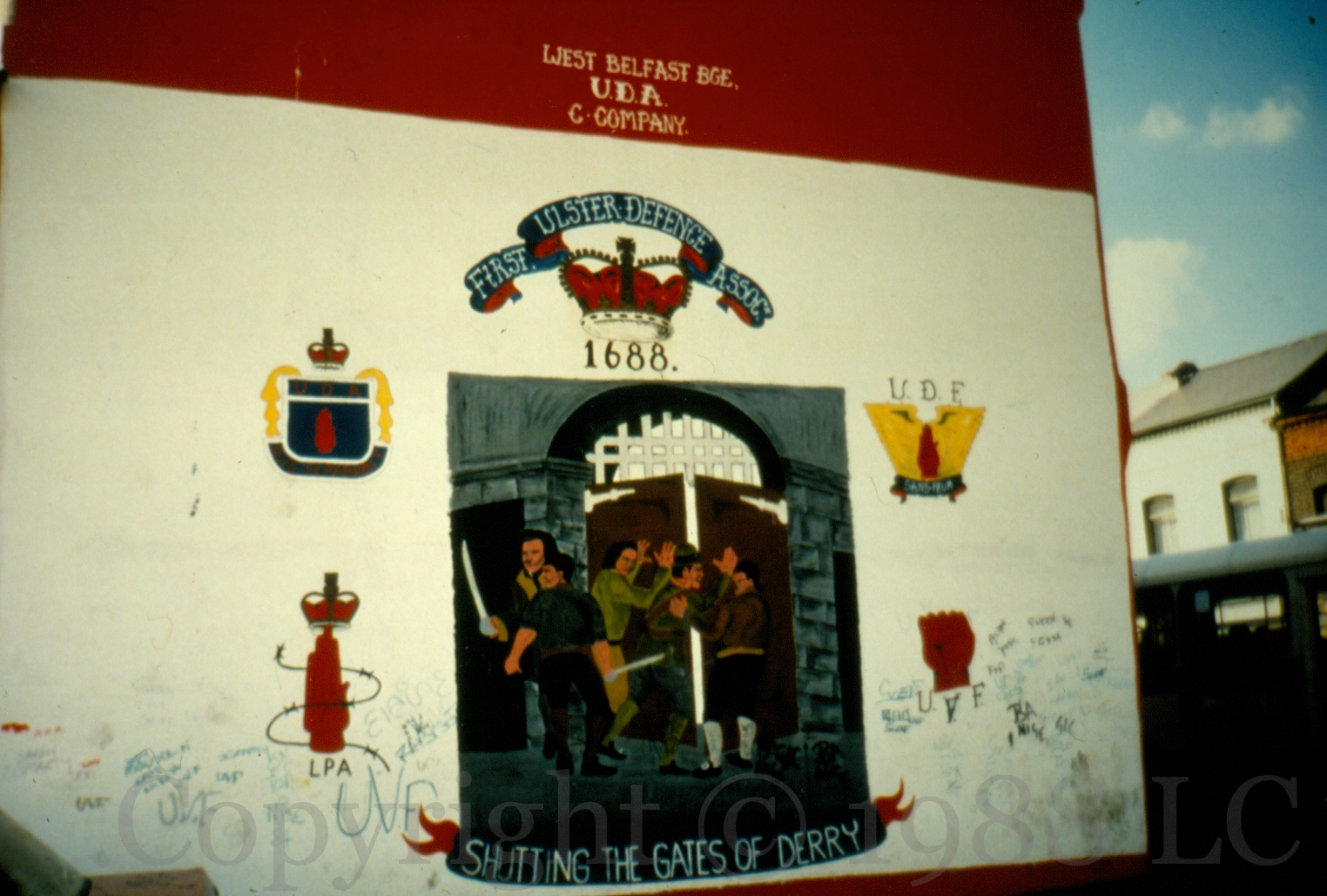
“West Belfast Brigade UDA C Company”. UDA/UDF/LPA/UFF mural on the Shankill. (For a similar quartet of names and explanation of “UDF”, see Sans Peur.)
The title “First Ulster Defence Assoc.” is an attempt to tie together the defenders of Derry in 1688 (300th anniversary) with the modern Ulster Defence Association. This is an early attempt to give the UDA historical roots, beyond the Shankill and Woodvale Defence Associations. To this end, the group would adopt Cú Chulaınn (beginning in 1992 – see the Visual History page) and (beginning in 2007 – see UDU-UFF-UDA) the 1893 Ulster Defence Union as ancestors.