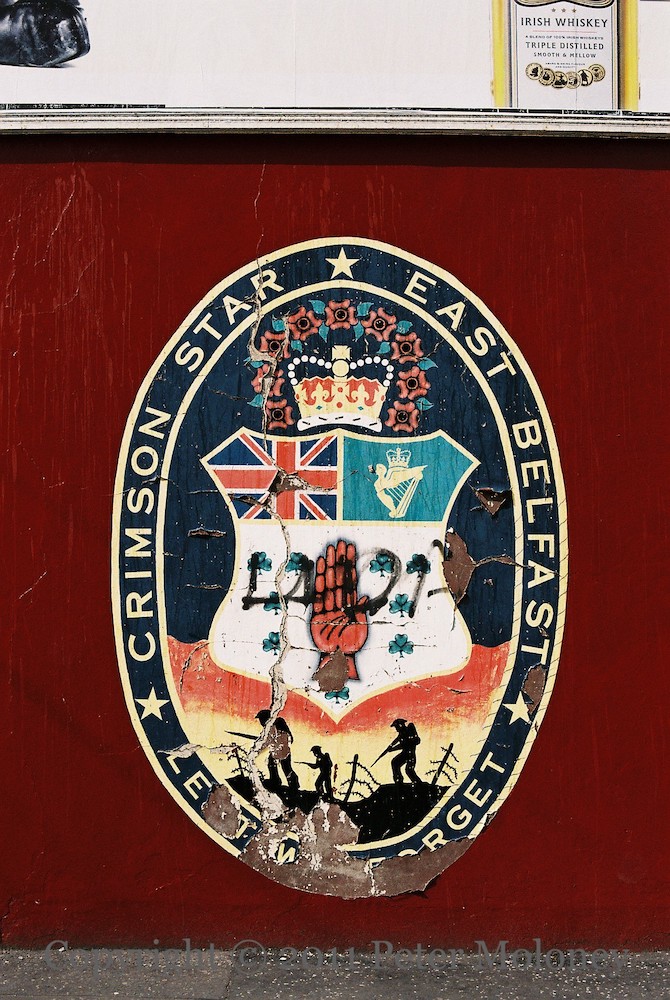
The Ulster Banner and Union Flag serve as bookends for two additional boards: “Still loud, still proud – No surrender” (presumably Seapatrick Flute Band) and the insignia of the 36th (Ulster) Division.
Seapatrick Road, Seapatrick (near Banbridge), Co Down
Work-in-progress images from the new mural in memory of the dead from the 36th (Ulster) Division in St Leonard’s Crescent (the old Newcastle Street) in east Belfast.
The four main panels show the men of the 36th going over the top on the first day of the Somme (1st July 1916), the “angel of Mons” (WP), Ulster Tower (“This tower was dedicated to the glory of God. In grateful memory of the officers, non commissioned officers and men of the 36th (Ulster) Division, and of the sons of Ulster in other forces who laid down their lives in the great war, and of all their comrades in arms who, by divine grace, were spared to testify to their glorious deeds. ‘Throughout the long years of struggle …. the men of Ulster have proved how nobly they fight and die’ – 16th November 1918 King George V”), and Thiepval Memorial (“Dear men and brothers, going out/to fight for Ulster’s need/we hail you with a mighty shout/brave friends, and true in deed.//Your country holds you in renown/your names will never be dead/and some sweet angel has a crown/for each dear, manly head.”)
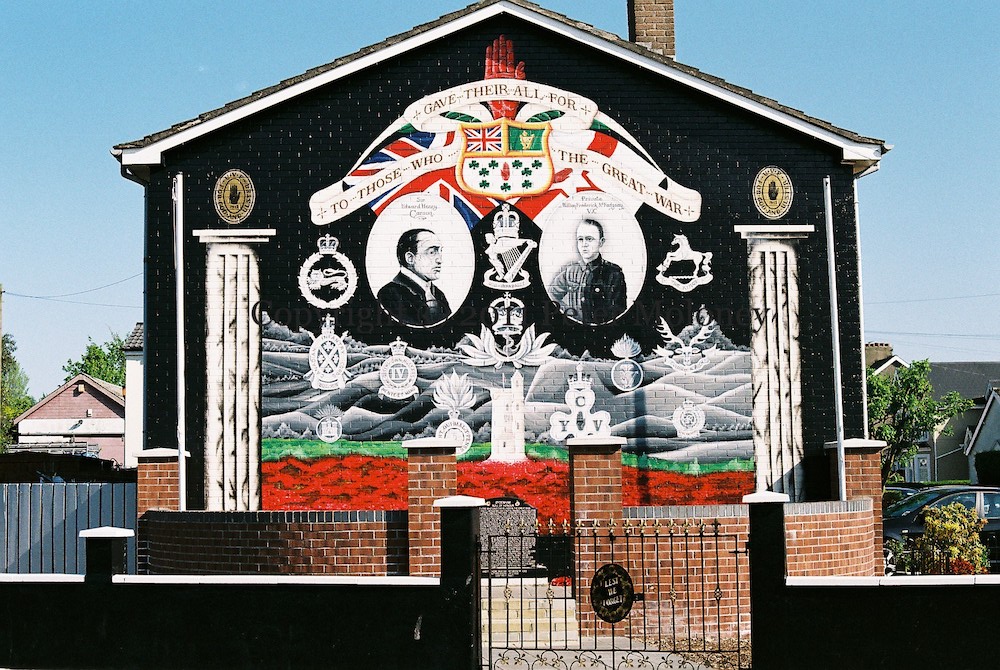
The portraits are of Edward Henry Carson and Private William McFadzean VC; the stone is a “Sydenham Roll Of Honour”. The insignia of various British Army units are shown over the hills around Thiepval and a sea of poppies. Seen previously from a distance in 2010.
Soldiers from the 15th Battalion (North Belfast) Royal Irish Rifles board ship for France in 1915. The five men featured in the apex are Sergeant Major Magookin, 2nd Lt De La Harpur, Rifleman Forrester, Rifleman Baird, and Rifleman Templeton.
British soldiers from the 36th (Ulster) Division go over the top on the first day of the Battle Of The Somme, July 1st, 1916. The mural is a reproduction of a famous photo by Paul Popper.
The mural replaces one to the UVF’s Platoon 5 , A Co., and the memorial stone is dedicated to it (and not to the WWI soldiers from the 36th (Ulster) Division who died in the charge from Thiepval Wood, July 1st, 1916): “This stone is dedicated to the memory of the fallen volunteers of No. 5 platoon A company 1st Belfast battalion Ulster Volunteer Force. ‘As poppy petals gently fall/Remember us who gave our all/Not in the mud of foreign lands/Nor buried in the desert sands//In Ulster field and farm and town/Fermanagh’s lanes and Drumlin’d Down/We died that violent death should cease/And Ulstermen might live in peace’ Lest we forget.” For the side walls, see Thiepval St.
“Rear Admiral Edward Bingham VC OBE, son of Lord Clanmorris, was born in Bangor and served in the Royal Navy during the First World War. He was awarded the Victoria Cross for his actions in engaging the German fleet during the battle of Jutland. The Bingham family name adorns various settings in the town where he is remembered with pride. Read Admiral Bingham’s Victoria Cross was purchased by north down borough council and is on display at the North Down Museum.” Born 26th July 1881, died 24th Sept. 1939.
This 2009 memorial garden in Owenroe Drive, Bangor caused controversy when built using Housing Executive funds as it was intended to commemorate only the dead of WWI. In addition, it contains headstones to members of the UDA (on which Cuchulainn is invoked as a “defender of Ulster”), RHC, and UVF (BelTel).