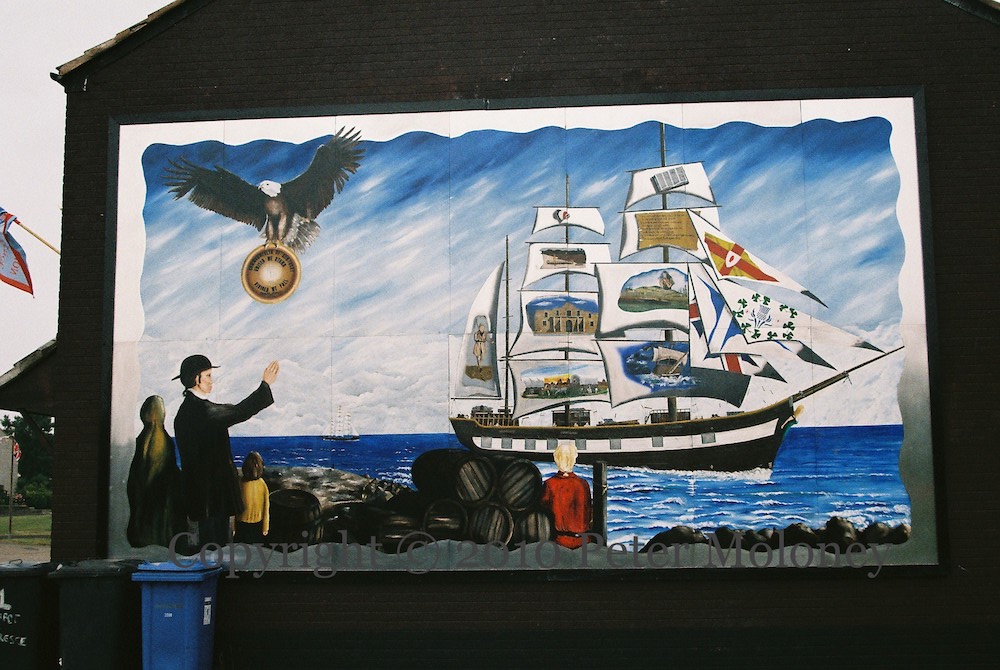
“From North Antrim To Gettysburg. ‘On this July morning my heart recalls the summer fields of hame, the townland of my mother, the sound and smells of the lower meadow. These memories I carry into battle between the drum beats of my heart.’ John McPherson, Confederate soldier, Gettysburg July 1st 1863. This mural marks the Trans-Atlantic heritage of our ancestors who set out from these fields, shores and townlands to establish a new life, and in doing so, helped create the United States of America.”
A bald eagle carrying a medallion reading “Commonwealth of Kentucky. (Dan Boone led the settlers into Kentucky, according to the mural previously in this spot.) United we stand, divided we fall” flies alongside a sailing ship carrying Ulster-Scots emigrants to the United States (the outer jib shows a thistle surrounded by shamrocks).
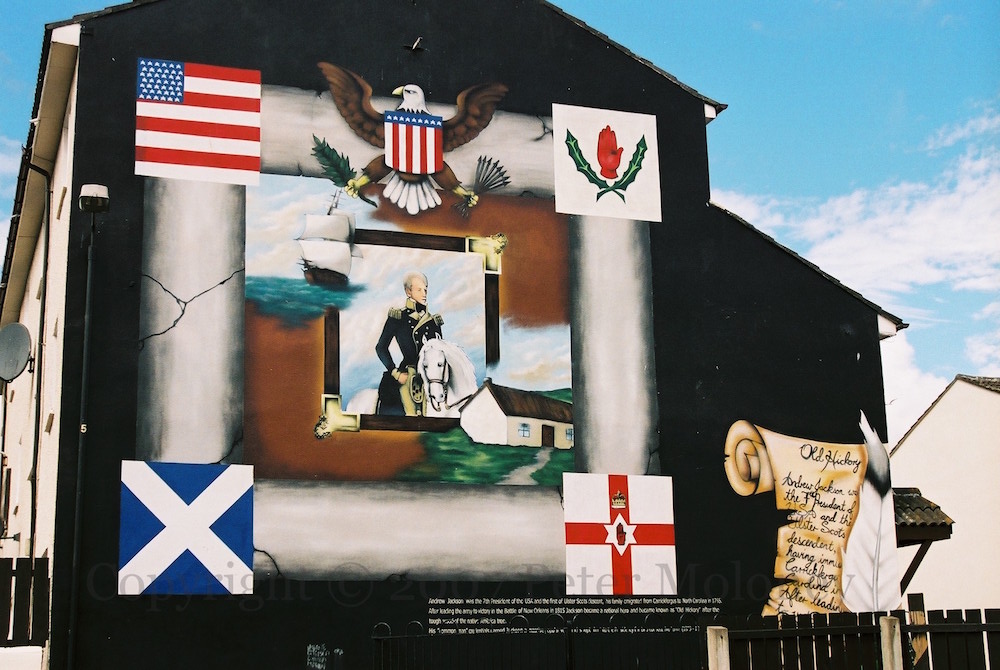
The information along the bottom reads: “Andrew Jackson was the 7th President of the USA and the first of Ulster-Scots descent, his family emigrated from Carrickfergus to North Carolina in 1765. After leading the army to victory in the Battle Of New Orleans in 1815 Jackson became a national hero and became known as “Old Hickory” after the tough wood of the native American tree. His “common man” credentials earned Jackson a massive popular vote and swept him into the Presidency for two consecutive terms (1829-1837).” He also hated the British, owned slaves, and signed the Indian Removal Act of 1830, which led to the infamous “Trail of Tears” (Irish Times).
This Ballymoney mural goes all the way back to at least 2004 and to the wave of Ulster-Scots – or as here, “Scotch-Irish” – murals painted in PUL areas after the promotion of Ulstèr-Scotch as a parallel language to Irish by the Good Friday/Belfast Agreement.
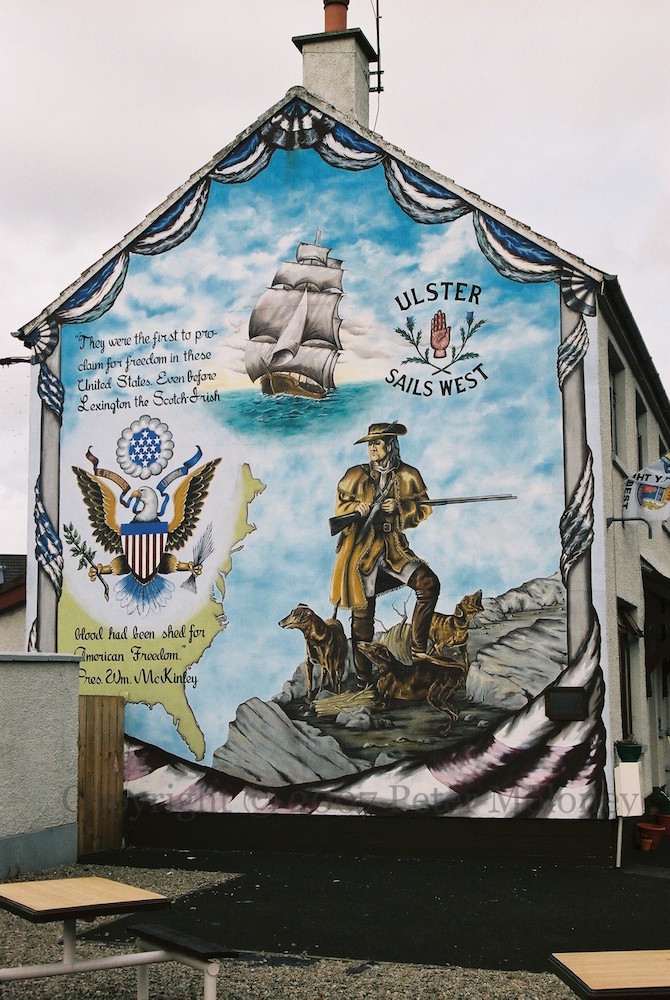
As the Visual History page on Ulster-Scots Murals shows, most of these murals made a connection to (what would-become) the United States, to where about a quarter million people emigrated (WP). The mural is intended to tell a story of emigration (signified by the sailing ship), American independence (the McKinley quote), and American expansion (the frontiersman).
The Scotch-Irish were Presbyterians and supporters of breaking the ties to Great Britain. In 1893, Governor Of Ohio (and later US President) (Ulster Nation) William McKinley said, “They were the first to proclaim for freedom in these United States. Even before Lexington [i.e. the outbreak of the Revolutionary War, on April 19, 1775] the Scotch-Irish blood had been shed for American Freedom.” (According to William Marshall’s book Ulster Sails West, the battle McKinley is referring to took place on the Alamace river in North Carolina in 1771 (p. 29).)
The frontiersman on the right is generally taken to be David “Davy” Crockett, from the 1830s (Rolston in Al Jazeera | McCormick J2024); it is in fact a 1991 sketch of a generic frontiersman by David Wright (web), called “The Long Knife”, and the figure is referred to generically as “a trapper” by the artist (BBC).
None of the conquests of European-American colonists provides a good parallel to unionism, due to the complicated nature of political conflicts both there and here. The Americans, of course, threw off British rule in their revolution; Irish unionists want to remain part of the UK. And Crockett died in the Battle Of The Alamo in the Texas Revolution; that is, he died fighting for Texan independence from the Mexican government, which again doesn’t line up well with the desire of Irish unionists to remain part of the United Kingdom. (For another strained analogy involving the Scotch-Irish and US political history, see The War Of Northern Aggression and its discussion in the Ulster-Scots Murals page.)
The reason for its inclusion is the simpler idea that the Scotch-Irish are a rugged and feisty people who are not to be trifled with, whether in North America or Ireland.
Painted by Kenny Blair (Fb) in Hillview Avenue, Ballymoney; sponsored by the North Antrim Cultural And Musical Society and funded by the Heritage Commission. “Ulster Sails West” is the title of a 1943 book by WF Marshall (Isles Abroad).
“250,000 Ulster Scots emigrated to America in the 1700s and were the driving force behind the American Revolution.” James Buchanan (senior) emigrated to the United States from Donegal (WP) or Tyrone (Ulster Scots). Junior was born in Cove Gap, Pennsylvania in 1791. He was elected president in 1856, the 15th president of the United States, immediately prior to Abraham Lincoln. A version of this mural was also painted in Londonderry in the same year (1999).
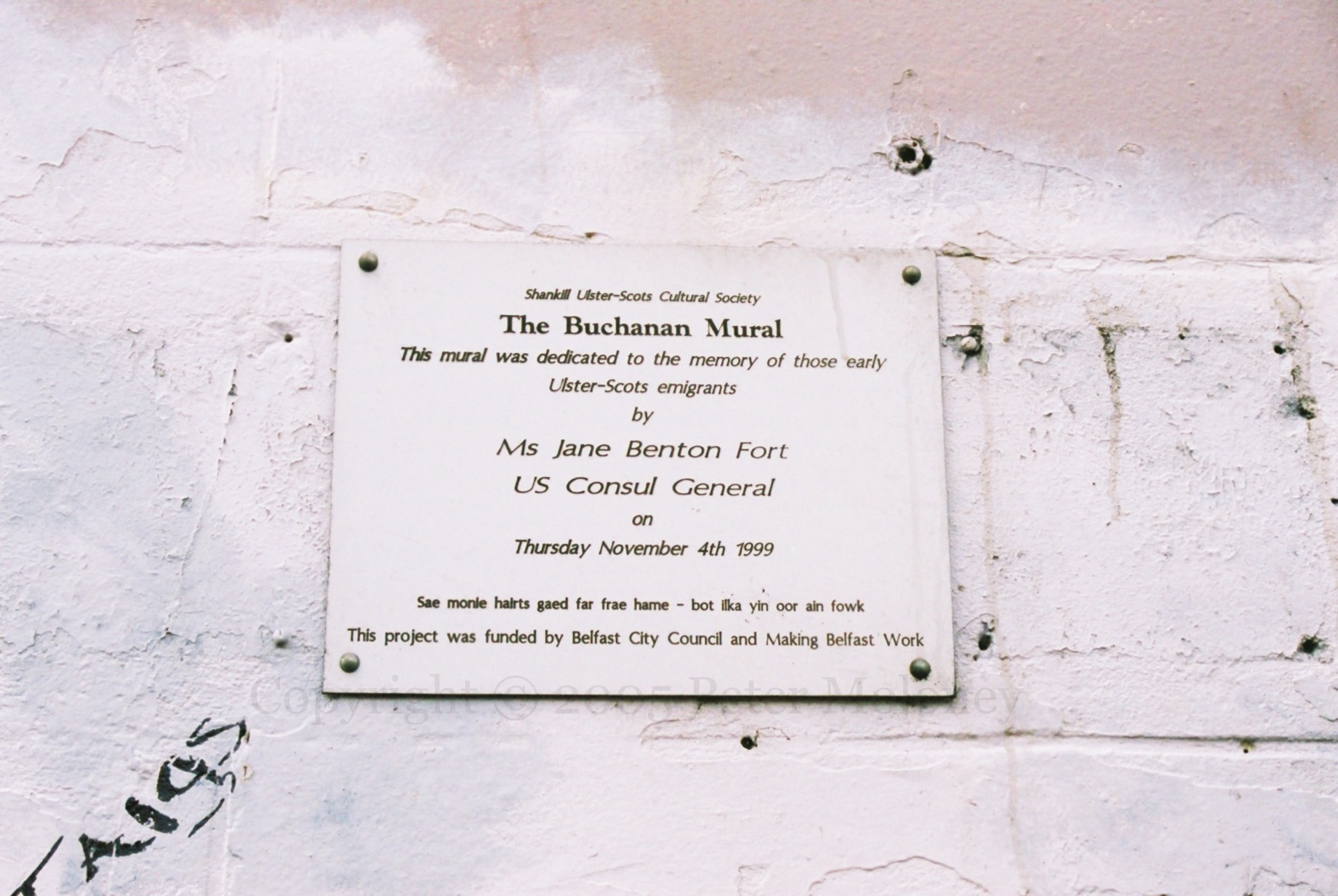
“Shankill Ulster-Scots Cultural Society. The Buchanan Mural. This mural was dedicated to the memory of those early Ulster-Scots emigrants by Ms Jane Benton Fort, US Consul General, on Thursday November 4th, 1999. Sae monie hairts gaed far frae hame – bot ilka yin oor ain fowk. This project was funded by Belfast City Council and Making Belfast Work.”
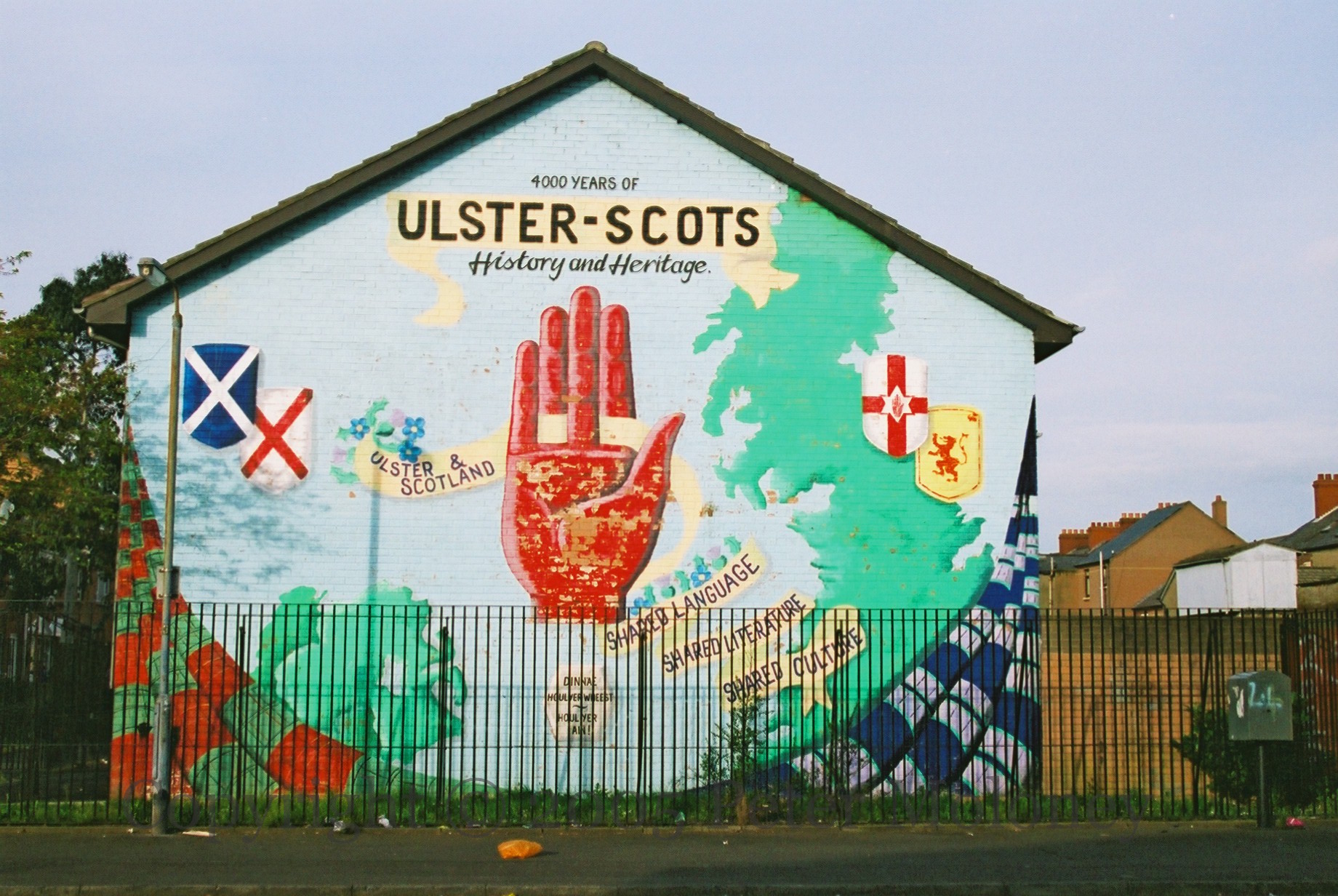
“4000 years of Ulster-Scots history and heritage. Ulster & Scotland – shared language, shared literature, shared culture.” 400 years takes us back to the plantation; 4000 years suggests an even deeper connection.
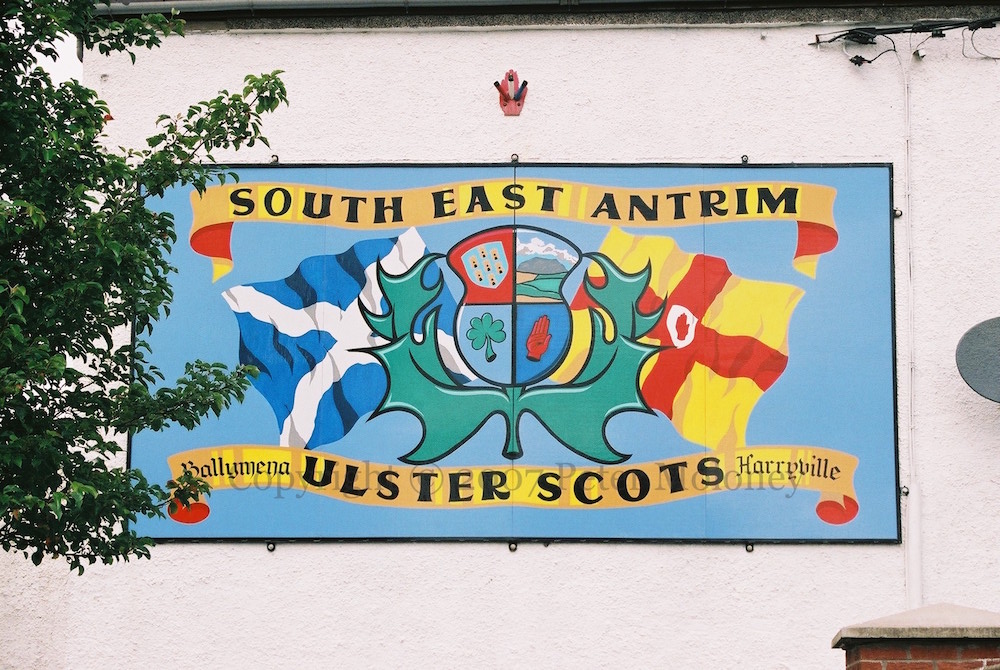
Ulster-Scots was included in the 1998 Good Friday Agreement under the principle of support for “linguistic diversity”. This mural celebrating Ulster-Scots and ties between Northern Ireland and Scotland dates to 1999, with the crests of St Andrew and St Patrick on the left, and an Ulster Banner and Scottish lion rampant on the right.
“Dinnae houl yer wheest, houl yer ain!” [Don’t hold your tongue, hold your own!]
“If defeated everywhere else I will make my final stand for liberty with the Scotch-Irish (Ulster-Scots) of my native Virginia.” George Washington commanded the Continental Army during the revolution and served as the first president of the United States beginning in 1789. His ancestry was English and the quote is undocumented, the closest being this statement from McKinley. The note in the corner reads “History records that almost half of Washington’s army were Ulster-Scots”; the basis for this claim might be General (Charles?) Lee’s report that “half the rebel Continental Army were from Ireland.” (See Chapter 2 of Bagenal, The American Irish and their Influence on Irish Politics.)
“‘My forefathers were … the men who had followed Cromwell and who shared in the defence of Derry, and in the victories of Aughrim and the Boyne.’ – President Theodore Roosevelt, 20th US president, 1901-1904.” The “shutting of the gates” of Derry is represented in the bottom left.
The quote is derived from Volume 1, Chapter 5 of Roosevelt’s The Winning Of The West (available at Project Gutenberg), though he is describing the forefathers of the Scotch-Irish, rather than his own forefathers (who, as the name suggests, were Dutch).
He writes, “The Presbyterian Irish were themselves already a mixed people. Though mainly descended from Scotch ancestors—who came originally from both lowlands and highlands, from among both the Scotch Saxons and the Scotch Celts—many of them were of English, a few of French Huguenot, and quite a number of true old Milesian Irish extraction. They were the Protestants of the Protestants; they detested and despised the Catholics, whom their ancestors had conquered, and regarded the Episcopalians by whom they themselves had been oppressed, with a more sullen, but scarcely less intense, hatred. They were a truculent and obstinate people, and gloried in the warlike renown of their forefathers, the men who had followed Cromwell, and who had shared in the defence of Derry and in the victories of the Boyne and Aughrim.”
Some sources claim that an ancestor(s) on his mother’s side emigrated from Gleno, Co Antrim in 1729, but this seems to be her great-great-grandfather James, who was Scots (WP) but appears to have emigrated directly from Scotland, specifically Baldernock, in 1728 or 1729 (WikiTree | Friends Of Bulloch). The search for a connection continues, according to Irish Central.
This mural is one (and perhaps the first to be painted) in the series “From pioneers to presidents”. For more such murals, see the Visual History page about Ulster-Scots murals.





 Peter Moloney Collection