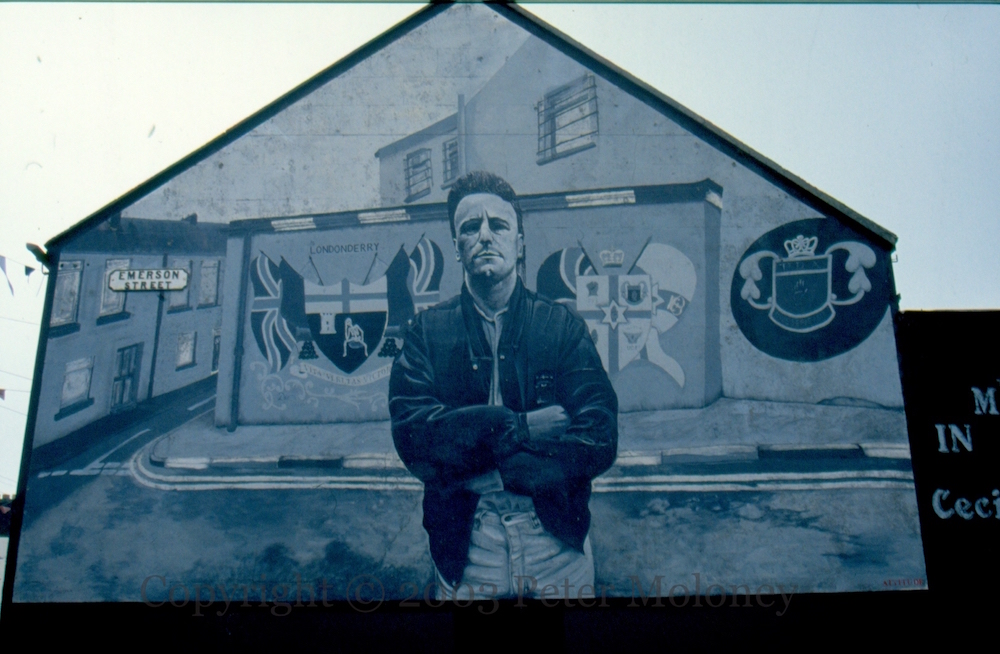
The siege of Derry began on December 7th, 1688 when thirteen apprentice boys – without official instruction – shut the gates of the city against the approaching Jacobite army of redshanks.
“If defeated everywhere else I will make my final stand for liberty with the Scotch-Irish (Ulster-Scots) of my native Virginia.” George Washington commanded the Continental Army during the revolution and served as the first president of the United States beginning in 1789. His ancestry was English and the quote is undocumented, the closest being this statement from McKinley. The note in the corner reads “History records that almost half of Washington’s army were Ulster-Scots”; the basis for this claim might be General (Charles?) Lee’s report that “half the rebel Continental Army were from Ireland.” (See Chapter 2 of Bagenal, The American Irish and their Influence on Irish Politics.)
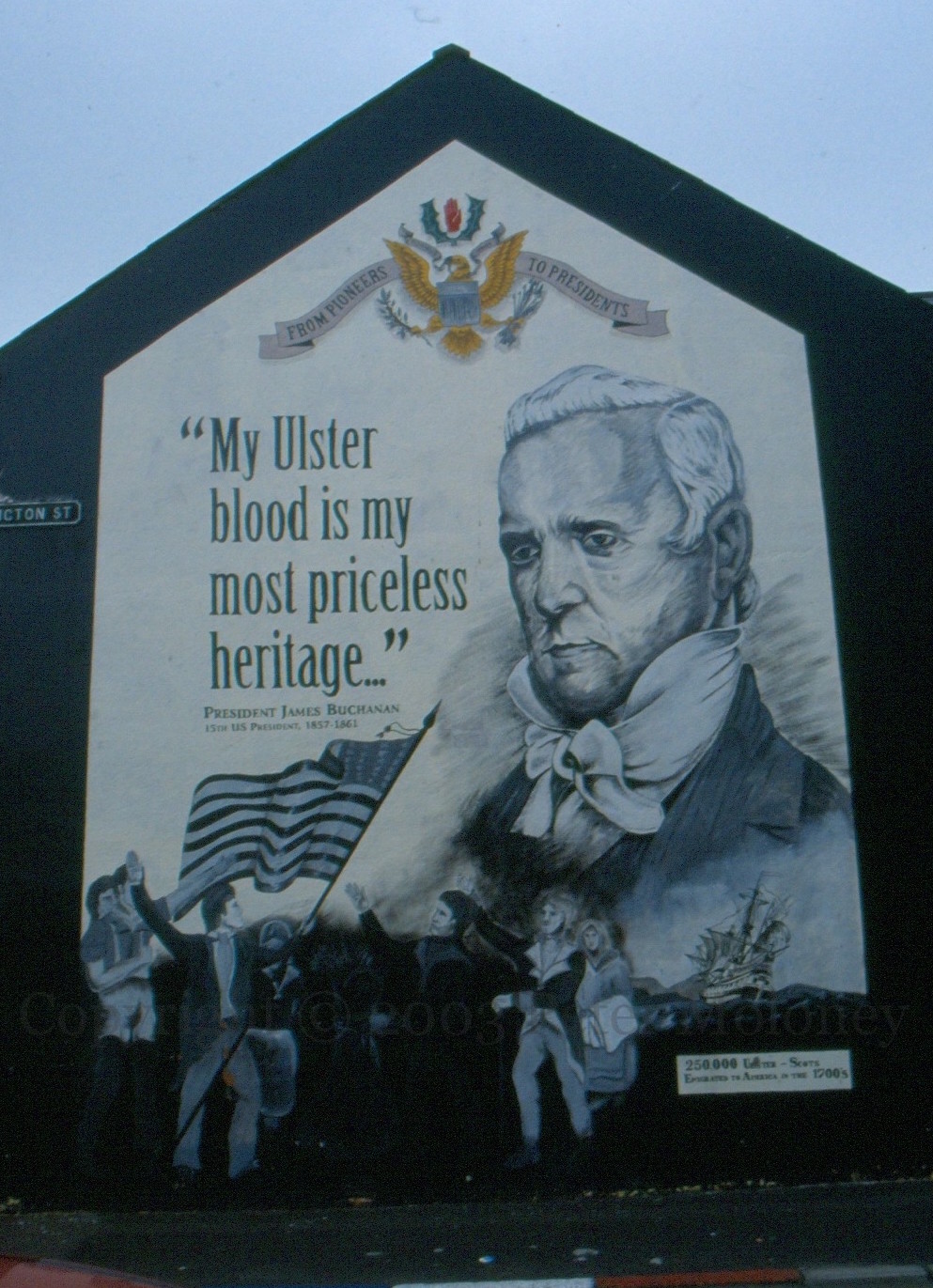
James Buchanan was “15th US president 1857-1861.” Buchanan’s father, also called James, was born in Ramelton, Co Donegal, and was living in Co Tyrone when he emigrated to the United States from Derry in 1783, (one of the “250,000 Ulster-Scots [who] emigrated to America in the 1700s”). James junior was born in 1791, the second of eleven children.
The confusion over the wording of the quote – “My Ulster blood is my most priceless [or simply: a priceless] heritage … [and I can never be too grateful to my grandparents from whom I derived it.]” – is matched by confusion over who said it (Buchanan junior or senior?); the source of the quote is unknown. Likewise we do not know where in Scotland the grandparents might have come from and perhaps the move to Ireland happened much earlier.
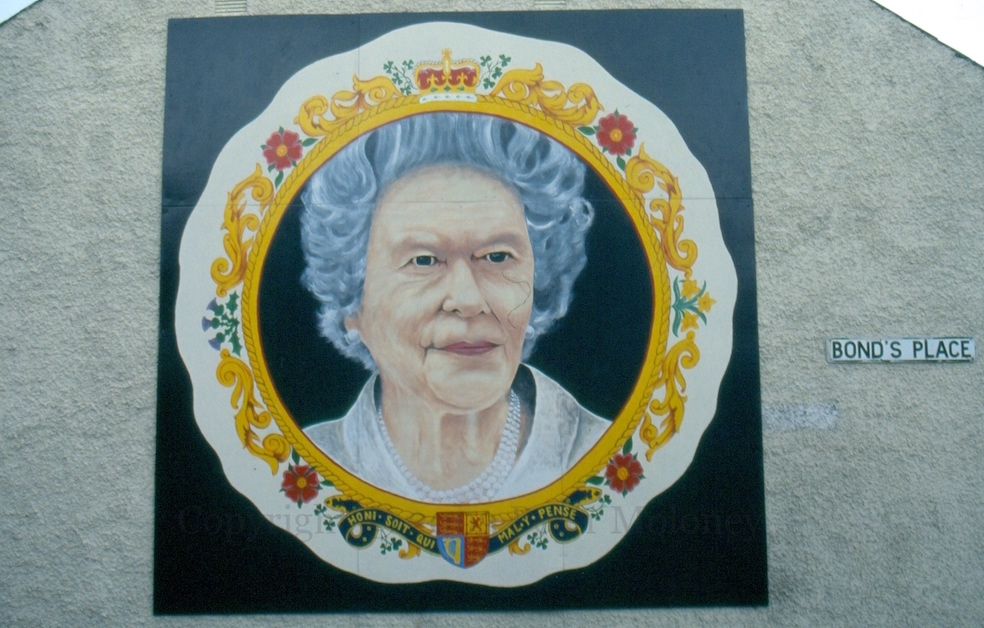
For the fiftieth anniversary of her coronation in 1953, a portrait of Elizabeth the second, Queen of the United Kingdom, Canada, Australia, and New Zealand. She is surrounded by the flowers of Ireland (shamrock), England (rose), Wales (daffodil), Scotland (thistle). “Shame to he who thinks bad of it” is in Anglo-Norman French.
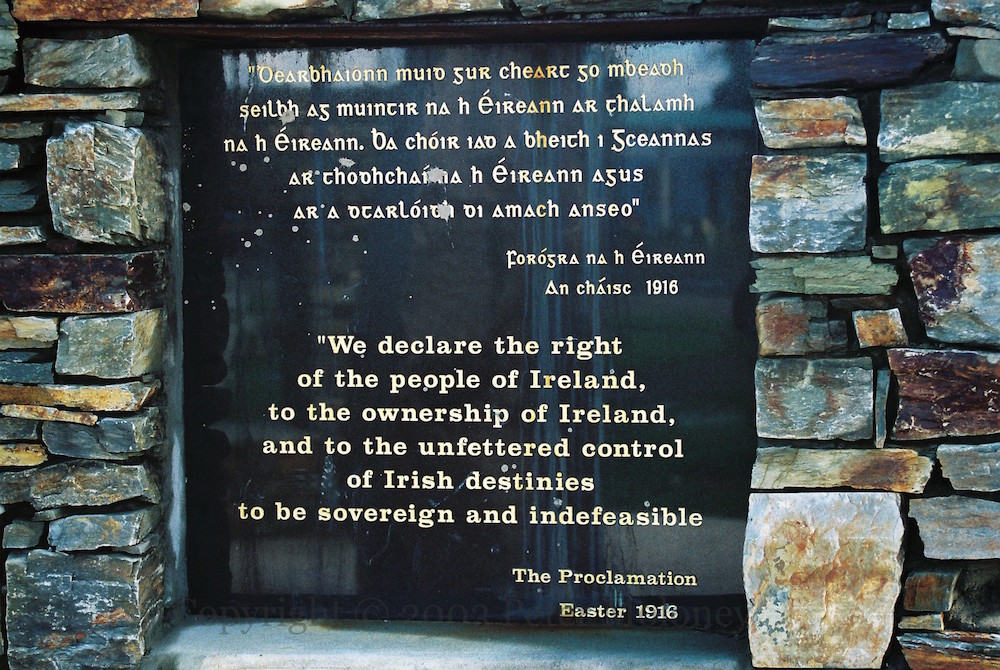
The IRA Derry Brigade memorial at the shops on Racecourse Road, Derry, includes quotes from Robert Emmet (not: Emmett) – When my country takes her place among the nations of the Earth, then and not until then let my epitaph be written – and the Easter Rising proclamation – We declare the right of the people of Ireland, and to the unfettered control of Irish destinies to be sovereign and indefeasible – in both English and Irish.
“Nuaır a ghlacfaıdh mo thír dhúchaıs a háıt cheart ı measc náısıún uıle an domhaın, ansın, agus chan go dtí sın, déanaıgí feartlaoı s’agamsa a scríobh amach. – Roıbéard Eıméıd 1803” – “When my country takes her place among the nations of the earth, then and not until then let my epitaph be written – Robert Emmett 1778-1803”
“Dearbhaıonn muıd gur cheart go mbeadh seılbh ag muıntır na hÉıreann ar thalamh na hÉıreann. Ba chóır ıad a bheıth ı gceannas ar thodhchaí na hÉıreann agus ar a dtarlóıdh dı amach anseo – Forógra na hÉıreann, An Cháısc 1916” – “We declare the right of the people of Ireland, to the ownership of Ireland, and to the unfettered control of Irish destinies to be sovereign and indefeasible – The Proclamation, Easter 1916”
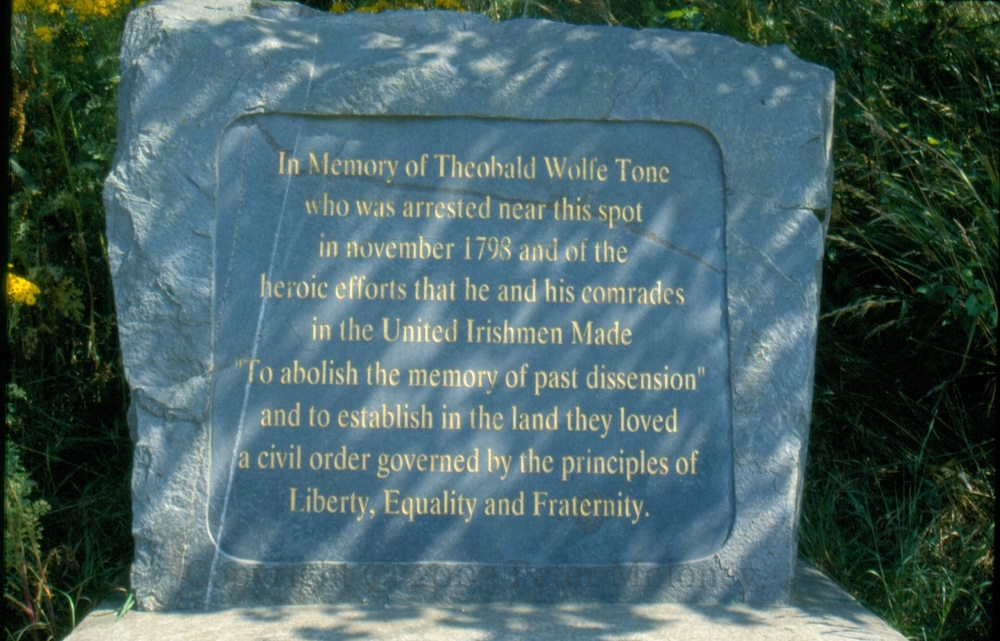
Here are two memorials from O’Doherty’s Keep in Buncrana, Co Donegal, originally a 14th century Norman Castle. Cahir Rua O’Dogherty/O’Dochartaigh/O’Doherty was a Gaelic lord loyal to the Queen of England (in opposition to the O’Donnells), but launched a rebellion, perhaps to settle a score with Sir George Paulet, governor of Derry, who was harassing the remaining Gaelic lords. O’Doherty was killed in the battle of Kilmacrennan in 1608 (WP | WP).
The other is to leader of the United Irishmen, Wolfe Tone, who was arrested in Lough Swilly in 1798 and held in Buncrana Castle before being moved to Derry and then Dublin, where he was executed.
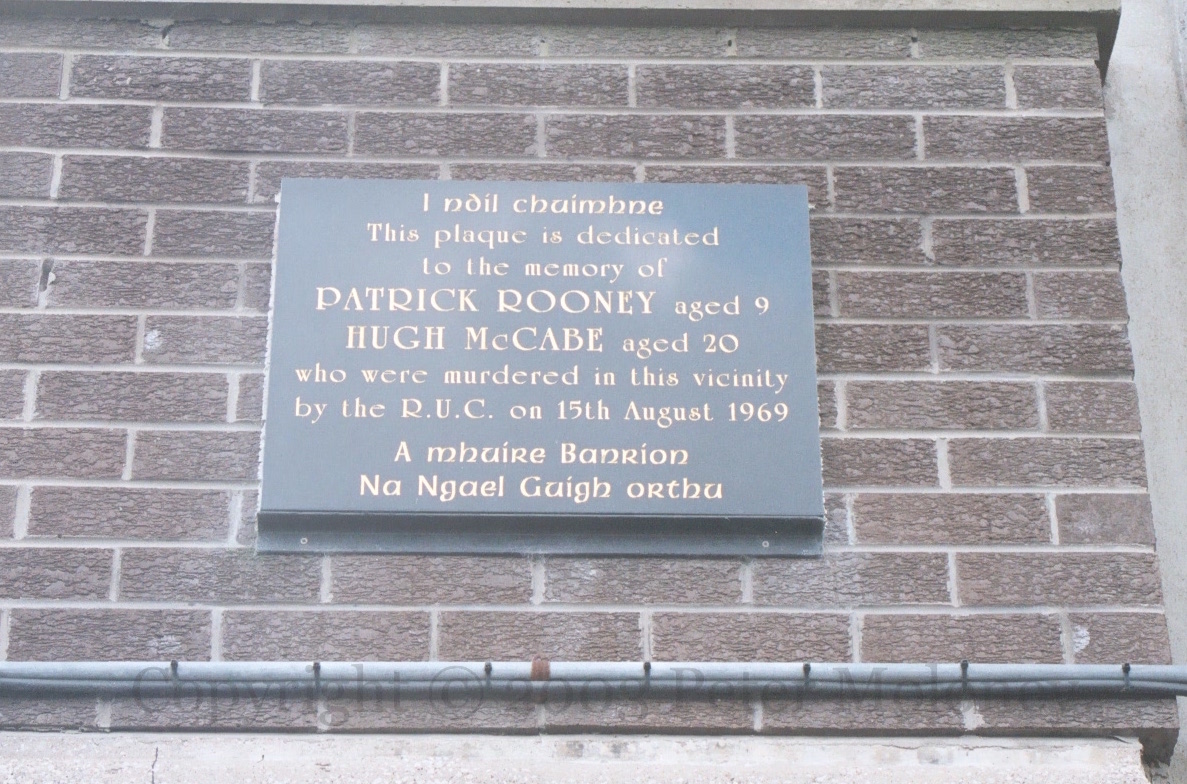
The Troubles in Belfast started in August 1969 with sustained rioting around Divis flats. On the night of August 14-15, nine year-old Patrick Rooney was hit in his home in the Divis flats by a bullet from an RUC machine-gun; he was the first child killed in the Troubles. A little later, 20 year-old Hugh McCabe, a (Catholic) British soldier on leave, was hit while dragging an injured person to safety on the roof of another flat (WP).






 Peter Moloney Collection