Unity – Solidarity

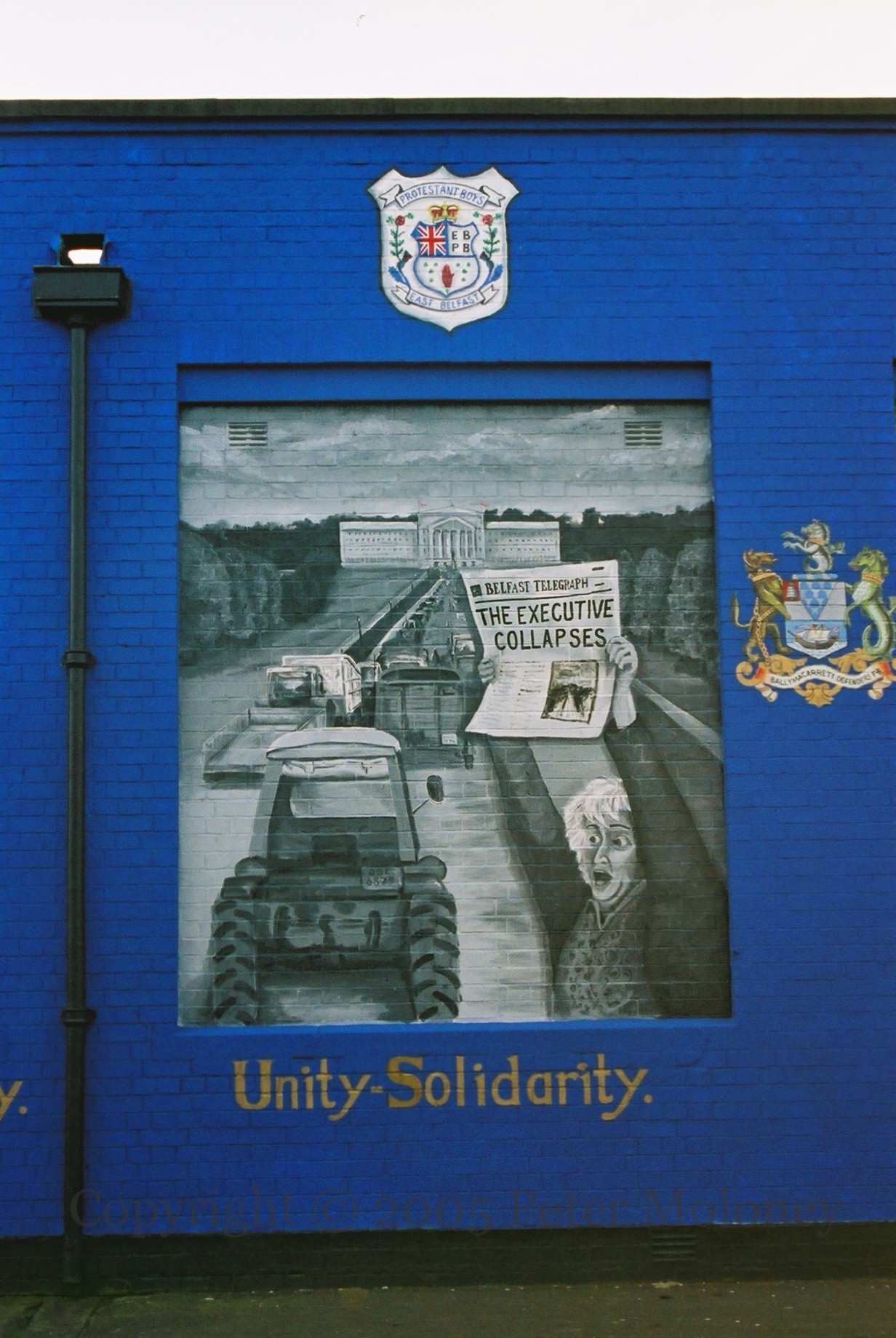
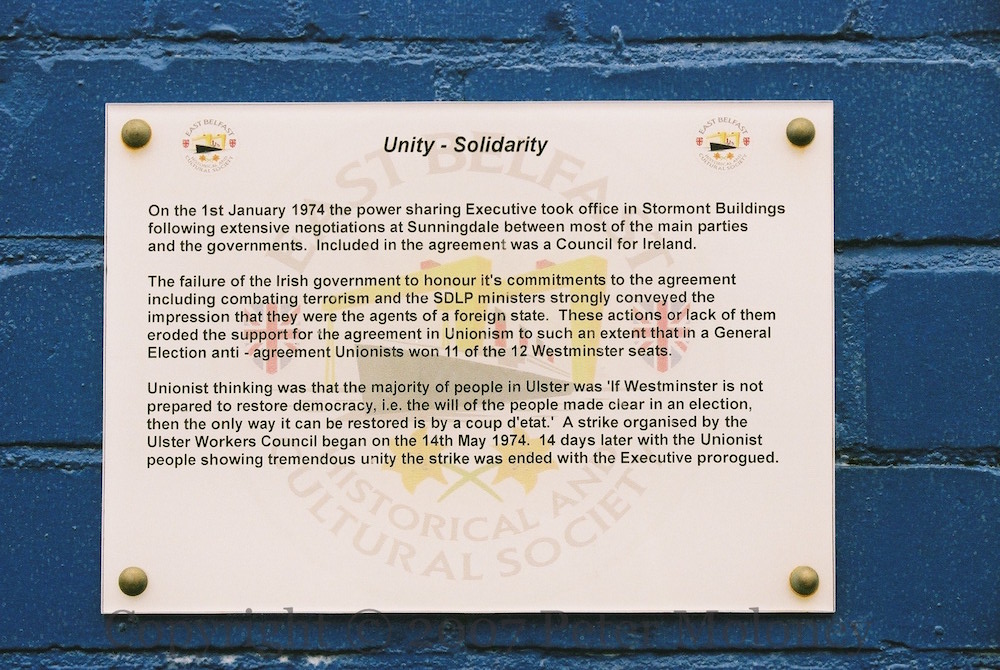
“On the 1st January 1974 the power sharing Executive took office in Stormont Building following extensive negotiations at Sunningdale between most of the main parties and the governments. Included in the agreement was a Council for Ireland. The failure of the Irish government to honour it’s commitments to the agreement including combating terrorism and the SDLP ministers strongly conveyed the impression that they were the agents of a foreign state. These actions or lack of them eroded the support for the agreement in Unionism to such an extent that in a General Election anti – agreement Unionists won 11 of the 12 Westminster seats. Unionist thinking was that the majority of people was ‘If Westminster is not prepared to restore democracy, i.e. the will of the people made clear in an election, then the only way it can be restored is by a coup d’etat.’ A strike organised by the Ulster Workers Council began on the 14th May 1974. 14 days later with the Unionist people showing tremendous unity the strike was ended with the Executive prorogued.” 10th panel on Thorndyke Street, Belfast. With emblems of the East Belfast Protestant Boys flute band and the Ballymacarrett Defenders flute band.

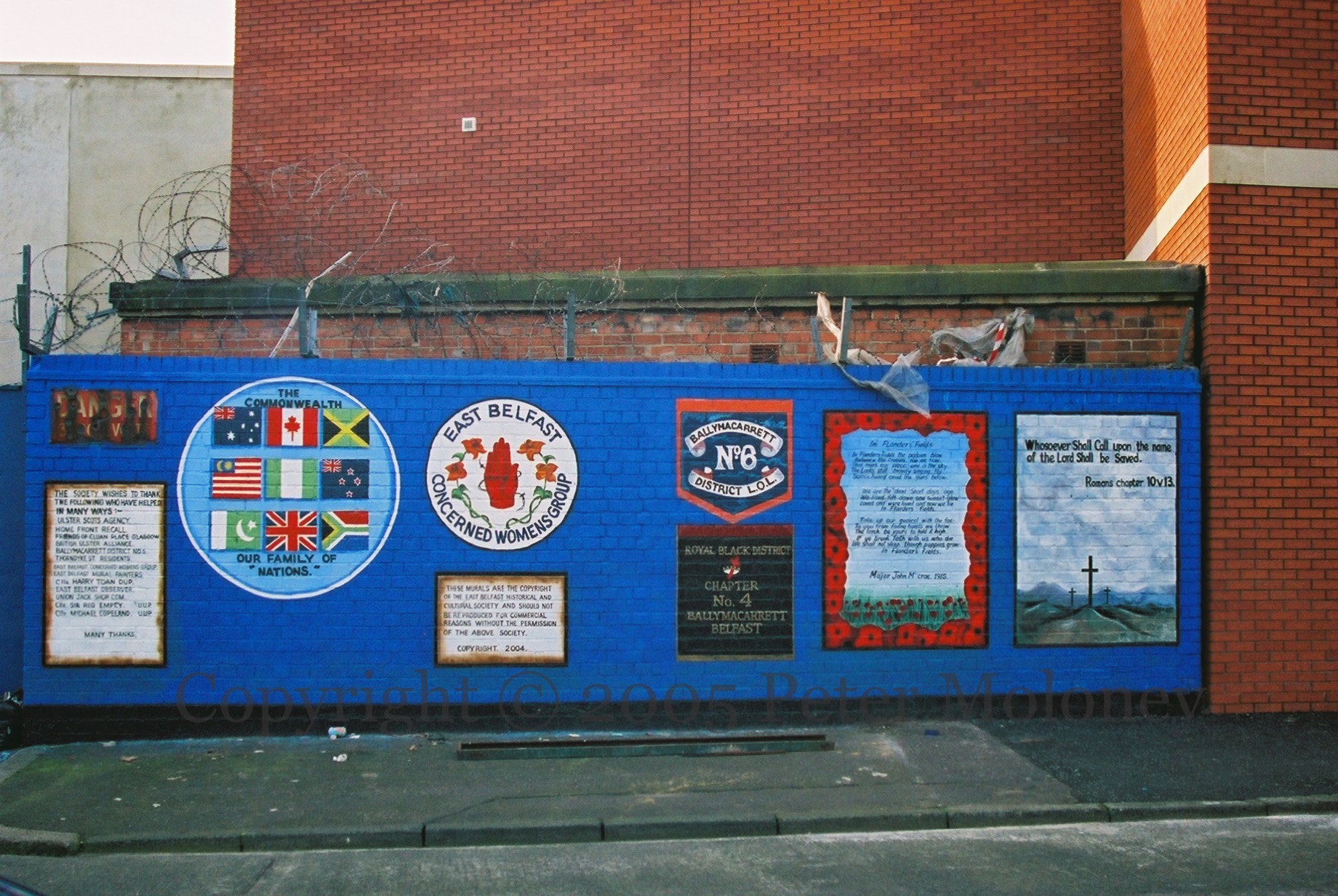
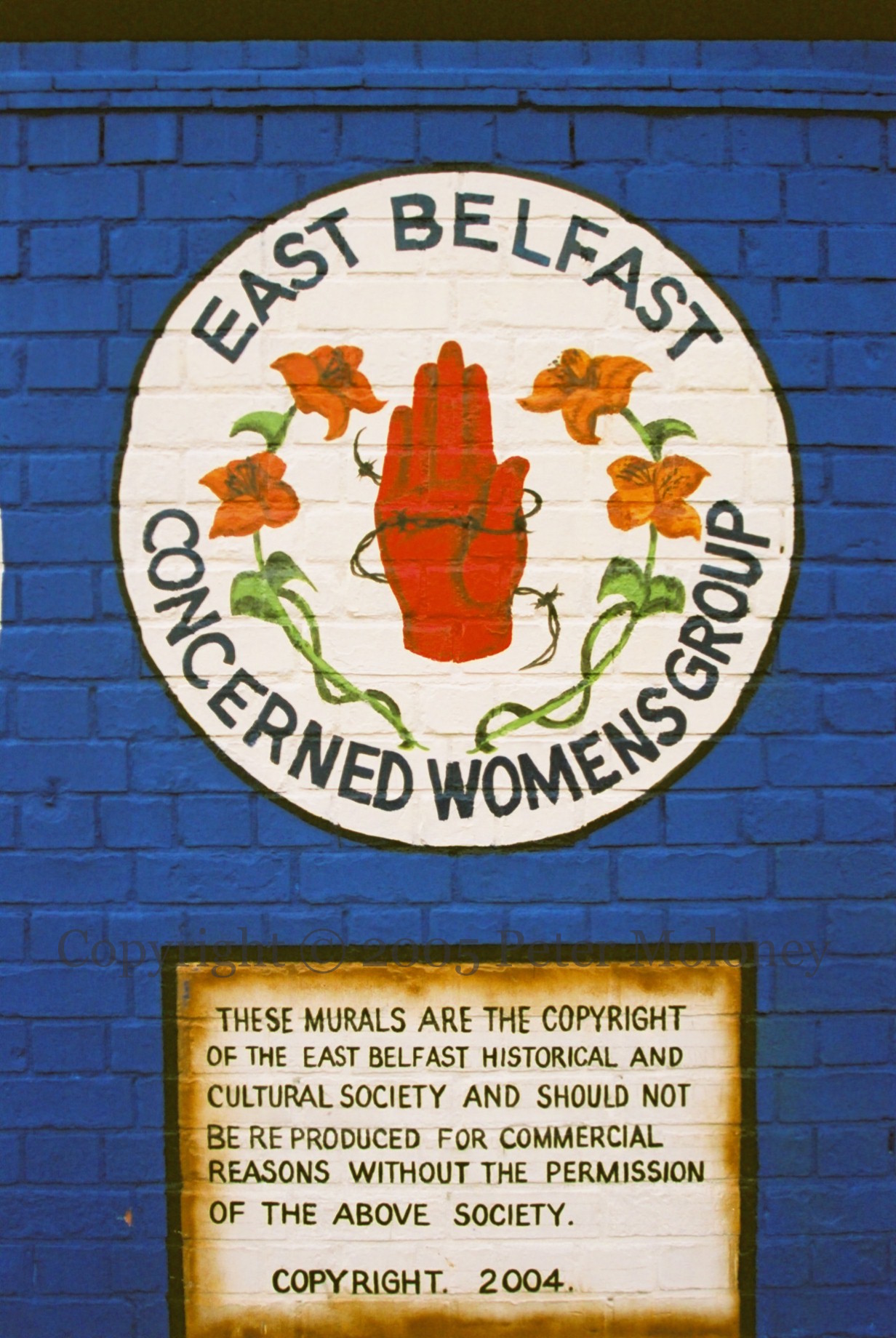
One of fourteen panels in Thorndyke Street, east Belfast. For a list of entries for each panel, see East Belfast Historical And Cultural Society.

Click image to enlarge
Copyright © 2005 Peter Moloney
M02308 M03628

Defending The Community

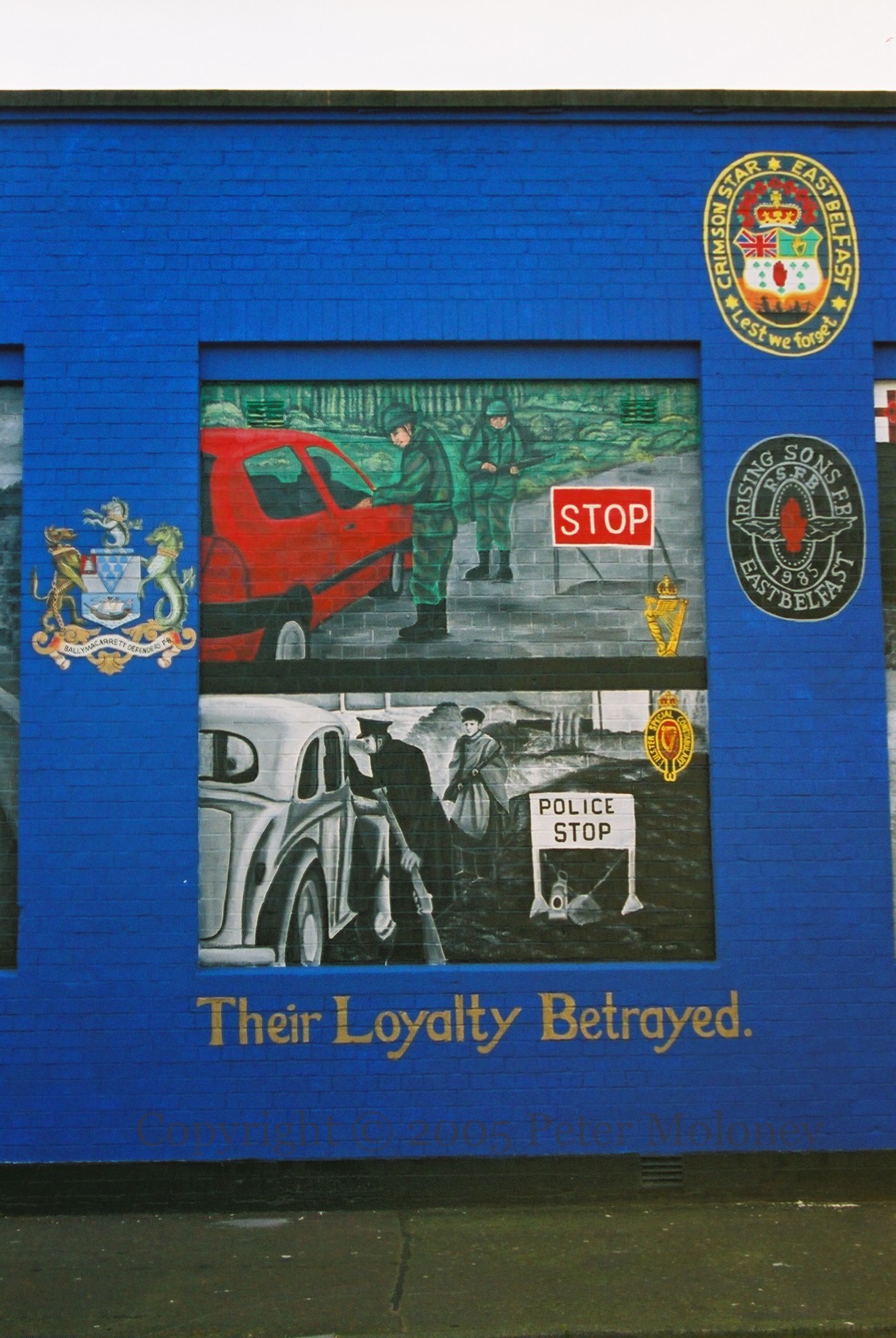
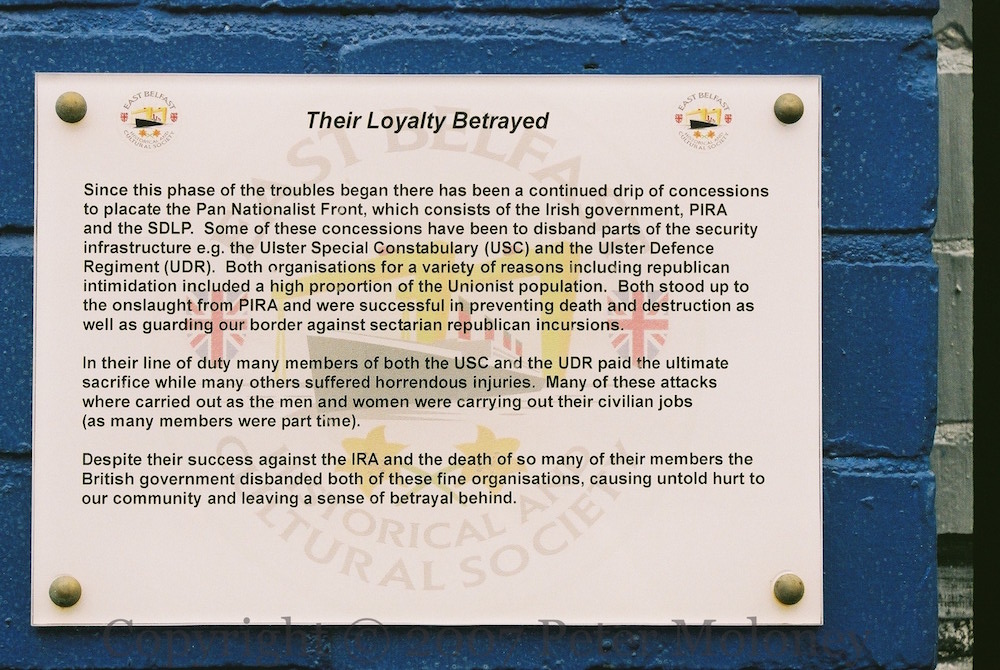
“In the early 1970’s the Provisional IRA (PIRA) flexed it’s muscles to demonstrate that the Official IRA were no longer the representatives of the republican community. Unfortunately for the Unionist population they were on the receiving end as PIRA launched sectarian bomb and gun attacks across Northern Ireland but in particular Belfast. Many innocent Protestants were murdered simply because of their religion, others were injured and many burnt out of their homes. The community was in turmoil and felt that there was no one to defend it. It was then that they (the communities) decided to take matters into their own hands and organise themselves into groups capable of defending their home and businesses from these violent and horrific sectarian attack. It was during this period of crises and community tension that the Ulster Defence Association was founded and the ranks of the Ulster Volunteer Force increased significantly. They became the defenders of the community, as they were the community.”

One of fourteen panels in Thorndyke Street, east Belfast. For a list of entries for each panel, see East Belfast Historical And Cultural Society.

Click image to enlarge
Copyright © 2005 Peter Moloney
M02307 M03629

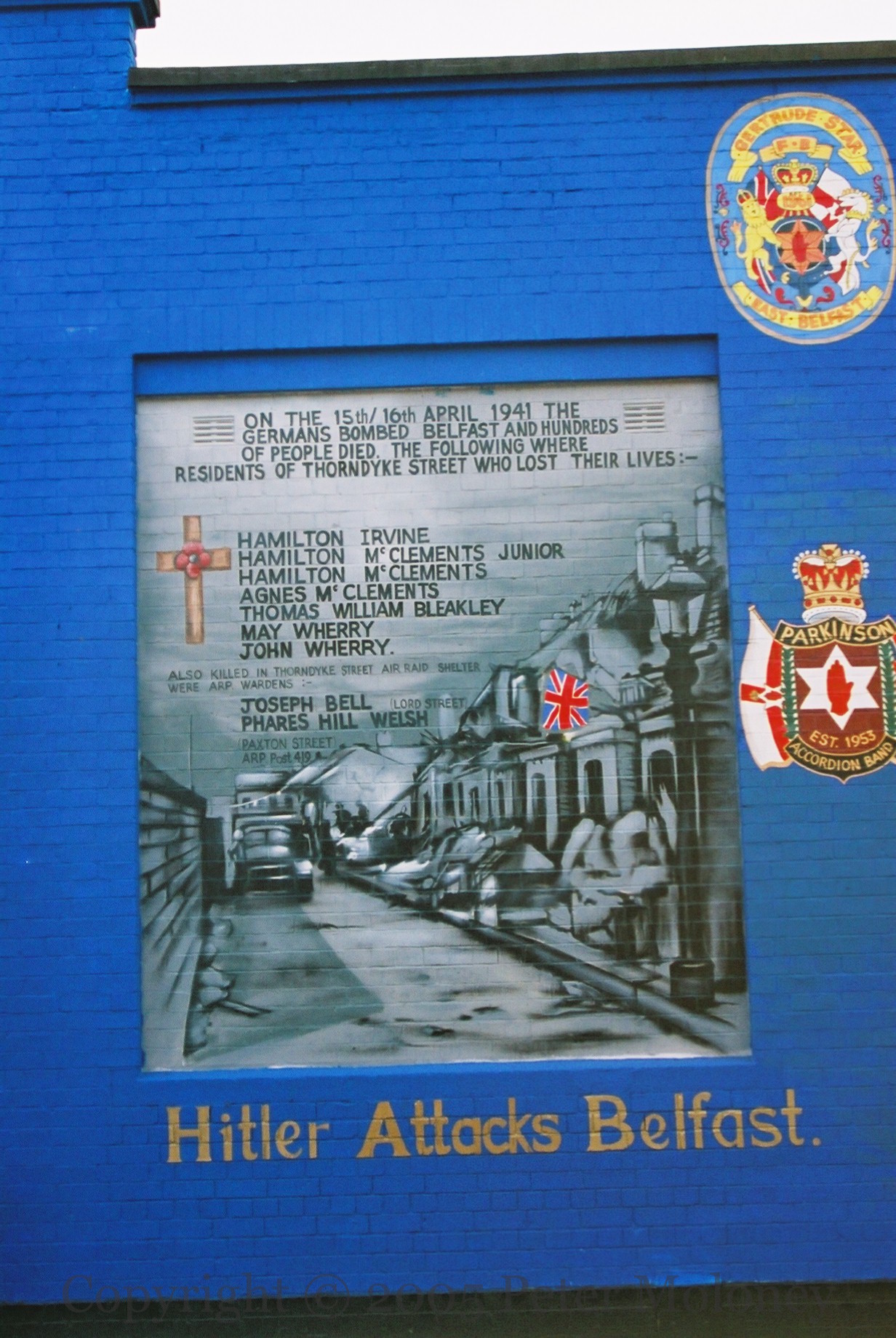
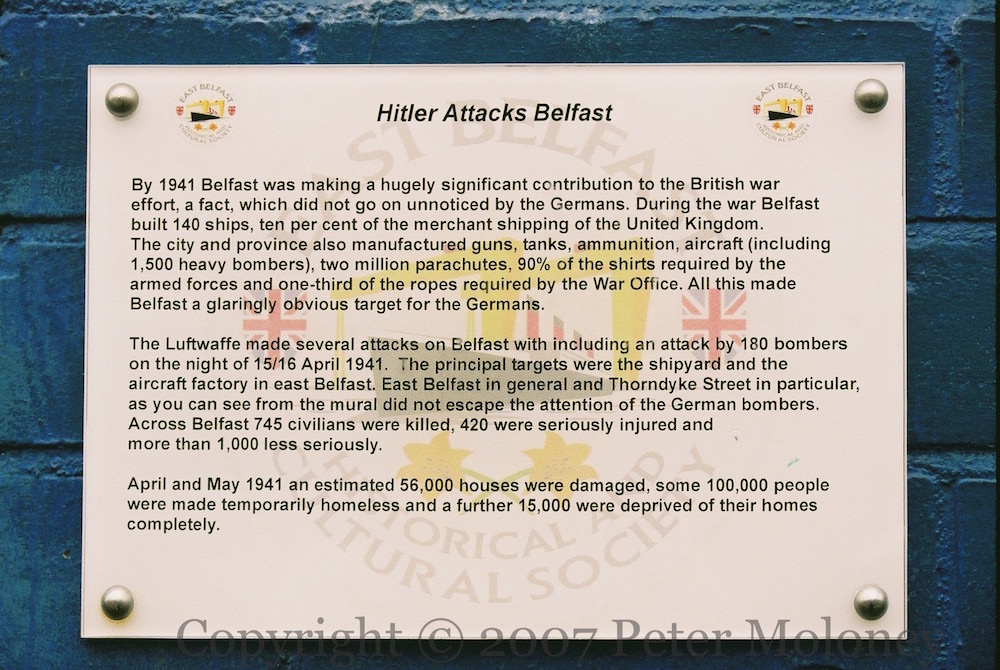
Hitler Attacks Belfast

“By 1941 Belfast was making a hugely significant contribution to the British war effort, which did not go unnoticed by the Garmans. During the war Belfast built 140 ships, ten per cent of the merchant shipping of the United Kingdom. The city and province also manufactured guns, tanks, ammunition, aircraft (including 1,500 heavy bombers), two million parachutes, 90% of the shirts required by the armed forces and one-third of the ropes required by the War Office. All this made Belfast a glaringly obvious target for the Germans. The Luftwaffe made several attacks on Belfast with including an attack by 180 bombers on the night of 15/16 April 1941. The principal targets were the shipyard and the aircraft factory in east Belfast. East Belfast in general and Thorndyke Street in particular, as you can see from the mural did not not escape the attention of the German bombers. Across Belfast 745 civilians were killed, 420 were seriously injured and more than 1,000 less seriously. April and May 1941 an estimated 56,000 houses were damaged, some 100,000 people were made temporarily homeless and a further 15,000 were deprived of their homes completely.” The Thorndyke Street casualties listed are Hamilton Irvine, Hamilton McClements Junior, Hamilton McClements, Agnes McClements, Thomas William Bleakley, May Wherry, John Wherry. “Also killed in the Thorndyke Street air raid shelter were ARP wardens Joseph Bell (Lord St), Phares Hill Welsh (Paxton St Post 419).” With the emblems of Gertrude Star Flute Band and Parkinson Accordion Band.

One of fourteen panels in Thorndyke Street, east Belfast. For a list of entries for each panel, see East Belfast Historical And Cultural Society.

Click image to enlarge
Copyright © 2005, 2007 Peter Moloney
M02306 M03630 [M08003]

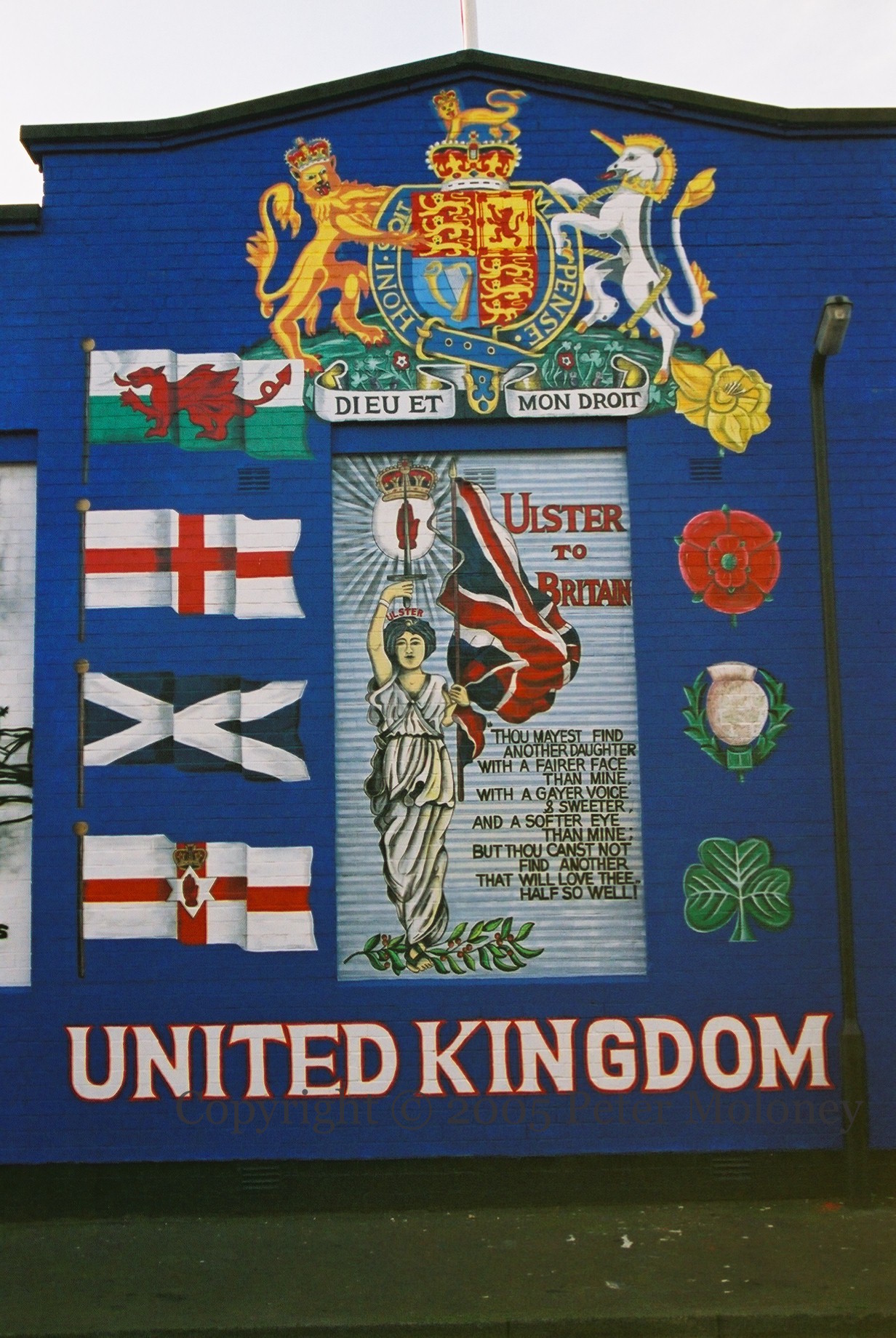
United Kingdom

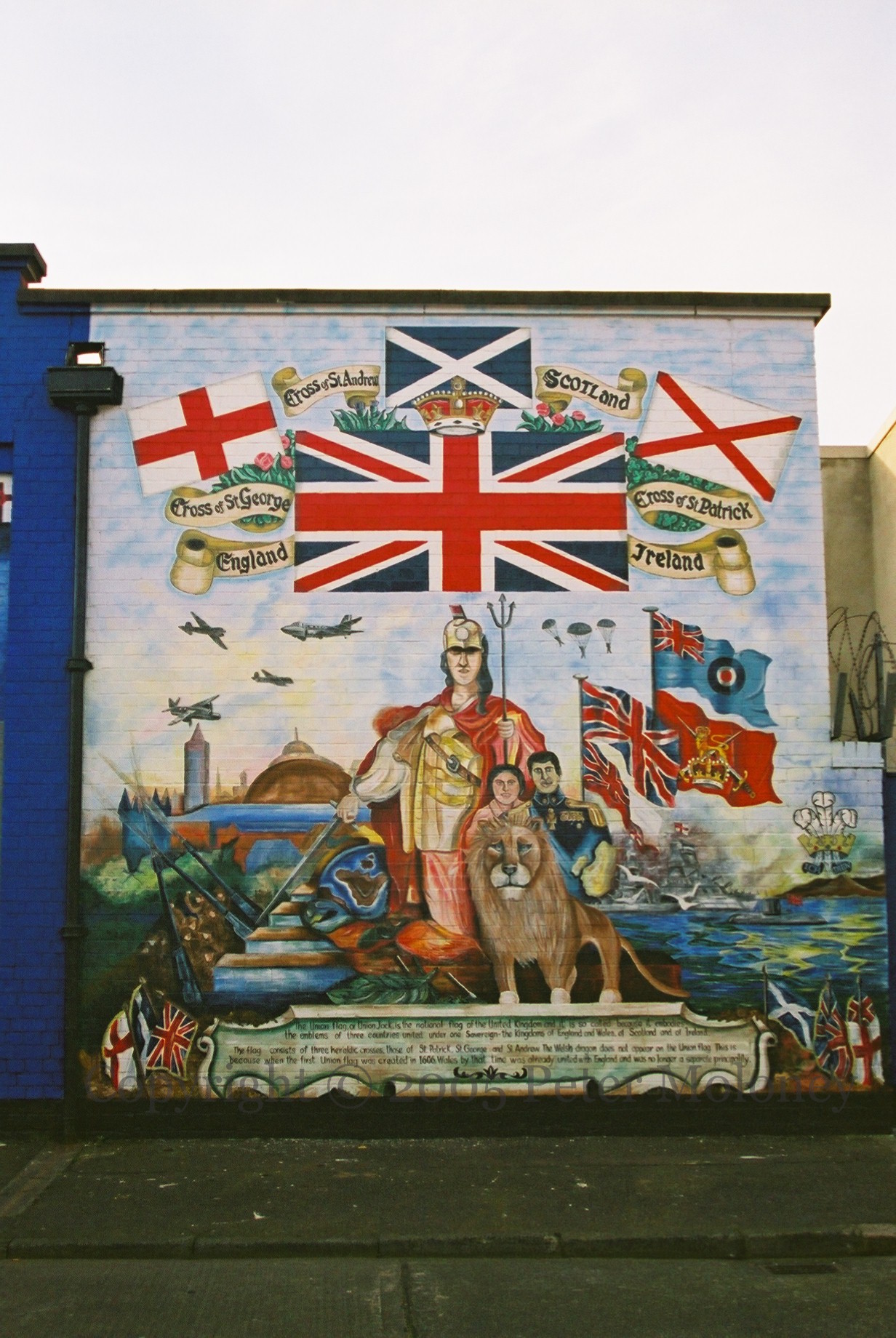
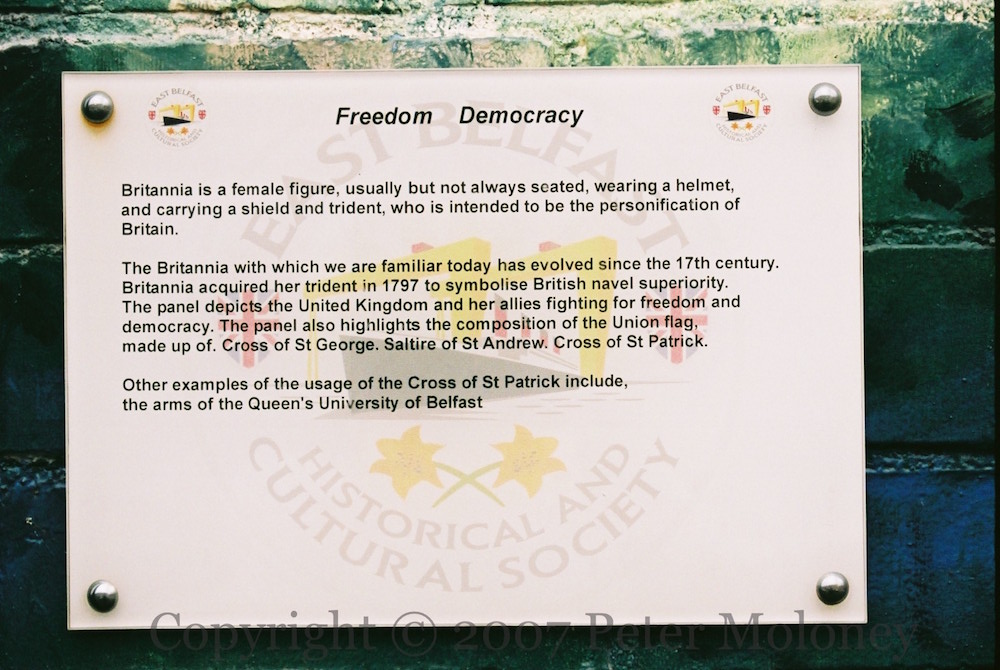
The central panel in Thorndyke Street, Belfast, reproduces a postcard from during the Home Rule debate: “Ulster to Britain: thou mayest find another daughter with a fairer face than mine, with a gayer voice and sweeter and a softer eye than mine; but thou canst not find another that will love thee half so well!” The Ulster Banner (a flag of Northern Ireland) is used to represent Ireland in the quartet of flags while the shamrock stands alongside daffodil, rose, and thistle. For the Anglo-Norman French around the crown’s coat of arms, see Honi Soit Qui Mal Y Pense.

One of fourteen panels in Thorndyke Street, east Belfast. For a list of entries for each panel, see East Belfast Historical And Cultural Society.

Click image to enlarge
Copyright © 2005 Peter Moloney
M02304

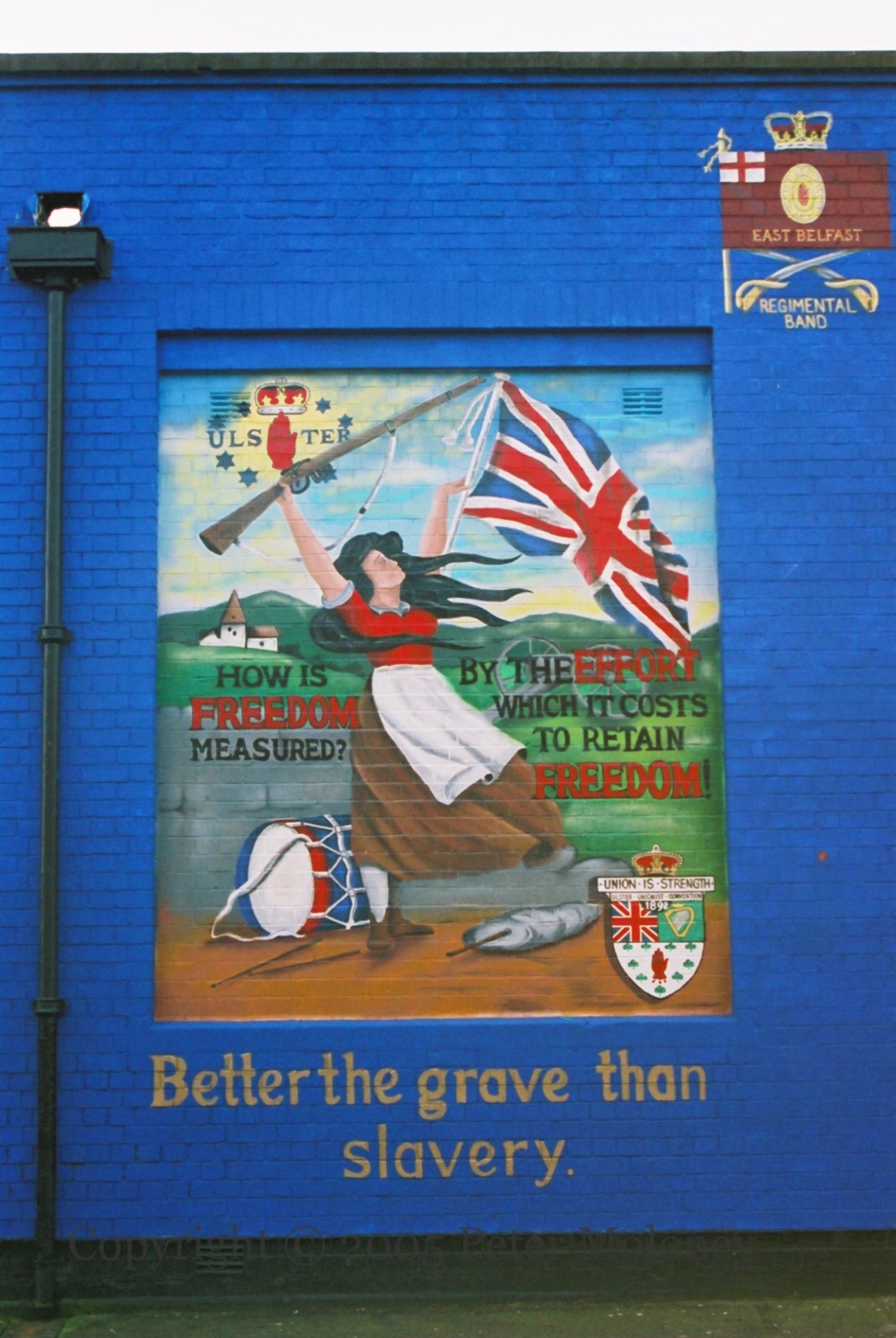
Better The Grave Than Slavery

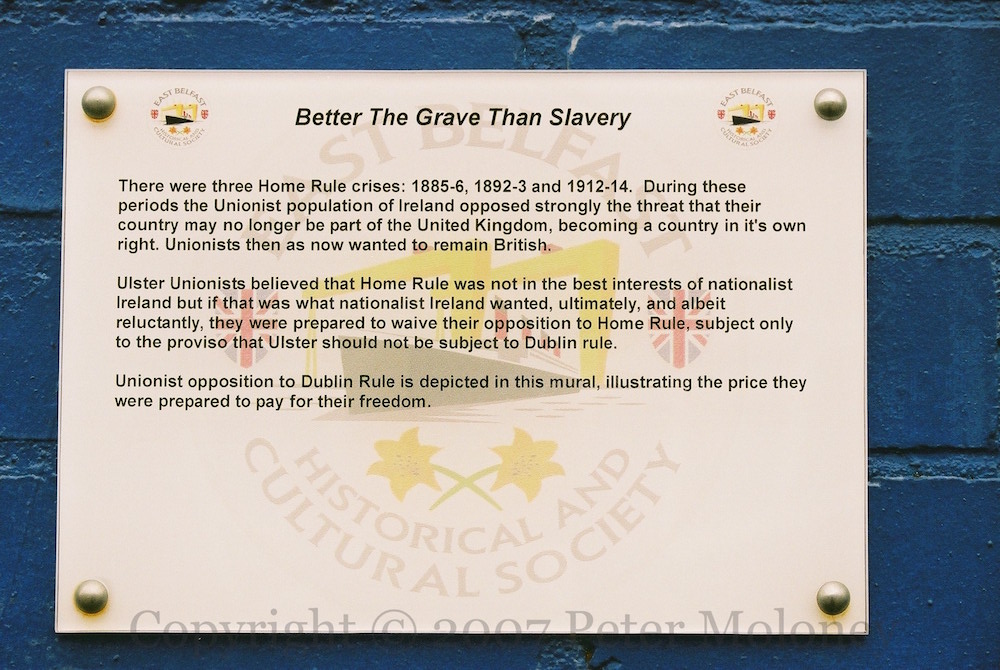
“How is freedom measured? By the effort which it costs to retain freedom!” (See also How Is Freedom Measured? and Deserted! Well – I Can Stand Alone) “Union is strength”. “There were three Home Rule crises: 1885-6, 1892-3 and 1912-14. During these periods the unionist population of Ireland opposed strongly the threat that their country may no longer be part of the United Kingdom, becoming a country in it’s own right. Unionists then as now wanted to remain British. Ulster Unionists believed that Home Rule was not the best interests of nationalist Ireland but if that was what nationalist Ireland wanted, ultimately, and albeit reluctantly, they were prepared to waive their opposition to Home Rule, subject only to the proviso that Ulster should not be subject to Dublin rule. Unionist opposition to Dublin Rule is depicted in this mural, illustrating the price they were prepared to pay for their freedom.”

According to this BBC page, the mural is rather a postcard from WWI, showing a woman exhorting Ulstermen to sign up for service in the British forces.

With the emblem of the East Belfast Regimental Band.

One of fourteen panels in Thorndyke Street, east Belfast. For a list of entries for each panel, see East Belfast Historical And Cultural Society.

Click image to enlarge
Copyright © 2005/2007 Peter Moloney
M02302 M03631

Civil And Religious Liberty For All

“Dan Winter’s cottage, Co Armagh. Dan Winter was one of the founders of the Orange Order.” “For many, perhaps even most, Orangemen the Order is primarily a religious organisation. As as organisation it is not anti-Roman Catholic; it is a Protestant organisation. The Orange Hall, the meeting place for Orangemen has long occupied a central place in the social life of the community. They serve as venues for a much wider range of gatherings than those, which are strictly Orange. The Orange Order is also a cultural organisation, transmitting a culture and heritage – whether it is banner painting, sustaining a great musical tradition or teachings its ritual – from one generation to the next. It also remains the most cohesive force in Ulster Protestant society and the essential expression of the culture and heritage of the Ulster Protestant people.” Fourth panel on Thorndyke Street, Belfast. With emblem of Pride of the Raven (flute band).

One of fourteen panels in Thorndyke Street, east Belfast. For a list of entries for each panel, see East Belfast Historical And Cultural Society.

Click image to enlarge
Copyright © 2005/2007 Peter Moloney
M02301 M03633 [M08004]

The City Is Saved

“In Londonderry on 7 December 1688 thirteen Apprentice Boys seized the initiative, closed the gates of the city and refused admittance to the Jacobite troops. This event is annually commemorated in Londonderry by the Apprentice Boys of Derry. The siege of the City did not actually begin until 18 April 1689,when James II appeared in person at Bishop’s Gate and was refused admittance. The City’s defenders greeted James with cries of ‘No surrender!’ and fired shots at him. The Jacobites were incapable of mounting an effective siege, thus, the Jacobites sought to starve the city into submission. The defenders too had to cope with severe problems. Some 37,000 people were trapped in a city whose normal population was approximately 2,000. The hard-pressed defenders were reduced to eating rats, mice and dogs fattened on human corpses. Some 15,000 people died of dysentery and malnutrition. On the 28th July 1689 three Williamite ships managed to break the boom on the Foyle and relieve the city.”

One of fourteen panels in Thorndyke Street, east Belfast. For a list of entries for each panel, see East Belfast Historical And Cultural Society.

Click image to enlarge
Copyright © 2005/2007 Peter Moloney
M02300 M03634

The Folk Come Home

“At the closest point, only 13 miles of water separate the coasts of Ulster and Scotland. From the earliest times to the present day there has been a constant flow of people and ideas between the two coasts. Geography and history have combined to link the peoples of Scotland and Ulster closely together. Indeed, some people have viewed Ulster as an extension of Scotland. With equal logic, Scotland might be viewed as an extension of Ulster. The most important migration across the North Channel was the early 17th century Plantation of Ulster. It has proved to be one of the most politically significant mass migrations to have taken place in western Europe since medieval times but it also should be viewed as part of a well established pattern of population movement between Ulster and Scotland.” Second panel in the Thorndyke Street, Belfast, series. The “Lord Protector of the Commonwealth” is Oliver Cromwell, who put down Irish rebellion (and allied Royalists) in 1650. With emblems of Albertbridge Accordion Band and Ballybeen Young Loyalists.

One of fourteen panels in Thorndyke Street, east Belfast. For a list of entries for each panel, see East Belfast Historical And Cultural Society.

Click image to enlarge
Copyright © 2005/2007 Peter Moloney
M02299 M03636 M03635

Ulster’s Solemn League And Covenant

“Being convinced in our consciences that Home Rule would be disastrous to the material well-being of Ulster as well as of the whole of Ireland, subversive of our civil and religious freedom, destructive of our citizenship, and perilous to the unity of the Empire, we, whose names are underwritten, men of Ulster, loyal subjects of His Gracious Majesty King George V., humbly relying on the God whom our fathers in days of stress and trial confidently trusted, do hereby pledge ourselves in solemn Covenant, throughout this our time of threatened calamity, to stand by one another in defending, for ourselves and our children, our cherished position of equal citizenship in the United Kingdom, and in using all means which may be found necessary to defeat the present conspiracy to set up a Home Rule Parliament in Ireland. And in the event of such a Parliament being forced upon us, we further solemnly and mutually pledge ourselves to refuse to recognise its authority. In sure confidence that God will defend the right, we hereto subscribe our names. And further we individually declare that we have not already signed this covenant.” “The above was signed by me at ______ “Ulster Day”, Saturday, 28th September, 1912. God save the King.” The covenant was signed by almost half a million people in anticipation of the (third) Home Rule Bill. This is the first in a series of murals from the East Belfast Historical And Cultural Society in Thorndyke Street, Belfast.

This is the first of fourteen panels in Thorndyke Street, east Belfast. For a list of entries for each panel, see East Belfast Historical And Cultural Society.

Click image to enlarge
Copyright © 2005/2007 Peter Moloney
M02298 M03637