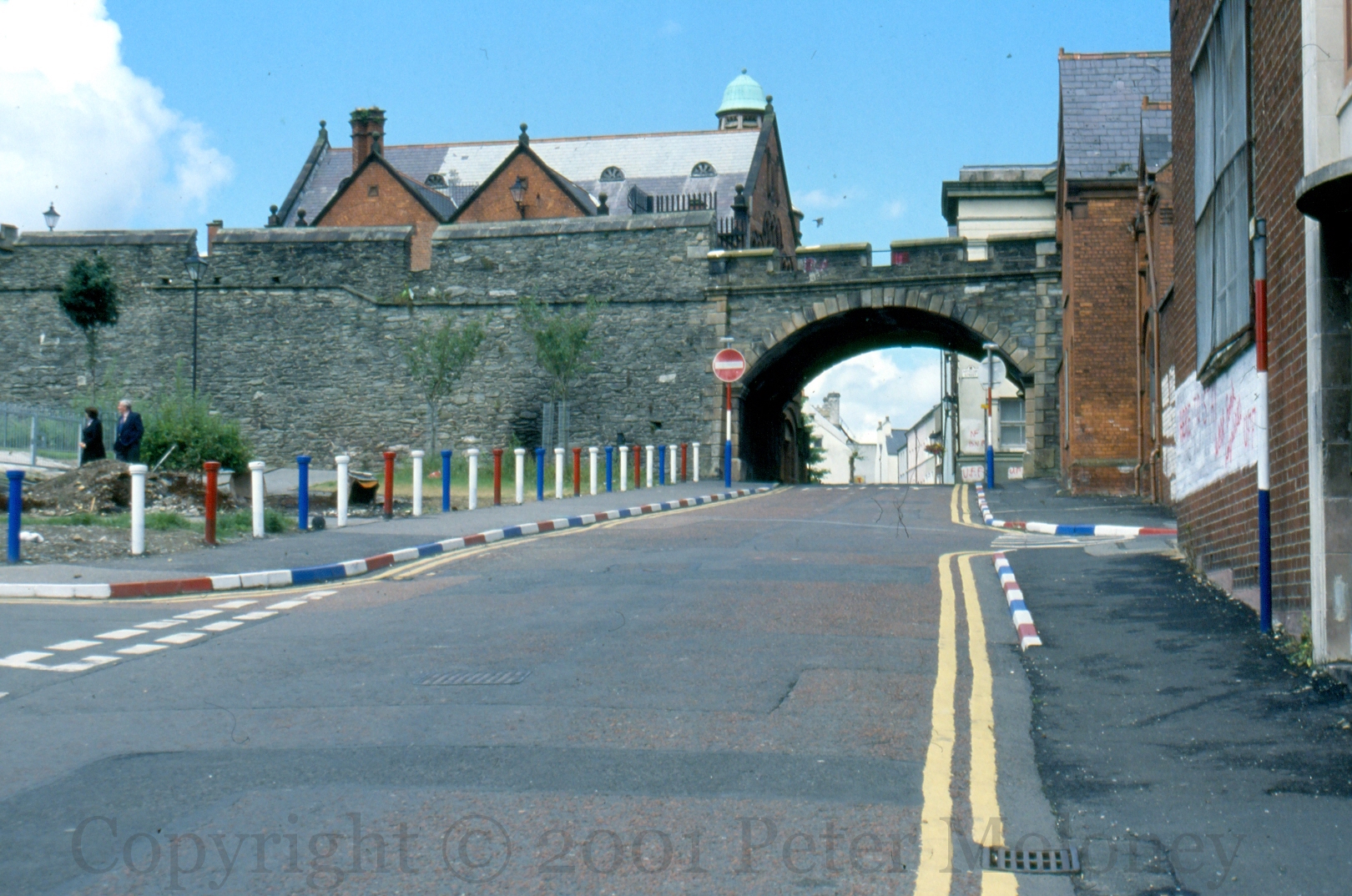
Red, white, and blue kerb stones and bollards around the demolished houses on the old Fountain Street.
Hawkin Street, Fountain, Londonderry
Click image to enlarge
Copyright © 2001 Peter Moloney
M01533
Red, white, and blue kerb stones and bollards around the demolished houses on the old Fountain Street.
Hawkin Street, Fountain, Londonderry
Click image to enlarge
Copyright © 2001 Peter Moloney
M01533

“‘My forefathers were … the men who had followed Cromwell and who shared in the defence of Derry, and in the victories of Aughrim and the Boyne.’ – President Theodore Roosevelt, 20th US president, 1901-1904.” The “shutting of the gates” of Derry is represented in the bottom left.
The quote is derived from Volume 1, Chapter 5 of Roosevelt’s The Winning Of The West (available at Project Gutenberg), though he is describing the forefathers of the Scotch-Irish, rather than his own forefathers (who, as the name suggests, were Dutch).
He writes, “The Presbyterian Irish were themselves already a mixed people. Though mainly descended from Scotch ancestors—who came originally from both lowlands and highlands, from among both the Scotch Saxons and the Scotch Celts—many of them were of English, a few of French Huguenot, and quite a number of true old Milesian Irish extraction. They were the Protestants of the Protestants; they detested and despised the Catholics, whom their ancestors had conquered, and regarded the Episcopalians by whom they themselves had been oppressed, with a more sullen, but scarcely less intense, hatred. They were a truculent and obstinate people, and gloried in the warlike renown of their forefathers, the men who had followed Cromwell, and who had shared in the defence of Derry and in the victories of the Boyne and Aughrim.”
Some sources claim that an ancestor(s) on his mother’s side emigrated from Gleno, Co Antrim in 1729, but this seems to be her great-great-grandfather James, who was Scots (WP) but appears to have emigrated directly from Scotland, specifically Baldernock, in 1728 or 1729 (WikiTree | Friends Of Bulloch). The search for a connection continues, according to Irish Central.
This mural is one (and perhaps the first to be painted) in the series “From pioneers to presidents”. For more such murals, see the Visual History page about Ulster-Scots murals.
Replaces the King Billy mural in Wapping Lane, the Fountain, Londonderry.
Click image to enlarge
Copyright © 2001 Peter Moloney
M01532
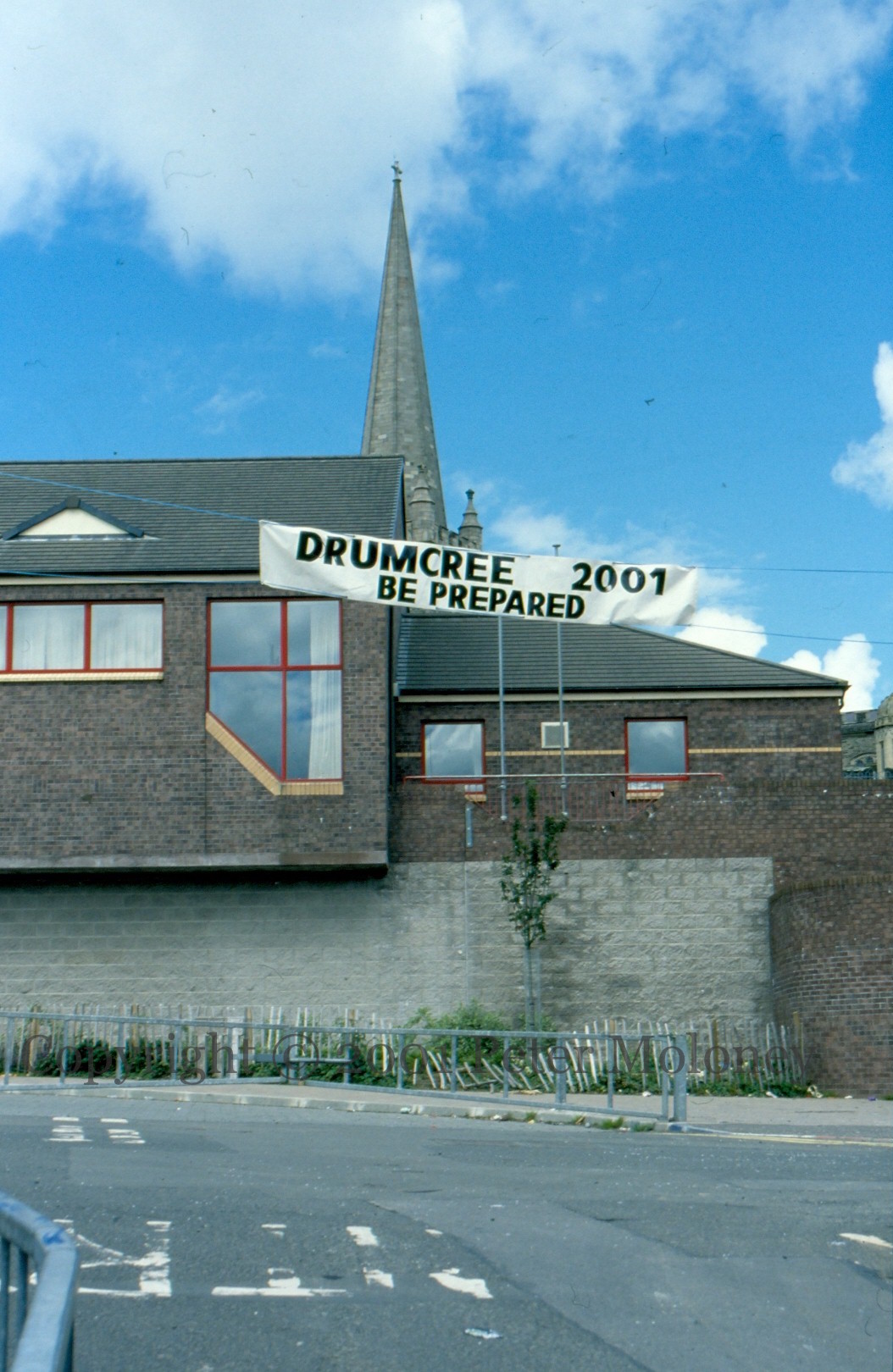
The Orange Order had not marched to Drumcree church in 1998, 1999, 0r 2000 (WP). This banner in Wapping Lane, Londonderry, reminds people to “be prepared” for the current year’s conflict.
Click image to enlarge
Copyright © 2001 Peter Moloney
M01531
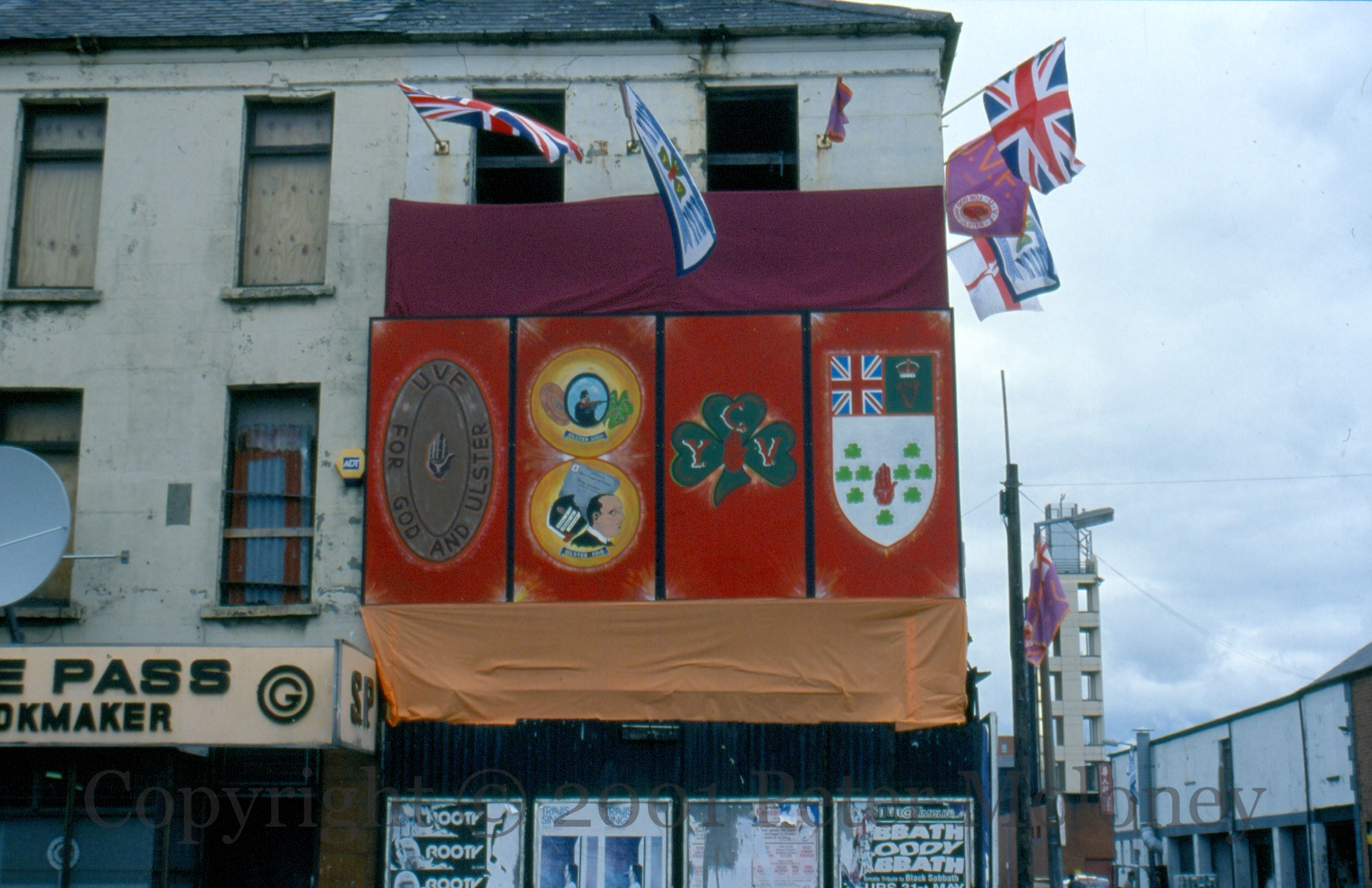
The second panel of the four shown here in Donegall Pass, Belfast, is the most interesting. The upper circle is labelled “Ulster 2001” and shows a modern volunteer between the UVF and YCV symbols. In the lower circle, which is labelled “Ulster 1916”, is a portrait of Carson and the text of the 1912 Ulster Covenant and a headstone which is broken and bloodied. The other panels contain the UVF emblem, the YCV emblem, and the emblem of the 36th (Ulster) Division.
Click image to enlarge
Copyright © 2001 Peter Moloney
M01530
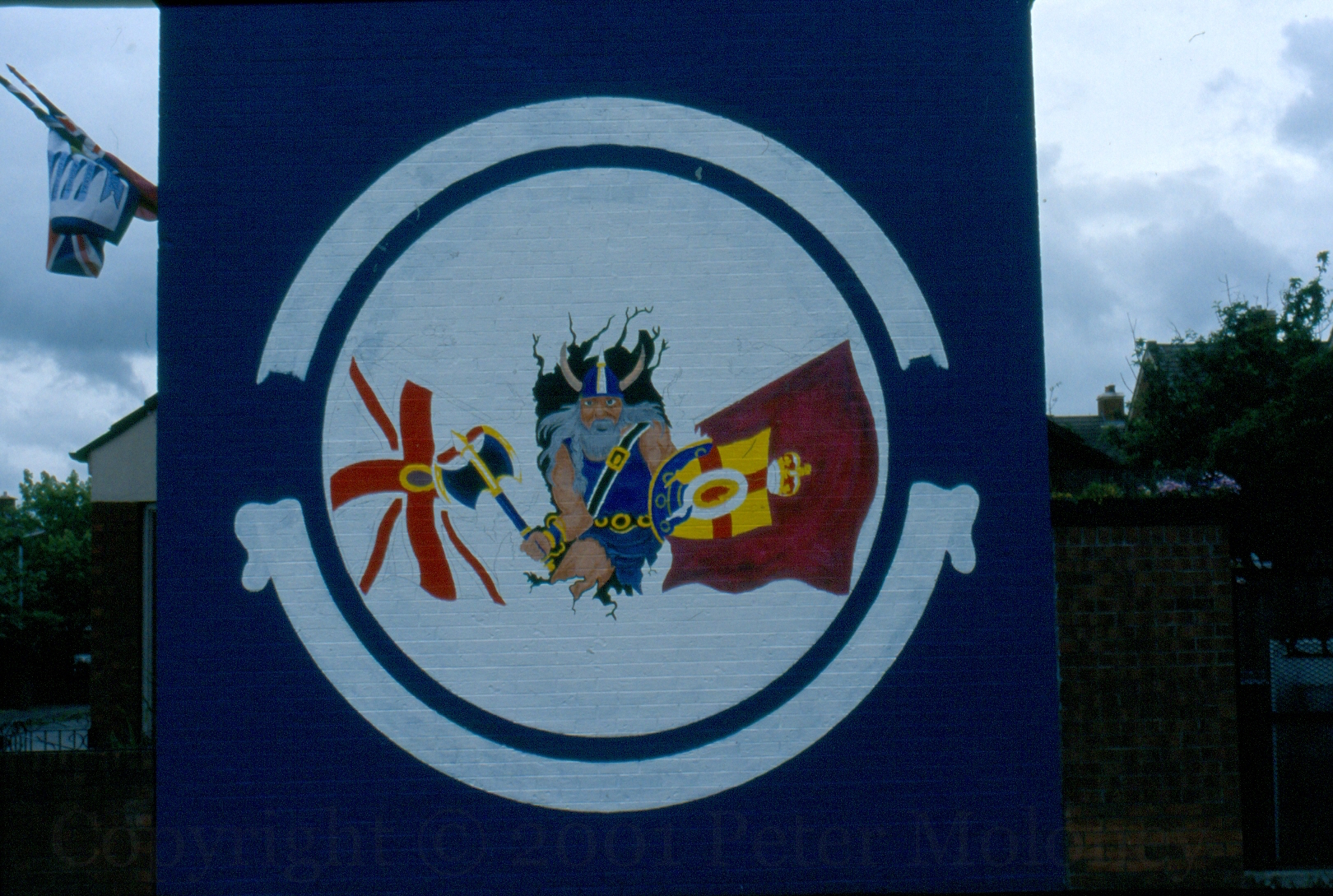
In-progress shot of the Young Conquerors Flute Band (Fb) “viking” mural in Pine Street, Belfast.
Here is the completed mural. The previous version had a cartoon viking at the centre – see the Paddy Duffy Collection.
Click image to enlarge
Copyright © 2001 Peter Moloney
M01528
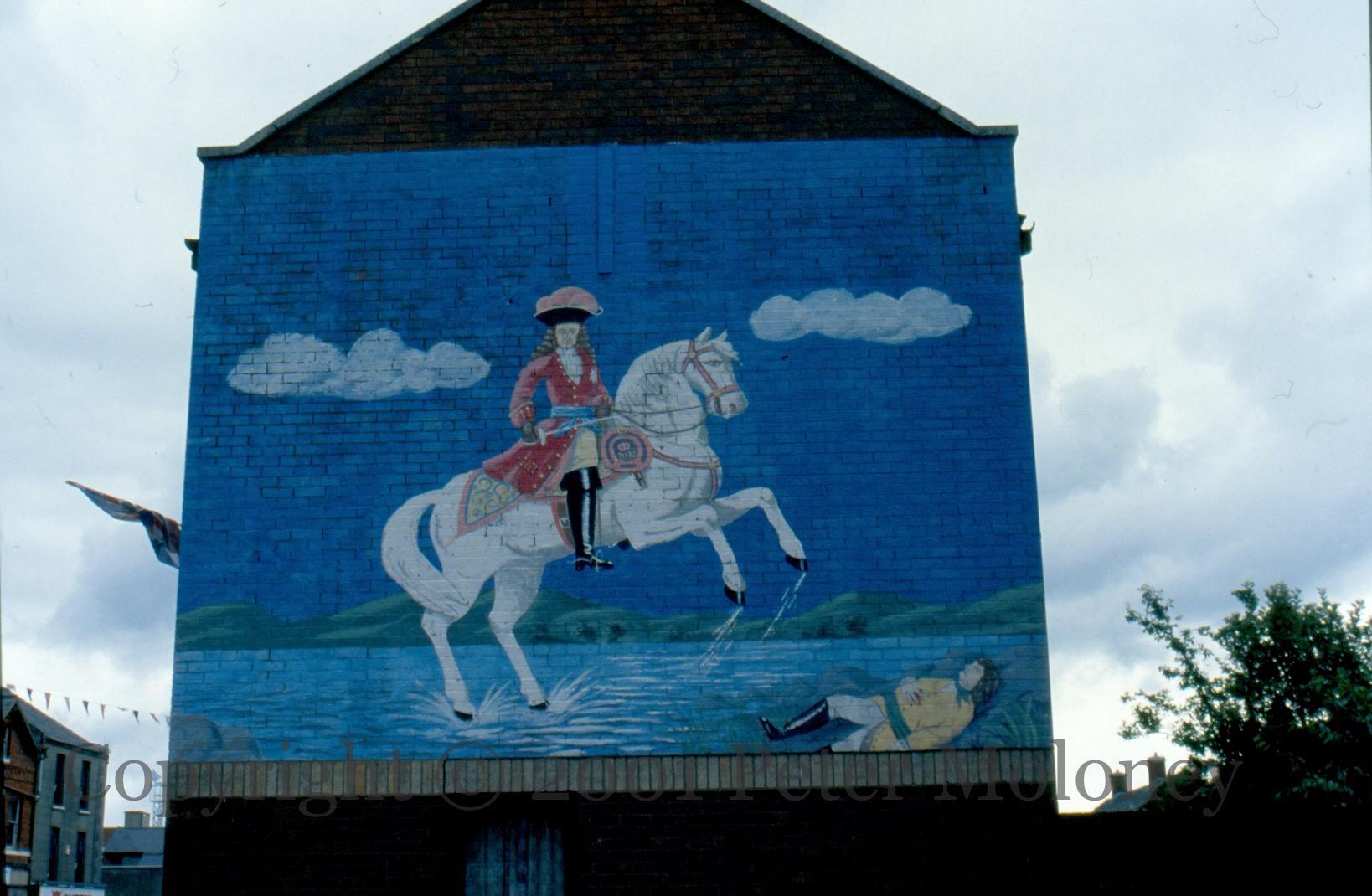
King Billy crossing the Boyne and trampling on a Jacobite soldier. This mural was painted in 1989 by a “H. Gibson” (according to the 2015 repainting). The original version of this mural was on the other side of the Pass, at the junction of Apsley Street and Howard Street South, next to a mural of the Lindsay Street arch dedicated to Robert Bradford. (See the Paddy Duffy Collection for both of these.) 1989 was the 25th anniversary of the erection of the arch in nearby Lindsay Street, but the arch was not painted into this mural until 2002.
Oak Street, Donegall Pass, south Belfast
Click image to enlarge
Copyright © 2001 Peter Moloney
M01526

South Belfast MP Robert Bradford was assassinated by the Provisional IRA in Finaghy at a meeting with constituents; the caretaker of the community centre, Ken Campbell, was also killed by the fleeing attackers. In late 1981, with the hunger strikes having ended only a month before, the killing was noted around the world and raised fears of broad civil unrest (BBC | NYTimes).
“Vita, veritas, Victoria” [life, truth, victory] is the motto of Londonderry. Here we have “vita, veritas, victa” [life, truth, conquered; perhaps the intended meaning was “conquering” rather than the passive]. The crest is also not quite the crest of the Apprentice Boys, with a ship in the bottom right rather than a skeleton. Get in touch if you can resolve either discrepancy.
Click image to enlarge
Copyright © 2001 Peter Moloney
M01525
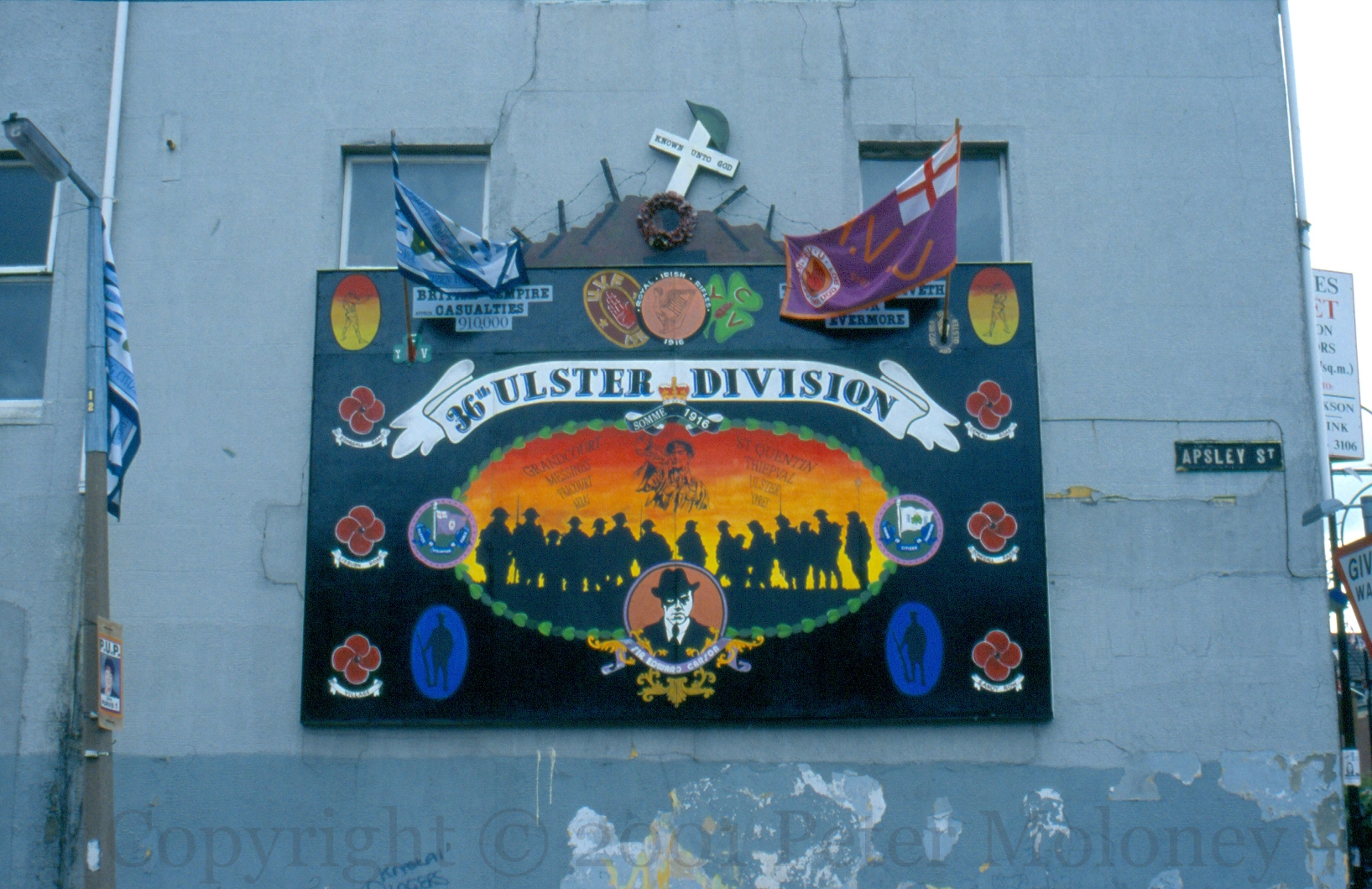
The apocryphal book of the Bible Ecclesiasticus reads “their bodies are buried in peace, but their name liveth for evermore” (44:14), which is here applied to 910,000 “British empire casualties” from the Great War, including the Ulster Volunteers and Young Citizen Volunteers raised by “Sir Edward Carson” which became the 36th (Ulster) Division and particularly the Royal Irish Rifles and fought at the Somme 1916.
Apsley Street, south Belfast
Click image to enlarge
Copyright © 2001 Peter Moloney
M01524

UVF and YCV flags flying over a painted Union flag with “South Belfast Regiment II” in the centre. Eight thousand men signed up for the Ulster Volunteers from south Belfast. Charlotte Street.
Click image to enlarge
Copyright © 2001 Peter Moloney
M01521
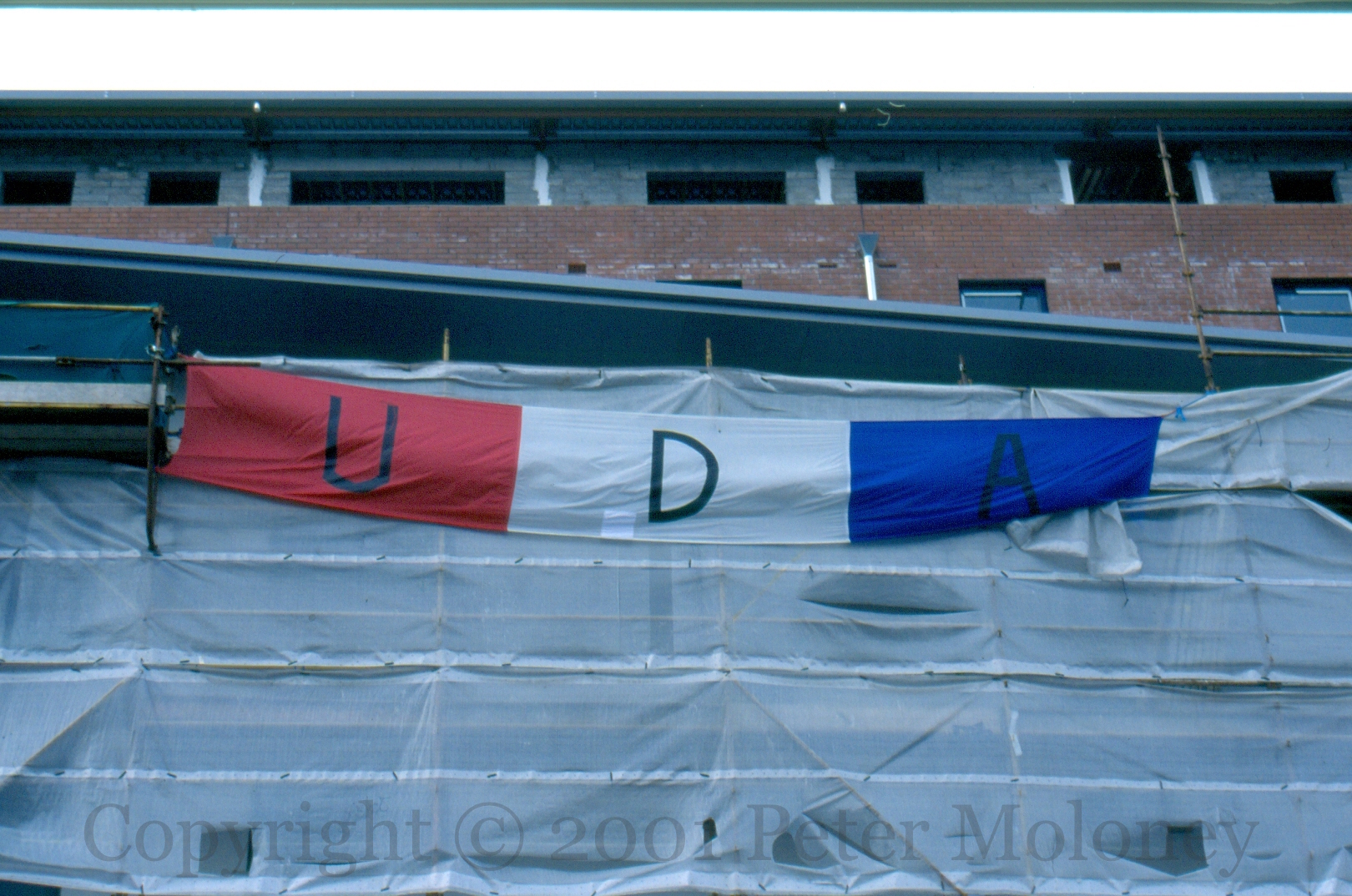
“UDA” on a red, white, and blue tricoloured banner on a building site (Whitehall Square apartments). Napier Street, Belfast.
Click image to enlarge
Copyright © 2001 Peter Moloney
M01520
 Peter Moloney Collection