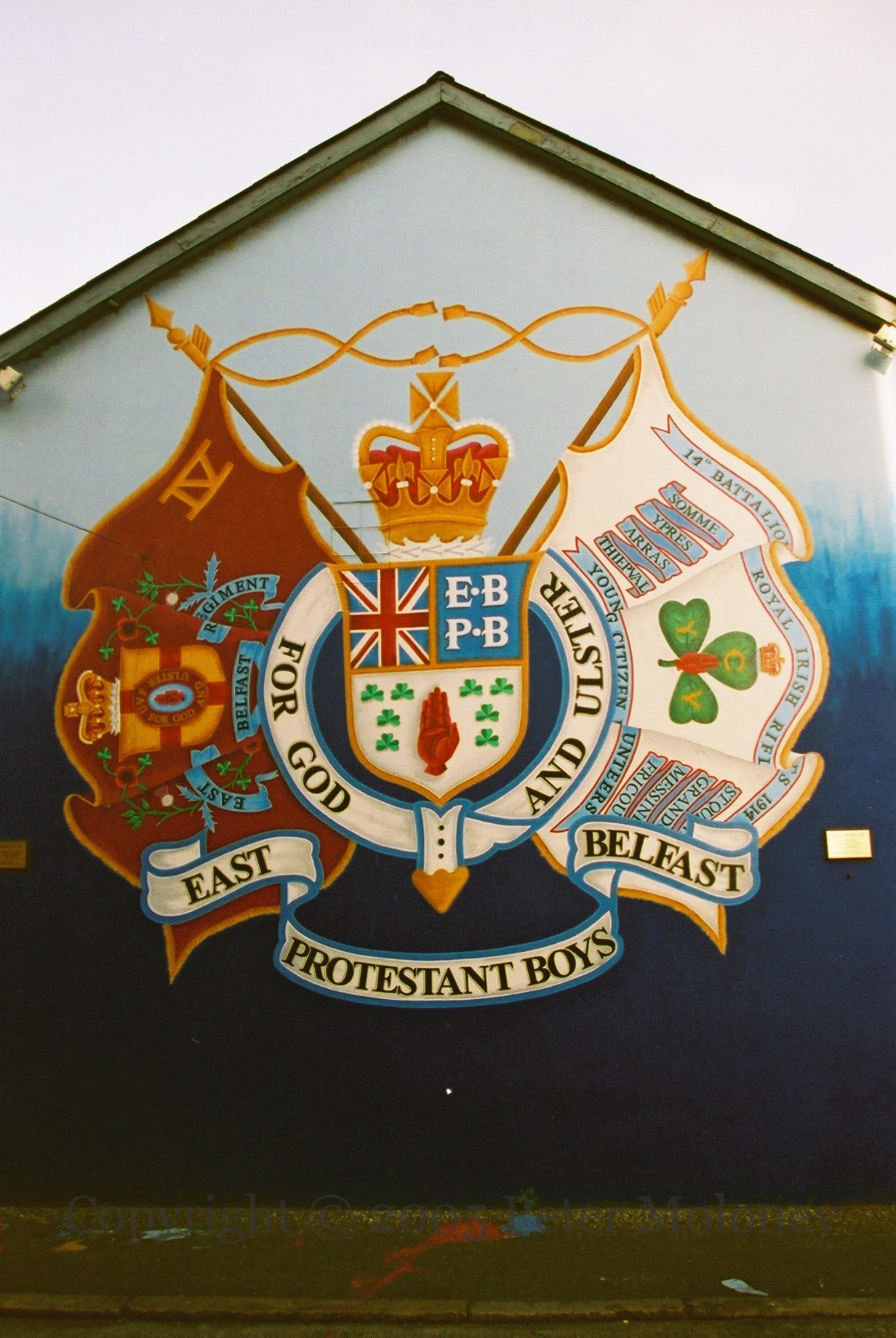
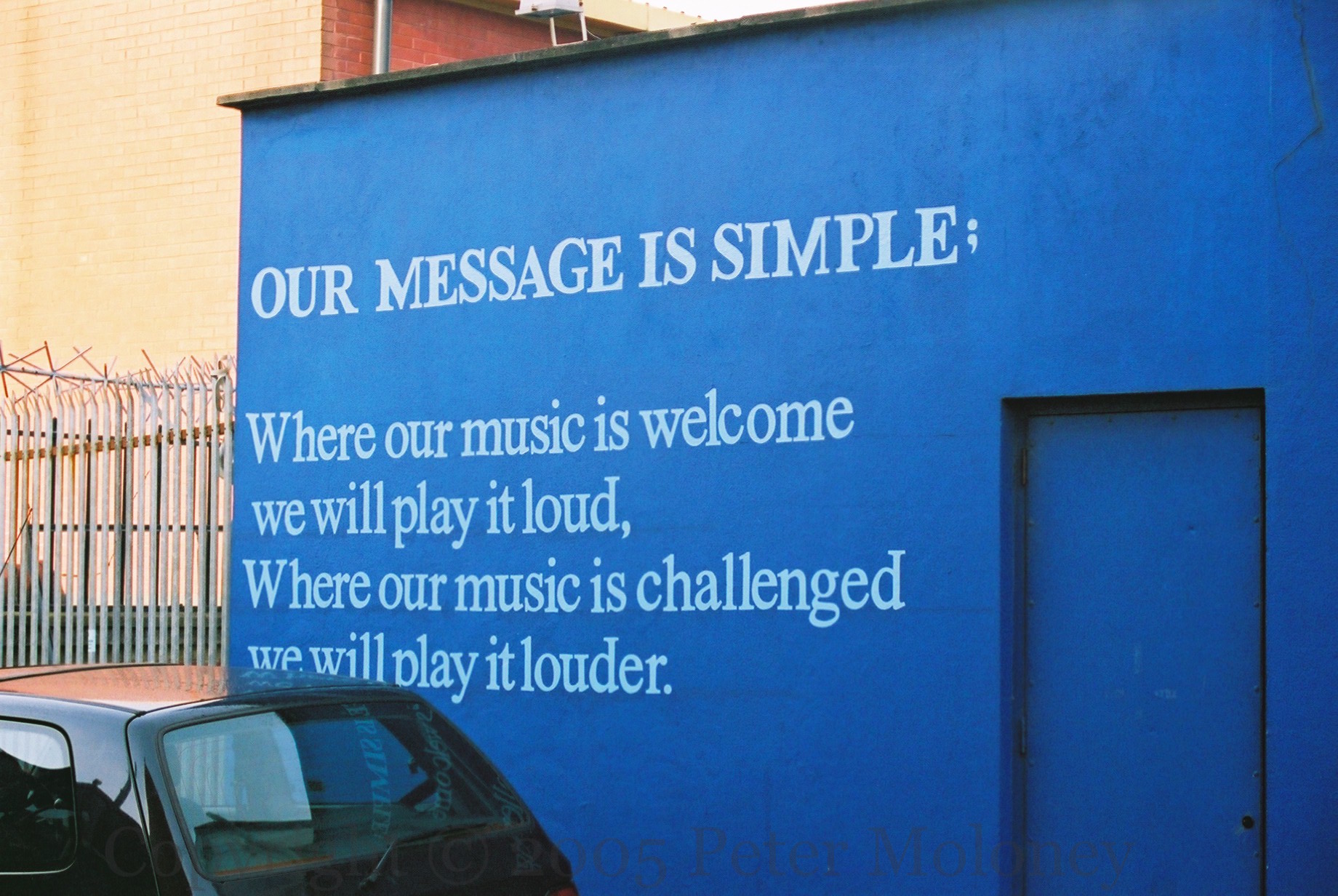
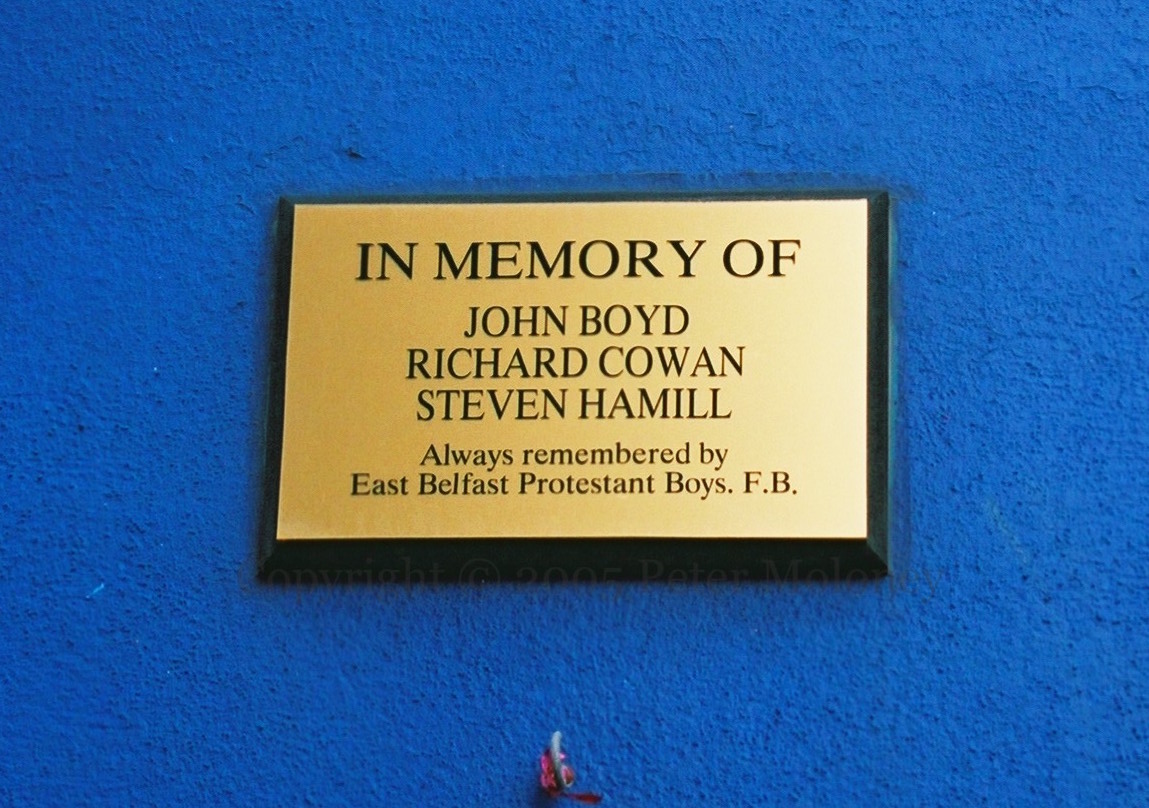
The 36th Division East Belfast regimental flag and the flag of the YCV, rather than of the Ulster Volunteers, flank a modified crest of the Division – the letters “EBPB” have replaced a harp and crown. “Our message is simple: Where our music is welcome we will play it loud; where our music is challenged we will play it louder.” “In memory of John Boyd Richard Cowan Steven Hamill. Always remembers by East Belfast Protestant Boys FB.” (Fb | tw)
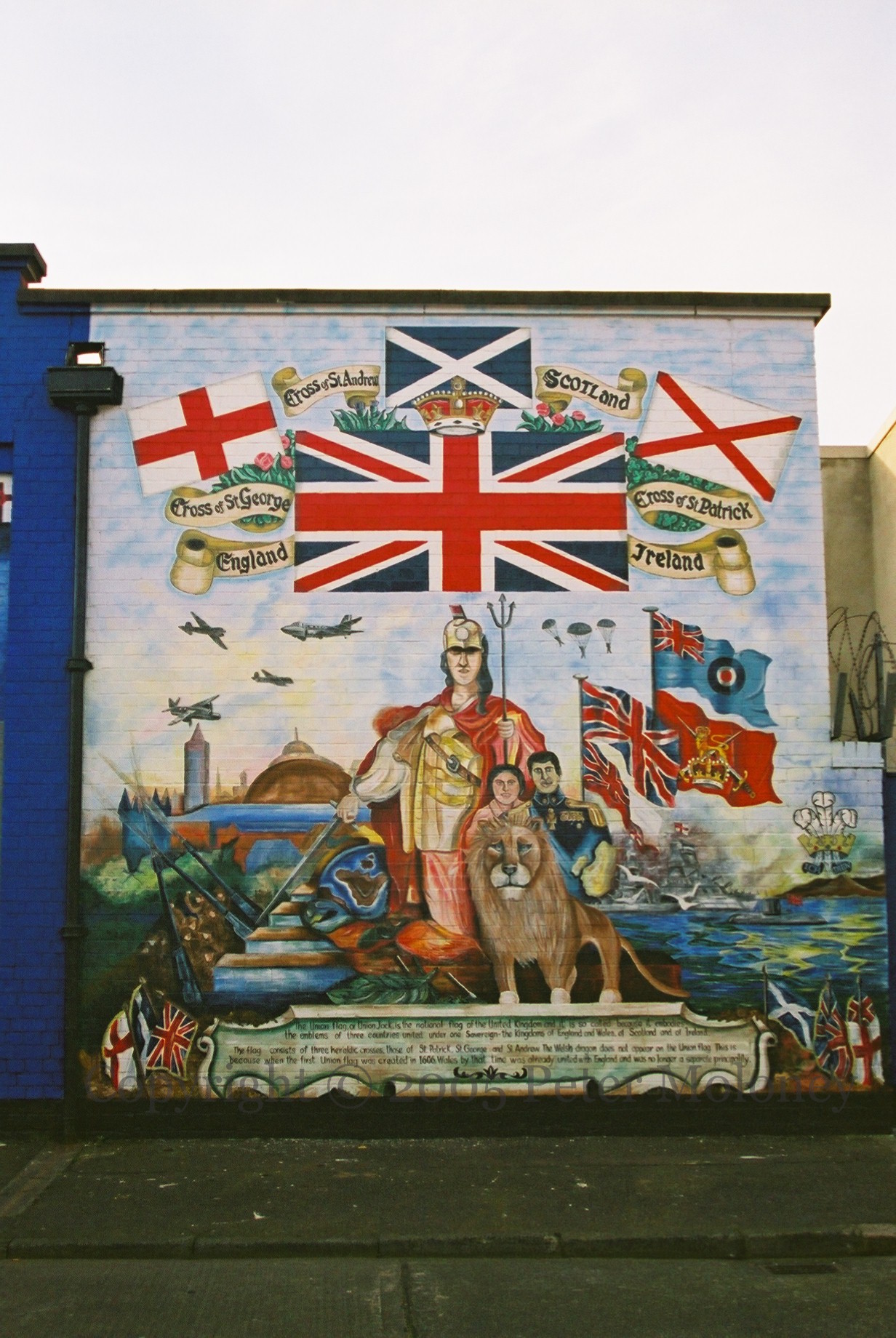
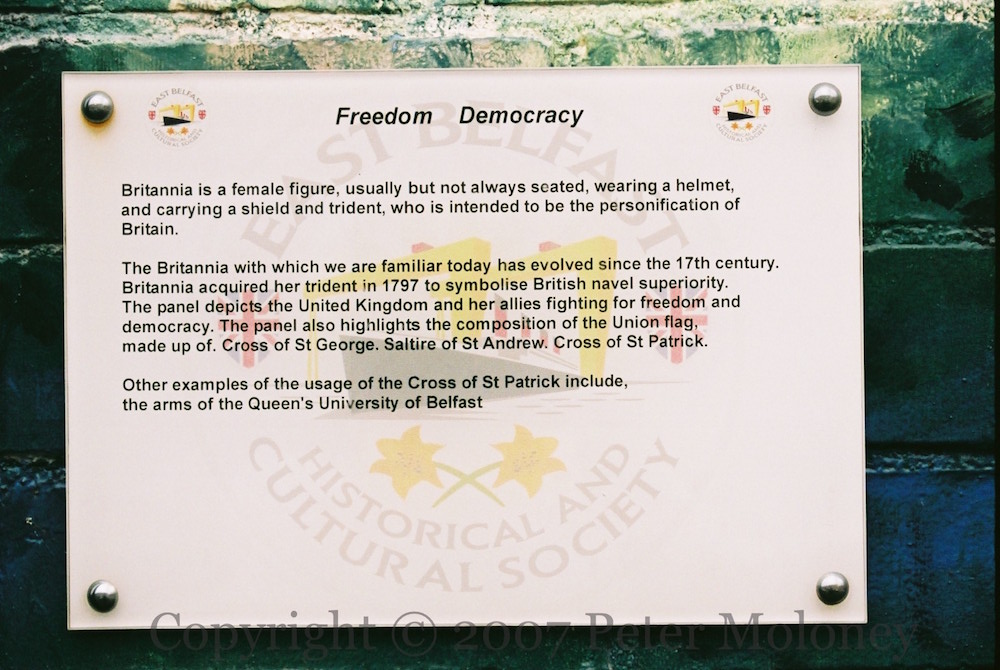
“Britannia is a female figure, usually but not always seated, wearing a helmet, and carrying a shield and trident, who is intended to be the personification of Britain. The Britannia with which we are familiar has evolved since the 17th century. Britannia axquired her trident in 1797 to symbolise British naval superiority. The panel depicts the United Kingdom and her allies fighting for freedom and democracy. The panel also highlights the composition of the Union flag, made up of. Cross of St George. Saltire of St Andrew. Cross of St Patrick. Other examples of the usage of the Cross of St Patrick include, the arms of the Queen’s University of Belfast.”
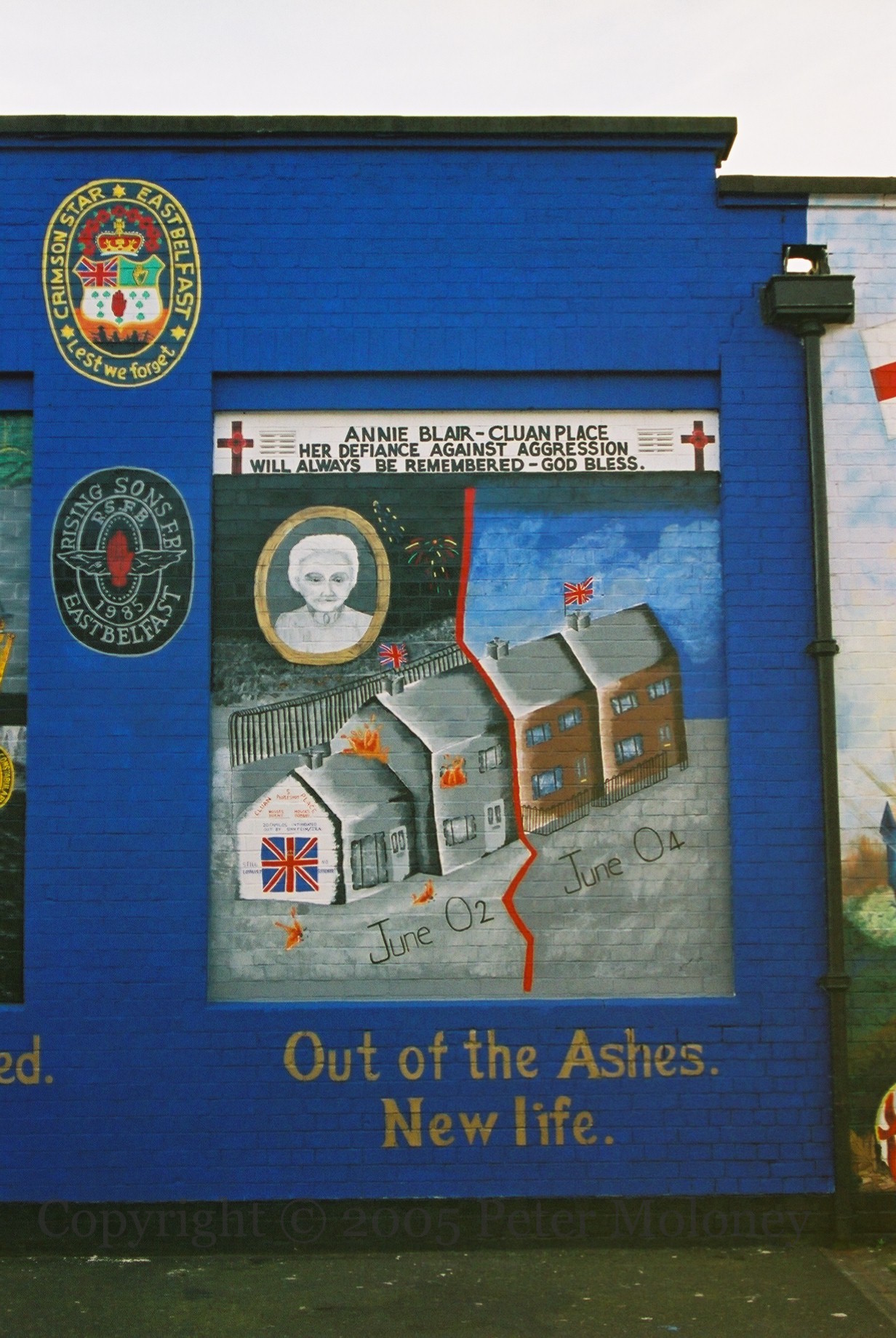
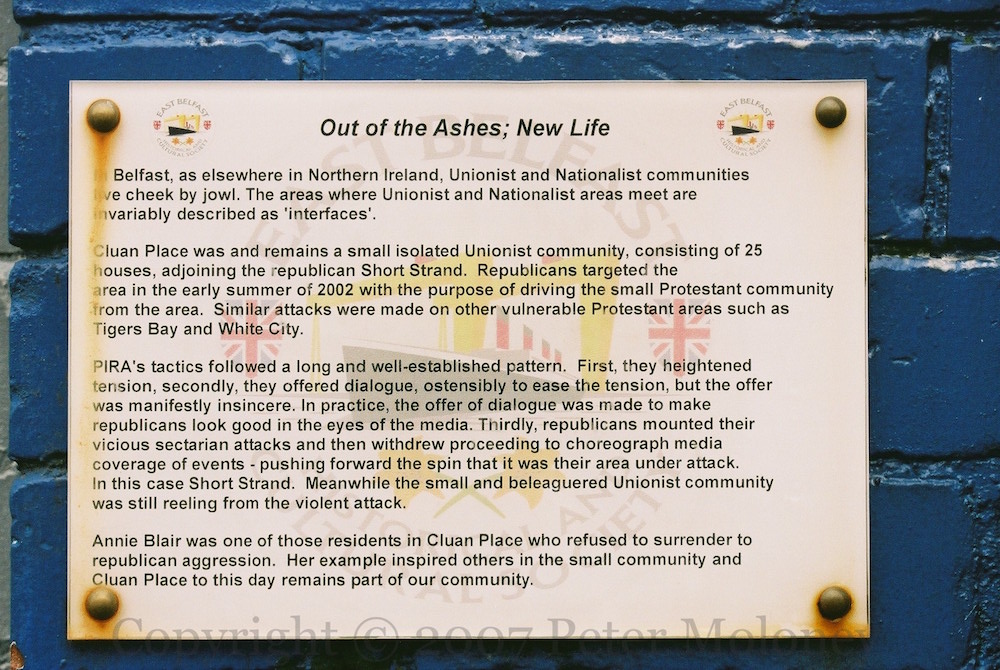
“In Belfast, as elsewhere in Northern Ireland, Unionist and Nationalist communities live cheek by jowl. The areas where Unionist and Nationalist areas meet are invariably described as ‘interfaces’. Cluan Place was and remains a small isolated Unionist community, consisting of 25 houses, adjoining the republican Short Strand. Republicans targeted the area in the early summer of 2002 with the purpose of driving the small Protestant community from the area. Similar attacks were made on other vulnerable Protestant areas such as Tigers Bay and White City. PIRA’s tactics followed a long and well-established pattern. First, they heightened tension, secondly, they offered dialogue, ostensibly to ease the tension, but the offer was manifestly insincere. In practice, the offer of dialogue was made to make republicans look good in the eyes of the media. Thirdly, republicans mounted their vicious sectarian attacks and then withdrew proceeding to choreograph media coverage of events – pushing forward the spin that it was their area under attack. In this case Short Strand. Meanwhile the small and beleaguered Unionist community was still reeling from the violent attack. Annie Blair was one of those residents in Cluan Place who refused to surrender to republican aggression. Her example inspired others in the small community and Cluan Place to this day remains part of our community”. See also: Welcome To Loyalist Cluan Place.
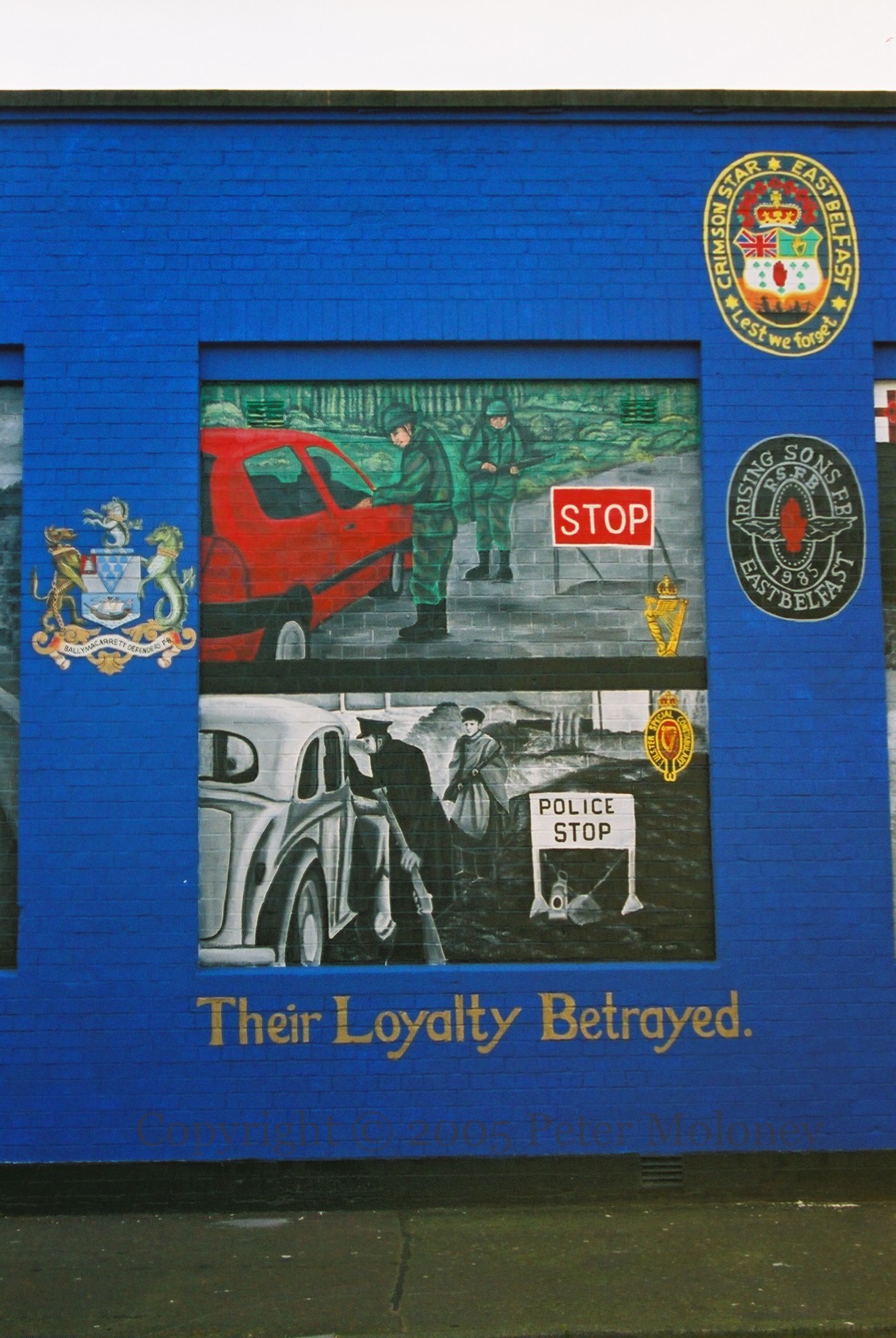
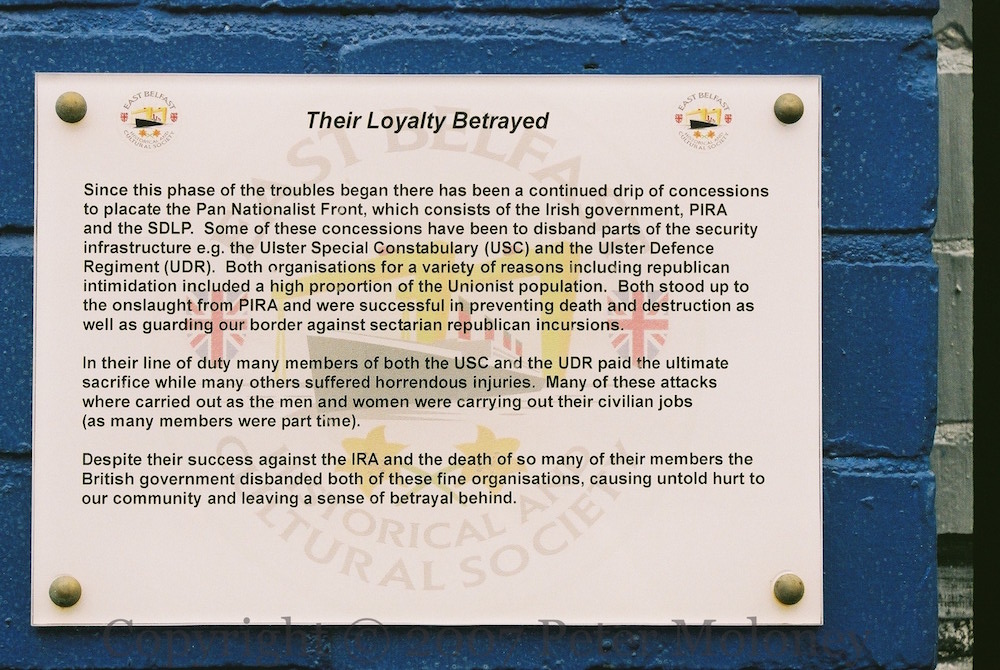
“Since this phase of the troubles began there has been a continued drop of concessions to placate the Pan Nationalist Front, which consists of the Irish government, PIRA and the SDLP. Some of these concessions have been to disband parts of the security infrastructure e.g. the Ulster Special Constabulary (USC) and the Ulster Defence Regiment (UDR). Both organisations for a variety of reasons including republican intimidation included a high proportion of the Unionist population. Both stood up to the onslaught from PIRA and were successful in preventing death and destruction as well as guarding our border against sectarian republican incursions. In their line of duty many members of both the USC and the UDR paid the ultimate sacrifice while many others suffered horrendous injuries. Many of these attacks where carried out as the men and women were carrying out their civilian jobs (as many members were part time). Despite their success against the IRA and the death of so many of their members the British government disbanded both of these fine organisations, causing untold hurt to our community and leaving a sense of betrayal behind.” With the emblems of the Crimson Star and Rising Sons flute bands.
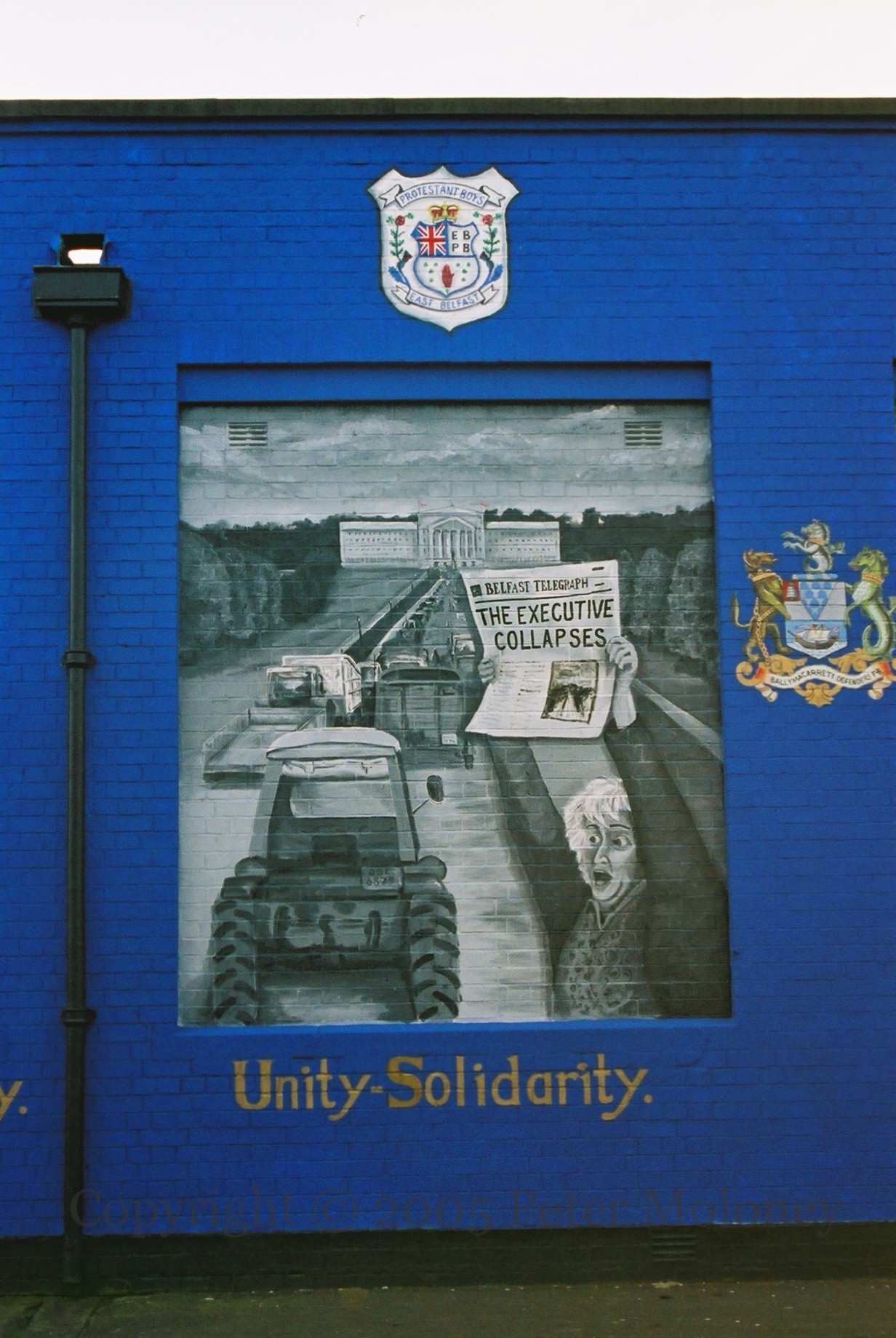
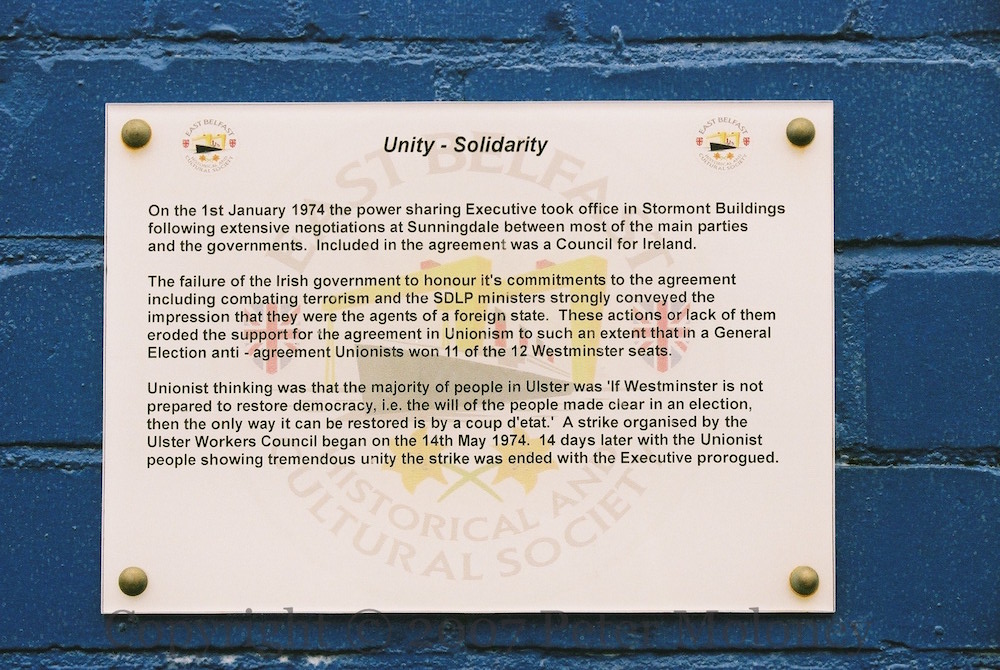
“On the 1st January 1974 the power sharing Executive took office in Stormont Building following extensive negotiations at Sunningdale between most of the main parties and the governments. Included in the agreement was a Council for Ireland. The failure of the Irish government to honour it’s commitments to the agreement including combating terrorism and the SDLP ministers strongly conveyed the impression that they were the agents of a foreign state. These actions or lack of them eroded the support for the agreement in Unionism to such an extent that in a General Election anti – agreement Unionists won 11 of the 12 Westminster seats. Unionist thinking was that the majority of people was ‘If Westminster is not prepared to restore democracy, i.e. the will of the people made clear in an election, then the only way it can be restored is by a coup d’etat.’ A strike organised by the Ulster Workers Council began on the 14th May 1974. 14 days later with the Unionist people showing tremendous unity the strike was ended with the Executive prorogued.” 10th panel on Thorndyke Street, Belfast. With emblems of the East Belfast Protestant Boys flute band and the Ballymacarrett Defenders flute band.
“In the early 1970’s the Provisional IRA (PIRA) flexed it’s muscles to demonstrate that the Official IRA were no longer the representatives of the republican community. Unfortunately for the Unionist population they were on the receiving end as PIRA launched sectarian bomb and gun attacks across Northern Ireland but in particular Belfast. Many innocent Protestants were murdered simply because of their religion, others were injured and many burnt out of their homes. The community was in turmoil and felt that there was no one to defend it. It was then that they (the communities) decided to take matters into their own hands and organise themselves into groups capable of defending their home and businesses from these violent and horrific sectarian attack. It was during this period of crises and community tension that the Ulster Defence Association was founded and the ranks of the Ulster Volunteer Force increased significantly. They became the defenders of the community, as they were the community.”
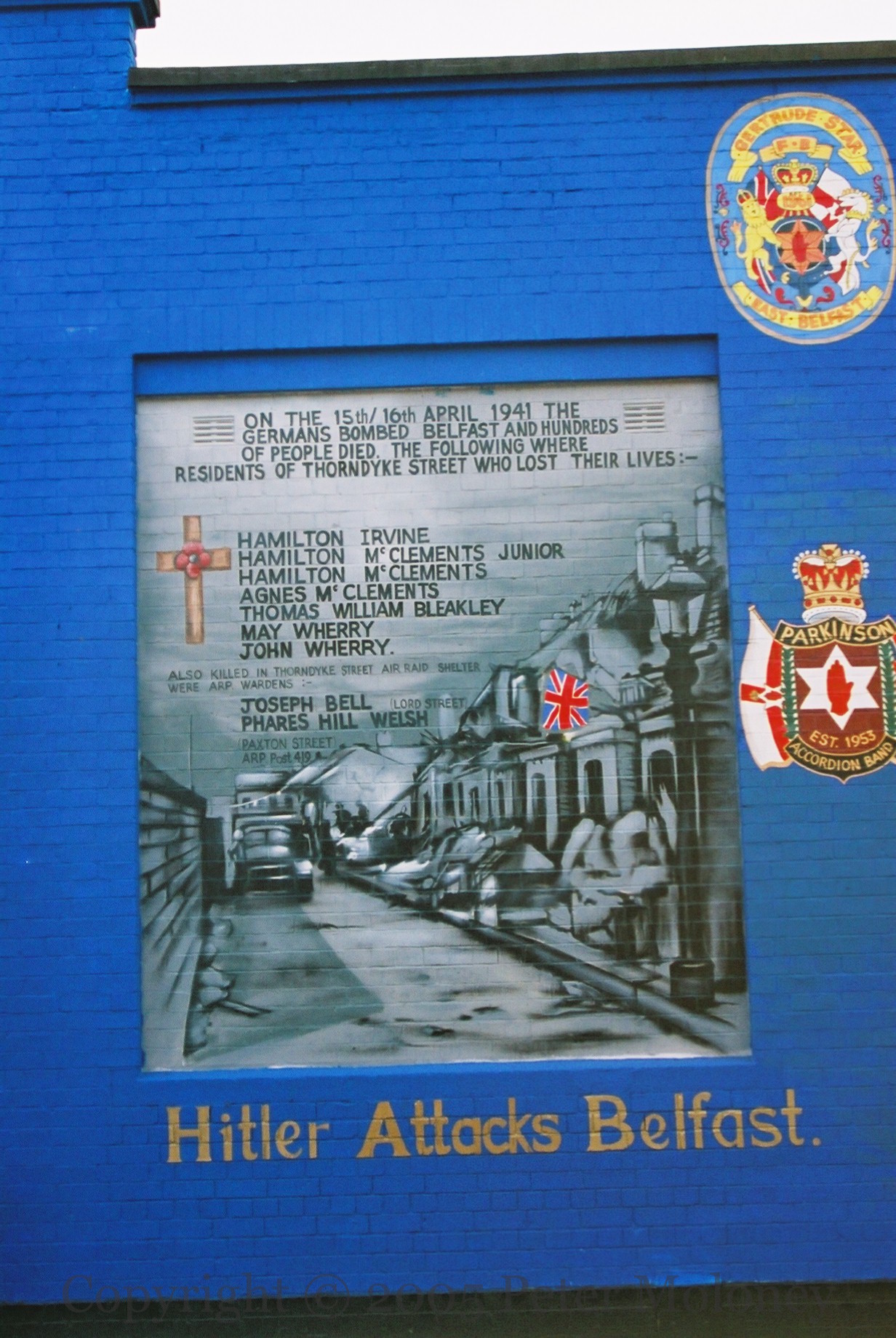
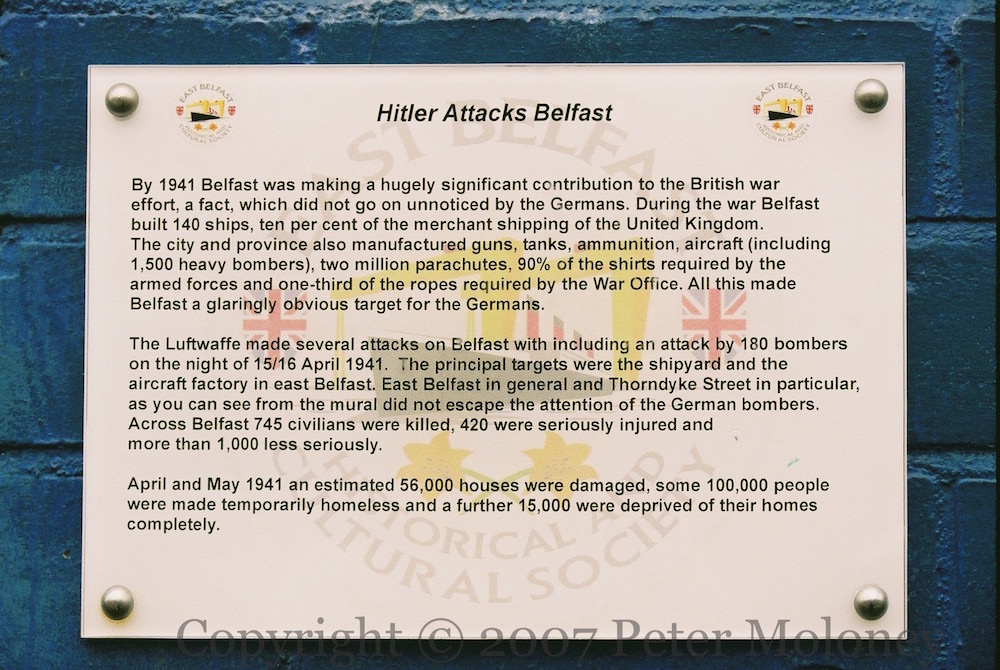
“By 1941 Belfast was making a hugely significant contribution to the British war effort, which did not go unnoticed by the Garmans. During the war Belfast built 140 ships, ten per cent of the merchant shipping of the United Kingdom. The city and province also manufactured guns, tanks, ammunition, aircraft (including 1,500 heavy bombers), two million parachutes, 90% of the shirts required by the armed forces and one-third of the ropes required by the War Office. All this made Belfast a glaringly obvious target for the Germans. The Luftwaffe made several attacks on Belfast with including an attack by 180 bombers on the night of 15/16 April 1941. The principal targets were the shipyard and the aircraft factory in east Belfast. East Belfast in general and Thorndyke Street in particular, as you can see from the mural did not not escape the attention of the German bombers. Across Belfast 745 civilians were killed, 420 were seriously injured and more than 1,000 less seriously. April and May 1941 an estimated 56,000 houses were damaged, some 100,000 people were made temporarily homeless and a further 15,000 were deprived of their homes completely.” The Thorndyke Street casualties listed are Hamilton Irvine, Hamilton McClements Junior, Hamilton McClements, Agnes McClements, Thomas William Bleakley, May Wherry, John Wherry. “Also killed in the Thorndyke Street air raid shelter were ARP wardens Joseph Bell (Lord St), Phares Hill Welsh (Paxton St Post 419).” With the emblems of Gertrude Star Flute Band and Parkinson Accordion Band.


 Peter Moloney Collection