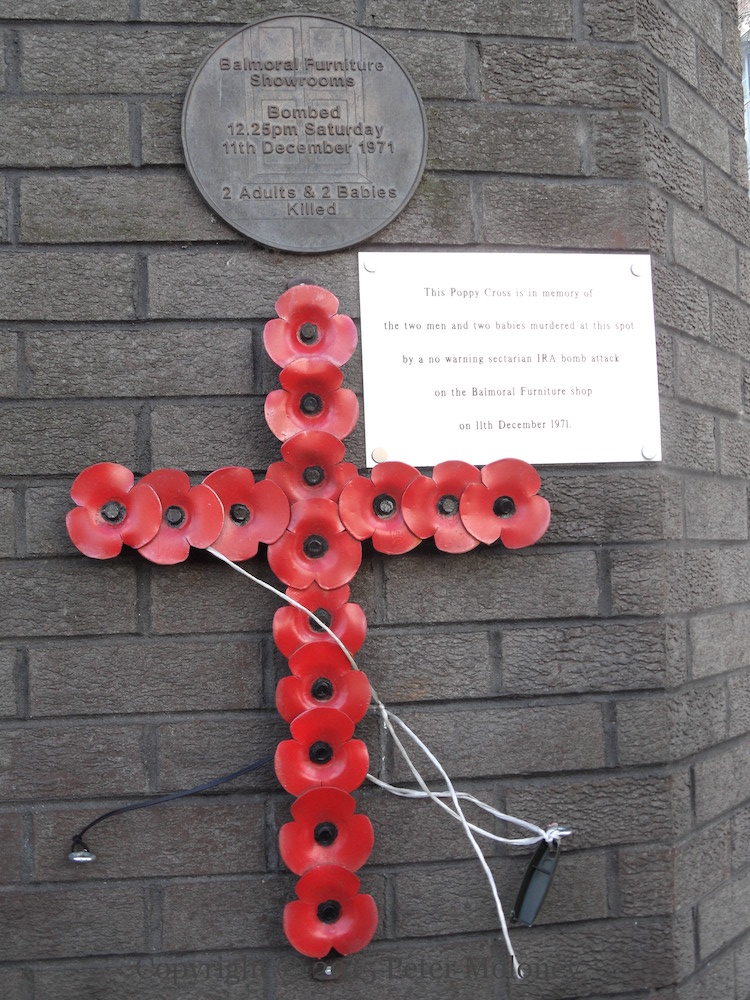
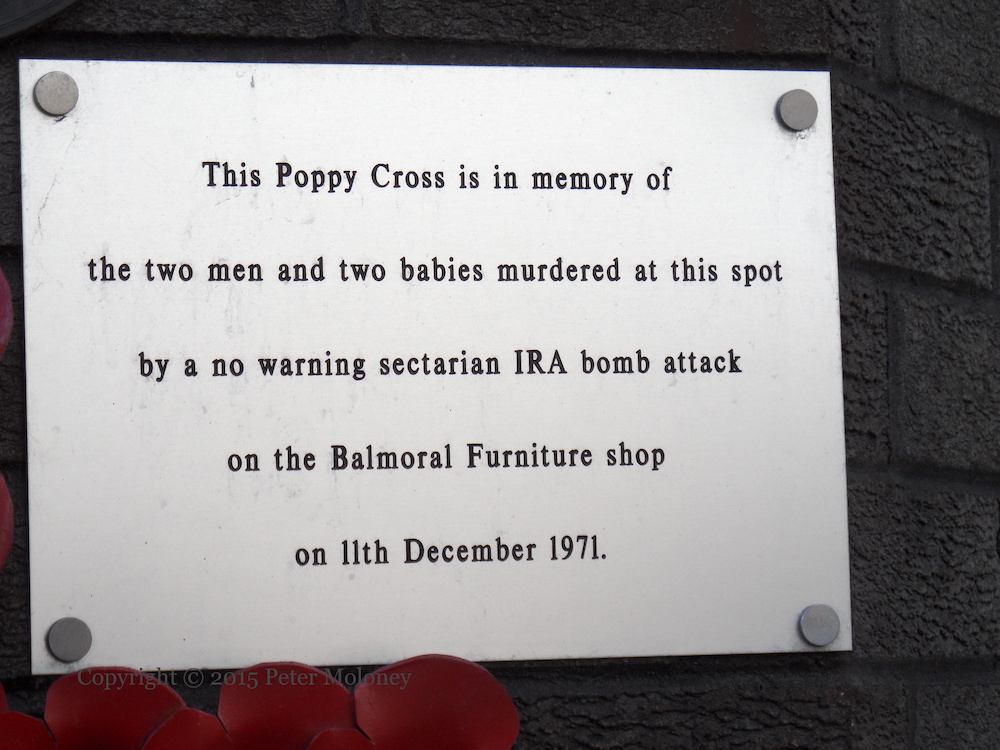
“This Poppy Cross is in memory of the two men and two babies murdered at this spot by a no-warning sectarian IRA bomb attack on the Balmoral Furniture shop on 11th December 1971”
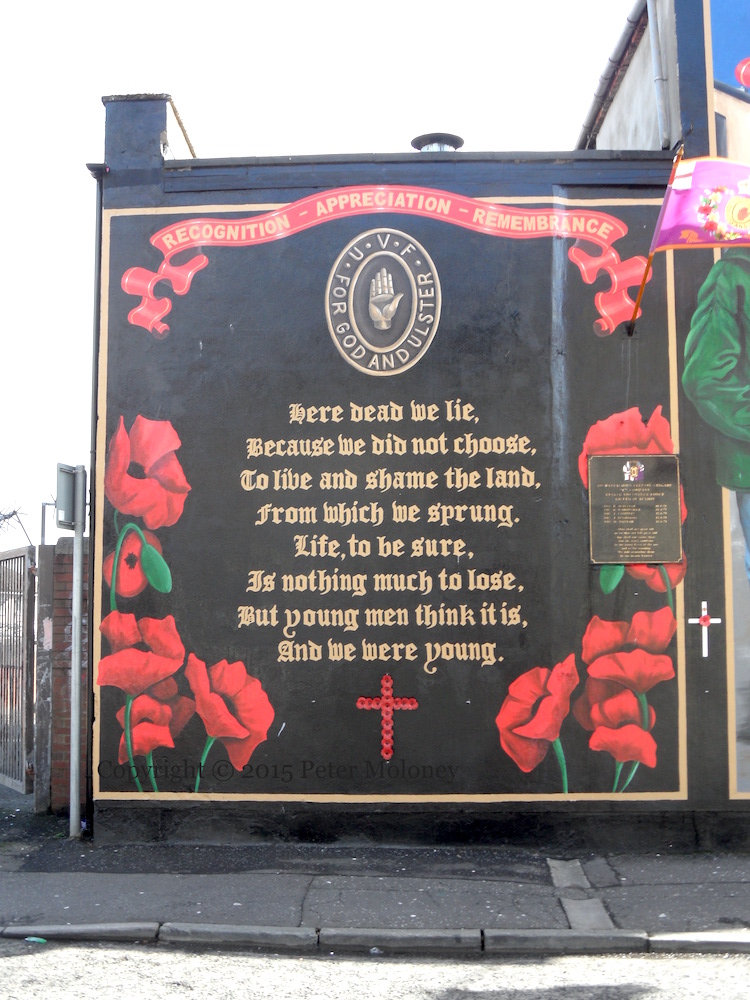
This pair of murals was launched in September last year (2014).
On the left A. E. Housman’s 1919 poem “Here dead we lie” is featured, together with the poppies that grew on the Western Front in WWI, in a UVF commemorative mural. The 36th (Ulster) Division is not mentioned specifically. “Here dead we lie, because we did not choose,/to live and shame the land, from which we sprung.//Life, to be sure, is nothing much to lose,/but young men think it is, and we were young.”
The plaque on the right-hand side (which pre-dates the murals) lists the names of five UVF members killed in the 70s who are depicted in the second mural.
They are (l-r) Thomas Chapman, James McGregor, Robert McIntyre, William Hannah, and Robert Wadsworth, who were killed between 1973 and 1978. The mural is unusual in that it shows bare-faced full figures; loyalist murals sometimes include head-shots (at the top of the mural, in the apex of a gable wall) but only masked men appear as full figures. There is a similarity in composition and style (and perhaps even palette) to existing republican murals such as this one of five B. Coy IRA volunteers in Ballymurphy.
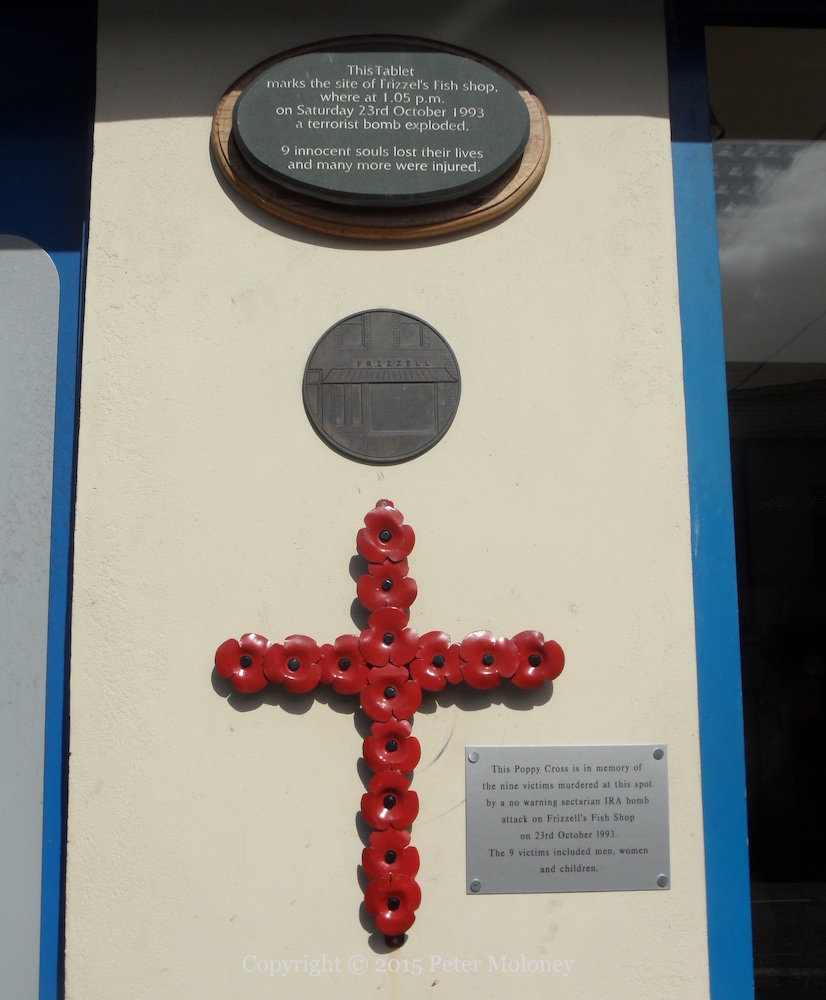
The memorial marker for what was Frizzell’s fish shop has been expanded with a (metal) cross of poppies. For the tablet alone (in 2011) see Frizzell’s; for the tablet and engraved medallion (in 2013) see Shankill Bombings.
“This Poppy Cross is in memory of the nine victims murdered at this spot by a no warning sectarian IRA bomb attack on Frizzell’s Fish Shop on 23rd October 1993. The 9 victims included men, women and children.”
“This tablet marks the site of Frizzel[l]’s Fish shop where at 1.05 p.m. on Saturday 23rd October 1993 a terrorist bomb exploded. 9 innocent souls lost their lives and many more were injured.”
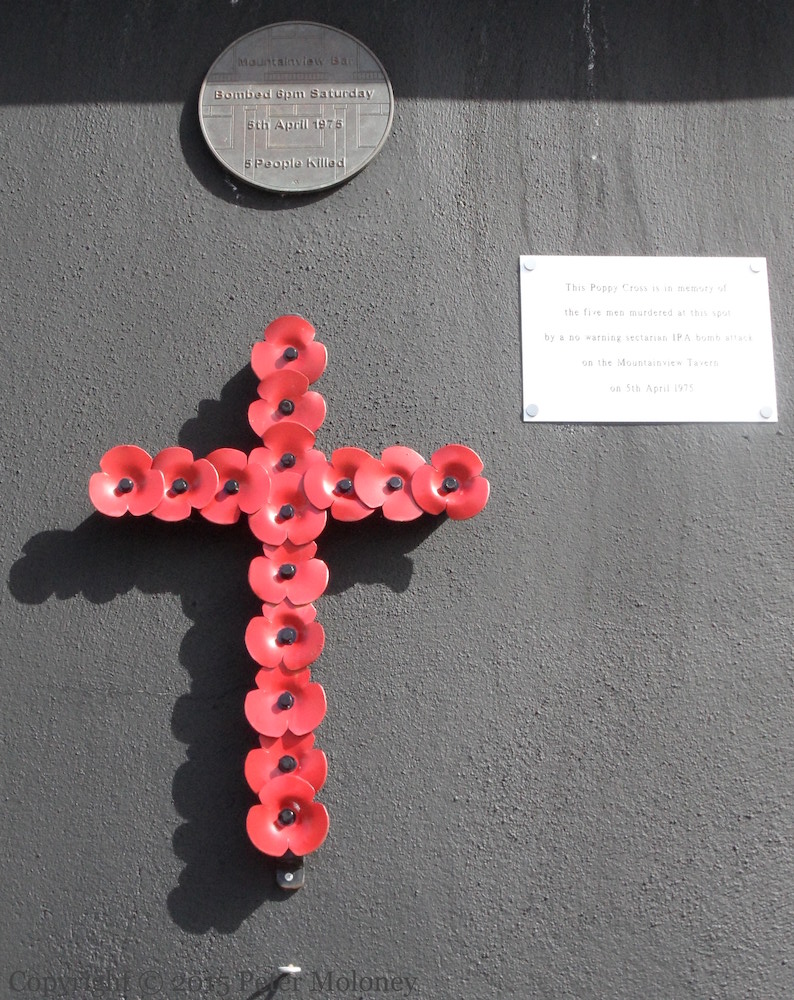
“This Poppy Cross is in memory of the five men murdered at this spot by a no warning sectarian IRA bomb attack on the Mountainview Tavern on 5th April 1975.” According to WP, the pub was full of punters who had been watching the 1975 Grand National (youtube) which Red Rum was attempting to win for a third consecutive time.
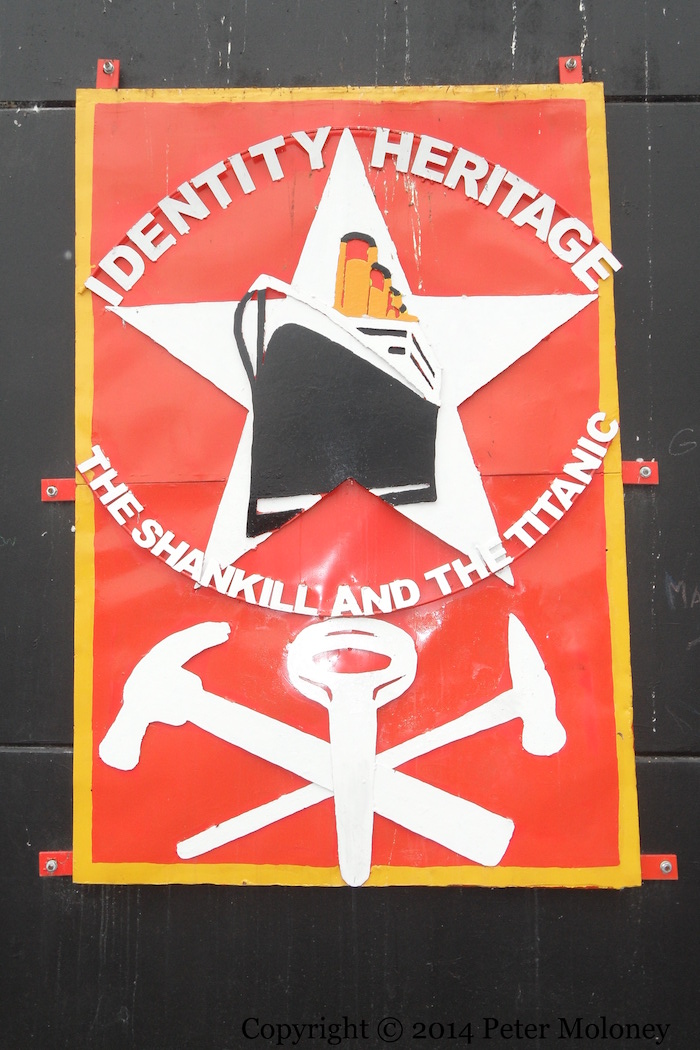
These are two painted metal-worked pieces bolted to the “peace” line on Cupar Way, celebrating “Shankill Ingenuity” and “Identity, Heritage”, while commemorating the lives lost on Titanic.
“1140” p.m. local time, April 14th, 1912, was when the ship hit an iceberg and began sinking. At about 2:20 a.m., in the early hours of the 15th, it went under.
“There can be no dignity in labour, till labour knows no master.” The statue of Jim Larkin in Donegall Street Place has been augmented with a massive mural celebrating the many unions which have membership in Ireland. 2013 marks the 100-year anniversary of the Dublin lock-out, which ran from August 1913 to January 1914. The three female figures in the border to the right of Larkin are Winifred Carney, Inez McCormack, and ?Betty Sinclair?.
For the statue without the mural, see James Larkin.
Here are images from the four panels that comprise the WWI memorial in Mount Vernon, showing men attacking (Thiepval?) wood, the battlefields around Messines, a soldier approaching a church with a spire, and back-to-back memorials to John Condon, the Waterford [city] “boy soldier”, who died aged 14 in a gas attack – “his memory is kept alive as a symbol of the futility of war” – and William McFadzean, who won a VC for throwing himself on a dislodged box of hand grenades.
At this time (2012) the boards on the outside wall had been taken down. They would later be restored – see X06017, which also has the reverse of one the panels.
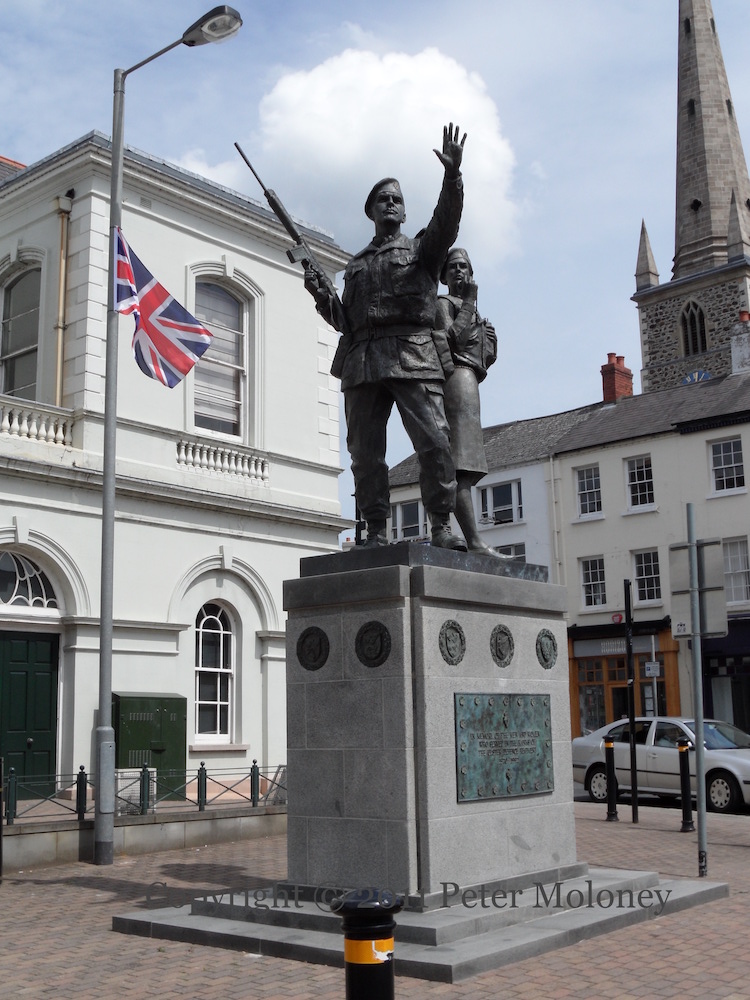
“In memory of the men and women who served in the ranks of the Ulster Defence Regiment 1970-1992”. The statue is by sculptor John Sherlock and was unveiled on June 17th, 2011 (NI World).









 Peter Moloney Collection